Monthly Archives: December 2011

Man vs. Needle

Needle

Image found here.

As long as I can remember, I’ve had a horror of needles. Even looking at the picture above, right now, is making me physically queasy. Actually getting an injection is very unpleasant, and worries me for days beforehand. Having blood drawn is worse.

I distinctly remember the first time I had blood drawn. The actual procedure went okay, better than I expected. Afterward, as I sat in the truck while my dad drove me home, the impact of what I’d done finally hit me. I felt more and more nauseous, dizzy, and light-headed. Dark spots swam across my vision. These grew thicker and thicker until, for a few minutes, I went completely blind.

It’s better now. I have a ritual. When they draw the blood, I look away, close my eyes, and hum Canon in D to myself. I feel silly doing it, but it’s better than the alternative. Afterward, I rarely get dizzy anymore, and I drive myself home.

But it still sucks.

Partly because I hate worrying like this over minor procedures. Partly because I’ve never in my life gotten an IV, and I’m terrified by the thought that sooner or later I’ll probably have to. And partly because I would like to donate blood at some point in my life.

As you can imagine, giving blood is one of the more horrifying experiences I can imagine. And yet – it saves lives, doesn’t it? What am I supposed to say to that? “Haha, oh man! I was thinking about saving your life, but, turns out, it makes me uncomfortable. True story. I’m gonna go play Zelda now.”

So I’ve decided to do something about it. I’ve embarked on a campaign of systematic desensitization, which has been shown to be consistently effective in treating phobias.

The concept is simple. You imagine a hierarchy of fear, from 0 to 100. 30 is, say, looking at a photo of an injection, 50 is watching a video of it, 70 is actually getting an injection, 100 is donating blood, etc. Then, you work your way up.

Right now I’m desensitizing myself to pictures of needles. I’ve set the screen saver on my computer to cycle through a bunch of photos of vaccination and other needle-related procedures.

I can already tell a difference. When I first went on Google to find the pictures, I felt sick to my stomach for half an hour afterward. Now, just a few days later, I can look at the pictures without flinching, without even feeling too uncomfortable. Yeah, I still feel sick sometimes, but it’s getting better.

I’m on my way up.

Do you have any phobias?

Friday Links

Yesterday morning, at the same time I posted about the Black Swallower, a comic went up on Dinosaur Comics about the very same thing. Ryan North must be reading the same sites I am. He also mentions the “sea squirt,” an animal that – I can’t make this up – eats its own brain. The relevant question, as he so neatly puts it: WHY IS THE SEA A NIGHTMARE WITHOUT END?

As a complement to my State of the Revolution post earlier this week, here’s the State of Internet Censorship around the world. Highlights include Thailand, where clicking “Like” on Facebook can land you in prison, and the UK, which is working on a system to monitor and report when people access Facebook and Twitter. (Don’t worry, they’re only going to use it against Bad People! Yeah.)

One of the cooler things I’ve seen this week: Star Wars Dueling Cellos. It cannot be explained; it merely is.

xkcd has been hit-or-miss lately, but this comic is a definite hit.

Finally, I’ve decided to open up the “Friday Links” concept a little. Instead of me just throwing websites at you, I think it’d be cool to hear what sites caught your attention this week, too. If you have any links to share, please post them in the comments! (Linking to your own site is fine if you want to share something cool. I’m confident y’all are too classy to turn this into a spam-fest.)

Have a great weekend!

The Ocean Is Scary

Chiasmodon niger

Yeah, so this is a real thing, apparently. The fish above is Chiasmodon niger, the Black Swallower.

(I’ll pause while you giggle. No, go on, get it out of your system.)

It’s less than a foot long, but its jaw unlatches and its stomach expands to let it eat fish ten times its own mass. That’s roughly equivalent to your next-door neighbor gulping down a giraffe.

According to Wikipedia, one scientist “speculated that the swallower seizes prey fishes by the tail, and then ‘walks’ its jaws over the prey until it is fully coiled inside the stomach.” Seriously.

These are deep-sea fish, and not commonly seen. In fact, the only reason we know about the damn things is that sometimes, it’ll eat another fish so big, and digestion takes so long, that the swallowed fish actually starts to decompose inside the Black Swallower’s stomach, and the gases released make it float to the surface.

Mind-blowing photo here. Another photo here.

Animals, man. Friggin’ animals. You think you’ve pretty much seen it all, and then nature goes and pulls this shit on you.

What’s the weirdest animal you’ve seen or read about?

An Open Letter to People Who Walk Slowly in the Middle of the Hallway

Dear person who walks slowly in the middle of the hallway,

You are not a fast walker. I get that. You have your pace, and if your pace makes glaciers impatient, well, so what? Hell, if I myself weren’t six and a half feet tall with correspondingly freaky long legs, I’d probably move a little slower too. Here’s the thing: I’m okay with slow walking. Really, I am.

You have also chosen to walk in the middle of the hallway. Traditionally, walkers have selected the right half of the hallway to practice their art, because this opens up the left half for other purposes (more on that soon). But hey, I’m okay with walking in the middle, too. Why not? To each their own, beat of a different drummer, et cetera.

But here’s the thing. These two elements, benign in isolation, turn dark indeed when forced into an unnatural union. No doubt you are wondering why. Allow me to explain:

You are not the only person in the hallway.

I’ll wait for a minute while that sinks in.

The corollary of this epiphany is that other walkers (for example, me) will sooner or later almost certainly want to pass you. That’s where that “leaving the left half open” thing comes in. Otherwise, my options are limited:

1. Get your attention and say “excuse me,” which is not only awkward but also requires me to speak to you, both of which I’m trying to avoid.

2. Try to pass you in the existing space to your left, which is even more awkward and also risks having to speak aloud.

3. Walk ever so slowly behind you, trying unsuccessfully to look like that’s my natural pace too, until the hallway widens or you turn or I turn or one of us dies of old age.

So do us both a favor. Either advance in the forward direction, or get out of my way.

Sincerely,

Every tall person in the world

P.S. If you happen to know who designed my cell phone so its vibration motor is as loud as its ringtone, can you send me their address? I’ve got a letter to write.

The State of the Revolution

Moscow Protests

Tunisia

On December 17, 2010, a Tunisian street vendor named Mohamed Bouazizi set himself on fire to protest incompetence and corruption in his government. The act sparked a nationwide revolution in the small north African country. On January 14 – just 28 days later – Tunisia’s dictator was forced to resign, and on October 23 of this year, the people had their first real elections.

Egypt

As Bouazizi launched Tunisia’s revolution, so Tunisia launched a massive wave of protests across the entire region. Egypt was among the most visible of these. Hundreds of thousands gathered in Cairo’s giant Tahrir Square, and on February 11, their own dictator – Hosni Mubarak – was forced to step down. Early celebration has turned to pessimism, however, as the “interim” military government shows signs of refusing to give up power.

Libya

The uprisings in Tunisia and Egypt succeeded with relatively little bloodshed. (Emphasis on relatively.) Libya was not so lucky. Clashes between the Gaddafi regime and the opposition led to a full-on civil war in which tens of thousands were killed. The U.N. got involved, supporting the rebels with an air campaign. On October 20, Gaddafi was killed. Power now is in the hands of the National Transitional Council, which seems to be moving toward democracy.

Syria

Protesters in Syria still have a long struggle ahead. Government forces have killed thousands of civilian demonstrators, but protests continue. Meanwhile the Syrian government has been increasingly isolated on the world stage, with the Arab League suspending Syria’s membership last month.

Myanmar

The revolution isn’t confined to the Middle East. This southeast Asian nation (also known as Burma) is still in the grip of a brutal military regime, which violently suppressed peaceful protests back in 2007. However, flickers of change are beginning to show through. The government recently released hundreds of political prisoners, including the iconic leader of the National League of Democracy, Aung San Suu Kyi. The United States recently sent Hillary Clinton to Burma on the first visit of its kind in over 50 years, in recognition of this (still very tentative) progress.

Russia

Despite a number of increasingly undemocratic moves, Russia’s leader Vladimir Putin remains popular. However, public resentment against his party – United Russia – is growing. In Sunday’s election, United Russia lost its supermajority in the Russian legislature, and barely held on to its majority. Even that majority is widely considered illegitimate, with reports of nationwide election fraud. Thousands of protesters took to the streets of Moscow yesterday (see photo above). In the past, rallies in Moscow have been small, because of apathy and fear. That appears to be changing.

The World

Time is too short to list every country where progress is happening. I could talk about Yemen, Morocco, the Ivory Coast, even Iran.

In 1978, Freedom House listed 41% of the nations on this planet under the category “Not Free.” Today that number is 24%.

Progress is slow, and it comes at great cost, but it’s happening. The revolution is real.

Armoring Your Ideas

Over the past year or so, I’ve noticed a change in the way I think.

Used to be, when I researched some new topic – science, politics, history, whatever – I was happy with just reaching a conclusion about it. I would look at the information, read different points of view, think about it, and form an opinion – and then, once I had my opinion, I’d discard the path that got me there.

I didn’t care any longer how I’d reached the idea. It was only the idea itself  – the end result – that mattered.

That meant that if somebody challenged me, I often didn’t know how to respond. I had my thoughts, sitting pretty on a shelf, but I hadn’t kept any supports to prop them up. The least wind could knock them over.

So I’ve started armoring my ideas. As I draw conclusions, I find myself thinking, “How would I defend this in an argument? What reasoning would I give? How will people criticize this?”

Instead of just forming opinions, I’m preparing them for battle.

This revelation of mine may seem frightfully naive to a lot of you. But then, I grew up as an only child, and didn’t have someone around to gainsay my proclamations on an hourly basis. I’m used to thinking about the pursuit of knowledge for its own sake. Digging moats around my knowledge, putting up catapults, not so much.

I’m glad to see myself changing, though. For one thing, it makes conversations a lot more interesting. Besides that, I think meaningful public debate is one of the foundations of a democracy. And I’m hoping we can keep this country in the “democracy” category for a few more decades yet.

Yeah, that’s right, world. The fate of free elections depends on how my brain operates. Isn’t that a scary thought at 6:30 on a Monday morning.

How much armor do you give your ideas? Have you always been that way, or is it a recent change?

Friday Links

People are afraid of all kinds of things, but what are books afraid of? This comic has the answer.

Now a device called Body Wave can supposedly measure your level of mental concentration based on physiological signs, and tell you when you’re at peak focus. I read about this in TIME and they made it sound like a big new thing, but there’s surprisingly little about it online so far. Still, I’m fascinated by any technology that could potentially let you control things with your mind.

The new Zelda, Skyward Sword, is looking pretty good, and it’s getting stellar reviews. Anyone had a chance to play it yet?

Have a good weekend!

Lots and Lots of Guns

How is my military research week going, you ask? Quite well, thanks. Very interesting stuff so far. I’ve been learning about the chain of command and the various ranks in each branch. (The Army and the Navy both have a rank called “captain” but they’re at totally different levels; attention generals, this sort of confusion is inconvenient for me, please fix it).

Besides that, I’ve also been learning about just how powerful the US Armed Forces really are.

I knew, of course, that the United States is considered a superpower on the world stage. But I’d also heard a lot of stuff about strained budgets, China gaining on us, etc., and I guess I sort of assumed that our position had eroded somewhat.

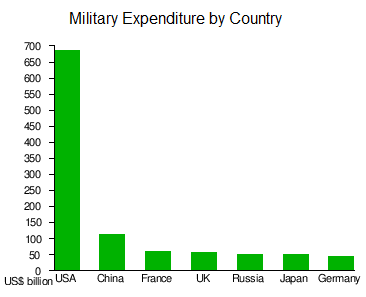
Take a look at the graph below. The bars indicate military expenditure by country, in 2010. Not per capita, not a percentage of GDP, just raw money pumped into the armed forces.

Military Expenditures by Country

If you look at the full table of data, the US spends more on its military than the next nineteen countries combined.

The US has eleven aircraft carriers. The rest of the world, collectively, has nine.

The US has 3 million troops. China, with over three times our population, has only 4.5 million.

The US has over 3,000 fighter plans. Our closest rival in that statistic, Russia, has less than half.

I mean, damn.

Now, despite being a blue-blooded bleeding-heart latte-sipping liberal, I generally see this force dominance as a good thing. Yes, the US has used its power in many, many ways that I’m not happy about. But generally, if someone’s going to have this kind of military dominance, I’m sure as hell glad it’s not China or Russia.

Unfortunately, there are some other areas where the US isn’t so dominant. Education comes to mind. This USA Today article from last year says “Out of 34 countries, the U.S. ranked 14th in reading, 17th in science and 25th in math.” Since the military in a democracy is ultimately accountable to the people, this is a problem. Stupid People Controlling Big Guns is generally not what we want to see.

More as it develops…