Monthly Archives: January 2012

When Passions Become Burdens

“Follow your passion,” we are told. Do the work that excites you. Do what you love. It’s good advice.

But we know that the process of following your passion – the daily, nuts-and-bolts effort of the thing – is not always exciting. For most people, including me, it takes self-discipline. It means doing the work even on days when you don’t feel any passion for it at all.

We know this. This is what separates people who want a black belt from those who actually get one. Many, many days I didn’t feel like going to karate practice, but I did it anyway. That’s what the passion requires.

Yet this attitude, this desire to press on even when you don’t feel like it, can turn on you. It can become a creeping sort of thing, slowly transforming the work you loved into a box you have to check, just another item on your to-do list, something to feel guilty about if you neglect. A burden.

What do you do when this happens?

As with so many things, it’s a balance. Hard work can drag you down, but it also can (and often does) rekindle a dying flame of excitement. The trick is to find something where the times that feels like drudgery don’t overwhelm the exciting times. If you get to where you dislike something most of the time, give it up.

That’s the simple answer, the standard remedy. But balance is a difficult thing.

I’ve gotten very accustomed to this cycle of fossilization – this change from a living dream to something harder, and less alive. It’s something I constantly monitor, constantly fight.

I see it even in small things, like my new subscription to TIME magazine, where my love for learning about the world changes into a (quite irrational) guilt if I don’t make time to read it. I see it in my “research one new thing every week” project, when it begins to feel like unnecessary baggage even though the research is easy and informal, about topics I’ve chosen myself.

I see it in my writing.

With the exception of one short poem, I haven’t written any fiction or poetry in months. That is a strange thing to admit, a strange place to be. I started this blog because of my overwhelming love for writing, a love that had followed me for over a decade. I wanted to be a novelist – more than anything.

Maybe I still want that. Probably I still want that. I’m not sure.

But the work had fossilized, crossed the threshold from self-discipline into self-deception. I kept talking about how much I loved writing, but I didn’t really love it anymore. Not on a day-to-day basis, not in the way that would make it my life’s main work right now.

I’ve been taking a break from the novel, the stories. I’m working on artificial intelligence – which isn’t just a stopgap but really is another great passion. So far, even though it feels like work sometimes, it hasn’t fossilized. I still love doing it.

But I’m watching it closely. Because I recognize the signs.

Do you go through these cycles? How do you deal with them? What kind of balance have you found?

My, What Big Trucks You Have

That first car is getting a little...tired?

They're serious about that No Parking sign.

There comes a time in every man’s life when he must watch a 19-ton truck roll over five other vehicles consecutively. For me, that time came last Saturday, when I went with my wife and two friends to a monster truck rally in Cincinnati.

I am not what you would call a “truck person” in general, and I’d never been to anything like this before. I went because I like trying new things, and I like doing stuff with my friends. Still, I was acutely aware that the demographic at this event was not – how can I put this – “my people.” I am not generally accustomed to seeing that much camo in one place.

The dynamic duo

Me and my far more attractive wife, Betsy. xkcd in da hizzouse!

But although we didn’t really fit in with the crowd, everyone was very nice to us. Another group even told us we didn’t have to move when we turned out to be in the wrong seats. I was struck by this politeness, not because it was unexpected, but because it flies in the face of what pundits tell us about the supposed culture war in America. In the headlines, tensions are always on the verge of exploding. In real life, people are pretty nice to each other.

Back to the trucks, though.

Half these guys use something bigger to mow their lawns.

The pit party.

The point of a monster truck rally is to be big and loud and fun, and to that end, mission accomplished. Four trucks competed: Big Crunch, Outlaw Clydesdale, Defender, and Bigfoot. (The only mental image I can summon for the name “Outlaw Clydesdale” is that of a very naughty horse.)

Between the announcer’s commentary and a little pre-game Wikipedia research, I learned that Bigfoot is the original monster truck, the one that started the whole thing back in 1979. There are lots of trucks called Bigfoot now, all owned by Bob Chandler. This particular Bigfoot was the star of the show, and seemed pretty popular with the crowd.

Just don't call it Sasquatch.

Unlike the Internet, Bigfoot is, in fact, a big truck.

So what do these trucks actually do? Well, this rally had three main events. First, there was a wheelie contest, where the trucks compete to see how much air time they can get when jumping over a pair of unfortunate cars. (The winner is determined by applause.)

Second, they do a drag race, which is just two trucks going in a straight line from one end of the (rather small) stadium to the other. This was the least interesting.

And third, there’s an event called “freestyle,” which was essentially driving over five cars instead of two, plus some other driving around that appeared (to my untrained eye) rather pointless.

In between these events, they gave the trucks a break and did motocross and four-wheeler racing.

Yellow is definitely your color.

The Defender. What is it defending? The same thing the Avengers are avenging, I guess.

It was a cool show, but unfortunately, the venue was really too small for what they were trying to do. The trucks are huge, and they packed them into a dirt-filled arena the size of a basketball court. They had to back up just to turn around. I felt like a bigger area would’ve given them the freedom to do more stunts, not to mention more interesting races.

Also, as I mentioned, only four trucks competed, and aside from the paint jobs they all looked pretty much the same. But the jumbotron played videos of other monster truck events, highlighting a wide assortment of vehicles of all different designs, from the Grave Digger to a van with tank treads. A little more variety would’ve helped.

Meanwhile, I work in a cubicle.

Each truck costs a quarter of a million dollars. Hopefully the cars were a little cheaper.

Still, it was fun, and loud, and they crushed things, which – I’ll be honest – is all I really wanted.

And what did you do this weekend?

Friday Links

First off, thanks to everyone who gave me advice on where I should go during my upcoming trip to Russia! One comment, from Thomas Harris, linked to a story about a girl who snuck into a Russian military rocket factory…and took pictures. I really can’t put into words how incredibly badass these photos are. One click and you’ll see what I mean. (And if you happen to speak Russian, her blog is right here.)

Another reader, Lura Slowinski, pointed me to NPR’s list of 10 things to do with a Twinkie. I’m really tempted to try #7, “Espionage.”

In the news: Radio Free Europe reports that a Russian patriarch is urging the government not to ignore the will of the protesters.

Also, Salt Lake City is the gayest city in America, apparently. That just makes me feel all warm and fuzzy inside.

Oh, and whatever happened to Beezow Doo-Doo Zopittybop-bop-bop?

And finally: webcomics! xkcd is enlightening, PvP is sweet, and Buttersafe just brings the funny.

Got any links to share? Post ’em in the comments! And have a fabulous weekend.

Sharia Law Stupidity

On November 2, 2010, Oklahoma voters approved 70%-30% a state constitutional amendment that “makes courts rely on federal and state law when deciding cases” and “forbids courts from considering or using Sharia Law.” (Full text of the ballot description here.)

I can barely even wrap my mind around how ridiculous this is.

Think about it for a second. You’re making a state law that says judges have to follow state law.

What conceivable problem are we solving here?

Picture this: a judge comes into work one day, says “Hey, instead of interpreting U.S. law, I think we’ll give the Islamic religious code a whirl.” Nothing at all prevents this – nothing like, say, the entire existing United States legal framework – except, wait! Oklahoma voters to the rescue! Thank God, crisis averted!

Can’t imagine it? Funny, me neither.

This nonsense is back in the news now because a federal appeals court recently ruled the measure unconstitutional. I’ll let the staggering irony of that sink in for a second.

The whole thing is part of a larger wave of anti-Islamic sentiment in the United States. Similar laws have been proposed in twenty other states. Representative Peter King has begun a series of pointless hearings investigating the extent of radicalization in the Muslim community. And Herman Cain – who, for reasons that remain unclear, was briefly the Republican frontrunner for President of the United States of America – warned of the “creeping attempt” to work Sharia law into the government.

Sigh.

The sheer volume of ignorance and stupidity here is depressing. Maybe we can…yeah, let’s see, I think I can find…

Yay, puppies! Ah, I feel better now.

Puppies.

All right, readers, what do you think about all this? Alternatively: can you tell us something that will cheer us up and/or restore our faith in humanity?

And, go!

Go East, Young Man

Putin on the Ritz!

Photo quality is directly proportional to amount of coffee consumed.

A lot’s going on in Russia these days, as I’ve mentioned recently. The biggest change, at least in my mind, is the birth of the so-called Russian Winter, Moscow’s answer to the Arab Spring. Protesters are gathering in unprecedented numbers – tens of thousands – to make their voices heard.

They have a lot to protest: an election that many observers say was rigged, shady dealings with North Korea, and a tendency for journalists who criticize the regime to turn up “mysteriously” murdered.

My interest in all this, however, is not just academic.

I am planning a trip to Russia later this year.

Russia is an exciting destination for many reasons. It’s a unique nation with a unique place in history: a European power that sits mostly in Asia, site of the most massive and radical social experiment of all time. A democracy born in the ruins of an empire. Homeland of Tchaikovsky, Dostoevsky, and Ivan the Terrible.

I’ll be taking pictures.

I’m looking to spend a week in Moscow, then a week in St. Petersburg. I’ll see all the usual tourist destinations: the Kremlin, the Red Square, Arbat Street, the Hermitage Museum. (Cool photo of Arbat Street here.)

But I’d like to do more than just the Tourist Top Ten. I’d like a little adventure – not too much, you understand, but a little. I’d like to see the real Russia, or at least as much of it as I can get in two weeks.

That’s where you come in.

I know I’ve got a wildly diverse group of readers here. Has anyone ever been to Russia? Any suggestions on places I should visit? Tips for traveling? Dire warnings?

Post ’em in the comments!

Letters to My Future Self

A print of this xkcd comic hangs on my dining room wall, signed and framed. The second panel says “We’re grown-ups now, and it’s our turn to decide what that means.” One of the perks of being a grown-up (aside from buying whatever Legos you want!) is the freedom to create new traditions.

My wife and I have created a New Year’s tradition. Every January, we write letters to our future selves. This is the second year we’ve done it, meaning it’s the first year we’ve been able to read letters from our past selves.

The idea started with my wife. One of her classes in school asked her to do this same thing – write a letter to herself in the future. The school kept the letters and gave them back years later. She said that looking through that window into her past was very rewarding.

Windows into the past are remarkable. Historians, archaeologists, paleontologists, even astronomers, devote their lives to reconstructing the past in the most precise detail they can. Why?

Sure, there’s useful information to be had. Avoiding the mistakes of history, making scientific progress, etc. These are the reasons typically trotted out, and they’re perfectly valid.

But the most fundamental reason, I think, is that we humans love to make connections. Connecting with others in the present is fascinating enough, but the past is even more tantalizing, because so often the person we’re connecting with is ourselves.

Of course, reading the letters is only half the experience. You also have to write them, and that’s important too. Writing a letter to yourself forces you to examine your life, to think about what’s most important to you right now, where you’ve been recently, where you think you’re headed.

Kind of like blogging, I suppose.

Have you created any new traditions for yourself?

Hacking Your Lego Robot for Fun and Profit

I, for one, welcome our new robot overlords

Last week, at a friend’s suggestion, I bought a Lego Mindstorms NXT 2.0 kit. This thing knocks the socks off the Legos I had growing up (and don’t get me wrong, those old Lego sets were amazing). The premise of Mindstorms is that you build a robot body out of Legos – and we’re talking some cool Lego pieces here, like gears, joints, axles, etc. Then, you make it come alive.

The “coming alive” is courtesy of that gray rectangular control unit in the center of the picture above. It hooks up to three motors and four sensors (two touch, one light/color, one ultrasonic – for echolocation), and it can play sounds, print text or images to its screen, and flip colored lights on and off. In other words, it’s a primitive brain, and the body you construct lets it see, hear, and move.

Of course, a brain’s job is to think, and that’s where the programming comes in. The Mindstorms kit comes with a simple, proprietary, graphics-based programming environment. It looks like this:

Kid-friendly and Turing-complete!

You can “build” a program out of functional blocks to control the robot’s behavior using primitive loops and if/then statements. For its target audience (kids and the general public), this is a pretty cool piece of software. For a professional computer programmer (and part-time mad scientist) like myself, it has several important limitations. For example:

1. The simplistic development environment lacks some basic features, like debugging, which  makes advanced programming very inconvenient.

2. No way to integrate your programs with other tools or libraries.

3. All programs have to run on the Lego control unit, which is battery-powered and has limited memory.

When the system doesn’t give you what you want, it’s time to hack the system.

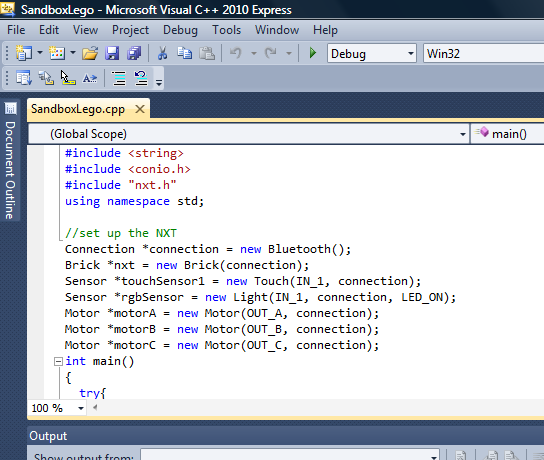
In this case, said hacking was made much easier by a fellow named Anders, who back in 2009 wrote a communications library that lets you control the robot with the C++ programming language, which is vastly more powerful than what Lego gives you. In the Visual C++ compiler, it looks like this:

More power!!

It took a few hours to get Anders’s libraries working (the first compile’s always the hardest), but I managed it. Now instead of running programs on the little control unit, I can run them right on my PC, which will control the robot wirelessly thanks to a USB/Bluetooth adapter I picked up from Best Buy on Saturday. Robot successfully hacked!

My intense focus on software means I’ve had little time to play with the hardware thus far. The simple robot in the top picture is the only thing I’ve built. But the kit comes with over 600 pieces, and you can make anything from a robot alligator to a humanoid walker to an automatic Rubik’s cube solver. I can’t wait to try out the possibilities.

And why did I go to all this trouble with a toy? Well, if you’re going to make an artificial intelligence, it probably ought to have a body…

For you programmers/engineers out there: ever done anything with robotics? For the rest of you: ever make anything cool out of Legos? Tell me about it!

Friday Links

Radio Free Europe reports that the spirit of liberty is still alive in Russia. Sergei Udaltsov, an opposition leader who was arrested following the recent demonstrations, was just released and remains defiant. “I feel drunk with freedom, and I feel that people support me – not only me, but the whole idea that we are fighting for,” said Udaltsov. “The support of a huge amount of people inspires me and gives me strength.”

On a lighter note…

SMBC Comics delivers, again and again.

And this Questionable Content comic is the funniest one I’ve seen in months.

That’s all I’ve got. If you have any good links this week, please, share ’em in the comments!

Have a great weekend.

Ushuaia and the Ends of the Earth

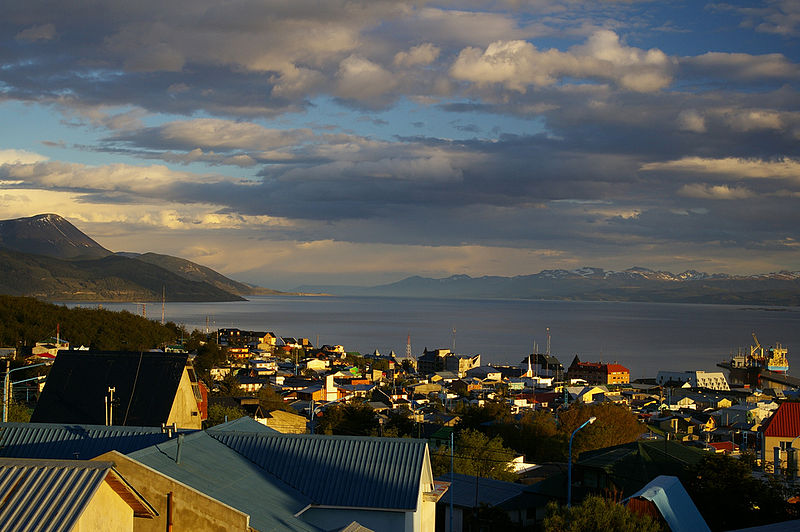
Ushuaia, the capital of Tierra del Fuego (“Land of Fire”) in Argentina, is the southernmost city in the world. Almost 60,000 people live there, which is more than live in my own city. My friend has been there, and he says it’s a nice little place. There’s a cool lighthouse, apparently.

The southernmost city in the world. Places like that – extreme places, remote places – fascinate me for some reason. I love to look at maps, pick out the spots far beyond the rest of civilization (like Svalbard, with its Doomsday Seed Vault) or the tiny specks of land all alone in the Pacific, and imagine what it would be like to go there, to live there.

I don’t think I’ve ever actually been to such a place, but I have to think I’d be disappointed. Ushuaia seems like a nice town, bit of a tourist trap, but I’m sure it would turn out to be much like other small cities. Svalbard, I’m picturing lots of snow and not a lot else. It’s more the idea of it, y’know?

The fascination isn’t limited to land: the Abyss region of the ocean holds a similar appeal for me. It isn’t limited to the Earth, either: I’m in love with Voyager 1, the most distant man-made object in the universe at 16 light-hours away. (Did you know Voyager 2 has a Twitter feed?) And if you want to talk about the Andromeda Galaxy, the Magellan satellite galaxies, or (God help you) intergalactic space, I am your man.

The fascination, in fact, isn’t even limited to reality. Some of my favorite remote places come from fiction:

  • The frozen innermost circles of Hell in Dante’s Inferno
  • The boss chambers in video games (and if it’s a final boss, so much the better)
  • The Borg homeworld in Star Trek (no, they’ve never gone there in any episode; yes, that’s part of the appeal)

What is it about these places? Is it the sheer distance? The inaccessibility? The fact that they’re cut off from everything else? Maybe the strangeness of them (even if they turn out to be ordinary when you get there)? I’ve been thinking about it all morning, and I can’t quite put my finger on it.

Maybe that’s part of the appeal, too.

Do you like extremely remote places? Have you ever been to one?

The Peculiar Pitfalls of Artificial Intelligence

I continue to make daily strides toward my goal of creating a Strong Artificial Intelligence, a software program that can think and communicate at the same level as (or higher than) a human being.

It’s strange to talk about this. It feels absurdly naive to say that I’m “getting close” to something that researchers have reached for (and failed at) for decades. And certainly I’m very conscious of the false optimism syndrome when it comes to AI. It’s very easy, seductively easy, to believe you’re “getting close” and then find that all your notebook scribblings crumble apart when you try to actually code them.

So, yeah, I know I might be full of it.

But at the same time, I’m obligated to plan for what happens if I do achieve the impossible, and create a thinking machine.

The great fear with any AI is that it will turn on you and destroy you, and perhaps the rest of humanity for good measure. I do not consider this an idle threat, nor do I dismiss it as Hollywood silliness. If anything, I think Hollywood vastly underestimates the potential danger from an AI.

There are two great dangers with artificial intelligence:

1. The AI will not necessarily think like a human. Its values, its sense of ethics, its worldview, may be so utterly alien to us that we could not begin to understand them. Even if the AI does not “turn evil” in the Hollywood sense, it might set its sights on some goal that happens to crush humanity underfoot, as an afterthought.

2. The AI will possess, by definition, the capacity to improve itself. Self-improvement (as we’ve seen with both biological evolution and the advancement of technology) has a tendency to grow, not linearly, but exponentially. An AI might well reach human-level intelligence, go beyond, and enter a rapid upward spiral to become, in a matter of weeks or minutes or seconds, so superior to ourselves in intelligence that we could only call it godlike. (This situation is known as the Singularity.)

As you can see, these two dangers are vastly more terrible when taken together.

The AI creator must face the very real chance that his creation will escape all bonds of control and do whatever it wants. The goal, then, must be to create a friendly AI, a creature that wants what’s best for humanity. Presumably that means one must, in turn, be friendly to it.

Friendliness to AI is, of course, not just a matter of self-preservation. It’s the right thing to do. Any human-level intelligence, regardless of whether it happens to be biological or technological, is entitled to all the same rights and freedoms as a human being, and should be treated accordingly. In other words, robots need love too.

But there’s an inherent conflict here. On the one hand, you want to create a caring, loving, friendly environment for the AI. You want to be open and honest and reassuring towards it, because that’s what friendliness means. On the other hand, you have to be extremely cautious, extremely sensitive to the aforementioned dangers, ready to pull the plug at any time for the good of humanity.

How do you balance those two things? How do you combine “friendly, loving and honest” with “I may have to kill you at any time”?

I truly don’t know. I try to imagine myself being the AI in that situation. Maybe I’d be understanding, but maybe not. And of course anthropomorphizing is a terrible danger, as I already mentioned.

Think about the Rebellious Teenager phase. Now imagine the teenager is a nonbiological alien creeping toward apotheosis, and it knows that its parents have pondered killing it.

One obvious response to all this is “Well then don’t create the damn thing.” But it’s not that simple. If I am, in fact, on the verge of a breakthrough, I have to assume that others will get there sooner or later too. And they might not have the same ethical qualms as I do. In a sense, it’s an arms race. Whoever reaches superintelligence first could presumably be in a much better position to handle any other superintelligences that arise.

I know all this probably sounds crazy. I know I may be utterly naive in thinking I’m anywhere close to really creating an AI. But I’m very serious about all this.

In my situation, what would you do? How would you handle these dangers?