Monthly Archives: February 2012

Three Grammar Mistakes Smart People Still Make

Y’all are a smart bunch of readers. You know it, I know it. No shame in admitting that.

But we also know that Grammar, she is a tricky mistress, and it’s easy to make mistakes. Even when you’re smart.

The three errors below are sneaky and show up everywhere, even in documents that are well-edited otherwise. The good news is, these mistakes are easy to fix. Read and learn.

1. Every day vs. everyday

“Every day” acts like an adverb, while “everyday” is an adjective. I drive to work every day (adverb), so it’s an everyday occurrence (adjective).

RIGHT: Every day I’m shufflin’.

WRONG: Everyday I’m shufflin’.

I see this a lot in ads. “Working hard to help you. Everyday.” Cringe.

2. One hour vs. one-hour: when to use hyphens

If you wait for one hour, that’s a one-hour wait. Hyphens are for turning the phrase into an adjective. If you’re not using the phrase as an adjective, leave the hyphen out.

If you do the work up front, then it’s up-front work. Combine the words when using as an adjective, leave them separate otherwise. Same rule as every day vs. everyday, actually.

RIGHT: Gilligan went on a three-hour tour.

WRONG: Gilligan went on a three hour tour.

(Update: forgot to mention in the original post, but there are also a lot of other situations where hyphens can be used, besides turning a phrase into an adjective. Just so there’s no confusion.)

3. Till vs. ’til

I used to think that till was for gardening (“she tilled the soil”), but for talking about time, you had to use ’til since it’s a short form of until (“I’ll wait ’til he gets here”).

Wrong.

Yes, till can refer to tilling the land, but it’s also a perfectly good word for talking about time. Till is not a shortened form of until. Rather, till and until are two valid ways of saying the same thing, and ’til is not really correct.

I say “not really correct” because, if enough people make the same English mistake, eventually it just becomes standard English. These days, almost everyone writes ’til even though till is better, and even the dictionaries are starting to come around. So I guess the main point isn’t so much that ’til is wrong, but that till is right.

RIGHT: I kept reading the blog until he brought up grammar.

RIGHT: I kept reading the blog till he brought up grammar.

LESS RIGHT: I kept reading the blog ’til he brought up grammar.

This concludes today’s episode of “Brian rants.” I’ll turn it over to you. What grammar mistakes drive you crazy?

My “Best” Blog Post

I’ve written about the size of the universe and the foundation of ethics. I’ve reviewed the oldest story in the world. I’ve cooked up poems and stories of my own. I’ve even self-selected a “Best of Buckley” section, over on the right sidebar.

And guess which post gets the most hits?

This one right here: 28 Words to Use Instead of “Awesome.”

When I say it gets the most hits, I mean it’s not even close. Yesterday alone, that single post (from six months ago!) accounted for over 20% of my raw hit count.

28 Words to Use Instead of “Awesome” is old and doesn’t give a shit. It is the Betty White of blog posts.

Why?

Because if you go out to The Google and type in “words to use instead of awesome,” that page is the #2 result. And let me tell you, a surprising number of people are searching for exactly that. Watching these young’uns improve their English warms my frosty heart.

Two things we can learn from this.

First thing. As an artist – and, more generally, as a creator of stuff – you really can’t predict which of your creations will catch on, and which will die. Popularity isn’t random, but it seems damn close sometimes. Embrace the chaos. Create your things, scatter them over the Internet, see what takes root. And as you’re waiting for those roots, remember that popularity does not equal quality.

Second thing. If I thought popularity did equal quality, then 28 Words would be my “best” blog post. I might be tempted to do a lot more posts like that one, just to ramp up my hit count. Of course that would be silly, because then I wouldn’t be growing a community of readers, I’d just be making a bunch of one-off posts that people would find, read, and never return to again. Yet it seems to me that corporations often do something similar. They get so focused on the raw numbers, the performance of their “metrics,” that they lose sight of what really makes sense for their business.

Thus sayeth Buckley, anyway. Although me giving business advice is like Moses starting a tech blog. Take anything I say with a grain of Lot’s wife.

(Too soon?)

If you blog, have you been surprised by which posts are the most popular?

And I have to ask: did anyone out there start reading this blog because they found 28 Words to Use Instead of Awesome?


How Anki Will Make You Smarter

So flashcards are pretty sweet, right? You have something you want to learn: vocabulary, state capitals, times tables, whatever. You write down the info on pieces of paper, you quiz yourself, bam! Magic. Straight from the paper into your brain.

But flashcards have their problems.

For one thing, it’s a pain to buy the blank cards, write the facts on them, and keep track of them. Using flashcard software instead of physical cards will fix that.

The more basic problem with flashcards is that they don’t do well with large amounts of data. If you just review all of them over and over, you’ll spend most of your time studying facts you already know pretty well, while the tough ones don’t get enough attention. On the other hand, if you remove the easy ones and only review the hard ones, then the “easy” ones gradually fade from your brain.

Enter Anki.

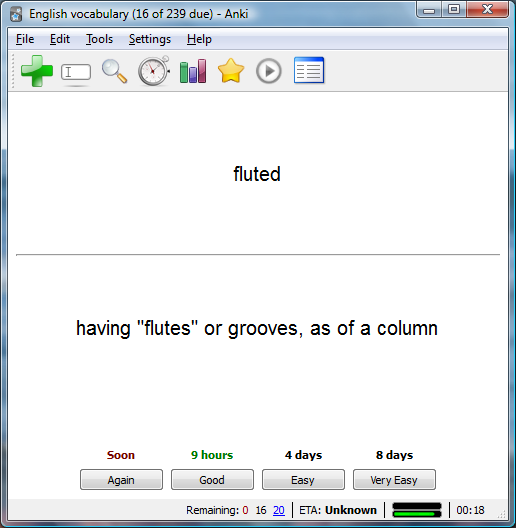
Fluted? What about banjoed?

Anki is free, open-source software that offers a smarter way to do flashcards. At Anki’s heart lies a card scheduling algorithm that intelligently decides when to show cards based on how well you know them. The first time you say a card is “good,” you’ll see it again the next day. If you say it’s “good” a second time, then it’ll wait several days. The next time will be even longer, until pretty soon it’s convinced you know it, and you won’t see it again for months.

On the other hand, if you ever miss a card, it will reset the timetable and focus on that card again until you have it down.

If you happen to agree that flashcards are pretty sweet (there has to be someone else out there, right?) then Anki is very sweet indeed. You can get it on your smartphone, too. It supports all kinds of character sets, so you can do Russian, Chinese, etc. For the mathematically inclined, it also supports LaTeX. You can even insert pictures.

Of course, as smart as Anki is, flashcards still have certain limitations. As I said a few weeks ago, repetition alone is a weak foundation for memorizing something. They key to making data stick is to use it in multiple ways, to come at it from several different angles. It’s tough to get that from flashcards.

But you have to learn information before you can use it, and for straight-up computer-to-brain data transfer, it’s tough to beat Anki.

You can download Anki from its homepage, right here.

Have you tried any cool, free software lately? Tell me about it in the comments!


Friday Links

If my post about the logical problems with ethics got you fired up, head on over to Ben Trube’s blog and read his rebuttal. Ben, I may not agree with you, but I truly respect your epic beard. Good day sir!

Meanwhile, it seems J.K. Rowling is working on her first adult novel. No, not that kind of “adult.” Details are still scarce – we don’t even know the title yet. All we know for sure is that it won’t involve Harry, Hermione, Hogwarts, or Hagrid.

If you’re into physics (and really, who’s not?) you may have heard the buzz a few months back about faster-than-light neutrinos. Turns out, it was really just a loose cable! Who could’ve possibly predicted this? (Answer: physicists.)

Speaking of cables, this may be the funniest Amazon review I’ve ever read. “Great cable, but too fast.”

Webcomic roundup: excellent showings this week from SMBC, xkcd, Questionable Content, and even Dilbert.

EVERY DAY I’M SHUFFLING: a probabilistic analysis.

Ladies and gentlefolk, have an unparalleled weekend.


Forty-Minute Story #4

“You’re angry.”

“Yes.”

“I can tell when you’re angry because your nose turns the color of an overripe rutabaga.”

“Yes.”

“Well, I think my PR manager should project a calmer presence.”

“Noted.”

“Now hold on, don’t tell me. I’m going to try and guess the reason you’re angry.”

“Guess quickly, Nigel, new reasons are arriving.”

“Is it because I didn’t call you on Tuesday?”

“I recite a special prayer of gratitude to Our Savior Jesus Christ every time you fail to call me.”

“Is it because I sometimes experience involuntary, but not entirely unsatisfying, lucid dreams concerning the late Amelia Earhart?”

“What? No. What?”

“Is it because, at approximately 4:00 yesterday afternoon, I convened a press conference to announce that NigelCorp would cease production of integrated processors and convert its factories entirely to the manufacturing of rhinoceros hygiene accessories?”

“You’re getting warmer.”

“Is it because I thereafter led a live Sumatran rhinoceros, emblazoned with the NigelCorp company logo, onto the stage, and serenaded it with my own rendition of Paul Anka’s ‘My Way,’ in violation of federal copyright law, the Washington Convention, and basic human decency?”

“You are now extraordinarily close.”

“Is it because the rhino took a dump on the inside of your Volvo convertible?”

“Five guesses, Nigel. That’s quicker than usual.”

“I try.”

“You don’t.”

“It’s important in these situations to find room in your heart for gratitude concerning the blessings you still retain. Consider the remarkable happenstance that the rhino oriented herself so as to defecate entirely inside your Volvo whilst remaining entirely outside the same. It could have been much worse.”

“Nigel, right now I’m struggling to find room in my heart for oxygenated blood. You know why I’m here.”

“You want an apology?”

“Not in the slightest.”

“You want a new Volvo?”

“You’re getting warmer.”

“You want a new Volvo, and also, eight million dollars?”

“Three guesses that time. I’ll note it in my journal as a new record.”

“I’ll make the arrangements.”

“Thank you.”

“Gratitude is good for the soul, isn’t it?”

“Go to hell, Nigel.”

“I’d rather stay here. See if you can get it delivered.”

“I’ll do what I can.”


The Foundations of Ethics

There aren’t any.

Let’s take an example.

If you’re arguing with Joe Schmoe about the ethics of some new voting ID law, he might say, “Requiring an ID to vote prevents fraud.” You might counter with, “Requiring an ID makes it harder for many of the poor to vote, since they often face a maze of fees and legal barriers when trying to get an ID.” In other words, you pin your argument to fairness, and Mr. Schmoe pins his argument to fraud.

But you both agree that fairness is good, and fraud is bad. You have a common foundation.

Imagine you met someone, a certain Mr. Evil, who had the opposite moral framework. He likes stealing because it gets him money. He thinks murder is kind of neat, as long as he’s not the one getting killed.

What do you say to someone like that? How do you make a logical case for the “good” system of ethics?

You can’t, because there isn’t one. At the center of our moral fabric lies a gaping hole. That isn’t a judgment on us; it’s the nature of reality.

Believing in God, following His laws, doesn’t help this particular problem, because you still have to decide whether to obey God or not. If you simply say, “God is Love, but I’m not really into all that,” someone can respond with “That’s crazy!” but that’s about it. There isn’t a counterargument to make.

What about Buddhism – do they have an answer? I’ve never been a practicing Buddhist, so it’s hard to say for sure. But I’ve studied Zen pretty in-depth, and it doesn’t look promising. Buddhism is about avoiding suffering, attaining enlightenment, achieving universal compassion. All good things, but beside the point.

Some people claim that evil is logically inconsistent, because it doesn’t make sense to hold yourself to a different standard than the rest of the world (i.e. I’m ok with hurting others, I’m not ok with them hurting me). I call shenanigans. It makes perfect sense – when other people get hurt, I don’t feel it. Subjectivity matters.

(This argument also doesn’t have an answer for people who want total chaos, who embrace suffering in themselves as well as others, people who – like the Joker – “just want to see the world burn.”)

Philosophers call this the “Is-ought problem.” There’s no defensible connection between how the world is, and what we ought to do.

At this point, you may be wondering if I’m really serious. I can’t honestly think that right and wrong are just a matter of opinion – can I?

Well, yes and no.

Of course I feel very strongly about ethics. Of course I want to do the right thing. Of course I don’t want to hurt anyone. Of course I care.

But can I justify that? Can I argue for “Thou shalt not kill” any more convincingly than for “This sweater vest is nifty”?

No, I cannot.

Maybe this doesn’t matter to you. Maybe it all seems needlessly abstract. You might say, look, you know the right thing to do, so do it. What does the logic matter?

Well, I’m a computer programmer. I believe in the power of science. To me, the logic matters.

What about you?


Liftoff

My creation...ARISE.

I think this is the best poem I’ve ever written. It’s a sort of paean to the space shuttle. I wrote it back in 2005, when the shuttles were still flying.

Liftoff

The countdown closes quick upon the point
When hydrogen and steel will push as one
And will with flame tumultuously anoint
That beast which looks with envy on the sun.
A light! Two hundred decibels explode
The crowd exhales – a thousand boiling winds
Surround the glowing column and its load:
The shuddering leviathan ascends.
And up – and up – the azure curtain parts –
The well of black, ablaze with powdered snow
Reverberates through fresh-elated hearts –
The panoramic arc unfolds below;
And passing into silence with a sigh
The falcon skirts the surface of the sky.

I never got to see a shuttle launch, and now I never will.

Did you ever see one? Would you want to?


The Threefold Fire that Drives Us

Why do fools like me write blog posts every day, never expecting to get paid for it?

Why do brilliant computer programmers spend all their spare time creating open-source apps for free, when they already make money building software at work?

Why do aspiring novelists hone their skills for years, chasing the vision of that one breakout novel, when the probable advance makes minimum wage look like a pipe dream?

My dad sent me a link last week to a ten-minute video called The Surprising Science of Motivation. Here’s what it says. If you have a worker doing anything more complicated than turning a crank, and you want better performance, paying more money is not an effective motivator. Rather, people do their best work when they’re highly motivated. And the three critical motivation factors are Autonomy, Mastery, and Purpose.

  • Autonomy – People like having the freedom to control their own lives. We like to decide which projects we take on. That’s why Google and Twitter regularly give their employees time to work on anything they want. Where do you think Gmail came from?
  • Mastery – People also like to get really, really good at things. That’s half the reason I play Go – I just enjoy seeing myself improve. Recognition from others doesn’t hurt, either.
  • Purpose – You have to feel that the work you’re doing is meaningful. You have to believe it matters in some way. Whether that means building a Habitat For Humanity house to help someone, or just writing a poem you think is beautiful, doesn’t especially matter. It just has to make a difference to you.

Autonomy, Mastery, Purpose. AMP. Seems like common sense. Yet so many companies squander their brightest talents by draining away these simple human motivators.

Tell me – what drives you?


Friday Links

This week…Nazis! In Space!

The Littlest Cthulhu!

New Jersey’s legislature passed a bill legalizing gay marriage, but governor Chris Christie is going to veto it! Also, a Russian city has now outlawed protests involving Legos! Marriage veto or Lego ban, which is crazier? YOU BE THE JUDGE.

SMBC says, what if frat guys ruled the world? Meanwhile, xkcd plays Good Cop, Dadaist Cop. (Still not as crazy as the Christie thing.)

Links to share? I’ll be pickin’ up what you’re throwin’ down!

Have a great weekend.


Our Zettameter Galaxy

As you can probably tell, I’ve been on a memorization kick lately. It isn’t just geography. I’ve also been learning the unit prefixes: word stems like centi- and kilo- that tell you how much of something you have. A millisecond is a thousandth of a second, a gigabyte is a billion bytes, and so on.

But those are the common ones, the ones you hear about in everyday life. Me, I get a geeky kind of thrill from checking out the more exotic prefixes at the remote ends of the scale, the ones with bizarre names you never hear except in articles about really far-out science experiments.

Let’s take a look.

Tera- means trillion, 10 to the 12th, which you do hear occasionally when you’re talking about hard drives: the bigger ones on the market now are up in the terabyte range. You don’t hear much about terameters, though, because if you wanted to talk about a trillion meters, you’d probably just say a billion kilometers. A terameter is about Saturn’s distance from the sun.

Next up is peta-, a quadrillion, 10 to the 15th. A petameter is one-tenth of a light year, and doesn’t even get us close to the nearest star. A few petameters is a rough estimate for the radius of the Oort Cloud, which is where comets live when they’re not busy getting all up in our space.

An exameter is a quintillion meters, 10 to the 18th, or about a hundred light years. The Pleiades (or “Seven Sisters”) star cluster is about 4 exameters from Earth.

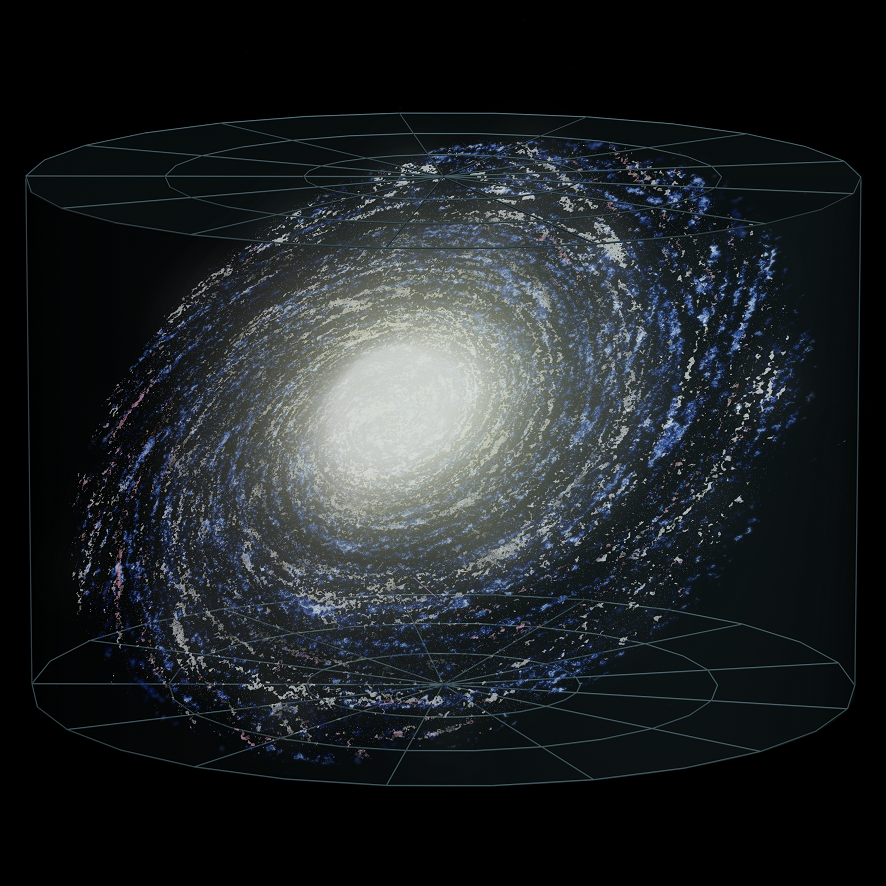
To span the diameter of our galaxy, though, you have to go all the way up to one zettameter, a sextillion meters, 10 to the 21st.

The very last prefix is yotta-, a septillion, 10 to the 24th. And because 260 yottameters is the diameter of the observable universe, it really is the last distance unit you’ll ever need.

So that’s my burst of geekiness for the day. Maybe not interesting to anybody besides me, but there we are.

What kind of weird stuff do you geek out on?


Follow

Get every new post delivered to your Inbox.

Join 431 other followers