Monthly Archives: April 2011

Polltergeist

The red phone rang last night, its soft siren wailing in my cavernous lair like a jilted lover. Only one person calls on the red phone.

The Chairman of the Internet.

“Herr Buckley,” she said, in that thick accent I could never quite place. “It is very serious. The webs, they have plenty of cat photos, a surfeit of popups, an excess of indie rock album reviews. But by God, we need more blog polls, and we need them now.”

“It shall be done, Madam Chairman,” I said, because that’s what you say when you’re talking on the red phone.

So, here we go. Poll question. It may seem strange, but please give it a vote, and I’ll explain on Monday.

And if nobody answers, then on Monday I’m just going to look like a dumbass. So, electoral participation and all that. Otherwise, fascism wins.

And nobody likes a Mr. Fascism.

Have a good weekend!

Writing Is Easy, Pass It On

Writing is hard, impossibly hard. We all know that.

I mean, look at what you’re doing. Just to get in the game, just as the price of admission, you have to follow literally hundreds of different rules about grammar, punctuation, and spelling – all the time. These rules are arbitrary, contradictory, vague, and ambiguous, accumulated over millennia as English wrapped itself around every other language it could find and absorbed little pieces, amoeba-like. What’s more, no one quite agrees on all the rules. So, you know, good luck with all that.

All the rules above get you no points if you follow them; you only lose points if you don’t.

Next, you need a story. You need to create believable characters, which merely means running the brains of a dozen other people inside yours like virtual servers. You need a believable world, which only means inventing a universe’s worth of specific, concrete, consistent details. You need a good plot, which just means architecting human conflict like a cathedral.

Grab the reader’s interest instantly, but don’t promise anything you can’t deliver. Unite your book with common themes, but don’t bludgeon the reader with them. No cliches. No info dumps. No Mary Sues. Nothing predictable. Nothing boring.

Now, do all the above, and also make it real and powerful and genuine and heartbreaking.

Oh, yeah, and everyone else is doing that, too; so make it different than everyone else’s books.

And if you get a chance, go ahead and wade through a multi-tier system of judgment and rejection in which – and I’m being charitable here – 99% of you won’t make it.

Yeah. Writing is hard.

But here’s the thing: writing is easy. You know why? Because you sit down, and you move your fingers. That’s it. That’s the whole thing. Let me say that again: you sit down, and you move your fingers.

Specifically, your job as writer does not require you to do any of the following.

Running into a battlefield and getting shot at by the forces of Muammar Gaddafi. Relying on your own steady fingers to save someone’s life in an operation. Starving. Spending decades in a prison cell. Spending decades hounded by secret police. Jumping out of a plane with no idea what will happen when you land. Sifting through the remains of a town after a tsunami swept most of it away.

I’m not trying to be dramatic or depressing. I’m trying to make a point. If writing is monumentally, inconceivably difficult (and it is), it is also absurdly easy. You sit down, and you move your fingers.

May we all be lucky enough to find a challenge so easy, and so hard.

Movin’ On Up

I am pleased to announce that my writing has ascended to a higher plane.

I used to do my novel revision downstairs, but we were painting that room, so we had to move all the furniture out. And we’re keeping everything out for a couple weeks since we’re going to install new carpet too. So my computer’s upstairs. See, when I said “ascended,” I meant I had literally taken my computer and…

What? You already got it? It wasn’t funny? You’re tapping your watch impatiently?

If it’s any consolation, this story has a point.

See, I have Internet access downstairs (which is how I’m posting this now, from my lap-top laptop) but not upstairs. I’m doing my writing on a disconnected computer.

I’m really surprised how much better that is.

I mean, I’ve heard other people talk about it. “Disconnect thy Internet,” they intone ominously, “lest thou be distracted by its sparkliness.” Pshaw, I thought. I was (and am) self-disciplined enough that I could still get my hour of writing time in. See, I use a stopwatch to make sure I write a full hour (or half hour, or two hours, or whatever time I’m shooting for that day, depending on how much free time I have) and if I get interrupted or feel the need to surf, I pause the stopwatch. That way, I’m sure that an hour really means an hour. And once I got into that habit, I wasn’t stopping my watch for surfing very much anymore. Writing time really was writing time.

But here’s the thing – there actually is a mental difference (for me, at least) between not using the Internet and not having the Internet. When I have the Internet, I still use it for little things, like looking up words and synonyms, and using Google for research. And those are useful tools, don’t get me wrong. But they always carry the temptation of doing more, surfing more, and it takes mental energy to fight that. And even these small disruptions, writing-related though they may be, are not actually writing. It’s a kind of distraction.

Having no Internet at all enforces a sort of mental austerity. It’s liberating. You’re here to write, and you write. You have a job to do, and you do it.

I am a fan of that.

Oh, by the way, I used to use Online Stopwatch for the aforementioned stopwatchery, and I’ve found it extremely useful. But that’s tricky now sans Interwebs. Anyone know of another smart way to do this, short of actually buying a physical stopwatch?

Second pass revision status: 59% (write faster, penmonkey!!)

Infinite Jester

I’ve been reading a lot about David Foster Wallace lately – old interviews, new reviews of The Pale King, old reviews of Infinite Jest, all sorts of articles. He’s made headlines recently because of The Pale King, but my interest in him isn’t new. I’ve been fascinated by him for a long time.

Hard to say exactly why. I’m much less interested in, say, Jonathan Franzen, who occupies a similar spot in the literary world. I haven’t even read any of DFW’s novels yet (have to remedy that someday).

Partly, I’m sure, my fascination comes from reviewers and authors who keep using words like “transcendent” and “brilliant” to describe his work. Partly it’s because I love what I have read – mostly essays and short fiction. (I recommend “The Depressed Person” and, most especially, “This Is Water,” which actually made me cry; your mileage may vary.) Partly it’s because of his own tragic story: his lifelong battle against depression, drugs, and alcohol, his suicide in 2008. Partly it’s his staggering vocabulary, which guarantees I will learn awesome new words like “fantods” every time I read his stuff. Partly it’s because, unlike so many other Great Men of Genius™, he seems to have been a warm, kind, and genuinely compassioniate person. And partly it’s because he was crazy, crazy smart, about everything from English to math to the game of tennis.

I came across this in one of his old essays that I stumbled across yesterday:

The best metaphor I know of for being a fiction writer is in Don DeLillo’s “Mao II,” where he describes a book-in-progress as a kind of hideously damaged infant that follows the writer around, forever crawling after the writer (dragging itself across the floor of restaurants where the writer’s trying to eat, appearing at the foot of the bed first thing in the morning, etc.), hideously defective, hydrocephalic and noseless and flipper-armed and incontinent and retarded and dribbling cerebo-spinal fluid out of its mouth as it mewls and blurbles and cries out to the writer, wanting love, wanting the very thing its hideousness guarantees it’ll get: the writer’s complete attention.

The damaged-infant trope is perfect because it captures the mix of repulsion and love the fiction writer feels for something he’s working on. The fiction always comes out so horrifically defective, so hideous a betrayal of all your hopes for it — a cruel and repellent caricature of the perfection of its conception — yes, understand: grotesque because _imperfect_. And yet it’s yours, the infant is, it’s _you_, and you love it and dandle it and wipe the cerebro-spinal fluid off its slack chin with the cuff of the only clean shirt you have left…

This is so very true. I love it.

On the Boiling of Watched Pots

Currently I’m waiting on partial-manuscript critiques from two different people whose opinions I value highly. Both will likely be a few weeks yet. I’m both excited and nervous to hear what they say.

I’m also struck by just how much of the writing and publishing process is simply waiting.

Not a new insight, I’m aware, but still: waiting on critiques from beta readers, then waiting on agents to reply to queries, then to partial manuscripts, then to full manuscripts, then waiting on a publishing contract, then waiting on the long process of actually getting a book published. And then, waiting on the reviews. I’m getting far ahead of myself here (personally I’ve never gotten further than step 4), but I know where the road leads.

And then there’s waiting on yourself, to finish writing. Watching the progress bar move like frozen molasses at a How Slow Can You Move convention. This, at least, you can control. This, at least, you know exactly how it’s going (or you think you do). But still: waiting.

The antidote for waiting is, of course, to do other things. It’s been a good weekend for that. We painted the computer room, mowed the lawn, took out the recyling, ordered new carpet, and finished our income taxes this weekend. (And can I just say, Columbus, your tax forms fail in ways I didn’t think it was possible to fail. Line 9: Enter the amount from line 8. They’re right next to each other. They’re the same number. You know why they’re the same number? Because you told me to write the same @$#%!@$@ number!!)

So, lots of good things getting done in Chez Buckley, especially with weather that thinks it’s summer. (Though, this being Ohio, I am not surprised this morning to hear a storm blowing outside.) And thus the waiting is bearable.

But still.

LMAO

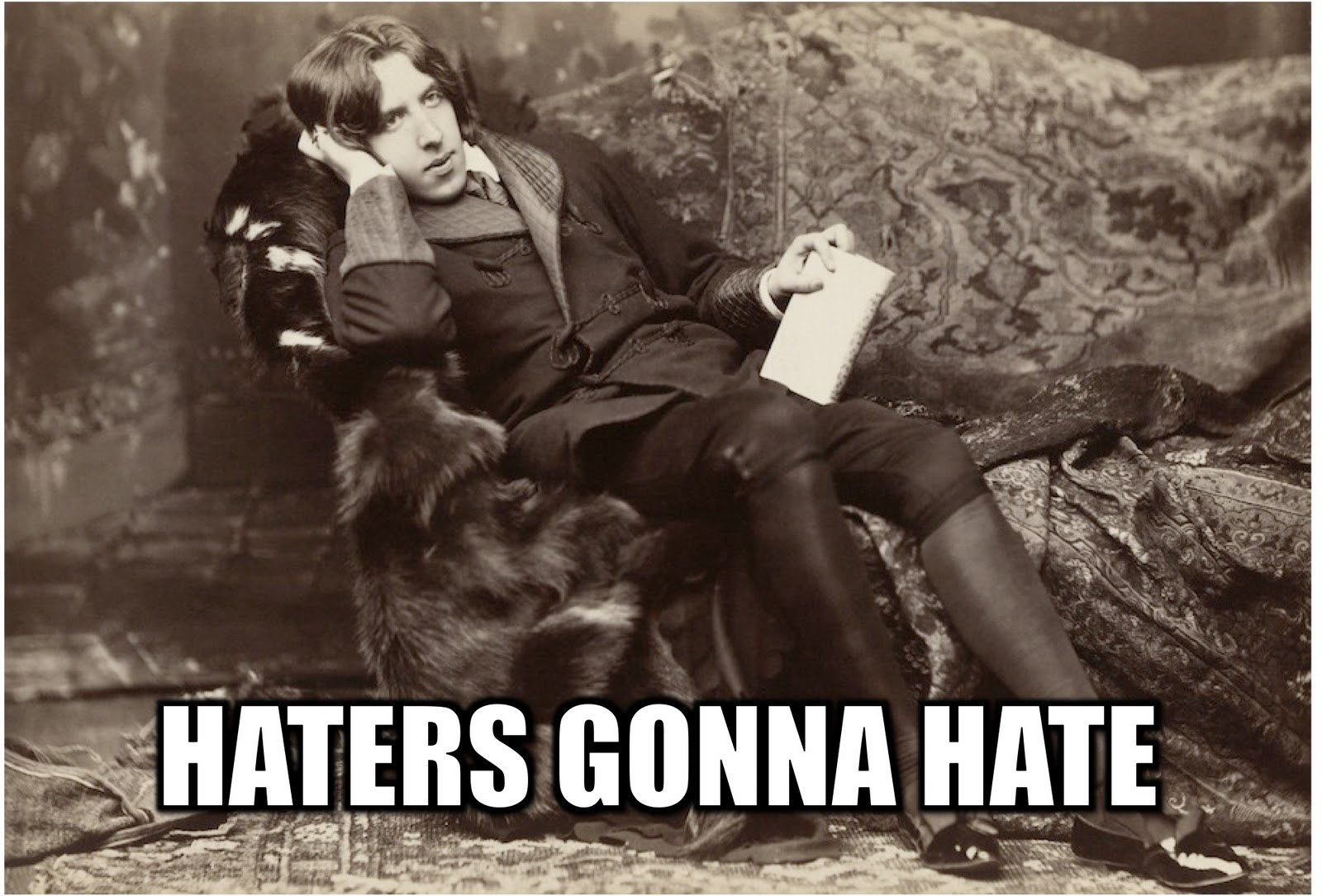
Oscar Wilde’s philosophy on dealing with bad reviews:

Haters Gonna Hate

Found via Nathan Bransford’s blog.

Beeing and Time

They should invent some kind of nerd detection system, to sift out our nation’s nerds at an early age, test them, and rank them according to nerdiness.

Ha! My mistake. This already exists, and it is called the National Spelling Bee. And ladies and gentlemen, I am very nerdy indeed. May I present Exhibit A:

…hm. Well, it seems that after several minutes of hunting, I can’t find the cover of the 2000 official spelling bee booklet to show you. But rest assured, my little face is on it. I made it to Nationals twice, in seventh and eighth grade, and the second time I got ninth place in the nation.

I know, right? Kick-ass. In the nerdiest possible way, which is pretty much how I roll.

I was thinking about all this once again because just yesterday, the company I work for sponsored a team for a local-area bee to raise money for literacy, and I was part of the six-person team. That was a lot of fun, not least because we won for the second year in a row. (Wooo!! Take that, other local organizations!!!)

Some interesting words, too. For instance, I had only the vaguest notion that there are two different words pronounced “sah-shay.” One is spelled phonetically, “sashay,” and means “to walk or move nonchalantly.” The other is “sachet” and refers to a small bag of potpourri. If you knew that already, well, aren’t you smart! But it was news to me.

All of which demonstrates a fundamental truth: English be crazy, yo.

Have a good weekend, everybody.

Battling Self-Doubt

As writers, we have a lot of voices in our heads, even on days when we take our medication. Many of these voices are intensely negative. I want to talk about two such voices: Self-Doubt, and the Internal Editor.

At first, these voices may seem similar; both are very critical of your writing. But if you listen carefully, you can tell them apart.

The Internal Editor is all business – just doing his job. When he spots problems in your work, he’ll be as specific as he can, and he’ll try to offer suggestions. “Your first chapter is boring,” he’ll say. “Cut it.” Or: “Death to the adverbs!” The Internal Editor is your friend, because his goal is the same as an external editor’s goal: to make your writing the best it can be.

Self-Doubt is lazy, lying on your couch all day, yelling out criticism but never offering to vacuum or help with the dishes. “You’re pathetic. Look at this thing you wrote. It’s terrible!”

If your Internal Editor is new and inexperienced, he may not be able to offer you many specifics or improvements. “This doesn’t work,” he may say, “but I don’t know how to fix it.” That’s okay. Keep reading, keep practicing. He’ll improve with time. But even from the beginning, his focus is on the work itself, and how to make it better.

Self-Doubt, on the other hand, just wants to hurt you; and because he’s inside your brain, he knows exactly how to do it. He insists that you are weak, that you are stupid, that you will never be good enough.

That’s what is known, among psychologists, as bullshit.

Telling stories is powerful, it is noble, it is brave, it is beautiful. Self-Doubt understands none of those words. That’s why he hates you. That’s why you have to beat him.

There are many strategies for this, but the one I know best is simple, dogged perseverance. Don’t engage your Self-Doubt directly, don’t argue with it, don’t analyze it, don’t drop down to his level. Just do your thing. Keep writing. Keep writing when you feel terrible. Keep writing when you get rejected. Keep writing when you think everyone else is better than you.

No matter what, keep writing.

I think of that song, Tubthumping, the singers ecstatically chanting its chorus with so much faith it transcends the cliche:

I get knocked down
But I get up again
They’re never going to keep me down

This is your creed. This is your map. If you say these words and believe them, there is only one voice that will matter anymore.

Yours.

Subversive revision

Revision is strange.

You spend weeks, months, even years, going through multiple drafts of a manuscript. These words you’ve written, they’re not just words anymore. You have a history with them. You know them.

So when I revise, I feel a little like a deviant monk, scribbling in the margins of some sacred text I was only supposed to transcribe. Cutting out a phrase here, a paragraph there, putting new words in the mouths of saints whose canon went unchanged for centuries. What will the abbot think when he learns of these shenanigans?

Don’t get me wrong; I’m not squeamish. If a scene doesn’t work, if a paragraph has to go, I seek and obliterate those suckers like a Sicilian plumber at a Goomba convention. Destroying one’s words has its own kind of joy; it’s cleansing. Yet it still feels, at some level, vaguely subversive.

This weekend I added a whole new chapter, written entirely from scratch. If fiddling with paragraphs is subversive, adding new scenes feels downright heretical. I stare at the infinite possibility of the blank page, and I think: really? You mean I can take these beloved characters, these people whose stories I thought I already knew, and make them do whatever I want?

Oh, hell yeah I can. And it’s fun, the way starting a new book is fun.

But this reverence for what’s gone before, for the draft as currently written, makes a certain amount of sense. If I can cram yet a third simile into this straining post, revising a manuscript is like hiking a trail. You forge the first draft from nothing, hacking through undergrowth, wondering where you’re going. But each time you pass over the trail again, whether it’s a full revision or just a re-read, you smooth the path in your passing. Almost subconsciously, you adjust, correct, improve. The result of many such passes is writing that’s polished, that’s been thought about a lot. And every time you leave that well-worn path, you’re cutting a new detour through the jungle, and the new path is rough, at first. There are panthers in the jungle. You were right to be wary.

But if you only walk down the same old path, you’ll only get to that same old destination.

Forge the trail.

Write the heresies.

Stomp the Goombas.

Jabberwocky

If you’ve never read Lewis Carroll’s poem “Jabberwocky,” give it a shot. The text is here and it’s only twenty-eight lines.

“Jabberwocky” was originally published as part of his novel Through the Looking-Glass, which is next on my reading list as soon as I finish China Mieville’s Kraken.

The poem is generally called “nonsense verse,” which means that he made up a lot of the words. But “nonsense” isn’t quite right, because although the words don’t have dictionary entries, you can still get a sense of what the poem is about. This is partly because of context, and partly because he didn’t form the words at random; if “mimsy,” for example, sounds vaguely weak or pathetic, maybe it’s because it’s a combination of “miserable” and “flimsy,” and sounds similar to “wimpy” for good measure.

I think it’s a fun poem, and I’m especially partial to its airtight meter. But what I find really remarkable is that no fewer than five of Carroll’s “nonsense” words went on to migrate into the dictionary. All five of the words below give their etymology as “coined by Lewis Caroll”:

chortle – to chuckle gleefully

galumph – to move along heavily and clumsily

bandersnatch – an unconventional person considered a menace

frabjous – wonderful, elegant, superb, or delicious

jabberwocky – writing that contains “nonsense” words, like the poem

There may be others I missed; and that list covers only the words that are widely accepted by Real Dictionaries (though not, apparently, by WordPress, which underlined “bandersnatch” and “frabjous” in red). Other words, like “vorpal,” though not quite to the status of dictionary words, have still gone on to wider use (in video games, for instance).

Five new words in twenty-eight lines: that’s about one new word coined for every six lines. Can any other English work claim to be that fertile?