Monthly Archives: November 2011

I Just Bought a +5 Battle Axe of Philanthropy

Yesterday I mentioned that one of the projects I’ve given up is an idea to raise money for charity using video games. I still think this is a useful idea, I just never had the time to pursue it. I want to throw it out here and see what you think. (Yes, you, hypothetical reader!)

The basic concept is to take the obsessive, borderline-addict enthusiasm that MMORPGs generate, and direct that toward charity.

You come up with a game that’s free to play, a game that’s genuinely fun on its own. Then you have certain elements – weapons, armor, spells, items, whatever – that you can buy with real-world money. Lots of games do this already, though it’s a controversial business model. But what if all this “optional upgrade” money, instead of going to some company’s bottom line, instead was donated to, say, Doctors Without Borders, or another worthy organization?

If you were up-front about how the system worked and what its goal was, I think gamers could get excited about it. People love nothing more than feeling good about themselves, and who wouldn’t want to think that the money they spend on their gaming habit – which they might normally feel a little guilty about – is actually a +1 to their Ethics stat?

This model would have to overcome some hurdles. The biggest, of course, is that games don’t design or build themselves, and servers don’t pay for themselves.

There are a few ways to handle this. One is to have only a percentage of the money go to charity, and the rest go to game costs (of course you’d have to be up-front about that too). Another way is to have a subscription fee to cover costs, and only the optional upgrades go to charity. But the former option is less exciting as a selling point, and the latter is a barrier to entry – a major problem for a game you’re hoping will go viral.

Two other options would be to find people willing to donate the necessary time and resources (which would be tough), or to piggyback on the success of an existing game by convincing the creators to add pay-for-charity content. Honestly, that last strategy might be the most realistic.

What do you think? Would you play a game like that? Do you think this could work? Does something like this exist already, and I just haven’t heard about it?

Letting Go

I have a problem: I try to work on too many projects at once. As I’ve told my wife, if I had a thousand lifetimes, I could happily devote each one to mastering a different pursuit. I end up trying to cram it all into one lifetime. It doesn’t always work.

Here are the projects I’m working on right now:

This actually isn’t too crowded, by my standards. The journal only takes a few minutes each night, the pen twirling I do in my spare time, and the exercise is pretty quick because I’m not, like, hardcore. The blog has its own built-in mechanism for not wasting too much time, and the “new topic each week” thing isn’t bad either.

Story-writing and AI development are the only major time sinks, which generally means I have to focus on only one at a time. For the past week or so, it’s been AI.

To give you a sense of how much worse this project-hoarding can get, here’s a partial list of projects I’ve given up (or at least put on long-term hold) in the past year or two. I say “partial” because I’m sure there are lots more I’m forgetting.

  • Go
  • Zen
  • Learning Italian
  • Learning Chinese
  • Improving my Spanish
  • Juggling
  • Karate
  • Rubik’s Cube
  • Dvorak typing
  • Tennis
  • A previous blog, Coffee With Sargeras
  • Writing articles for the now-defunct website Insulin Funk
  • An idea on how to raise money for charity using video games

Letting go of a project is always hard for me. A lot of these efforts had gotten pretty far before I stopped. I could solve a Rubik’s cube in about three minutes (though I’ve since forgotten the patterns). I could touch-type in Dvorak at a pretty decent speed. I could juggle three balls, and two in one hand, and do all sorts of tricks. Coffee With Sargeras was pretty successful – and a lot of fun – before I finally decided to end it. And Zen…well, Zen was Zen.

Karate was particularly hard to give up. I had done it for over three years, reached black belt, got to really like a lot of people in the class. But I had to stop.

Why?

Projects compete for many different kinds of resources. Sometimes lack of time is the deciding factor. Sometimes it’s mental energy. And sometimes it’s sanity.

I know there are people who can thrive on being nonstop busy, scheduling every waking moment. I am not one of those people. I need peace, simplicity, quiet.

Karate was a good thing, but I had too many good things.

What have you let go lately?

Master and Margarita Postmortem

Master and Margarita

The Master and Margarita, by Mikhail Bulgakov. Translated by Mirra Ginsburg.

The Master and Margarita is considered one of the great masterpieces of the twentieth century. Its premise is simple and intriguing: Satan comes to Russia.

The first chapter, titled “Never Speak to Strangers,” opens in Soviet-era Moscow. Two men meet a stranger named Woland, who turns out to be the Devil. He gets them talking about religion:

The foreigner [Satan] threw himself back against the bench and asked, his voice rising almost to a squeal with curiosity, “You are atheists?”

“Yes, we are atheists,” Berlioz answered…

“Oh, how delightful!” cried the amazing foreigner…

Satan goes on to explain that God and Jesus are both quite real, and that he ought to know, because he was there for the Crucifixion. He then gives his own account of Pontius Pilate sentencing Jesus to death: the familiar story of the Gospels, with enough little twists to make it feel completely new.

I found the beginning utterly fascinating, and I tore through the first fifty pages. But as the book goes on, it gets more convoluted, and seems to lose its way.

We meet more of Satan’s retinue, including the giant black tom cat, Behemoth, pictured above. Satan & Co. wreak havoc in Moscow, framing people for crimes, inciting hysteria, generally causing confusion and trouble everywhere they go. We also meet the titular characters, the beautiful Margarita and the man she loves, a writer known only as the Master.

The novel is by turns beautiful, confusing, and laugh-out-loud funny. There’s much talk of redemption, for Pontius Pilate, the Master, and others too. I know that the author, Mikhail Bulgakov, is trying to tell me something about grace, but I’m not sure what it is. I’m also told that the story is a satire of Stalinist Russia, though I’m afraid that aspect of it went completely over my head. From my point of view, The Master and Margarita ended up feeling like a jumble – a lot of strange and pretty things, but I’m not sure what they added up to.

Sometimes you just have to give up and admit that a book is smarter than you are. I read Bulgakov’s masterpiece cover to cover, but I can’t say I understood it.

Friday Links

I’m still on vacation with my family, so I’ll keep it short today. This Thanksgiving comic made me laugh. If you like it too, it means your sense of humor is as ridiculous as mine.

See you Monday!

Happy Thanksgiving!

Butter
Connie Wanek

Butter, like love,
seems common enough
yet has so many imitators.
I held a brick of it, heavy and cool,
and glimpsed what seemed like skin
beneath a corner of its wrap;
the décolletage revealed
a most attractive fat!

And most refined.
Not milk, not cream,
not even crème de la crème.
It was a delicacy which assured me
that bliss follows agitation,
that even pasture daisies
through the alchemy of four stomachs
may grace a king’s table.

We have a yellow bowl near the toaster
where summer’s butter grows
soft and sentimental.
We love it better for its weeping,
its nostalgia for buckets and churns
and deep stone wells,
for the press of a wooden butter mold
shaped like a swollen heart.

Why Thanksgiving Is My Favorite Holiday

As a child, I belonged to the Worldwide Church of God (which I just learned has changed its name to Grace Communion International…weird). We were Christian, but we observed a lot of the Old Testament holidays, like Passover and the Feast of Tabernacles. We also shunned a lot of mainstream holidays. For doctrinal reasons, I was not permitted to celebrate Christmas, Halloween, Easter, or Valentine’s Day.

So, unlike most people, I don’t have many special childhood memories of Christmas or Halloween, which seem to be most Americans’ favorite holidays. But we did celebrate Thanksgiving.

I love Thanksgiving for a lot of reasons. Of course, I love seeing my family, and I love all the food. I also love that it’s a distinctly North American holiday, and that it’s the perfect capstone for fall.

I also love the sheer simplicity of it. No decorations, no costumes, no goofy mascots, no parties, no songs, no presents, no cards. Thanksgiving is like, “Man, just get your family together and make a bunch of food. It’ll be a good time.” And you know what? It is.

And finally, I love what Thanksgiving represents. I think the spirit of gratitude is one of the most important and underrated values of modern society. I’m agnostic now, so the idea of giving thanks to God is less meaningful for me. But the act of appreciating what you have is as important as ever. If you don’t value your blessings, you lose them.

Also, we don’t really care about football. So, there’s that.

What does Thanksgiving mean to you?

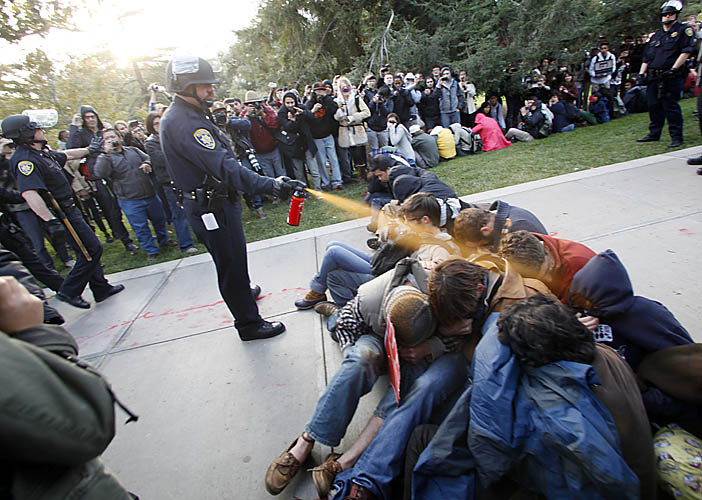
Why Pepper Spraying Kids in the Face is a Bad Idea

In case you haven’t heard, some seriously bad shit is going down at the University of California-Davis.

The video above is more than eight minutes long, but the first 30 seconds will show you all you need to see. A line of student protesters is seated peacefully on the ground on the campus of their own university. A police officer walks up and down the line, deliberately and repeatedly dousing the crowd with pepper spray. This happened on Friday.

In the wake of this fiasco, it seems like all the right things are happening. The campus chancellor has apologized. The university president is taking steps to ensure this doesn’t happen again. The officers involved are being investigated for disciplinary action. The press has blown the whole thing wide open. The students are right back in the same place, protesting again. All this is as it should be.

The absurdity of a police action like this is mind-boggling. Forget for a moment the basic and obvious ethics of using chemical weapons on someone for sitting on the ground. Forget the massive PR debacle that anyone could have predicted. Let’s focus for a minute on the biggest reason this attack doesn’t make sense:

You’re on the same side.

In a democracy, police and protesters are working toward the same goal. Both roles exist to serve the people, and both roles are absolutely essential. If either ceases to function, the entire system crumbles.

Pepper Spray

We see the most extreme manifestation of this Government vs. People mentality happening all around the world. Syria’s dictator has already killed four thousand demonstrators, with no sign of stopping. Egyptian protesters are gearing up for a second revolution, after their first one earlier this year didn’t bring about the changes they needed. In Burma, things are so bad that when an opposition leader runs for Parliament, it’s international news.

Obviously the situation in all three of those countries is far, far worse than anything going on at UC Davis right now. But that’s where the path leads, if left unchecked.

If necessary, I’ll take to the streets too. I’ve done it before.

Skynet in the Basement

In the past week I’ve been working on designing an artificial intelligence. Now, normally when people say they’re working on AI, they mean some particular AI-ish sub-problem, like text-to-speech or chess-playing or facial recognition. In typically quixotic fashion, however, I’m going straight for the top: a Strong AI, a software program with human-level intelligence.

This isn’t the first time I’ve worked on this problem. Strong AI is an appealing project to me for a lot of reasons. For one thing, it blends nearly all my interests: computer programming, language, philosophy, theories of consciousness, ethics, even Go. It’s also deceptively simple; it just seems like it shouldn’t be that hard, though of course nobody’s ever done it before. And, because nobody’s done it before, nobody really has any idea how to do it, which means the field is wide open. All very exciting, provided you’re geeky enough. (Check.)

Part of me says I’ll never get anywhere with this stuff, but another part can’t help planning for what happens if I succeed. I take very seriously the theory of the Technological Singularity – the idea that machine intelligence, after reaching a certain critical threshold, might grow exponentially and leave humans so far in the dust that all we could do is hope it doesn’t squish us. I’ve got some ideas on how to deal with that, too.

I’m running out of time this morning, so I’ll cut this short. Let me ask, have you ever worked on an AI? Or, if someone else built an AI for you, what would you do with it?

Friday Links

I came across a blog by a Canadian woman living and working in Mozambique. In her latest post she talks about some Mozambican school kids, and how excited they were to receive pictures of…well, I’ll let you see for yourself.

This comic summarizes my feelings on every economic issue in this country.

And this one pretty much sums up my thoughts on the First Amendment.

And finally…there are a lot of reasons to be recommend a book. Maybe it gave you some practical advice. Maybe it touched you spiritually. Maybe you liked the writing style. Or maybe…it just has the greatest book title ever created.

Have a good weekend, everybody!

Hidden Wars

A couple days ago, while having the brake pads replaced on my silver four-cylinder base-model 2006 Honda Accord, I found myself in a waiting room with hours to kill and a lot of magazines to read. I came across a recent TIME article that really got me thinking.

The article says that, in the U.S., the divide between soldiers and civilians has never been bigger. Many outside the armed forces are ignorant of even the most basic details of how the military works, what it’s currently doing, and what daily life is like for service members. Meanwhile a lot of soldiers grow more isolated from the country they serve.

The percentage of Congress that’s made up of veterans has dropped from 77% in the 1970s to 22% today.

The article got my attention because I’m part of the problem. What do I know about the military? I know we’re in Afghanistan, and pulling out of Iraq. I know we were involved with the Libyan air strikes and that we’ve sent “advisors” to help fight the LRA. But…specific details of how the Afghanistan war is progressing? Knowledge of the military command structure? An understanding of what everyday life is like for a soldier? Things I can do, as a civilian, to help those who are risking their lives? On all those subjects, I’m hazy at best.

This is a big deal. Democracies rely on the people to be informed about what their country is doing. In the U.S., I see a population increasingly distracted by entertainment, increasingly apathetic about what their guns are doing and why. And it seems to me that this is how democracies fall.

I mentioned recently that I’ve started learning about a new subject every week. This week was Mozambique. I think sometime soon I’ll take a week and learn more about the armed forces.

How much connection do you feel to your country’s military, and how well do you understand them?