A little more Buffy goodness this Friday. First, we have Buffy’s Mom:
And then Buffy, Friends-style:
Have a great weekend! I’m off for two weeks for the holidays. The blog returns Monday, January 5.

A little more Buffy goodness this Friday. First, we have Buffy’s Mom:
And then Buffy, Friends-style:
Have a great weekend! I’m off for two weeks for the holidays. The blog returns Monday, January 5.
As mentioned previously, I’m working in the genealogy section of the library these days. Currently I’m typing up death records from the 1880s-90s.
It’s cool seeing all the old names.
Most are still familiar a century later: Mary, Peter, Sarah, William, Joseph, Daniel, etc. Some have alternate spellings that are much less common now: Catherine/Catharine, Elizabeth/Elisabeth.
But there are a lot of strange ones.
Here, for your viewing pleasure, I’ve collected the most unusual and interesting first names I’ve encountered as I worked through 3,000+ records. All of these belonged to people lived in Ohio, though not all were born here.
And finally, who could forget…
Yes, there really were men named Philander, back in the day.
Have you ever wondered why “philanderer” and “philanthropist” sound similar, but mean such different things? Okay, probably not. But it turns out, it’s not a coincidence, and the meanings aren’t as different as they seem.
See, “phil” means “loving,” and “andr”/”anthr” means “man” or “mankind.” So a philanthropist is someone who loves mankind. Philander, as a name, used to mean something similar. But then it morphed into the other meaning of loving, er, mankind, and after that, people started picking different names for their baby boys.
Which is funny, considering how many babies exist solely because of philandering.
Anyway.
That’s, uh, that’s all I’ve got for now. Who knew working in a library could be so educational?
Posted in Uncategorized
Exhibit A: the North American cantaloupe.
Exhibit B: the honeydew melon.
Recently, I got curious about these two. Is the honeydew melon a type of cantaloupe? Or vice versa? Or are they completely separate species? What, in short, is the deal?
I fired up Google, expecting an answer in thirty seconds or less. What I found, instead, was a subject of astonishing confusion and complexity.
Part of the trouble is terminology. For instance: “muskmelon” can be either a synonym for “cantaloupe,” or a larger group that includes both cantaloupe and honeydew. Honeydew melons are also said to be a type of “winter melon,” but “winter melon” can also refer to an entirely unrelated Asian fruit. Even “cantaloupe” is confusing, because what Americans call a cantaloupe is different than the so-called “true” cantaloupe, also known as the European cantaloupe. Oh, and apparently “honeydew” is also an alternate name for cantaloupe.
You see the problem.
Let’s talk science. Botanists have official, unambiguous scientific names for everything, right? That should clear up the confusion.
Well, cantaloupe (both North American and European) and honeydew all belong to the same species: Cucumis melo. So they’re different subgroups of the same species. That’s good to know. But what kind of subgroups, exactly? And do they overlap?
Well, what are the biological taxonomic levels below species?
Turns out, it depends which kingdom you’re in. We’re talking about the plant kingdom – botany – and there, the taxonomic levels below species (the so-called “infraspecific” levels) are:
So honeydews and cantaloupes are both Cucumis melo, but different subspecies, maybe? Or different varieties?
Wiki gives the subspecies of cantaloupe as “C. melo subsp. melo.” This terminology is known as a trinomial name, because it includes three names: the genus (Cucumis, here abbreviated “C.”), the species, “melo,” and the subspecies, which is also called “melo.” The connecting word – “subsp.” – indicates that the third name is a subspecies, as opposed to a variety or form.
So the cantaloupe is Cucumis melo subsp. melo. That cover subspecies. What about variety?
Wiki has us covered there, too. The variety is “Cucumis melo var. cantalupensis” – but it also gives the variety as “Cucumis melo var. reticulatus.” What’s going on there? Why two names?
Wiki doesn’t say, but further research reveals that North American cantaloupes belong to C. melo var. reticulatus, whereas European or “true” cantaloupes belong to C. melo var. cantalupensis.
Cool! What about honeydews?
Wiki defines the honeydew melon as part of a “cultivar group” of Cucumis melo – specifically, the “inodorus” group. What in the world does that mean? We know about species, subspecies, variety, and form, but cultivar group is new.
A cultivar, I have learned, is a type of plant cultivated (usually by humans) for a specific characteristic. A cultivar group is, well, all the plants that belong to a particular cultivar. Logical enough, but where does “cultivar group” fit in with the taxonomy we’ve learned so far?
Turns out, the subspecies/variety/form stuff is all cooked up by the International Code of Nomenclature for algae, fungi, and plants, or ICN. Cultivar groups, on the other hand, are handled by the International Code of Nomenclature for Cultivated Plants, or ICNCP. That’s why the terms don’t match up – they’re governed by different organizations. A cultivar group can match up with any level of the ICN taxonomy from genus on down.
After doing yet more research, I think – I think – that cantalupensis, reticulatus, and inodorus are all varieties (in ICN-speak) and cultivar groups (in ICNCP-speak). In other words:
Neat and tidy, more or less. The only thing that still bothers me is that inodorus doesn’t mean honeydew, it’s just a group that the honeydew belongs to. (Other members of inodorus include crenshaws and casabas.) Likewise for the two types of cantaloupes.
So what, precisely, is the official or scientific status of the North American cantaloupe, the European cantaloupe, and the honeydew melon? Is there any? Or do those terms belong strictly to the vernacular? That, sadly, I’ve been unable to determine, despite my best efforts. In the unlikely event that anyone knows, I’d love to hear from you.
And in the even-more-unlikely event that you’ve kept reading through all of this, congratulations! Hope it made sense. And yes, I am quite, quite mad.
Posted in Uncategorized

Comic by Jim Davis. Image source
I have a theory – completely without proof – that “Elizabeth” has more variants than any other name. You have:
(Thanks to Baby Name Wizard for helping with that list.)
Other names have variants you might not expect. Peggy, for instance, is a diminutive of Margaret.
And John is fun to trace around the world:
…not to mention Jack.
James, meanwhile, is a derivative of the biblical Jacob, which means “heel-grabber.”
Crazy.
Coming soon: weird old American names that nobody uses anymore. Like “Philander.” No, really.
Posted in Uncategorized
First up, some Dinosaur Comics goodness, of course.
And then we have this: a mother gives her young children terrible Christmas presents as a joke, and films their reactions. The results are both hilarious and strangely touching:
No, it’s not a euphemism. Get your mind out of the gutter.
Betsy, my lovely wife of four years (and maybe more! Give it time!) has started playing Smash Bros. with me. This is a very exciting time in the Buckley household.
Smash Bros. is a sort of social activity for me and my friends, like polo for rich people, or football-watching for normal people. Betsy wants to be able to hold her own in these friendly free-for-alls, so she’s picked a character to get good at (Peach) and she’s learning how to be a contender.
I’m showing her how to use the various directional-B attacks, how to grab, how to dodge, how to recover from a hit by jumping and up-and-B-ing. It’s fun for both of us.
But we have very different video game backgrounds, she and I.
I played the original, N64 Smash for probably hundreds of hours, and Melee even more. I’ve beaten Super Mario Bros., World, 64, Sunshine, and Galaxy (not to mention Lost Levels and Yoshi’s Island). I’ve beaten Zelda: Ocarina of Time, Majora’s Mask, Wind Waker, Twilight Princess, and Link’s Awakening. I’ve beaten Super Metroid and Metroid Prime, Donkey Kong Country 1 and 3 (and 64), Pokemon Red and Silver (and Snap), Earthbound, and a host of other games besides, mostly Nintendo.
None of those games are especially hard; I’m not trying to impress you. My point is simply that, game-wise, I’ve been doing this a while.
Betsy, on the other hand, has mostly played Sonic 2 for the Sega Genesis, with a little Virtual Boy action thrown in. (Yes, she was one of the eighteen people who owned a Virtual Boy, and one of the three who liked it.) She doesn’t like 3D worlds or games where you have to explore (Mario 64 and Ocarina right out, Smash Bros. fortunately okay) and she doesn’t like having too many buttons (which is more of a problem).
So, there’s a learning curve.
Perhaps an even bigger difference is that she doesn’t have the completionist/perfectionist drive, nor the bloodlust, the desire to kick the other guy’s ass and be the greatest of all time, common to so many gamers (like me). She just wants to have fun.
Fun. With a video game. Can you imagine?
Two backgrounds, two worldviews, coming together with a common purpose. Isn’t that what marriage is all about? A mech-suit bounty hunter launching homing missiles at a floating princess – isn’t that what love really is?
Anyway, we’re enjoying it.
Have you tried to teach/persuade a significant other to play a game? How’d it go?
Posted in Uncategorized

Jeanne Calment in 1996, on her 121st birthday. She still had a year and a half to go. Image source
The oldest person ever to live (as far as we know) was Jeanne Louise Calment. She was born in 1875 in Arles, France, and died in 1997, in the same city, at the age of 122 and a half.
She met Vincent van Gogh when she was thirteen, and says he was “dirty, badly dressed, and disagreeable,” as well as “very ugly, ungracious, impolite, sick.”

Calment at age 20, circa 1895. Image source
She saw the construction of the Eiffel Tower…and the launch of eBay. She was alive during the administrations of Ulysses S. Grant…and Bill Clinton. Had her husband lived as long as she did, they would’ve been married for 101 years.
I don’t have anything profound to say. I just think that’s amazing.
Posted in Uncategorized
Do you like statistics? Do you have a hankering for data? Do you sometimes find yourself compiling lists of information for no clear reason but the sheer pleasure of it?
No? Just me then.
Now that I’ve unlocked all the characters in the new Smash Bros., I got curious about how they broke down. Prepare yourselves for pie chart goodness.
A few notes on method before we start…
Ok, let’s get started…
1. Breakdown by Universe

Made with Meta-Chart
This one was mostly straightforward, though I did have to think about a few of them. For instance: is Donkey Kong part of Mario’s universe, or does he have his own? The first-ever Mario appearance was in Donkey Kong, after all, and he’s in all the Mario Kart games. But it didn’t seem fair to think of the Donkey Kong Country series as Mario games, or Diddy as a Mario character. So he gets his own universe.
Anyway – Mario, Zelda, and Pokemon dominate. No surprise there. It is surprising that a series as obscure (to me) as Fire Emblem gets four, but apparently it’s big in Japan.
2. Breakdown by Gender

Made with Meta-Chart
Overwhelmingly male (67%), just 18% female, no surprise there either. For what it’s worth, though, this is a big improvement on past games. The original SSB had only one female character out of 12 (8%), and Melee had two and a half out of 25, or 10%. (Ice Climbers were responsible for the “half.”)
Figuring out gender was trickier. Most were easy, but what gender is R.O.B. the robot? I picked male because of the name, but it’s iffy. Meanwhile Meta Knight has a non-gendered name and no obvious gender characteristics at all, but his page on the Kirby Wiki assures me he’s male as well.
The 7 “Others” consist of: five Pokemon (gender could be either), the Duck Hunt dog (gender unknown…I think), and the Mii Fighter (gender customizable).
3. Breakdown by Species

Made with Meta-Chart
This is another one where I had to do some research. Mario and Link are obviously human, while Bowser and Kirby obviously aren’t. But what about Mega Man? Where do I put Mr. Game & Watch? And exactly what the hell is Captain Olimar?
As I eventually decided, the five “Human-Like” are Mega Man (humanoid robot), Pit and Dark Pit (angels), Palutena (goddess), and Olimar (tiny humanoid alien).
You could argue that Game & Watch is just a depiction of a human using primitive technology, but his appearance in Smash is so strange (and two-dimensional) that I wasn’t quite sold. I did go ahead and call Wii Fit Trainer human, however, in spite of her white skin and weird eyes, because I felt her eccentricities were a matter of artistic style rather than species.
4. Breakdown by Skin Color
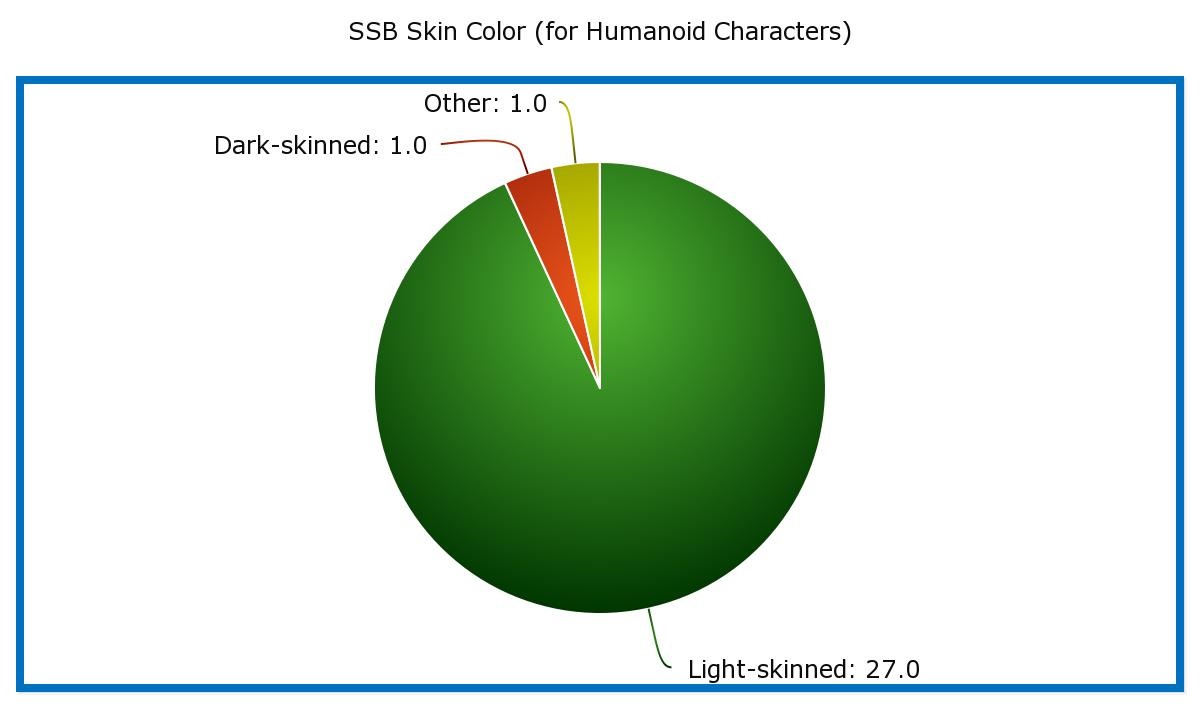
Made with Meta-Chart
And finally, of the 29 humanoid characters, 27 (93%) are light-skinned, while just one (4%) is dark-skinned. (“Other” is the Mii Fighter, whose skin color is customizable.)
It’s also worth pointing out that the only dark-skinned member of the group, Ganondorf, is also one of the very few villains. Interesting, no?
Well, this concludes today’s Video Game Stats Hour with your host, me, Brian Buckley. Feel free to worry about my sanity now.
Posted in Uncategorized
First there was Super Smash Bros. for the Nintendo 64, and it was good.
Then came Super Smash Bros. Melee for the Gamecube, and it was very, very good.
Next was Super Smash Bros. Brawl for the Wii, and it had its problems, but it was pretty good too.
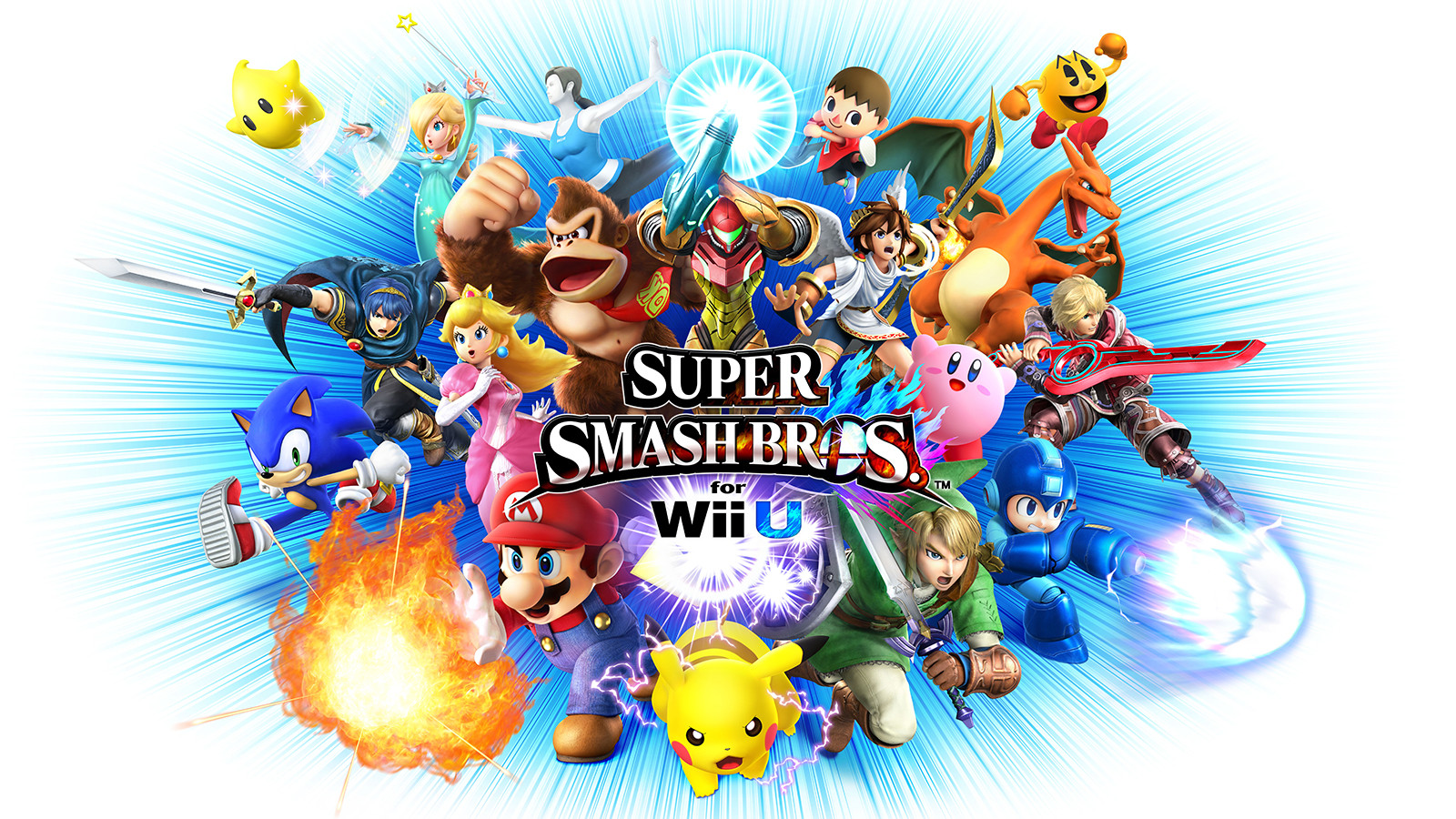
Now, on the Wii U, we have the creatively titled Super Smash Bros. for Wii U, and it’s pretty much consuming my life.
For those who don’t know, the Smash Bros. premise has remained unchanged from the first iteration: you take a bunch of characters from all different Nintendo games – like Mario, Link, Kirby, and Pikachu – and you make them all playable characters in a fighting game. So you can play Starfox vs. Yoshi, or Donkey Kong vs. Jigglypuff, or pretty much anything your twisted heart desires.
It’s fun single-player, and even better multi-player. When four friends are united by Smash, a good time is had by all.
And while the basic mechanics are basically the same after fifteen years, what we have gotten are options, options, options.
The original twelve-character roster has grown to an incredible forty-eight, including Bowser, Ganondorf, Sonic, Mega Man, the Duck Hunt Dog (!), Wii Fit Trainer (!!), and Pac-Man. The original nine stages are now forty-seven. And there are more game modes, items, trophies, challenges, minigames, customizations, and unlockables than I have the patience to describe.
Smash Bros. isn’t just a great game. It’s a tribute to the entire history of Nintendo gaming.
But it is a great game too.
Anyone else picked it up? What are your thoughts?
Posted in Uncategorized




 Brian D. Buckley


