
Another photo from a trip to Big Bend several years ago.
Rooted in dry rock,
flowerless under cruel sun:
little is enough.

Another photo from a trip to Big Bend several years ago.
Rooted in dry rock,
flowerless under cruel sun:
little is enough.
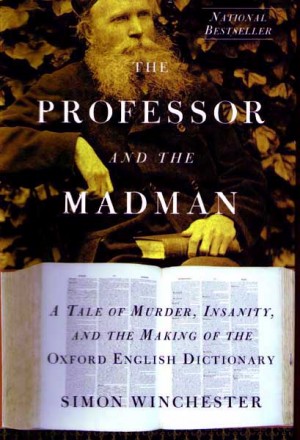
The Professor and the Madman, by Simon Winchester, is a history book – and probably the most gripping, page-turning, can’t-put-it-down, stay-up-till-2-am history book I’ve ever read. It tells the story of how the Oxford English Dictionary was made, and of two men who were instrumental in making it.
First off, the Oxford English Dictionary (or OED) is way more interesting than I ever suspected – and this from a guy who loves words. I had no idea how huge it is: over 300,000 entries, over 20,000 pages, 20 volumes, at last count. Literary quotations for every word. It’s like an encyclopedia for a language. The first edition took 70 years to make. A monumental work.
James Murray (the professor) was head editor of the OED’s first edition. Nothing like the OED had ever been attempted before, and he had no idea if he would succeed. But he knew he and his small team couldn’t possibly do it alone. So they sent out paper slips all over London and beyond, requesting volunteer readers to hunt out all different shades of meaning for all different words in all different works of literature. He was, in other words, crowd-sourcing – a radical idea at the time.
William C. Minor (the madman) was an American born in Sri Lanka, a brilliant surgeon who served in the Army and found himself exposed to the horrors of the Civil War. As he grew older, he struggled more and more with paranoid delusions and powerful sexual urges. He moved to London, shot and killed a man while in a delusional state, and was committed to an asylum, with a room full of books.
While he was there, he received a certain paper slip about creating a certain dictionary…and, with a brilliant mind and abundant free time, he became one of the OED’s most prolific contributors.
The two men’s paths converge from there, and they become close friends, their lives inextricably tangled.
Well-written, thoroughly detailed, meticulously researched, surprisingly suspenseful, The Professor and the Madman is simply a beautiful book. Read it if you can.
(Or, I mean, if you want to. I’m not the boss of you!)
All three links today contain strong language, if you’re worried about that sort of thing.
The best SMBC I’ve seen in a while.
An illustrated version of my favorite Louis C.K. routine ever.
And, uh, this:
Have a great weekend, everybody!
(Warning: spoilers for Korra and Avatar.)
It hasn’t exactly been a secret that Avatar: The Last Airbender is one of my favorite shows of all time. It’s a mass of contradictions. An American cartoon – in an anime style. A kids’ show – featuring revenge, honor, Eastern philosophy, and political intrigue. An epic journey – squeezed into 22-minute increments. A colossal battle of good and evil – with bright colors and funny jokes.
When it ended, fans wanted exactly one thing: MORE. And starting in 2012, they got it.
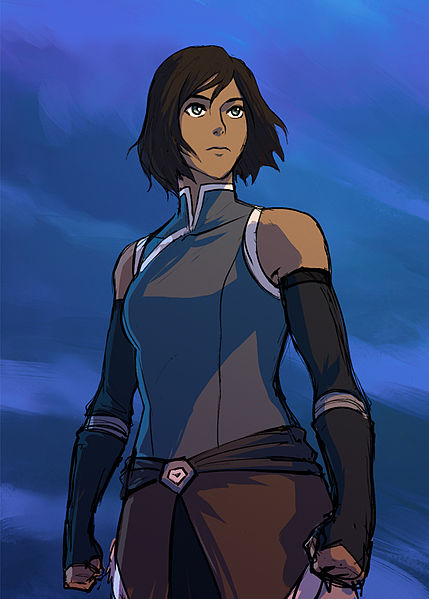
The Legend of Korra is a sequel series to Avatar, set seventy-ish years later in the same universe. As before, certain people can “bend” (manipulate) the four classical elements, earth, air, fire, and water. Most can bend only one, but the Avatar commands all four, and has some other pretty intense mojo to boot. The first show’s Avatar, Aang, has died, and the new one – Korra – has inherited the mantle of saving the world, keeping peace where she can, drop-kicking bad guys when necessary.
Korra has the same creators, the same premise, the same universe, the same style, even some of the same characters. But does it work?
Betsy and I – who watched both shows together – got to the Korra finale a couple weeks ago. The verdict is yes, it works…and no, it doesn’t.
First, the good:
But there are some problems…
That last one is the biggest problem by far.
Don’t get me wrong – I like Korra, Bolin, Asami, Tenzin, even (I suppose) Mako. But who in Korra is as funny as Sokka? As purebred awesome as Toph? As wise as Iroh? As terrifying as Azula?
And when the old characters do show up in Korra, they’re ghosts of their former selves. Zuko is passive, Iroh is a mere caricature, and Toph has gone from smartass-and-cool to just plain, annoying smartass. Only Aang retains any of his former glory. I get that the writers can’t have old characters monopolizing the show, but that doesn’t mean they have to be cardboard cutouts.
Korra had its high points, certainly. The two-parter about Wan, the first Avatar, had a beautiful story and beautiful art. The death of the Earth Queen. The season 3 finale, when Korra went full-on wrath-of-god on Zaheer. The realistic, heartbreaking, and shockingly adult portrayal of what can only be called clinical depression in Korra. And her recovery in “Korra Alone.”
Besides which, this exchange is one of the funniest things I’ve ever seen:
“You amuse me. I will make you mine.”
“You mean like a boyfriend, or like a…slave?”
“Yes. Win me prizes.”
But for every great episode, there are four more that are just okay.
And then there are the villains.
I salute the creators for writing villains with complex, realistic motives, beyond the basic Ozai-style “I WILL DESTROY TEH WORLD.” The problem is, it never really works.
Amon starts off intriguing, as it seems like he might actually have some moral high ground…but then it turns out it’s all lies, and they just have a big fight. Unalaq becomes a Dark Avatar, which is an intriguing idea…but it turns into a spirit-fueled slugfest with no real deeper meaning. Zaheer – the best of the bunch in my opinion – just didn’t connect with me for some reason. And Kuvira’s basically a generic dictator.
Which leads me to the series finale.
In a technical sense it was great. Lots of well-orchestrated action, heroic sacrifice, “emotional” moments, lessons learned. The problem was, I didn’t care about any of it.
Look at Avatar.
When Sokka, Suki, and Toph took down the airship fleet, it wasn’t about the explosions. It was about Toph, hanging on for dear life to Sokka, the only real family she’s ever had – her tough veneer stripped away, not a cocky show-off anymore, just a twelve-year-old girl who doesn’t want to die.
When Aang fought Ozai, it wasn’t about the fireworks. It was about Aang’s ethical struggle, his determination not to kill the Firelord, no matter what the cost. And it was about him finally claiming his birthright, finally becoming a full-fledged Avatar. He wasn’t just a fighter anymore; he was a force of nature. But he never lost his compassion.
And when Zuko finally fought the half-insane Azula in the Last Agni Kai, it wasn’t about the charged-up firebending, or the hauntingly beautiful score, or even the Fire Nation throne. It was about Zuko redeeming himself; it was about sacrifice; it was the conclusion of a lifelong mortal rivalry. As they prepared to duel, the atmosphere was simply electric. (Metaphorically, I mean, though it turned out to be literally as well.)
By contrast, when Korra fought Kuvira, it was mostly about the logistics of taking down a giant mech. Yes, there was some sense of Korra trying to redeem herself, and yes, they tried to play up the similarities between hero and villain. But mostly, it felt like empty action.
One final note, the obligatory Korrasami comment. I don’t have any particular feelings about it, except I love that they threw gasoline on the already-intense shipping fire. We’re going to see a lot more fan art, and that always makes me happy. (That, and of course I’m always happy to see positive portrayals of gay relationships.)
Anyway – I’ve rambled on way longer than I ever intended, so I’ll wrap it up. Overall, in spite of all its flaws, I did enjoy Korra, I’m glad it exists, and I respect what they were trying to do. But for my money, it doesn’t hold a candle to Avatar.
What do you think?
Betsy and I spent a week with her family in Ohio and a week with my dad, stepmom, and other family in Texas. Lots of flying and driving, but also lots of good food and good times.
Also lots of time to read. In just the last two weeks, I read:
Besides which, Betsy and I finished watching The Legend of Korra (good, but not great) and Angel (great – not quite as great as Buffy, but a vastly superior finale).
More thoughts on all these stories are likely to percolate into the blog all this week, so brace yourselves.
Posted in Uncategorized


 Brian D. Buckley
_appearance.jpg)