Category Archives: Uncategorized

The Foundations of Ethics

There aren’t any.

Let’s take an example.

If you’re arguing with Joe Schmoe about the ethics of some new voting ID law, he might say, “Requiring an ID to vote prevents fraud.” You might counter with, “Requiring an ID makes it harder for many of the poor to vote, since they often face a maze of fees and legal barriers when trying to get an ID.” In other words, you pin your argument to fairness, and Mr. Schmoe pins his argument to fraud.

But you both agree that fairness is good, and fraud is bad. You have a common foundation.

Imagine you met someone, a certain Mr. Evil, who had the opposite moral framework. He likes stealing because it gets him money. He thinks murder is kind of neat, as long as he’s not the one getting killed.

What do you say to someone like that? How do you make a logical case for the “good” system of ethics?

You can’t, because there isn’t one. At the center of our moral fabric lies a gaping hole. That isn’t a judgment on us; it’s the nature of reality.

Believing in God, following His laws, doesn’t help this particular problem, because you still have to decide whether to obey God or not. If you simply say, “God is Love, but I’m not really into all that,” someone can respond with “That’s crazy!” but that’s about it. There isn’t a counterargument to make.

What about Buddhism – do they have an answer? I’ve never been a practicing Buddhist, so it’s hard to say for sure. But I’ve studied Zen pretty in-depth, and it doesn’t look promising. Buddhism is about avoiding suffering, attaining enlightenment, achieving universal compassion. All good things, but beside the point.

Some people claim that evil is logically inconsistent, because it doesn’t make sense to hold yourself to a different standard than the rest of the world (i.e. I’m ok with hurting others, I’m not ok with them hurting me). I call shenanigans. It makes perfect sense – when other people get hurt, I don’t feel it. Subjectivity matters.

(This argument also doesn’t have an answer for people who want total chaos, who embrace suffering in themselves as well as others, people who – like the Joker – “just want to see the world burn.”)

Philosophers call this the “Is-ought problem.” There’s no defensible connection between how the world is, and what we ought to do.

At this point, you may be wondering if I’m really serious. I can’t honestly think that right and wrong are just a matter of opinion – can I?

Well, yes and no.

Of course I feel very strongly about ethics. Of course I want to do the right thing. Of course I don’t want to hurt anyone. Of course I care.

But can I justify that? Can I argue for “Thou shalt not kill” any more convincingly than for “This sweater vest is nifty”?

No, I cannot.

Maybe this doesn’t matter to you. Maybe it all seems needlessly abstract. You might say, look, you know the right thing to do, so do it. What does the logic matter?

Well, I’m a computer programmer. I believe in the power of science. To me, the logic matters.

What about you?
Liftoff

My creation...ARISE.

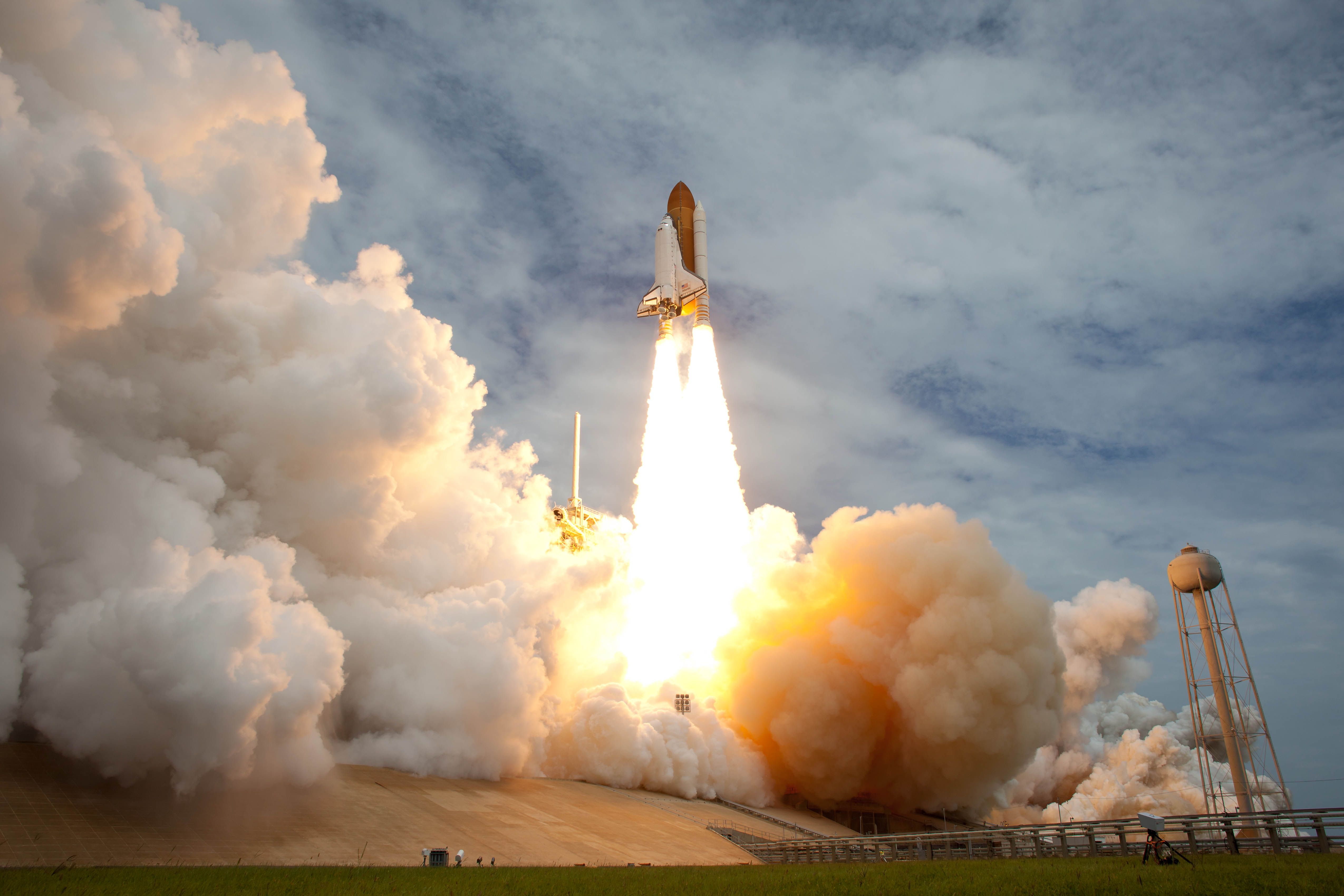
I think this is the best poem I’ve ever written. It’s a sort of paean to the space shuttle. I wrote it back in 2005, when the shuttles were still flying.

Liftoff

The countdown closes quick upon the point
When hydrogen and steel will push as one
And will with flame tumultuously anoint
That beast which looks with envy on the sun.
A light! Two hundred decibels explode
The crowd exhales – a thousand boiling winds
Surround the glowing column and its load:
The shuddering leviathan ascends.
And up – and up – the azure curtain parts –
The well of black, ablaze with powdered snow
Reverberates through fresh-elated hearts –
The panoramic arc unfolds below;
And passing into silence with a sigh
The falcon skirts the surface of the sky.

I never got to see a shuttle launch, and now I never will.

Did you ever see one? Would you want to?

The Threefold Fire that Drives Us

Why do fools like me write blog posts every day, never expecting to get paid for it?

Why do brilliant computer programmers spend all their spare time creating open-source apps for free, when they already make money building software at work?

Why do aspiring novelists hone their skills for years, chasing the vision of that one breakout novel, when the probable advance makes minimum wage look like a pipe dream?

My dad sent me a link last week to a ten-minute video called The Surprising Science of Motivation. Here’s what it says. If you have a worker doing anything more complicated than turning a crank, and you want better performance, paying more money is not an effective motivator. Rather, people do their best work when they’re highly motivated. And the three critical motivation factors are Autonomy, Mastery, and Purpose.

  • Autonomy – People like having the freedom to control their own lives. We like to decide which projects we take on. That’s why Google and Twitter regularly give their employees time to work on anything they want. Where do you think Gmail came from?
  • Mastery – People also like to get really, really good at things. That’s half the reason I play Go – I just enjoy seeing myself improve. Recognition from others doesn’t hurt, either.
  • Purpose – You have to feel that the work you’re doing is meaningful. You have to believe it matters in some way. Whether that means building a Habitat For Humanity house to help someone, or just writing a poem you think is beautiful, doesn’t especially matter. It just has to make a difference to you.

Autonomy, Mastery, Purpose. AMP. Seems like common sense. Yet so many companies squander their brightest talents by draining away these simple human motivators.

Tell me – what drives you?

Friday Links

This week…Nazis! In Space!

The Littlest Cthulhu!

New Jersey’s legislature passed a bill legalizing gay marriage, but governor Chris Christie is going to veto it! Also, a Russian city has now outlawed protests involving Legos! Marriage veto or Lego ban, which is crazier? YOU BE THE JUDGE.

SMBC says, what if frat guys ruled the world? Meanwhile, xkcd plays Good Cop, Dadaist Cop. (Still not as crazy as the Christie thing.)

Links to share? I’ll be pickin’ up what you’re throwin’ down!

Have a great weekend.

Our Zettameter Galaxy

As you can probably tell, I’ve been on a memorization kick lately. It isn’t just geography. I’ve also been learning the unit prefixes: word stems like centi- and kilo- that tell you how much of something you have. A millisecond is a thousandth of a second, a gigabyte is a billion bytes, and so on.

But those are the common ones, the ones you hear about in everyday life. Me, I get a geeky kind of thrill from checking out the more exotic prefixes at the remote ends of the scale, the ones with bizarre names you never hear except in articles about really far-out science experiments.

Let’s take a look.

Tera- means trillion, 10 to the 12th, which you do hear occasionally when you’re talking about hard drives: the bigger ones on the market now are up in the terabyte range. You don’t hear much about terameters, though, because if you wanted to talk about a trillion meters, you’d probably just say a billion kilometers. A terameter is about Saturn’s distance from the sun.

Next up is peta-, a quadrillion, 10 to the 15th. A petameter is one-tenth of a light year, and doesn’t even get us close to the nearest star. A few petameters is a rough estimate for the radius of the Oort Cloud, which is where comets live when they’re not busy getting all up in our space.

An exameter is a quintillion meters, 10 to the 18th, or about a hundred light years. The Pleiades (or “Seven Sisters”) star cluster is about 4 exameters from Earth.

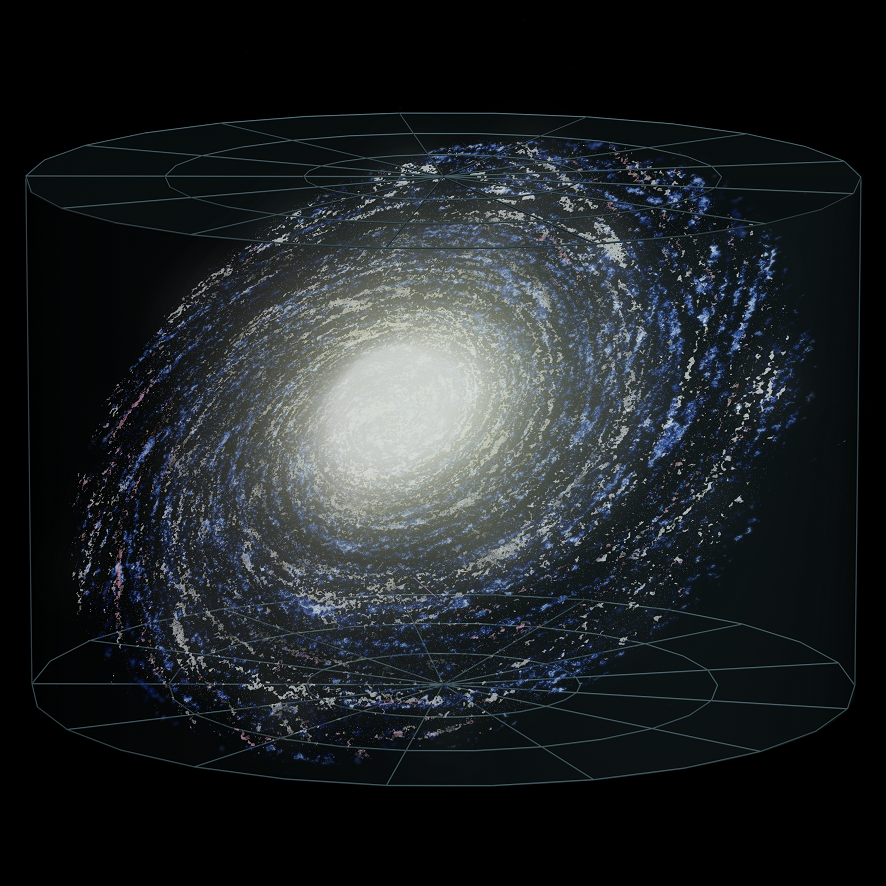
To span the diameter of our galaxy, though, you have to go all the way up to one zettameter, a sextillion meters, 10 to the 21st.

The very last prefix is yotta-, a septillion, 10 to the 24th. And because 260 yottameters is the diameter of the observable universe, it really is the last distance unit you’ll ever need.

So that’s my burst of geekiness for the day. Maybe not interesting to anybody besides me, but there we are.

What kind of weird stuff do you geek out on?

Atlantis

Tried to do another Forty-Minute story this morning, but I realized halfway through that (for reasons I won’t get into) I wouldn’t be able to use it. My brain is too dead to attempt a twenty-minute story this morning.

Instead, please enjoy this video of the final launch of space shuttle Atlantis. It’s very well-done and one of the coolest things I’ve seen in a while.

A Poem for Valentine’s Day

Not just my favorite love poem, but one of my all-time favorite poems, full stop.

Love Is Not All
Edna St. Vincent Millay

Love is not all: it is not meat nor drink
Nor slumber nor a roof against the rain;
Nor yet a floating spar to men that sink
And rise and sink and rise and sink again;
Love cannot fill the thickened lung with breath,
Nor clean the blood, nor set the fractured bone;
Yet many a man is making friends with death
Even as I speak, for lack of love alone.
It well may be that in a difficult hour,
Pinned down by need and moaning for release,
Or nagged by want past resolution’s power,
I might be driven to sell your love for peace,
Or trade the memory of this night for food.
It well may be. I do not think I would.

What are your plans for Valentine’s Day? Me, I’ll be chillaxin’ with my sweetie, luxuriating in the sheer joy of not having any plans.

Dante the Astronomer

Who knew Heaven would be grayscale?

Back in college, I read Dante’s Divine Comedy – not just the Inferno, but all three parts, in a translation by Mark Musa. I remember that after Dante passes through Hell and Purgatory, he enters Heaven, Paradiso. In Dante’s universe, there is no distinction between “Heaven,” the realm of angels, and “the heavens,” the solar system and interstellar space. God lived, not up in the sky, but out among the stars.

As Dante the pilgrim travels outward from Earth, he passes the Moon, the Sun, and all the planets. And then – as his guide, Beatrice, prepares to lead him to the very edge of Creation – he turns around and looks all the way back home:

My vision travelled back through all the spheres,
through seven heavens, and then I saw our globe,
it made me smile, it looked so paltry there.

Fast forward over seven hundred years, to 1990. Carl Sagan, one of the preeminent astronomers of the modern era, had a request for NASA. He wanted them to reorient the camera on the Voyager 1 spacecraft, which had passed the planets and reached the edge of the solar system. He wanted our most distant pilgrim to turn around and look all the way back home.

The idea had little practical value in the strict sense of scientific research, but astronomers are nothing if not romantic. They took the picture.

Here’s what Earth looks like from three billion miles away, a single pixel floating in a ray of light:

Oh wait, that's not the Earth - I forgot to dust the lens.

This is the legendary Pale Blue Dot photo. As Sagan describes it:

We succeeded in taking that picture [from deep space], and, if you look at it, you see a dot. That’s here. That’s home. That’s us. On it, everyone you ever heard of, every human being who ever lived, lived out their lives. The aggregate of all our joys and sufferings, thousands of confident religions, ideologies and economic doctrines, every hunter and forager, every hero and coward, every creator and destroyer of civilizations, every king and peasant, every young couple in love, every hopeful child, every mother and father, every inventor and explorer, every teacher of morals, every corrupt politician, every superstar, every supreme leader, every saint and sinner in the history of our species, lived there on a mote of dust, suspended in a sunbeam.

As far as I know, neither Dr. Sagan nor anyone else made a conscious connection between what he had done and Dante’s epic poem. But the facts remain. In less than a thousand years, the human race took an idea that was – to a medieval writer – mere metaphysical fantasy, and built a robot to actually do it.

And that was twenty years ago. We didn’t even have the Web.

This is it, boys and girls. This is the future. We’ve arrived.

Friday Limerick

Today in my hyperlink file,
Instead of a hyperlink pile,
I found in my store
This comic – no more –
so I hope it’ll last you a while!

How to Memorize Anything

It's all Greek to me.

Because of my recent geography craze, and for other reasons too, I’m focusing a lot these days on memorization. And frankly, memorization is something I’m pretty damn good at. (I’m allowed to say that here – it’s my blog!)

Here are the best strategies I’ve found.

Memorizing Lists

A few years ago, for no particular very good reason, I memorized the first 500 digits of pi. Really. I could sit down and rattle them off, “3.14159265358979…” without looking at anything.

When you say “I memorized the first 500 digits of pi,” it sounds hard, and also insane. On the other hand, saying “I know the phone numbers of 50 friends” sounds a lot more reasonable (or at least it did, back before cell phones remembered it all for you). Yet it’s the same total number of digits, if you include area codes. Why are the phone numbers so much easier?

First, because you break it up into groups. Each phone number is a group of ten digits, and is  broken into three more subgroups in the format (nnn) nnn-nnnn.

The grouping helps. A lot. I split up the 500 digits into blocks of 100, and split those blocks into 10 lines of 10 digits each, and for each line, I broke it down into three or four little groups.

But grouping alone isn’t enough. I also created mental pictures and stories, which are a lot easier to handle than raw digits. For instance, if two lines in a row both began with 8, I’d imagine that the 8’s were round-bodied, big-headed people, and I’d call those two lines the Land of the Big-Heads. (Some people claim I live in that land myself.)

Then if one of the subgroups in those lines is “543,” I imagine it’s someone counting down to a bomb exploding, and now I’ve got a Big-Headed Terrorist. Another subgroup is “727,” which I imagine is like a smaller version of a 747 (I know nothing about planes), and…well, okay, terrorists and planes is turning into a sensitive subject – which I didn’t try for on purpose – but you know what? It’ll stick in your brain.

Anyway, you can see how this goes. Break into groups, create stories or pictures to tie it all together, repeat.

Memorizing Unfamiliar Terms

I made it all the way to the National Spelling Bee in seventh and eighth grade. The latter year, I placed ninth in the country. I was on ESPN and everything, in all my awkward geeky glory.

They give you a book for the spelling bee, a list of about 3,000 words. Almost all the words for the school, county, and regional bees come straight from that book. So to get to nationals, the strategy’s simple: memorize 3,000 words.

Some of the words were easy, but many (syzygy, teledu) were so obscure they might as well have been a foreign language. (The Firefox spellchecker doesn’t recognize them either, but trust me – they’re English!) How do you deal with gibberish like that?

To learn something unfamiliar, first, make it familiar.

There’s a lake in Russia called Lake Baikal. It’s the oldest and deepest lake in the world. I remember the name by thinking of it as Lake “Bi-Call,” that is, two calls: one call to tell someone it’s the oldest lake, another call to say it’s the deepest. Bam: I not only remember the name, I get some information too.

The capital of Kazakhstan is Astana. The biggest lake in Kazakhstan is Lake Balkash. So if I go to Kazakhstan, I’ll use my American baseball skills (HA!) to do a “ball-catch” (Balkash) and the locals will be “astonished” (Astana).

You can do this with pretty much any weird-sounding word.

Memorizing Anything

The theme in my examples above is that rote repetition is not enough. If you try to memorize hundreds of digits by just saying them again and again, you’ve got a long, hard road ahead of you.

The brain remembers things best when you use them in multiple ways. If you think about stuff from several angles (not just an 8 but a person, not just Balkash but ball-catch) the brain automatically decides it’s more important and remembers it better.

This works even if you don’t use any of the little games I mentioned above. For instance: the capital of Suriname is Paramaribo. I don’t have a trick for that one. But I went on Wikipedia and read about Paramaribo, and I learned it’s one of the most diverse cities in the world. It was formerly an English colony and a Dutch colony. From the pictures, it looks like a cool place to visit. Just those extra few minutes, turning Paramaribo from a nonsense word into a real place, makes it much easier to recall.

I should add that, although repetition alone isn’t enough, repetition is still crucial. Use the data in different ways, but also, use it a lot. Each iteration makes its hold on your brain a little firmer.

So, that’s me. What about you? What techniques have you found for memorizing things?