The Hits

This past weekend, Betsy’s grandmother celebrated her 90th birthday. Betsy and I gave her an mp3 player we had loaded with the #1 hit song for every year from 1925 – her birth year – to 2014. (For the most part, I used Tsort to tell me which song was #1.)

Reading the list is like stepping in a time machine, only without all those pesky paradoxes. You can, of course, hear any of these songs by searching for them on YouTube.

1925 – Ben Bernie – Sweet Georgia Brown
1926 – Gene Austin – Bye Bye Blackbird
1927 – Hoagy Carmichael – Stardust
1928 – Jimmie Rodgers – T For Texas (Blue Yodel No 1)
1929 – Eddie Cantor – Makin’ Whoopee
1930 – Ben Selvin – Happy Days Are Here Again
1931 – Cab Calloway & His Cotton Club Orchestra – Minnie the Moocher
1932 – Fred Astaire & Leo Reisman – Night and Day
1933 – Ethel Waters – Stormy Weather (Keeps Rainin’ All the Time)
1934 – Benny Goodman – Moonglow
1935 – Fred Astaire – Cheek to Cheek
1936 – Bing Crosby – Pennies From Heaven
1937 – Benny Goodman – Sing, Sing, Sing (With A Swing)
1938 – Artie Shaw – Begin the Beguine
1939 – Judy Garland – Somewhere Over the Rainbow
1940 – Glenn Miller – In the Mood
1941 – Glenn Miller – Chattanooga Choo Choo
1942 – Bing Crosby – White Christmas
1943 – The Mills Brothers – Paper Doll
1944 – Bing Crosby – Swinging on a Star
1945 – Les Brown & Doris Day – Sentimental Journey
1946 – Perry Como – Prisoner of Love
1947 – Francis Craig – Near You
1948 – Dinah Shore – Buttons & Bows
1949 – Vaughn Monroe – Riders in the Sky
1950 – Nat King Cole – Mona Lisa
1951 – Nat King Cole – Too Young
1952 – Jo Stafford – You Belong to Me
1953 – Les Paul & Mary Ford – Vaya Con Dios (May God Be With You)
1954 – The Chordettes – Mr. Sandman
1955 – Bill Haley & His Comets – Rock Around the Clock
1956 – Doris Day – Que sera sera (Whatever will be will be)
1957 – Elvis Presley – Jailhouse Rock
1958 – The Kingston Trio – Tom Dooley
1959 – Bobby Darin – Mack the Knife
1960 – Elvis Presley – Are You Lonesome Tonight
1961 – Chubby Checker – Let’s Twist Again
1962 – Pat Boone – Speedy Gonzales
1963 – Elvis Presley – (You’re The) Devil in Disguise
1964 – Roy Orbison – Oh, Pretty Woman
1965 – The Rolling Stones – (I Can’t Get No) Satisfaction
1966 – Frank Sinatra – Strangers in the Night
1967 – Procol Harum – A Whiter Shade of Pale
1968 – The Beatles – Hey Jude
1969 – The Beatles – Get Back
1970 – The Beatles – Let It Be
1971 – George Harrison – My Sweet Lord
1972 – Don McLean – American Pie
1973 – The Rolling Stones – Angie
1974 – Carl Douglas – Kung Fu Fighting
1975 – Billy Swan – I Can Help
1976 – ABBA – Dancing Queen
1977 – Eagles – Hotel California
1978 – Bee Gees – Stayin’ Alive
1979 – Blondie – Heart of Glass
1980 – Pink Floyd – Another Brick in the Wall (part 2)
1981 – Kim Carnes – Bette Davis Eyes
1982 – Survivor – Eye of the Tiger
1983 – Irene Cara – Flashdance (What a Feeling)
1984 – George Michael – Careless Whisper
1985 – USA for Africa – We Are the World
1986 – Berlin – Take My Breath Away
1987 – Whitney Houston – I Wanna Dance With Somebody (Who Loves Me)
1988 – Phil Collins – A Groovy Kind of Love
1989 – Madonna – Like a Prayer
1990 – Sinead O’Connor – Nothing Compares 2 U
1991 – Bryan Adams – (Everything I Do) I Do it For You
1992 – Whitney Houston – I Will Always Love You
1993 – UB40 – Can’t Help Falling in Love
1994 – Ace of Base – The Sign
1995 – Coolio – Gangsta’s Paradise
1996 – Los Del Rio – Macarena
1997 – Elton John – Candle in the Wind
1998 – Celine Dion – My Heart Will Go On
1999 – Britney Spears – Baby One More Time
2000 – Madonna – Music
2001 – Kylie Minogue – Can’t Get You Out of My Head
2002 – Eminem – Lose Yourself
2003 – OutKast – Hey Ya!
2004 – Usher – Yeah!
2005 – Madonna – Hung Up
2006 – Shakira & Wyclef Jean – Hips Don’t Lie
2007 – Rihanna & Jay-Z – Umbrella
2008 – Leona Lewis – Bleeding Love
2009 – Lady Gaga – Poker Face
2010 – Eminem & Rihanna – Love The Way You Lie
2011 – Rihanna & Calvin Harris – We Found Love
2012 – Gotye & Kimbra – Somebody That I Used to Know
2013 – Robin Thicke, T.I. & Pharrell – Blurred Lines
2014 – Pharrell – Happy

Bring back any memories? I love “Somewhere Over the Rainbow,” “Let It Be,” “Kung Fu Fighting,” “Lose Yourself,” and “Poker Face.” Draw your own conclusions.
Transcendence: System Failure

Each week, we’ll look at another example of what I call a “moment of transcendence” – a scene from a show, a passage from a book, or anything else, that I find soul-piercingly resonant: joyful, sad, awe-inspiring, terrifying, or whatever. These moments are highly subjective, so you may not feel the same way I do, but nevertheless I’ll try to convey why I find the fragment so powerful. I hope we can enjoy it together.


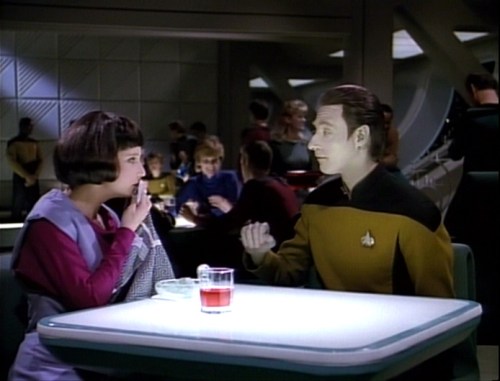
Father and daughter. Image source

Father and daughter. Image source

Star Trek: The Next Generation was my favorite show in the world when I was a kid. These days, honestly, it’s not even in my top five. A host of awful and mediocre episodes (especially in the early and late seasons), a near-total lack of continuity, an oddly sterile view of the future, an over-reliance on technobabble: these flaws, which hid in my child self’s blind spot, are painfully apparent to me as an adult.

Yet TNG will always hold a hallowed place in my heart, and not just because I loved it as a child. Because when TNG is bad, it can be really, really bad; but when it’s good, it can be really, really good. It deserves its reputation as one of the greatest sci fi shows ever made.

That reputation rests, in large part, on episodes like “The Offspring” (3.16).

Lieutenant Commander Data, an android, builds another android – similar to himself, more advanced, less experienced – a daughter named Lal. Most of the episode is about Data learning to be a father, and Lal learning to be human (ish). The whole story is beautiful, and I had to resist the strong temptation to re-watch it all the way through as I was writing this post.

But the fame of “The Offspring” as an emotional wrecking ball comes from its final scenes, when Lal unexpectedly experiences her first emotion, and her positronic brain spirals into a cascading system failure. Data works beside Admiral Haftel (a one-off character) in the lab, trying to save her.

Finally, Haftel emerges and tells Data’s friends the result of their efforts. Throughout the episode, Haftel has been a pompous, seemingly heartless antagonist, trying to wrest Lal from Data’s care so that Starfleet can study her. It isn’t until his final lines that you realize he has a heart after all.

I wasn’t able to find a good video clip of his lines, so audio will have to suffice.

Transcript:

She won’t survive much longer. There was nothing anyone could have done. We’d…repolarize one pathway, and another would collapse. And then another. His hands…were moving faster than I could see, trying to stay ahead of each breakdown. He refused to give up. He was remarkable. It just…wasn’t meant to be.

Out of context, the lines may seem melodramatic. I’m not sure; I’ve never heard them out of context. As for me, I’m not going to lie, I cried just now as I watched the scene to record the audio.

It’s the part about the hands that gets me.

Data, of course, can’t feel emotion. Many people take that to mean that Data can’t love; in fact, the episode itself says precisely that. I disagree. Love has an emotional component, of course. But love is not, itself, primarily an emotion. It is a state of being, a connection, a way of relating. It is even, at times, a decision. It is the cord that binds parent to child, husband to wife, sister to brother, heedless of joy or anger or boredom or grief. It is deeper than feeling and infinitely stronger.

This is the love that Data has for his daughter, which she feels and he cannot. Like all profound forces, it lies hidden most of the time, behind the android’s polite mannerisms and bland exterior. It isn’t until something happens – something like the death of his daughter – that the mask falls away, and we glimpse the full magnitude of Data’s superhuman skill and power. His love manifests in ways that no human could hope to match. His hands move faster than the eye can see.

In typical TNG fashion, Lal is barely mentioned again after this episode. The fans, however, remember.

Friday Link

‘Man With The Golden Arm’ Donates Blood That Has Saved 2 Million Babies – and now I feel like a schmuck, having only saved a hundred thousand.

Have a great weekend!

Backlash

A little over a week ago, Sir Tim Hunt, a 72-year-old Nobel Prize-winning biochemist, made the following remark at a public talk in Korea:

Let me tell you about my trouble with girls. Three things happen when they are in the lab. You fall in love with them, they fall in love with you, and when you criticise them, they cry.

So, Mr. Hunt made some comments that were sexist, insensitive, and potentially hurtful. (He has since apologized.)

What he did not do was sacrifice a kitten to Beelzebub whilst reciting Mein Kampf, which is what you might think, based on the general reaction:

  • According to Hunt and his wife, University College London (UCL) told Hunt less than twenty-four hours later that he must resign or be fired from his position as Honorary Professor. He resigned. (Admittedly, UCL’s official statement tells a different story, claiming they received his resignation before they were able to contact him for discussion.)
  • Hunt also resigned from the European Research Council (ERC), also – evidently – under pressure.
  • He has been widely pilloried in the news. CNN began their story with the words: “It’s safe to say few tears have been shed by women in science over the resignation of Nobel-winning scientist Sir Tim Hunt after his now infamous comments regarding his experience of ‘girls’ in laboratories.”
  • Hunt’s comments, as well as the man himself, have been the target of the #distractinglysexy Twitter campaign, in which (mostly) female scientists post mocking and sarcastic comments and pictures to demonstrate that they are not distracting to their male colleagues. (To be fair, the comments are – for the most part – lighthearted rather than malicious.)
  • At the moment, it appears that Hunt’s career has been effectively ruined.

Look, I get it. Sexism in math and science is a big issue, and comments like his are a potential setback to the progress toward equality that has been earned only with great effort and at great cost. He shouldn’t have said it. Nobody – least of all Hunt himself – is arguing that point.

But there is such a thing as proportional response. You correct the error publicly, you make sure it won’t happen again, and you move on. You don’t tarnish a lifetime of accomplishment because of a brief, well-meaning but ill-conceived joke.

Physicist Athene Donald, who knew Hunt personally – and who has devoted enormous energy to promoting gender equality in science – wrote a wonderfully sane and insightful response. She says, in part:

I was naturally appalled by his remarks, but I think it is worth asking what damage they have caused and whether the response actually helps the situation…My impression is firmly of a man who genuinely supports people, whatever their gender, background or specific interests.

Now, perhaps we can get on to the issues that really matter. Like Donald Trump’s campaign.

The Best Grammar Joke I Know

A high school student was supposed to meet his English teacher for a study session. He called her up and said, “Where you at?”

In a severe tone she replied, “One should never end a sentence with a preposition.”

He thought a second, then said, “Where you at, bitch?”

Postmortem: Amélie

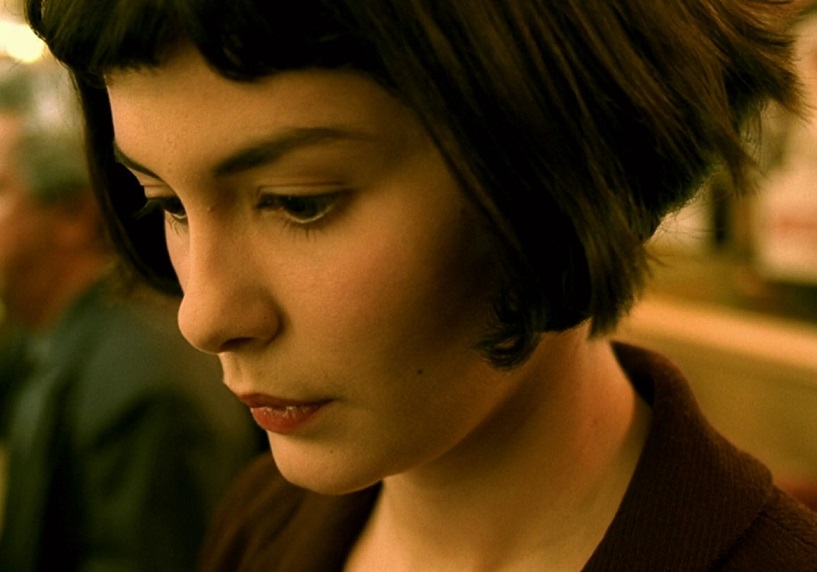
Amelie

Warning: spoilers ahead. But, I mean, this isn’t Game of Thrones we’re talking about here.

I had heard that Amélie was a bubbly, joyful, heartwarming kind of movie. It was – but it’s also deeper, heavier, even a little darker than I expected. That’s a good thing.

It’s a French film, French-language with subtitles, released in 2001. Nominated for five Oscars. I kept finding little references to it in various corners of the Net, and finally decided I should give it a try. Betsy and I watched it on Sunday.

Amélie is an introverted young Parisian woman with a menagerie of eclectic neighbors, including a brittle-boned old painter who can’t leave his apartment, a grocer who abuses his slow but kind assistant, and a middle-aged woman who obsesses over her long-dead husband. Amélie’s father is distant and cold (think Spock without the charm or the science). She has no close friends and has never formed a serious romance.

Then one day she finds a tiny old box of toys and tracks down its owner, a grandfather who lost the mementos a lifetime ago. She moves him to tears and vows to become an angel of kindness in her complicated little society, enacting elaborate schemes to give people what she thinks they want.

Not all her schemes end well, and even the successful ones remind her of the gaps in her own life. She eventually finds love of her own and must confront her fears of getting close. Of course, it all turns out happily in the end.

The movie has a warm, quirky style that reminds me of Wes Anderson. (The actual director was Jean-Pierre Jeunet, who also directed, of all things, Alien: Resurrection.) A faceless omniscient narrator explains the likes and dislikes of characters as they’re introduced, giving us an insider’s guide to this colorful world.

We learn Amélie’s entire life history, from conception (complete with a photo of the exact sperm that created her) to her mother’s death (caused by a suicidal jumper landing right on top of her) to her unusual hobbies (trying to guess how many orgasms are happening in the city right that moment, as we are treated to vivid footage of the same). Special effects create visual metaphor, as when Amélie literally melts into the floor from emotion, or when we actually see her heart pumping away inside her.

Most of all, I was struck by Amélie‘s boundless energy, endless creativity, and hilarious audacity. Streaks of darkness are often played for laughs, but there’s sadness and magic in her world as well. By the end, I felt lucky to have been a part of it.

Transcendence: The Tornado

Each week, we’ll look at another example of what I call a “moment of transcendence” – a scene from a show, a passage from a book, or anything else, that I find soul-piercingly resonant: joyful, sad, awe-inspiring, terrifying, or whatever. These moments are highly subjective, so you may not feel the same way I do, but nevertheless I’ll try to convey why I find the fragment so powerful. I hope we can enjoy it together.


This is my favorite TV commercial of all time:

A great storm has descended on the Great Plains. A girl stands in front of her house, staring forward, awestruck, oblivious to her father’s shouts. Fighting the wind, he rushes out, picks her up, and takes her to safety. Even as she is carried away, she can’t stop staring. She has seen a tornado, descended from on high, screaming across their quiet land like a black serpent of heaven.

Very often – almost always, I think – moments of transcendence are moments of unveiling. Everything in life is veiled, masked in drab exterior, sometimes for secrecy but usually just by default, because it’s normal for things (and people) to hide their true character. We glimpse inside only in brief flashes of revelation, and our minds clutch these precious insights like diamonds.

Nature is that way. Most of the time it’s calm, even dull, and we may think of nature as just another creature we’ve domesticated. And then one day the veil slips, and we catch just a glimmer of the beast underneath, something big as a planet, feeding on oceans, breathing winds the size of countries, still rolling in the same great cycles it has followed for numberless aeons.

Years ago, I read a forum post about this commercial. Somebody said it was ridiculous, that the girl was an idiot for standing outside in such obvious danger. The comment is interesting for two reasons.

First, it demonstrates the wildly divergent opinions that different people can have about the same work of art. For me, this video is so beautiful that I struggle to find words to express it. For him (or her), it’s garbage. Many things are sacred, but no one thing is sacred to everyone.

Second, it’s a valid point: standing outside watching a tornado is, from a certain viewpoint, stupid. That’s one of the side effects of beauty, of enchantment. It distorts logic, elevates the heart, confuses the mind. It makes you do stupid things. The “smart” thing is to stay indoors, increase your chance of survival, never look directly at a storm.

Except then you have to ask – what, exactly, are you surviving for?

If you have thoughts about the commercial, or wish to share a transcendent moment of your own, leave a comment!

Friday Links

Sir Christopher Lee has died at age 93. He played Dracula, Fu Manchu, Saruman, Count Dooku, Bond villain Scaramanga, and Frankenstein’s monsters – among many other roles – in a career that spanned over 250 movies. He could trace his lineage back to Charlemagne, he released a heavy metal album at 92, and he seems to have been respected and loved by many who worked with him. He never retired; he went on acting right up till the end.

You Are Not Dr. Seuss. A good analysis of why so many Dr. Seuss imitators fail so badly. (Answer: among other virtues, Dr. Seuss commanded not only excellent rhyme but also excellent meter. Most people only get the rhyme.) My own poetry is far from perfect, but I have long prided myself on sterling meter.

Astounding scientific fact: this weekend, our planet will make two complete rotations. Don’t miss it! See you Monday.

The World Between Yes and No

“Did you give him the money?”

“Well, listen, here’s what happened – ”

“Did you give him the money, yes or no?”

People sometimes feel that a yes-or-no question should be answered (or answerable) with one or the other, a single word, and that anything else means the responder is being evasive.

Sometimes this feeling is correct. Sometimes there really is a simple yes or no, and they’re trying to confuse the issue.

But many times, the best answer or most direct answer isn’t a simple yes or no. The term “yes-or-no question” is, in fact, misleading. There are plenty of perfectly valid responses not covered by either word. Responses like…


A clear answer exists, but you refuse to give it.

Maybe the answer would compromise your privacy, someone else’s trust, national security, or any of a million other interests.

Maybe answering would set a bad precedent (e.g., the answer is in the FAQ, and you don’t want to keep re-answering it forever).

Maybe you just don’t feel like answering, and you don’t need a specific reason, because the questioner is Not the Boss of You.

A clear answer exists, but you’re not certain what it is.

Maybe you have no idea.

Maybe you have a good guess, but you’re not 100% sure. Maybe the source for your answer isn’t entirely reliable.

Maybe the answer theoretically exists, but is unknowable at this time (e.g. “Will it rain three weeks from today?”).

Maybe you don’t know right at the moment, but given some time, you could look it up or figure it out.

No clear answer exists; the answer is undefined.

Is fan fiction legal in the U.S.? It isn’t just that you don’t know the answer; the answer literally does not exist. It depends on a judge’s interpretation of a law, and that interpretation has not yet been given.

The question is defective in some way.

Maybe the question is ill-defined. (“Is this the best way to get to Cleveland?” “Well, what do you mean by ‘best’? Do you mean fastest? Easiest? Cheapest?”)

Maybe the question contains a false assumption. (“Have you finished writing the Sandburg Report yet?” “Uh, you didn’t assign that to me.” Technically “no” would be the correct answer there, but it’s certainly not the best answer.)

Maybe you need more information to answer the question; “It depends.”

The answer is complex.

“Are your students doing their homework?” “Well, the majority are pretty consistent. Several have struggled in the past, but they’re getting better. Amy and Tristan haven’t turned in a single assignment all year.”

A literal, unqualified yes or no would be misleading.

“Do you think we should outlaw these horrible activities?” “No…because I think existing laws prohibit them already, and we can fight this most effectively by enforcing the laws we have.”

You are unable to process the question.

Maybe you didn’t hear what they said.

Maybe you’re too tired, confused, or drunk to come up with a good answer.

Maybe the question is too complicated for you to understand.

Maybe English (or whatever) isn’t your first language, and you’re still trying to figure out what they asked.


Obviously the list above is not exhaustive, and many questions or situations could fall under multiple categories. But I think the point is clear: yes-or-no questions are not always yes or no. It’s a false dichotomy – like most dichotomies are.

Love the complexity. Embrace the fuzzy.

Haiku 365: May

#122: 5/4/2015
Eating ice cream straight
from the carton. Keeping it
classy, Buckley-style.

#123: 5/4/2015
Re-painting the fence.
Body gets to be outside,
mind wanders. Win-win.

#124: 5/4/2015
History, symbols,
mythology, and Carl Jung.
Reading addiction!

#125: 5/4/2015
Like the lawnmower,
my mind needs a couple pulls
to start its engine.

#126: 5/5/2015
Night has descended:
whence this dim sunless ghost-light
lingering on high?

#127: 5/6/2015
Slim young apple tree
stands up straight, blossoming pink,
nuzzled by cold fog.

#128: 5/7/2015
Brown leaf on driveway
hunched in its evening shadow
like a surly toad.

#129: 5/9/2015
Focus on haiku.
A helpful wall blocks my view
of dirty dishes.

#130: 5/9/2015
When will the rain come?
How much work before sky-drops
send us scurrying?

#131: 5/10/2015
Morning of yard work,
wearing sunscreen, feeding grass.
Sniff – now I smell green.

#132 – 5/11/2015
The rustling forest
calls at dusk, whispering old
songs, promising charms.

#133: 5/12/2015
The eyes of the wolf
pierce darkness, cleave midnight mist,
apprehend moonlight.

#134: 5/13/2015
A thousand faces
for but a single hero.
Whither his bright blade?

#135: 5/14/2015
Calligraphy needs
steel resolve. Shaky thumbs make
shaky majuscules.

#136: 5/24/2015
Peter’s Neverland,
the looking-glass of Alice:
what realm waits for me?

#137: 5/24/2015
Drifting toward summer,
lazy sunlight and brief nights
welcoming solstice.

#138: 5/24/2015
Eyes of hurricanes,
the Eye of the Sahara.
Earth is watching us.

#139: 5/24/2015
Breathless, unblinking,
frigid angels of the Deep
fear no hook or net.

#140: 5/24/2015
Nickels and a dime
jangle loose in my pocket.
Pipsqueak percussion.

#141: 5/24/2015
Clumsy number eight
could slip on rounded feet, fall,
become infinite.

#142: 5/24/2015
Poets love the moon.
Does it hang in space, august,
judging motley verse?

#143: 5/24/2015
Dear sir or madam:
Do you enjoy short letters?
Sincerely, B. B.

#144: 5/24/2015
Do you make mistakes?
I once vowed to be faultless.
That was a mistake.

#145: 5/24/2015
Deep in the Great Plains,
sea of grass and sea of sky
watch each other dream.

#146: 5/25/2015
Dying smoke alarm,
nestled – where? All day we hunt
that infernal beep.

#147: 5/26/2015
Jealously we guard
our rectangles of trim grass.
Fences loom like walls.

#148: 6/5/2015
Just before midnight:
I’m an isle of consciousness
in a dream-wracked sea.

#149: 6/5/2015
Blind, dark, and heavy,
that was depression. Viscous.
Future’s fluid now.

#150: 6/5/2015
My orange slices
sit on their newly-shed skin
like five plump reptiles.

#151: 6/5/2015
This burned-out light bulb
ought to symbolize something.
Hmm…you work it out.

#152: 6/5/2015
Quoth the raven: “It
might not happen for a while.
But, I mean, who knows?”