Postmortem: In the Land of Invented Languages

Languages

Ever heard of a language called Esperanto? Hundreds of thousands of people speak it worldwide, yet it’s not the official language of any country. That’s because it’s a constructed language, something invented by Ludwig Zamenhof in 1887. He wanted an international auxiliary language, easy to learn, belonging to everybody, owned by nobody, to promote world peace.

Or perhaps you know about Lojban, a more recent language created to be unambiguous and grammatically precise.

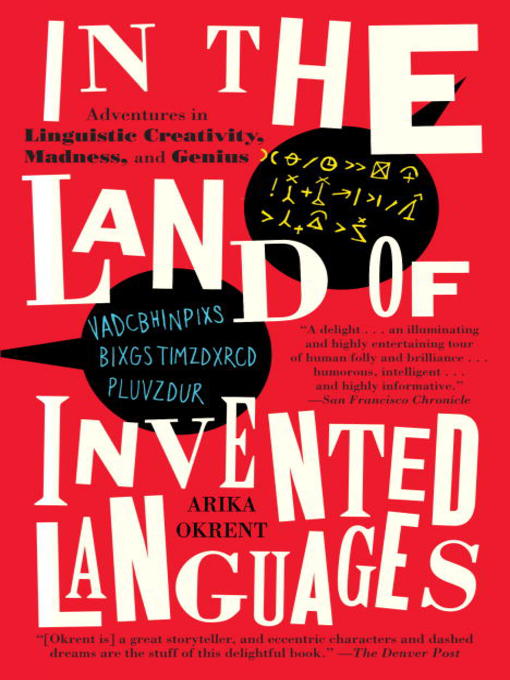
Arika Okrent’s In the Land of Invented Languages is a whirlwind tour of these and many others, from Hildegard of Bingen’s Lingua Ignota in the twelfth century, down to Star Trek‘s Klingon in the modern day.

And it’s utterly fascinating.

Part of it is the sheer variety of languages themselves, each trying to fill a different niche in the vast sphere of human activity – like John Wilkins’ philosophical language, where the structure of each word describes the meaning of the word itself.

Part of it is the personalities involved – like Charles Bliss, who was so controlling and erratic that he made it almost impossible for anyone to actually use his “Blissymbols.” He demanded (and received) $160,000 from a center for disabled children as part of a settlement involving his language.

And a big part of it is Okrent herself. Her style is light, quick, and full of vivid detail, which makes her a delight to read. Even better, she leaps into her research, going to Klingon-speaking conventions to see firsthand what it’s all about. You couldn’t ask for a better guide.

If you’ve ever wondered about made-up languages, this is the book for you.

So flying snakes are a real thing

Chrysopelea, better known as the flying snake, is a real thing that actually exists. Technically it glides rather than flies – it can’t gain altitude – but it does in fact move through the air. The video above is legit.

So. How did I not know about these? How does one get through twenty-eight years of life without finding out about flying snakes?

Doesn’t that seem like something they should teach you in schools? First day of biology: Hey kids, there are snakes that can fly. You’d better believe that would’ve gotten my attention.

Perhaps, you argue, it’s irrelevant because they don’t live in the U.S. Even if I grant you that, people need to be warned before they travel to these places. Southern India, southern China, Sri Lanka, the Philippines, Vietnam, Cambodia, Laos, Indonesia. If you buy a ticket to any of these areas, it should come stamped in giant letters HELLO DO YOU KNOW THERE ARE FLYING SNAKES WHERE YOU ARE GOING.

People. I have been to the Philippines. I did not know about this.

It’s not that I’m even especially terrified. They’re only mildly venomous. They’re not going to hurt you. I get that. I’m just saying, that is some necessary, up-front information right there.

Flying. Snakes.

Tell your children!

Sick today

bleckgghghg

On suffering

Indeed, the truth that many people never understand, until it is too late, is that the more you try to avoid suffering, the more you suffer, because smaller and more insignificant things begin to torture you, in proportion to your fear of being hurt.
-Thomas Merton, “The Seven Storey Mountain”

I’m still reading Merton’s fascinating and insightful autobiography, and recently I came across the quote above. It’s striking, in part, because it mirrors the First Noble Truth of Buddhism: the truth of suffering.

You are going to suffer. To a greater or lesser extent, you are going to suffer every day of your life. You will be nervous, anxious, angry, bored, impatient. You will experience pain. There is no getting around it. Even if you had all the power in the world and could summon every conceivable pleasure and comfort, something would still be missing. Humans suffer; it is in our nature.

But once you understand that – once you truly and finally accept that suffering is not going away – you begin to find a new kind of power. A new space opens up, a space in which you need not constantly run toward pleasure and away from pain, a space in which real peace is possible. Far from being pessimistic or depressing, the truth of suffering is the root of enormous joy, a joy so deep that it doesn’t depend on external circumstances.

Or so I am told. I am trying to apply this to my own life now.

Of course, accepting the truth of suffering doesn’t mean I put my finger in a buzz saw for the fun of it. It also doesn’t mean I should turn a blind eye to the deep suffering of much of the world, or my own rather privileged position in it. It doesn’t mean we should stop trying to improve things, or stop taking medicine. Far from it. The world desperately needs us, and we should be active and engaged within it.

What it means, though, is that the constant barrage of ads, proclaiming you can be happy if only you buy X, can be seen for the nonsense they are. It means that you can stop seeing your dissatisfaction as something broken that needs to be fixed. It means accepting that there will always be someone smarter, someone richer, someone better. That’s okay. That’s life.

Or so it seems to me on this Monday morning.

Friday Link

alone

This week, from the BBC: eleven untranslatable words from other languages. Enjoy!

Afternoon of the fawn

1

2

3

Visitors to our back yard yesterday.

What I’m reading now

Living Zen, by Harvey Daiho Hilbert Roshi. Just finished. Daiho is a Zen teacher and Vietnam veteran who lives in New Mexico and self-identifies as a Jewish Buddhist, or “JuBu.” (Website here.) This book is his diary for the year 2007. He examines his own, rather troubled life through a lens of peace and forgiveness. Though I don’t agree with everything he says – and the copyediting is nothing short of atrocious – nevertheless it’s an engaging little book.

The Fault in Our Stars, by John Green. Just finished. I’m not ashamed to say I cried over this book. The characters are funny, human, and unflinchingly honest. It’s a quick read, and despite the aforementioned weeping, it’s not all sad – the first few chapters actually made me laugh more than any book in recent memory. Give it a shot.

The Lotus Sutra, translated by Gene Reeves. Still reading. Buddhist scripture, written about two thousand years ago. Out of respect for those who consider it sacred, I won’t be rude here, but let’s just say it doesn’t resonate with me – and that’s putting it mildly. Endless repetition, endless obsession with categorizing and numbering, and a degree of self-praise that puts Pitbull to shame. Not for everyone.

The Seven-Storey Mountain, by Thomas Merton. Just started. (Yes, that’s “storey” with an “e.”) Merton was a Catholic monk, prolific writer, and well-known theologian. He also reached a level of spiritual attainment that Zen folks might call enlightenment. This is his autobiography. About eighty pages in, very interesting so far.

The Star-Spangled Buddhist, by Jeff Ourvan. Just started. The author takes a look at Buddhism in America, especially the three most popular sects – Zen, Tibetan, and Soka Gakkai. I had never even heard of that last one. I’m learning a lot so far.

Letters to a Young Mathematician, by Ian Stewart. Ordered, haven’t received yet. I’ve been getting back into math lately (planning to start tutoring high school and college math again) and this is supposed to provide a good look at what it’s like to be a mathematician. Who knows? Sounds interesting, anyway.

What are you reading these days?

This space intentionally left blank


Image

Happy Fourth of July!

fireworks

Visiting the temple

Last night I visited the Buddhist Temple of Toledo. I had listened to their podcast for weeks, and finally decided I needed to go for myself and see what it was all about.

The zendo (Zen practice hall) is right next to an aikido dojo, and both areas are very elegant and well maintained. Racks of swords and calligraphy adorn the dojo, while the zendo has its meditation cushions, its Buddha statue, and the Ten Ox-Herding Pictures on the wall. The smell of incense pervades the room.

The people there were universally friendly, open, welcoming, and helpful for a newbie like me. As it turned out, I wasn’t the only new person, and we had our own little zazen (meditation) class in the back at the start of services (though I was already familiar with the basics).

So what did I think?

Certain rituals – chanting the Heart Sutra, bowing, and most especially prostrations before the Buddha statue – were unsettling to me and felt vaguely cultish. Zen is not a cult, but there were moments last night that felt that way. I am not accustomed to prostrating myself to anyone – not even God, back when I was a Christian – so doing it to a mere man feels off-putting. We Zenners don’t worship the Buddha, but that’s the vibe it gave off. So I didn’t like that.

Zazen was fine. More distracting than normal, since everything was new and people were all around, but it was fine. We did seated and walking meditation, and instead of shikantaza (choiceless awareness), which I normally do, we did counting the breath. But it’s not really that different.

Things picked up dramatically after that.

The teacher, Rinsen, is a very warm, funny, and outgoing guy, a real contrast to the stiff formality that had come before. He gave a brief talk about “leaving no trace,” which means doing your good work in the world with non-selfish intention. I love listening to him talk. I could listen for hours, and in fact I have, on the podcast. I feel like he’s speaking directly to my heart. He has that ability.

Then services ended, after a little over two hours, and I had a chance to talk to others in the sangha (community). They were wonderful. The people I met felt like instant friends. Again, I could have stayed to talk and listen for hours.

And then the drive home – traffic, construction, waiting for a train, delays, all the joys of everyday life. 🙂

So that was my experience. All in all, very rewarding. I will definitely be back.

Have you ever been to a new kind of religious service for the first time? What was it like for you?