Monthly Archives: August 2011

Supercharge Your Stories

Remember how it felt to get a Fire Flower in Super Mario Bros.? In half a second you transformed from a simple plumber into some mad flame god, spewing your wrath to every Goomba in sight.

What if your writing could get the same kind of power-up?

Well, you just bopped the lucky question mark box, ’cause I’ve got your special overalls right here. This power-up is two simple words:

Be specific.

This has helped me so much in my own struggles as a writer, and it’s pretty easy to follow. Nothing fancy. Just be specific.

When you’re talking about the spaceship that carried your band of swaggering good-for-nothings to their base on Izzdrathil, don’t just call it a “spaceship.” What kind of spaceship was it? A corvette? A corsair? A cruiser? (Possibly something that doesn’t begin with C? Sheesh.) Whatever – pick something and run with it. And bam, suddenly your scene is that much more real, that much more alive.

You can do this in almost every single paragraph.

I used to be very generic and boring with the details in my stories. Mainly it was laziness. I just didn’t take the mental energy to think up all those little bits and pieces (and I didn’t think it mattered). Now I know better. I still fight this tendency, but I’ve come a long way from where I used to be.

One key turning point was William Gibson’s Neuromancer. After finishing the novel, I read an interview where he refers to its “imaginative hyper-specificity.” Gibson’s a master of this, and when I read that phrase, it really clicked. Neuromancer felt confusing at times, but one thing it never felt was fake.

Of course, like anything, it’s possible to overdo it with specifics. “Corsair” may be better than “spaceship,” but I don’t necessarily need to know it’s a Delta Model G6 Superluminal Falcon With Retractable Sunroof. Nor does “being specific” mean “inventing a paragraph of extra description just because you can.” It’s still important to be frugal with your words.

And, just as Mario has Buzzy Beetles to contend with, you too may find certain situations where the Specificity Fire Flower just doesn’t apply. Maybe you’re trying for a certain style, and  generic words just work best.

As always, do what fits the story.

Before I duck out, here’s some good news. I’m very excited to announce that Agent Courtney picked my story, “Marva,” as the first-place winner in her contest! The prize is a query critique, and you’d better believe I’ll make full use of that. Mad props to Courtney for being excellent enough to host the contest in the first place. And if you haven’t read the story yet, why not check it out now?

28 Words to Use Instead of “Awesome”

It’s official: “awesome” is dead.

It’s our fault. We killed it. We took a word that literally meant “awe-inspiring” – a word used to describe Mount Everest and the Andromeda Galaxy and God Almighty – and applied it to a YouTube video of a kid failing to swing a stick.

Don’t get me wrong. Words change meaning over time, I’m all for evolution. But “awesome,” in its current state, has the impact of limp ramen on Kevlar. When someone tells me something is awesome, my brain files that something into the category of things that exist, because that’s all they’ve told me about it.

I know – I’m as guilty as anyone else. But as I carried the disease, so shall I deliver the cure.

Let’s give “awesome” a break. As writers (or merely as excellent dudes and ladies) let’s do our duty to the English language. The next time you feel like using “awesome” for something really good, give another word a chance instead.

28 Words to Use Instead of “Awesome”

1. Outstanding
2. Astounding
3. Staggering
4. Kryptonian*
5. Breathtaking
6. Stunning
7. Prodigious
8. Stupendous
9. Righteous
10. Wicked
11. Superb
12. Sublime
13. Indomitable
14. Transcendent
15. Marvelous
16. Resplendent
17. Phenomenal
18. Remarkable
19. Funkadelic*
20. Magnificent
21. Virtuosic
22. Rapturous
23. Flawless
24. Majestic
25. Splendiferous
26. Badass
27. Kickass
28. Legendary

*Some people may try to tell you this is not a real word. Ignore them.

Now, a caveat. Remember when your fifth-grade English teacher passed out those handouts of words to use instead of “said,” and suddenly every story had people “exclaiming” and “expounding” and (scary but true) “ejaculating”?

Same deal here. Every word is a little different, and you can’t necessarily just drag and drop. You may have to examine the context a bit. Y’all are smart, you can do it. I have faith.

Got any other words for “awesome”? Tell me in the comments!

Bookends!

My wife is amazing. No, no, that’s not just some blind assertion. I can prove it. Like, with science.

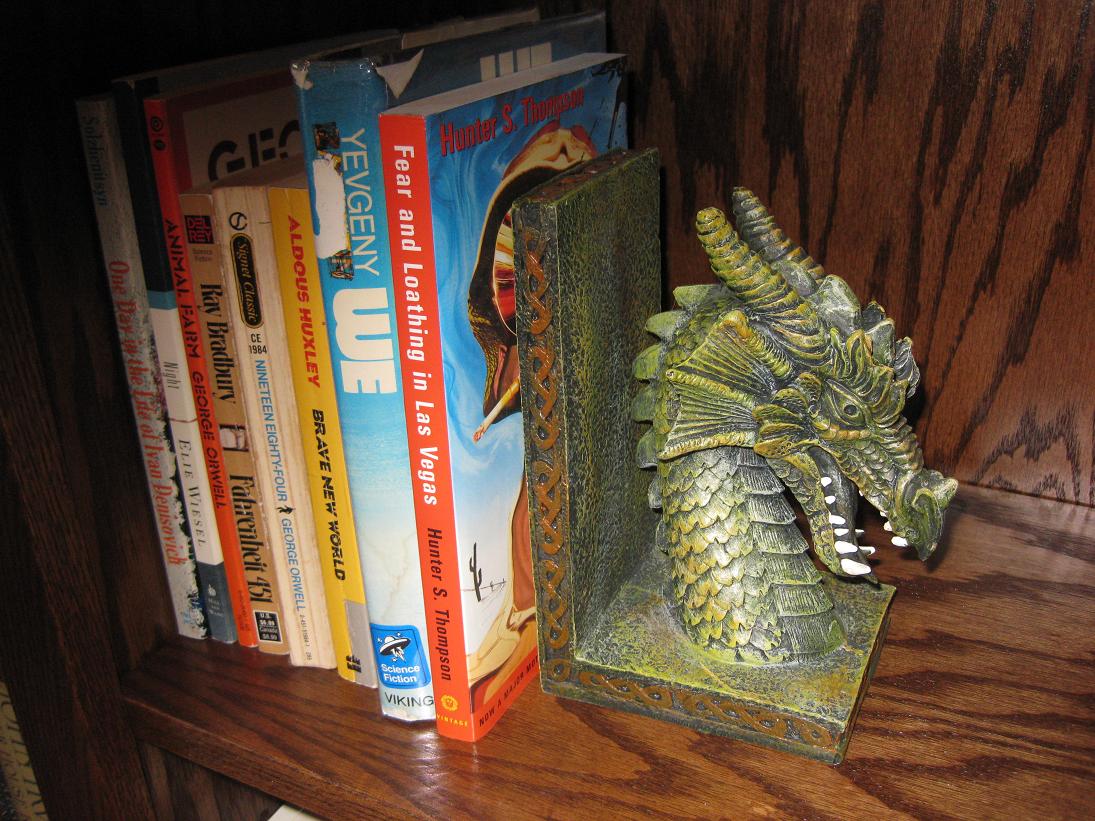
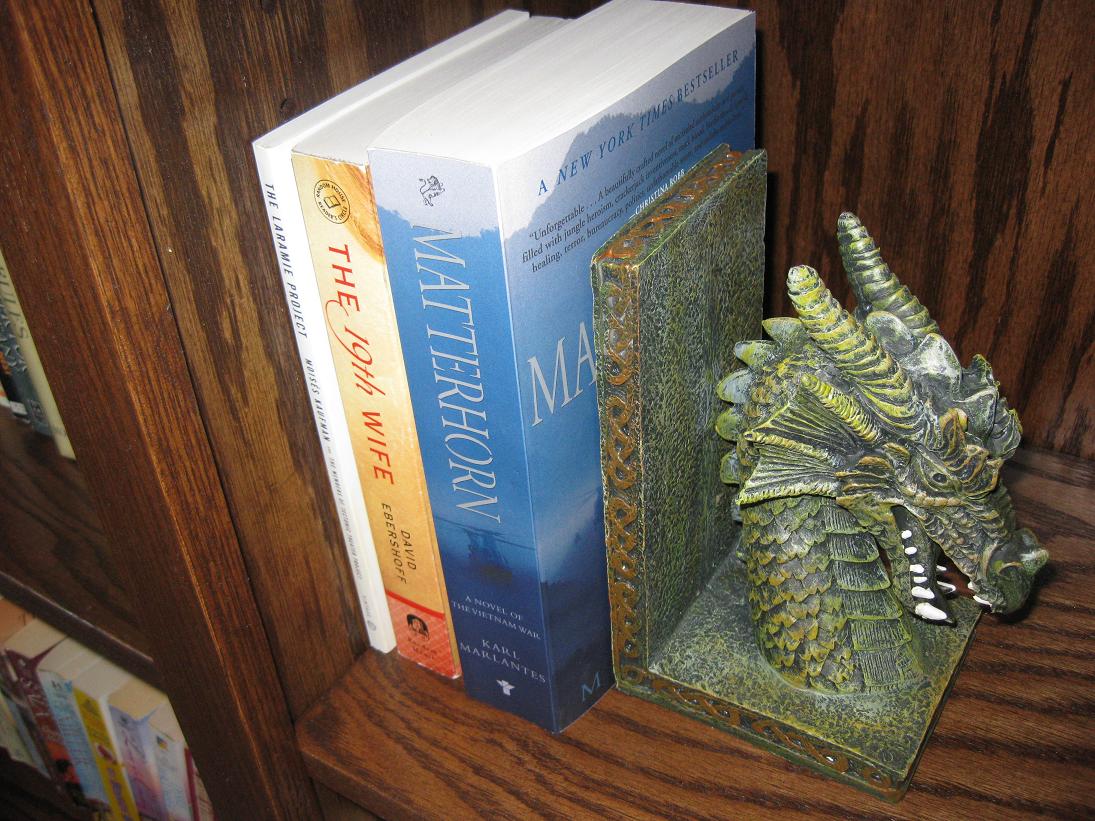
Here’s the evidence: check out what she got me for my birthday last week. (Click to enlarge.) Hola, Señor Dragón!

Dragon 1

What’s this? You brought a friend?

Dragon 2

I reckon the one on top, guarding my dystopias, is Smaug, and that’s Glaurung underneath. Bit of a family resemblance, wouldn’t you say?

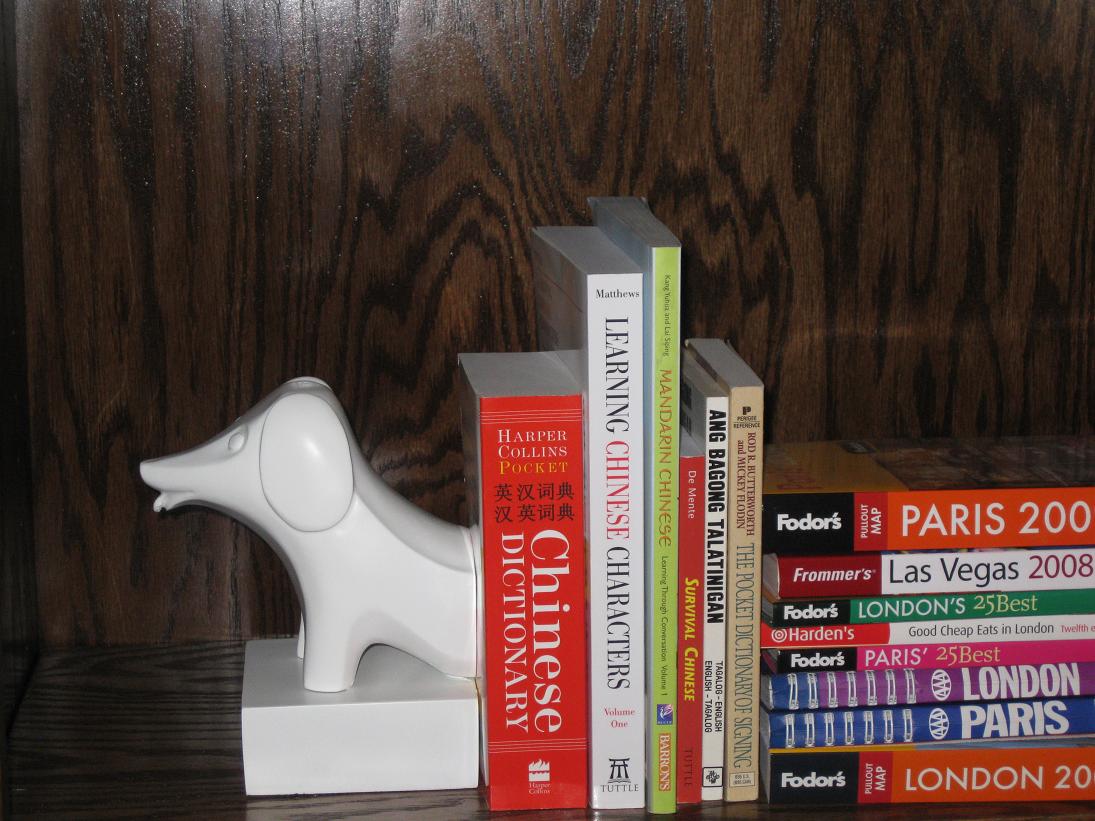
But wait, there’s more:

Dog 1

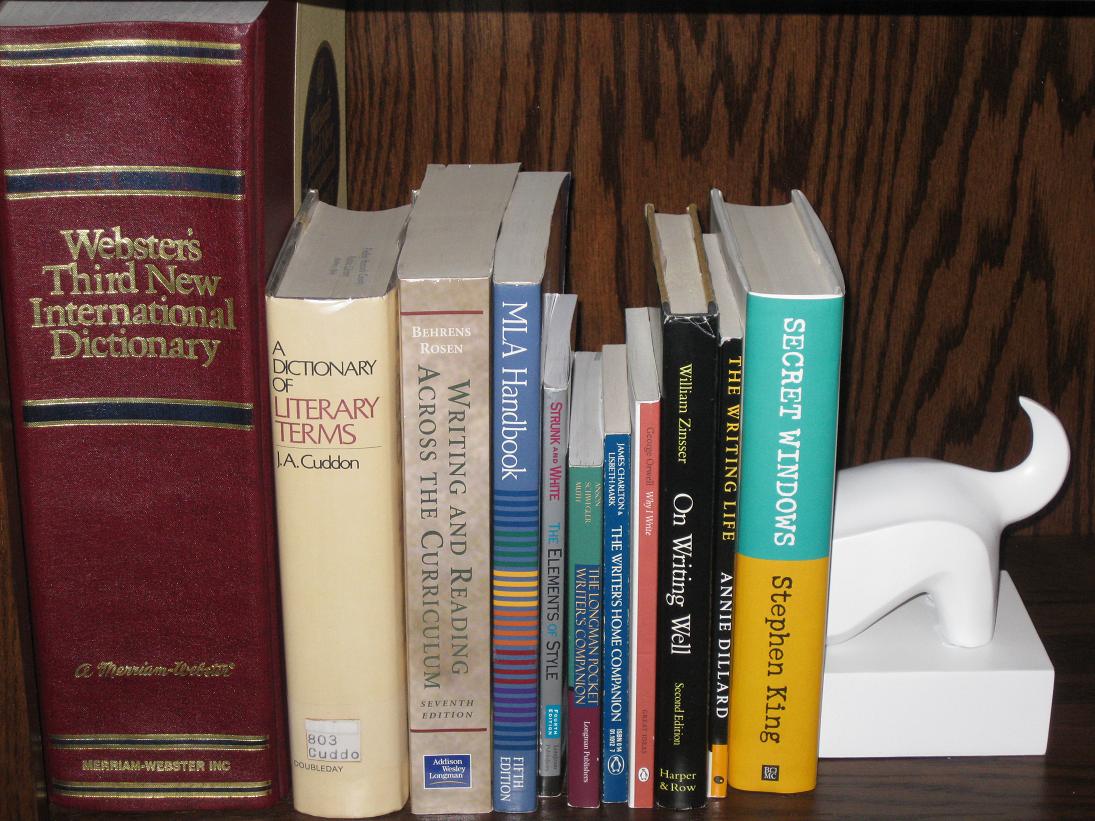
Dog 2

If the dragons are from Tolkien, I suppose that makes the dog Huan, eh? (Fitting, too – this is my eleventy-first blog post.) Well, maybe not. Perhaps I’ll learn his name later.

He does look like he has a bit of separation anxiety. (HA! Get it? Because he’s…right, okay. I’ll stop.)

Anyway. Wife = amazing. Hypothesis = proved. QED, bitches!

Friday Links

Ciao, amici! Let’s link it up.

Writing Links

James Patterson is the world’s highest-paid author, taking in $82 million last year. The average author makes only about $14 million per year so Mr. Patterson is doing very well for himself.

A Pixar artist writes an open letter to artists everywhere. “The important thing is to slog diligently through the quagmire of discouragement and despair.” Sure, you’ve seen this “never surrender” advice before, but have you seen it decorated with a sketch of the kid from Up?

Read four letters by four famous authors: Jack Kerouac, Kurt Vonnegut, J.R.R. Tolkien, and John Keats. Vonnegut writes about his P.O.W. experience, Tolkien shows love to a fan. All four taken from Letters of Note.

They’re coming out with a documentary about Ken Kesey, author of One Flew Over the Cuckoo’s Nest. Or rather, a documentary about a certain road trip in particular. I’ve never even read the book, but for some reason this movie intrigues me. Maybe I’m just a sucker for stories with LSD as a plot element?

Non-Writing Links

What’s this, you ask? Oh, nothing special. Just a woman PLAYING FLIGHT OF THE BUMBLEBEE ON AN ACCORDION.

You’re welcome.

Hope your weekend is trippy and your drugs are legal. Failing that, if you start a counterculture revolution, make it a good one. See you on Monday!

Flash Fiction: “Marva”

This week’s story is a response to one of Agent Courtney’s writing prompts: “He opened the last box, and inside he found…” Slipping it in just before the August 26 deadline. Enjoy.

Marva

“Slave!”

A Handler’s voice, booming and rough. Jovo looked up, shading his eyes from the scouring noonday sun. No – not just one Handler but two, approaching slowly from the landrunner they’d parked some distance away. He gripped the shovel tighter.

One was bad enough. Two meant trouble.

He stepped out of the shallow hole he’d been digging, laid down the shovel, and began the usual gesture: a deep bow, pressing his nose as close to his knees as he could manage, though the effort sent waves of agony down his tired back. But he’d barely begun when he paused, noticing what he had not seen before in the dusty summer haze: only one of these two men wore Handler white. The robes on the other were light blue.

A Master.

Jovo’s breath caught on the scorching air and he dropped to the ground, prostrating himself. He pressed his cheek silently to the white-baked earth, spread his callused fingers on its surface, praying he had not been too slow. The rock-hard soil burned him, dirtied his ragged beard, but he ignored all that. Life and death in this land came not from the heat, but from the hands of men like these.

A Master. What did it mean?

Jovo could see nothing but the long vertical horizon, yellow ground against yellow sky, but he heard them murmuring to each other in their outlanders’ language: those soft, melodious tones, so alien in this cracked wasteland. Then scuffles and grunts, as of something being moved. What were they moving that was so valuable they couldn’t trust a slave’s hands to the job?

Now the Master’s voice again, louder, and the Handler translating: “Stand up, slave!”

Jovo rose, taking care to keep his eyes down. His friend Marva had forgotten once; he tried not to imagine Marva’s left hand, the pock-scarred stump where the third finger had been.

“You may look up, slave, but take care not to look at the Master.”

Not knowing where the Master stood, Jovo looked up very slowly indeed.

A red blanket, stained white with dust already, lay spread over the bare earth. On the blanket sat three cubes. Beyond, at the edge of his peripheral vision, two men lurked shadowlike. The cubes were an arm’s length on each side, brilliantly gleaming blue-green metal, surfaces worked with ornate curls. Smooth oval gems shone white and gold along all the edges, and one fat jewel sat clear as water in the center of each square face.

The boxes looked identical at first, but a moment’s study revealed that was not quite true. The middle box was just a little bigger than the left one, and the right box just a little bigger than the middle.

Again the master’s voice, like music, and the harsh echo of the Handler.

“The Master is pleased with your work, slave. As a reward for your labor, the Master permits you to open these three boxes and gaze on their contents.”

Rubbish, of course. The only reward for labor was not to be killed. And what nonsense was it, anyway, to open a box and look inside but not get to keep it? What game were they playing?

Only, the men’s shadows retreated now, and he knew. They were afraid. Something dangerous was in these boxes – or at least, the Master suspected there might be.

So have a slave open them. Jovo was old, anyway, close to useless in his late forties. No great loss if something happened. That was how they thought, these men, and he had found it useful to learn exactly how they thought.

Jovo stumbled forward, squatted on the blanket in front of the leftmost, smallest box. He reached forth trembling, sun-dark fingers, but stopped short of the brilliant metal. He did not ask the question; speech was forbidden, mostly. But his wide-eyed questioning look was enough.

“Yes, start with that one,” said the Handler. “Smallest to largest – may as well do it in the order she wanted. Touch the center jewel on top.” Still he heard them backing further away. What were these boxes, to frighten them so?

And who was ‘she’?

But despite his fear, he never even considered disobeying. Nothing atop this blanket could be worse than a Handler’s wrath. Again Marva’s four fingers flashed in his mind, that awful, obscene gap.

His own fingers brushed the top center jewel of the first box, surprisingly cool under the pitiless sun. The top split into four triangular pieces as the four sides fell away. Inside sat a silver dish. A pale blue lasergram flickered to life above it, taking the form of a shimmering woman four meters tall. Jovo dared not raise his eyes too far – the Master still waited some distance away – but he could see the gown of pure light, the bare feet peeking out from the folds.

Belatedly he noticed the Summerstar ring on her big toe – a sign that even slaves recognized. This was an image of the Empress Herself, Monarch of the Hundred Thousand Lands, Keeper of the Light of Centuries. He hurled himself to the blanket once more, burying his cheek in its softness, genuflecting before these hallowed photons. Was this only a recording, or could she see him now? His skin turned cold in the pounding heat.

“Lord Feumis,” said the lasergram, a woman’s voice, not melodious like the Master’s but cool and flat as iron, proper as the sun. Yet he relaxed. Only a recording. “I greet you in the language of your servants to remind you that you are my servant. But I greet you by name. You are a servant, not a slave.

“You know I am not pleased that anyone in my Empire should indulge in slaving, by far the least palatable of your world’s numerous…blotches. Yet a wise ruler respects the customs of her lands. So I present you these gifts, that you may know I am everyone’s Empress, even yours. Take them in peace.”

Gifts from the Empress. So that was what had them so worried. Marva said the Empress was no great friend of this backwater region, and might well try to assassinate one of their leaders if she saw an advantage. But that had sounded like a friendly enough speech. He cradled his fingers and they shook a bit less.

He took no pleasure, though, from her lip service toward the Emancipation Movement. Her Imperial Majesty said a lot of things, but little had changed since she captured these lands eighteen years ago.

“The next one,” called the Handler. Jovo rose and obeyed.

This time the box opened on an oval mirror, its border gilded even more lavishly than the containers themselves. Jovo looked into this gift that was meant for the Master, studying the careworn lines of his own face, the eyes like old granite, the fear he’d hoped would be less obvious. A slave’s face, surrounded by swirls of gold.

A halo, perhaps. Or an omen.

“Slave!”

He opened the last box, and inside he found a machine.

It was a fat thing, the size of a dog but utterly alien, a convoluted mess of black tubes and black spines and dull gray metal.

“What is it?” shouted the Handler, and the tremor in that voice was unmistakable now.

Jovo reached forward, setting his fingers on the strange device –

Quick as heat lightning the metal – unfolded, opening klik-klak-krak and shooting up his hand, his arm, his entire body. In less than a second it coated him like a suit of armor. Knobby gray gauntlets snapped cold and tight around his hands, thick robotic sinews clung to his thighs. A green visor slipped over his face. He stumbled back, and the suit moved with him.

A recording of the Empress’s voice crackled in his ear.

“Oh, my,” she said, not sounding the least bit surprised, “DNA sensors indicate you aren’t Lord Feumis at all. He must have had one of his slaves open it. How very unexpected. And now, alas, there will probably be a slave rebellion. If only he had trusted me more, this politically convenient tragedy might have been avoided. As it is, you’ll most likely start all sorts of trouble with your brand-new, fully-automatic Phlogiston missile launcher, which you can fire by curling your right forefinger.”

The voice switched off.

A bolt of piercing orange light rocketed from the Handler’s painstaff into Jovo’s metal-encrusted torso. It bounced away harmlessly.

Jovo looked up and, for the first time in his life, met the Master’s gaze. Through the green visor, those unassailable eyes looked stark and fearful. The Master – the man – turned and scrambled away. Jovo followed, invincible, taking meters at a stride. More orange beams failed to hurt him.

The targeting computer drew a thin blue circle around his retreating form, and the missile launcher on Jovo’s right arm clicked invitingly.

He smiled, and thought of Marva.

Writers Don’t Actually Know Anything

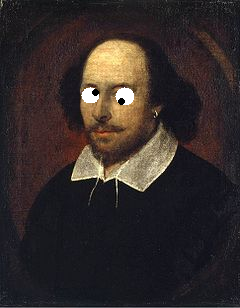
Shakespeare with googly eyes

If you read enough stuff by a given writer, sooner or later you are going to read Opinions, and most of the time these will be Opinions About Things In Which The Writer Is Not An Expert. This is natural, because writers are people too (no, honest!) and people like spouting off their Opinions.

This is also very dangerous, because you’ve got someone whose entire job is to make things sound believable, blabbering authoritatively about stuff they don’t really understand.

No matter the topic – religion, philosophy, politics, lepidopterology – you’re going to get a well-reasoned, well-structured, polished, coherent, grammatically correct argument. And then, if you’re not careful, you can find yourself nodding along and thinking “Hey, that makes sense, we should employ genetically modified marmosets to direct air traffic.” And you have to snap out of it and remind yourself that Writers Don’t Actually Know Anything.

“Okay,” says you, “but there is one thing writers actually know about: writing. Surely I can trust their opinions on writing?”

Ah, to be young. I remember the days when I myself was a naive lad of but 25 years.

I got a book one time – I’ve long since forgotten the title – that was nothing but interviews with writers, asking about their process and their thoughts on the craft. Every writer described their own process – throwing out words like “of course” and “naturally” to make their experience sound universal and obvious – and every process was totally different from all the others.

Probably you’ve heard this before, that every writer’s process is different, that you should do what works for you. But the less-publicized corollary is that most writers don’t actually understand writing, they only understand the writing process that works for them.

I’ll say that again. Most writers don’t actually understand writing.

This is part of the reason you get so much conflicting advice. Because even though writers know that they’re all different and readers are all different, even though they read other writers’ blogs and think about other ways of doing things, fundamentally (and naturally) they are still rooted in what works for them. And a lot of writers understand this, and that’s why the smart ones put disclaimers like “This has worked for me, but your mileage may vary.” Because they know that when one person’s driving a Hummer and another has a Harley, mileage will indeed vary.

Me, I have a silver four-cylinder base-model 2006 Honda Accord, and I include myself very much in the “writers who don’t understand writing” category. Which is why I try to be careful about the advice I give here.

Because I Don’t Actually Know Anything.

P.S. To all the well-wishers yesterday: my birthday was great, so you got your wish. Yeah. On my birthday, you got your wish. Jerks.

I mean, uh. Thank you. I really appreciate it.

Happy Birthday, Mr. Buckley!

Today I turn 26.

Coincidentally (I hope) I woke this morning with a headache like Bane had pounded a railroad spike through my left eyeball. “Life is suffering,” said the Buddha; I believe he meant this headache specifically. Yes, Tylenol, good, work your deep inscrutable magic…

Between the celebration and the woe, no writing-related post today. Instead I leave you with this, one of the coolest Mario 64 videos you will ever see (if you’re into that sort of thing). Yeah, it’s TAS. Doesn’t mean it won’t rock your socks off.

See you tomorrow!

Hating Twilight Does Not Make You Cool

Fair warning: this one’s gonna be a rant.

I think we can agree that when we’re talking about books – online, IRL, whatever – certain ones are cooler to like than others. I think we can further agree that Twilight and its sequels fall firmly in the “others” category. In fact, I’ll go further: in the current literary landscape, if you like Twilight, you almost have to hide it. Like it’s some shameful secret to tell your priest in confession, like they’re going to put a scarlet “T” on your chest.

And for good reason. Because mention Twilight, and prepare to watch people who are otherwise nice, thoughtful, reasonable individuals start spewing comments about how those books are only for teenage girls who read fantasy fulfillment stories because they’re too stupid to understand real writers.

Not to put too fine a point on it: this is bullshit.

Hang on, I think that was too subtle. I’ll try again.

If you look down on people for reading Twilight, that is FUCKING BULLSHIT.

Literary snobbery is a fool’s game to begin with, of course, because anything you like, someone else is looking down their nose at it. Harry Potter fans turn up their noses at Twilight, Lord of the Rings lovers mock Harry Potter, people who read “real” literature scorn anything in a genre, and James Joyce fanatics chuckle condescendingly at everybody else in the world. Even if you like Ulysses you’re not safe, because the guy to your left has read Finnegans Wake and thinks you’re adorable for writing it with an apostrophe. There’s always a snobbier snob.

Yes, you say, but snobbery is silly. I like what I like because it appeals to me, and nobody’s going to tell me otherwise just because they have more letters after their name.

Ah. Now we’re getting somewhere. Because, you see, here’s the key point, the deep dark secret of books (and art in general) that no snob wants to admit:

The quality of all fiction is totally subjective.

Or, to put it another way: “good writing” and “bad writing” are all in your head. If you like it, it’s good; end of story.

I can already hear people protesting. There have to be objective measures of skill, right? What about plot? Pacing? Structure? Word choice? What about style? An enticing hook and a satisfying ending? Worldbuilding? Hell, if nothing else, what about spelling the words right?

Sorry, folks. All of that stuff only matters insofar as it creates a better subjective experience for the reader. (Now, to be clear, certain factors will make you appeal subjectively to a lot more people, which is where the delusions of objectivity come from. But fundamentally it’s all subjective.)

I’ll put this another way.

My favorite book is The Lord of the Rings. Why? Is it because the characters are deep, the worldbuilding is unprecedented, the scope is literally epic? Partly, but none of that gets to the core. The reason I love The Lord of the Rings is that it touches something inside me. Tolkien’s words reach into my soul and give me feelings that are indescribable. Reading that book is, for me, transcendent. And because of that, nothing else matters.

You can tell me the beginning is slow, the dialogue is cheesy, the plot is derivative, the morals are hypocritical, the story is racist. All those things may be valid to varying degrees, and are certainly worthy of further discussion. But when it comes to loving the book, none of that is right or wrong, it’s simply irrelevant.

I love the book because I love it. You can’t retroactively invalidate the experience of love.

I’m not personally a fan of the Twilight books. You don’t have to be, either. You can think Stephenie Meyer is a bad writer; that’s your opinion and you are entitled.

But if you’re honestly going to look down on another human being because their positive feelings are triggered by a different series of words than you? Then it’s possible you might be missing the entire point of reading books in the first place.

Okay. Rant over! See you tomorrow, kids!

Friday Links

As seems to be the trend lately, we’ve got many, many succulent links this week. I’ll run through them quickly.

Writing Links

Two good articles from Slate: authors discuss the most overrated books (Catcher in the Rye catches some heat) and a book about the Periodic Table of Elements inexplicably gets some sexy ladies on the cover of its Chinese edition.

Chuck Wendig offers Top Sekrit Writing Advice, and he’s in rare form. “I don’t care what you’re writing — a novel series, a film script, a freelance RPG, a television show, a web-comic — you damn well better love what you do.” Amen, Chuck.

Did you know Herman Melville has a whale name after him? Learn about six strange things named after writers.

Is there a book whose title you can’t remember? Reddit may be able to help you out. I actually want to try this – there’s a book I read over a decade ago that I can describe reasonably well, though I’ve never been able to come up with the title.

Here’s a list of every book Obama’s read since before taking office. He got around to Jonathan Franzen’s Freedom quicker than I did – my copy’s still sitting on the shelf.

How about a list of the top ten books that influenced J.R.R. Tolkien? Fascinating if you’re a LotR geek – not that, ahem, I know any such people. Beowulf is the obvious one, but this list digs quite a bit deeper.

And finally, just had to share this great quote from Tom Robbins: “Disbelief in magic can force a poor soul into believing in government and business.” (Source.)

Non-Writing Links

10 ways you can help right now with the famine in Somalia. I’ll point out #4 in particular: “Text SOMALIA to 80000 to donate $10 to USA for UNHCR – the UN Refugee Agency.”

Check out a photo gallery of World Beard Champion Jack Passion.

And finally, the Onion reports that the apocalypse actually occurred three years ago. As my mother-in-law would say: “This is my shocked face.”

That’s a wrap, bambinos. This weekend I plan to eat ice cream, watch a movie, go on a road trip, and maybe even start on my next short story (I finally came up with a good idea). How ’bout you?

Writing Status Update

It occurs to me that I haven’t talked about my own writing projects in a while. On the (rather dubious) theory that y’all come to this site partly to hear about me, here’s a quick rundown of what I’m working on (and waiting on) right now.

1. The Novel. I haven’t mentioned The Counterfeit Emperor in a while. I’m still in the Getting Feedback phase. I’ve gotten a ton of critiques back on the latest draft, and I have a pretty good idea of what kind of revision it needs (mainly: tighten up the opening, sharpen the ending, miscellaneous to-do list in the middle). However, I’m still waiting on one more critique in particular before I tackle my next, hopefully final, revision. So in the meantime I’ve been practicing my short fiction. For example…

2. The Machine of Death story. I submitted my story for Machine of Death Volume 2 just before the July 15 deadline. So did, um, about 2,000 other people, so the competition is pretty stiff. Fingers crossed – I actually think my work here is one of my best stories. Unfortunately I won’t hear back on that one till October 31, so in the meantime I’ve been trying my hand at a bunch of…

3. Chuck Wendig’s short story prompts. I’ve written stories for three of Wendig‘s weekly challenges so far, plus a sonnet for fun. I’ve really been digging those, for a lot of reasons: the prompts are intriguing, it’s fun to read other people’s stories, and it’s fun when the other participants read my stories. And hey, I’ve done pretty well; “Scissors With Running” and “Bald Pregnant Women” were chosen as top-five winners by Wendig and his readers, respectively. Cool! However, I don’t have a story this week. That’s because lately I’ve forsaken Chuck (he’ll get over it – in time) to work on…

4. Agent Courtney’s short story prompts. I don’t know if I’ve linked to Agent Courtney yet, but she’s fairly new to the agent-blogging scene and she’s already got a bunch of story prompts up on her site. Deadline is August 26, and the prize is a query critique. I was planning to have a story for this challenge up here today, but it just hasn’t worked out. I’ve made no fewer than three false starts on two different prompts, and I just can’t seem to get anything I’m happy with. Very frustrating, actually. But August 26 waits for no man, and I will have an entry up before it does. Next Thursday it is. In the meantime, I’m also waiting on…

5. Something secret. I don’t want to say anything just yet, because I’m not sure when it will happen, but I do have something else that I’m looking forward to announcing. Oh, and in the back of my mind there’s still…

6. The next novel. Which I have a lot of truly righteous ideas for. But this is a long ways off yet so I won’t talk too much about it, either.

Huh. That’s weird – I was feeling unproductive lately, but when I write it all out like that, it actually sounds like I’m pretty busy. Ok, we’ll go with that.

What projects are you working on, writing or otherwise? Tell me in the comments! (I mean, if you want. If not, that’s cool. Just click that little X and close the window. No, go on. It’s fine. Not like I’m sitting here…waiting…alone…in the darkness…)

Uh, right. See you tomorrow!