Monthly Archives: September 2011

Friday Links

Just two links this Friday, and they’re both writing-ish. You don’t have to click either of them, but then, you don’t have to wear clothes in public, and you do that. (Presumably.) So, you know, ipso facto, QED.

Amidst all the gloomy prophecies of the End of the Book, it’s good to see a study suggest – for once – that Americans are actually reading more. The article says specifically “more literature,” and they apparently define literature as “novels and short stories, plays, or poems.” The article goes on to mention that “Cultural decline is not inevitable.” Fingers crossed!

And from Veronica Roth, a good post about the gift of upheaval, the growth that comes from difficult change.

Them’s the links. As for me, I finished Cory Doctorow’s Little Brother and now I’m on to The Screwtape Letters by C. S. Lewis. So far it’s pretty prodigious.

What are y’all up to this weekend?

Why Fiction Matters

I remember once, a long time ago, someone asked me what the point of fiction was. Why waste your time reading (let alone writing) novels when nonfiction is so much more instructive? It wasn’t a mean or spiteful question. They were just curious. They didn’t get it.

I remember I was taken aback. I didn’t know what to say. It was like trying to explain why I breathe. I think I said something about how you can learn from fiction, too. Maybe something about how reading fiction is fun, enjoyable. But I knew that I was missing the point, that none of it got to the heart of why I read (let alone write).

That was then, this is now. Certain recent events have reminded me that – how can I put this? – life is occasionally shitty.

Of course bad things happen; we know this; some people are reminded of it much more often than others. But if you are cheerful enough or strong enough or British enough, you can deal with it in a positive frame of mind. “Life is occasionally shitty,” you brightly opine, “but I’ll make the best of it.”

The alternative is that the external becomes internal, that Bad Stuff enters your mind and shakes hands with your soul and kicks off its shoes and helps itself to a cup of coffee and gets comfortable in your recliner. This is when you go from having a bad mood to a bad month, from thinking that “life is shitty” to “life is shit.” It is a withdraw, a deadening, an irrational hatred, an anti-enlightenment.

Here’s something you already know, but it bears repeating: this Bad Mental Stuff, this brain poison, is bullshit. Not bullshit in the sense that it doesn’t exist, or doesn’t matter, but bullshit in the sense that, if you let it, it will destroy you.

Fuck it. Seriously. Fuck. That. Shit.

Perhaps at some point you have asked yourself this question: what is the meaning of life? Helpfully, I have the answer: the meaning of life is to create and protect beauty. Heavy stuff on a Thursday morning, I know, but stay with me for just a second longer and then you can look at cat videos again.

Beauty is the opposite of bullshit. Life is the opposite of death. Fundamentally they are both about the same thing: never giving up. It is a battle and it is a war and both sides have their weapons.

Fiction is not about teaching you facts or making you feel better. Of course it does both these things, and they are good and important things to do, but they are accessories, accoutrements, nonessential.

Here’s the essence. Fiction is beautiful; fiction is life; and that is all.

Ideaphoria

The Johnson O’Connor Research Foundation defines ideaphoria as “the ability to produce ideas quickly.”

This is a trait I’ve never possessed. I’ve got the “ability to produce ideas” part down, but I’ve never had “quickly.” I think this may be my biggest problem as a creative writer. I’m fairly good at the destructive aspects of writing – finding specific problems in a piece as I read it – but generating the raw material has always come slowly.

You might expect this would make me a lot better at revision than composition, but in practice I’ve found that revision requires almost as much creativity as the first draft – at least for novel-writing.

Fortunately for me, writing is not a race. The ideas come if I’m patient; and I am; and they do.

What’s your ideaphoria like: high or low? How does it affect you?

Star Maker Postmortem

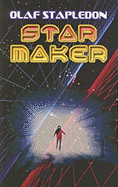
Star Maker

Olaf Stapledon’s 1937 book Star Maker may be the most influential novel you’ve never heard of.

Arthur C. Clarke deeply admired it. Freeman Dyson credits it for giving him the idea for Dyson Spheres. Jorge Luis Borges wrote an introduction to one of its editions; Doris Lessing wrote an afterword for another. Brian Aldiss opined “Stapledon’s book embraces the firmament. Read it and you will be forever changed.” H. G. Wells and Virginia Woolf were fans, and C.S. Lewis felt strongly enough to write a letter condemning it as anti-Christian.

So what’s it about? And does it live up to the hype? I read it about a week ago, and I’m here to give you the answers.

Star Maker centers on an unnamed protagonist, an Englishman, who begins the story by standing outside one night pondering the Big Questions. What’s the point of life? Where is everything headed? Is there a God? If we’re all going to die, why does any of it matter?

He suddenly finds that he’s been transported, bodiless, into space, and that he can explore the galaxy. He heads to another planet, similar to Earth, with natives of its own, and gets to know one of these human-ish natives. Then he and his friend go bodiless-space-exploring together to yet another world, where they meet yet another friend, and gradually they amass more and more minds into a larger and larger group that explores more and more of the galaxy, and eventually, the universe. They travel back and forward in time, seeing the origin of the cosmos and its ultimate fate, witnessing the evolution of a single unified cosmic mind comprised of all its constituent organisms. Finally they reach an event Stapledon calls the Supreme Moment, when this cosmic mind comes face-to-face with its creator, a demiurge known as the Star Maker.

The story, such as it is, is mostly a vehicle for Stapledon to showcase his ideas about philosophy and science (emphasis on the philosophy side). The characters are entirely (and deliberately) plot devices. The only real conflict in the book consists of the philosophical questions mentioned above, so your reading enjoyment will come in direct proportion to your own fascination with Stapledon’s ideas.

For me personally, I got very excited as I started reading, because the first chapter seemed to phrase the central questions of existence in a very elegant and compelling way. I felt like Stapledon got it – he understood the real questions about life, and he had already rejected the easy answers. I settled in for the ride that would take me to his answer with a real sense of anticipation.

And now that I’ve read it?

Well, I’ve gotta say, I don’t find his answer(s) very compelling. Stapledon’s “Supreme Moment” gives a glimpse of God as the Star Maker, an aloof, non-loving, non-personal, endlessly creative spirit whom its creations (i.e. us) worship not because it promises salvation, but because worship is the proper response of created to Creator. For me, this is unfulfilling for a variety of reasons, not least of which is that I have no particular reason to believe his version of God actually exists.

So it’s a philosophical novel whose philosophy failed to move me; your mileage, of course, may vary. Yet I still think it was a good read. Star Maker is incredibly imaginative even by science fiction’s current standards; back when it was written, it would have been unprecedented.

The best thing about the book, by far, is its sheer audacious scope. Stapledon really pulls out the stops, painting a reasonably believable portrait of a universe (and eventually a multiverse) that encompasses the vastest possible ideas of time and space, in which aeons are smaller than pixels.

Star Maker wants to open your mind, and for the most part, it succeeds. For that alone, I’d say it’s worth the read.

The Rocky Mountain Picture Show

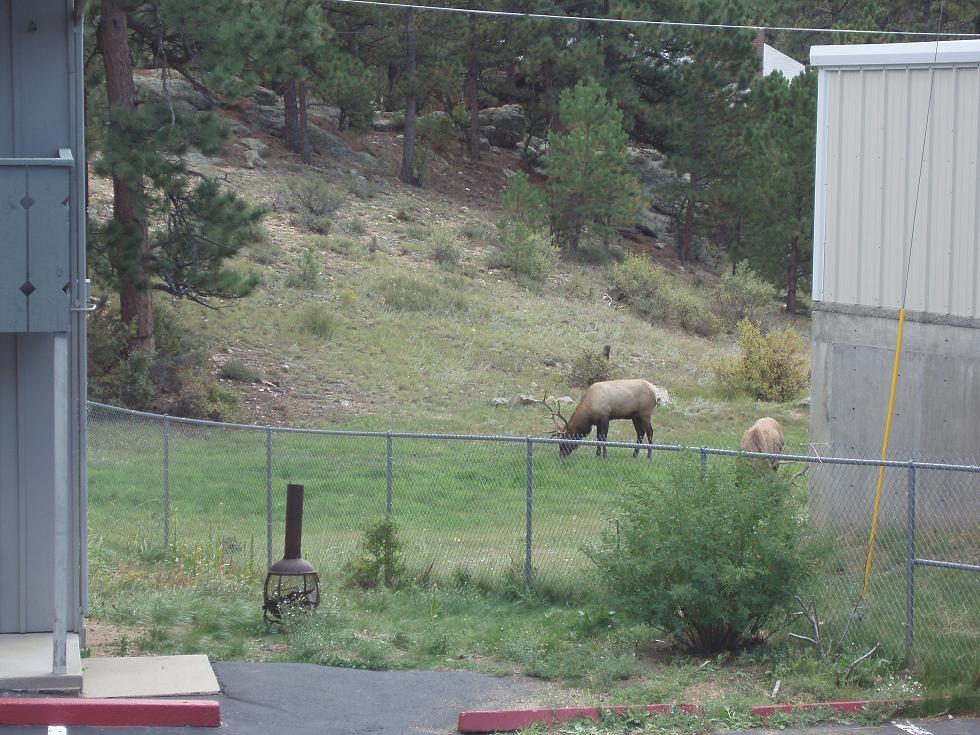
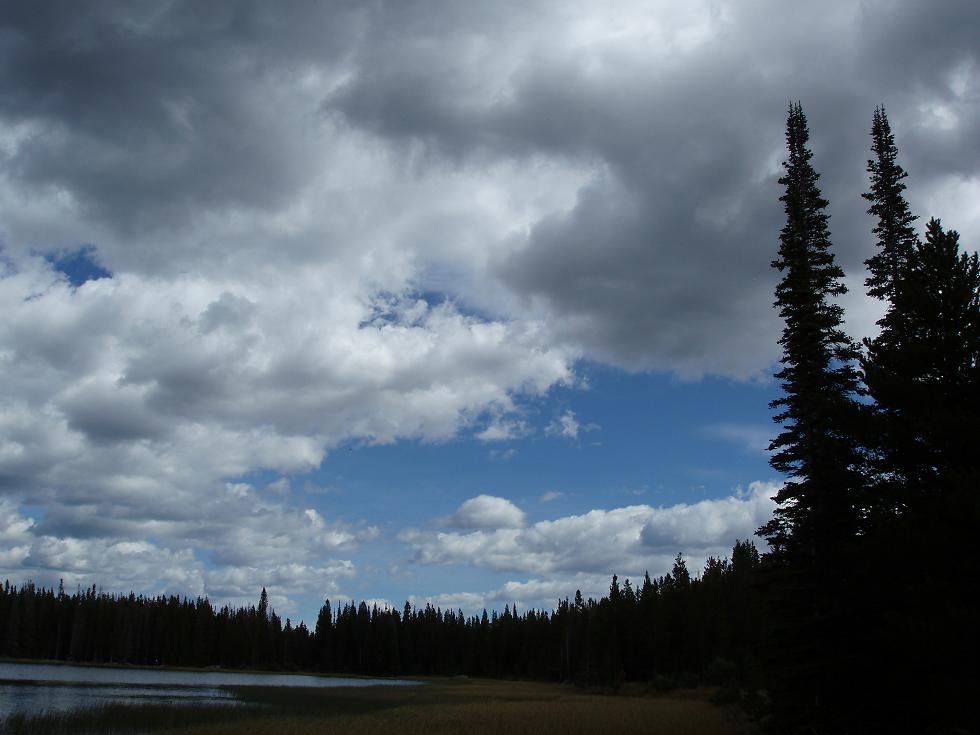
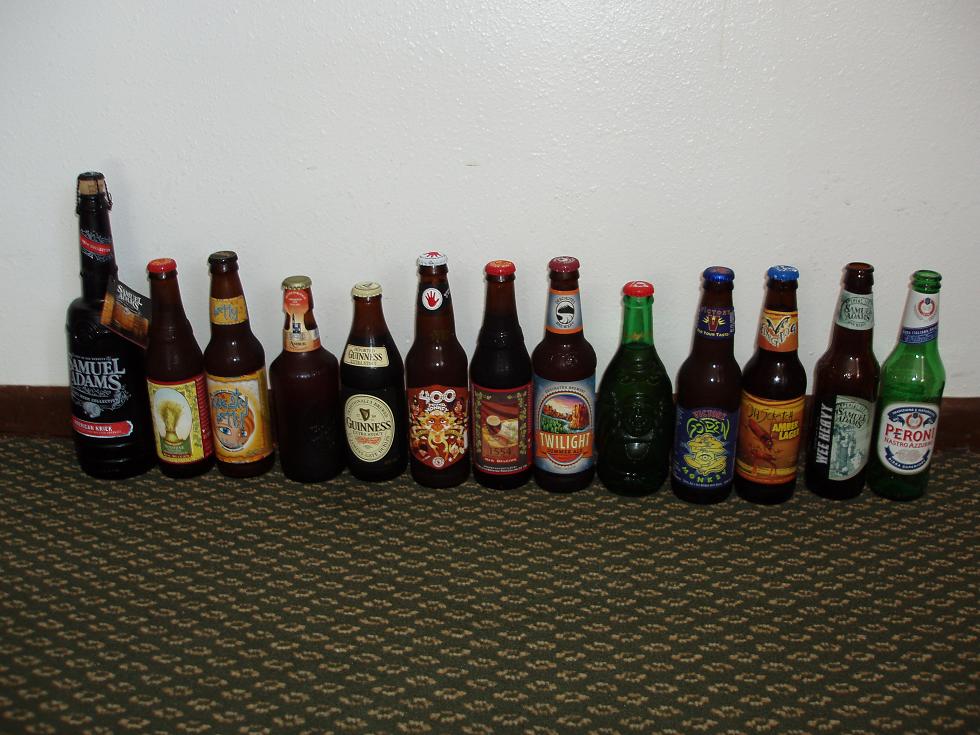
This is what my vacation looked like. (Click to enlarge.)

Moose

Trail

Sky

Mountain

Lake

Stream

Trees

Church

Mountains

Trees

Rocks

Mountains

Rocks

Tree

Sky

Chipmunk

Beers

…and in my spare time, I read Star Maker by Olaf Stapledon, Three Men in a Boat by Jerome K. Jerome, The Secret Sharer and Heart of Darkness by Joseph Conrad, and The Crying of Lot 49 by Thomas Pynchon. Right now I’m halfway through Little Brother by Cory Doctorow.

And how was your week?

On Vacation Till September 26

My wife and I are heading to Colorado for a week, meaning no new posts and no replies to comments till Monday, September 26. I trust y’all will manage without me somehow. It’ll be hard, I’m sure, but slog through that Buckley-less wilderness the best you can; it’ll build character in the end.

In the meantime, Friday Links!

First, I got some good answers to my question yesterday about why people like zombies. So if you’re interested, go check it out and find out how smart y’all are.

Next up: as a prize for winning her short story contest, Agent Courtney critiques my query letter. Righteous! (And the contest-winning story is here, if you’re into that sort of thing.)

We now move on from the Flagrant Self-Promotion portion of our post…

Writing Links

GalleyCat reports that some companies are using computer-generated stories to avoid paying the astronomical salaries writers normally command. *snort* This is interesting, but until A.I. improves dramatically, I don’t see it as much of a threat. (And if A.I. does improve dramatically, we’ll have bigger and more interesting problems anyway.)

Post-revolution, what’s the literary scene looking like in Egypt? The New York Times is on it. (Update: weird, it’s asking for a login now. It wasn’t doing that ten minutes ago. Not sure what’s going on.)

People everywhere are reading less, and everyone’s worried about the future of publishing. This photo captures the sadness and the fear.

NaNoWriMo is for wusses. Anyone can write a novel in 30 days. How about writing a novel in 3 days?

NEW TRAILER FOR THE MUPPETS MOVIE. Prodigious! (And yes, it’s book-related…you’ll see.)

Non-Writing Links

If My Little Ponies were superheroes. Disturbing and fascinating in equal measure.

There are two types of people in this world: people who like Star Trek and people who don’t. The latter group can move along. For the former group: this. Click through all fourteen comics for utterly inexplicable goodness.

I’m fleeing the state, you’re fleeing the blog, we’ll meet back here in a week. Everyone remember where we parked. Y’all have fun, now. Bye!

Why Zombies?

At 26, I am already an old person.

I don’t watch TV. I’m not on Twitter. I went to a Trans-Siberian Orchestra concert and thought the music was “too loud.” I worry people aren’t reading enough. I write myself reminders to do things I’m going to forget, and then I forget to look at the reminders. I haven’t told any kids to “get off my lawn” yet, but it’s only a matter of time.

So maybe you, the youthful generation, can explain something to me. Why are people so fascinated with zombies?

Ninjas, I get. They’re silent deadly badass assassins. Pirates, I get. They have cool accents and swords and ships. Robots I get. I even get the obsession with monkeys.

But zombies?

They’re mindless, they’re disgusting, and they want to make you the same way. Don’t we have that enough in real life?

Granted, I haven’t read many zombie books – the only one that comes to mind is Cherie Priest’s Boneshaker, which was more about steampunk than zombies anyway. And granted, Pride and Prejudice and Zombies is a hilarious concept; but it’s hilarious (to me) in the same way that Android Karenina is hilarious – because of the mashup of old and new, literary and silly, not because of the zombie element in particular. I’ve heard good things about World War Z and The Zombie Survival Guide, but was never interested enough to try them.

I guess a lot of the appeal is speculating on how you would kill them, how you’d defend your house, what strategies you’d use in the zombie apocalypse. Which, you know, is all fine. I can see how that would be fun to talk about for, like, a few days. I just don’t understand what’s so appealing about zombies that there seems to be a never-ending stream (irony!) of books about them, an army of authors determined to document every facet of the zombie experience.

Which is fine – people like different things, I’m not saying everyone should agree. I’m just curious, is all. Zombies: what’s the appeal?

Help an old man out.

Epic Rejection

A couple years ago, the Rejectionist hosted a contest to see which of her readers could come up with the coolest query rejection letter. I managed to win first place, which I was very excited about, and I still think it’s one of the best things I’ve ever written. I thought y’all might enjoy seeing it too.

Dear Sir or Madam:
Please don’t be offended. Your query’s horrendous.
We can’t understand why you’d bother to send us
A missive so deeply in need of an edit
we wanted to vomit as soon as we read it.
Its hook was insipid, its grammar revolting,
its font microscopic, its manner insulting,
its lies unconvincing, its structure confusing,
its efforts at comedy less than amusing.
We think that on average the writing is better
in comments on YouTube than inside your letter.
“No matter,” we said to ourselves after retching,
“The novel itself may be perfectly fetching.”
On reading your pages we promptly were greeted
with something a wallaby might have excreted:
a plot so moronic, a premise so weary,
and characters so unrelentingly dreary,
descriptions so lifeless, a setting so boring
that only our nausea kept us from snoring.
In short: if your book was a vaccine for cancer,
its margins inscribed with Life’s Ultimate Answer,
and all other novels on Earth were rejected,
we’re still pretty sure we would not have selected
this terrible, awful, impossibly hated,
unspeakably horrible thing you’ve created.
But thanks for submitting! We hope you’ll consider
alternative ways to get published (like Twitter)!

“Your Book Sucks Like a Hoover” …and Other Things Not to Say

I read a book recently. (I know, right? I’ve been trying to quit.)

Had high expectations for it, and it didn’t deliver. Not awful, just sort of mediocre. Normally I’d write up a Postmortem for it here, analyze why it didn’t work and what I did like, and move on with my life.

Here’s the thing, though: the author is someone I know.

Not, like, someone I know well. She’s much further along in her writing career, has multiple books out and thousands of devoted readers, couldn’t pick me out of a lineup. But we have exchanged several e-mails, she’s given me some encouragement and good advice, and basically been an all-around excellent person.

And so writing a post that amounts to “her book isn’t worth your money” feels like, you know, sort of a dick move.

Not because of the criticism – I’m sure she could take it (and probably couldn’t care less). It’s more the fact that she supports herself with her writing, and it feels distinctly ungrateful to return her kindness by stepping on that means of support, however slightly.

So that (apparently) is my policy for this blog: if the author’s dead, or is someone like Stephen King who’s ascended to a higher plane, I’ll share negative opinions. But if it’s someone who is still getting established, I’ll keep it to myself. “Professional courtesy” isn’t the right term, but it’s the closest I can think of.

It feels a little strange, deciding to hide thoughts about books on a writing blog. But no more strange, I guess, than deciding not to say “Hey, has your nose always been shaped like Wisconsin?” when you meet someone.

Silence is as far as I go, though. I don’t think I could bring myself to actually recommend a mediocre book just because I know the author, even if I really want them to succeed. Because if you start doing that, pretty soon that’s all you’re doing: recommending mediocre books. And we’ve all seen blogs like that, where every week the blogger’s raving about some amazing new novel so-and-so wrote (“and by the way you should totally follow him on Twitter too”) and pretty soon you’re thinking wow, his friends must be some pretty incredible writers because I don’t think I’ve ever liked five books in a row by ANYBODY.

That turned out maybe a little more bitter than I intended?

Anyway: having a public forum for your opinions turns out to be kind of weird, is what I’m saying. Tell me, have you ever run into this problem? How did you handle it?

Why Don’t Men Leave Comments?

Like many of you, I read a lot of blogs, and lately I’ve noticed a trend: it seems like I see a lot more blog comments from women than from men. I wondered if it was just my imagination. This weekend I decided to investigate.

That’s right, peeps. IT’S SCIENCE TIME.

Method

I have 24 blogs that I read on a regular basis. For each of them, I simply grabbed the latest post and counted up the number of comments by each gender. (This took a surprisingly long time.) A few notes:

  • I counted commenters, not comments. So if a person left multiple comments on a post, I only counted that person once.
  • I did not count comments from the original poster.
  • Commenter gender is not always obvious, but I did my best. If they linked to a profile or website that gave their gender explicitly, I used that; if not, I judged by first name. No doubt I made a few errors, but I think by and large I guessed right.
  • If I couldn’t figure out the gender (“Anonymous,” gender-neutral name, etc.) or if the individual did not fit neatly into either gender (e.g. transgender) I put them into the “Unknown/Other” category.

I ended up with a total of 245 commenters.

Results

My suspicions were confirmed:

Men vs. Women

Explanation

I don’t have a single good answer for what’s causing this, but (lucky you!) I’m full of ideas. Probably it’s a combination of factors. Here are the possibilities as I see them.

Maybe women just comment more than men as a general rule. I have no idea if this is true or not. It’s the most obvious explanation, but that doesn’t make it the right one.

Small sample size. 245 commenters on 24 blogs is not really a huge sample. Maybe these imbalances would even out if I just had more data. Based on my own anecdotal experience, though, I suspect that’s not the case.

Biased sample. Now we’re getting to the heart of it. These 24 blogs are not a random cross-section of the Internet; they are the 24 blogs that I read regularly, which means they are skewed toward my interests. Specifically, all 24 are related to writing in some way: they are written by agents, editors, authors, etc. What does that have to do with gender? Two ideas. First…

Women are more into literary discussion than men. It’s no secret that publishing is a mostly female industry; something like 85% of the publishing world consists of women. Moreover, women read more than men, especially when it comes to fiction; women read four times as many novels as men. So maybe men just aren’t into this sort of thing anymore (and isn’t that a cheerful thought). Or…

Maybe men don’t comment on women’s blogs. Largely for the reasons I just mentioned, 19 of the 24 blogs in my sample were written by women. Maybe that has something to do with it; that is, maybe men aren’t avoiding these blogs because they’re about books, but because they’re written by women. I don’t have data at the moment, but anecdotally I’ve noticed a striking feature: blogs written by men seem to be much closer to 50/50 in the comments, whereas blogs written by women tend to be skewed much further toward all-female commenters. “Anecdotally” is always a dangerous word, of course, but I’d be lying if I said I didn’t see a trend.

Conclusion

As you see, I have no shortage of possible explanations, but I don’t think I have enough data for a conclusion yet. What are your thoughts? Have you noticed anything like this in your own experience?