Monthly Archives: June 2012

Friday Links

This week: funny stuff!

Field goal!

Ian McKellan, the actor who played Gandalf, reenacts the balrog scene while an audience laughs.

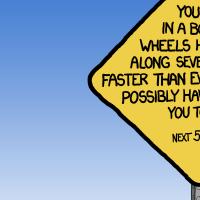
Text is funnier inside geometric shapes!

xkcd has an important warning for drivers.

Movin' on up

SMBC nails it: perhaps the best explanation of aging I’ve ever seen.

DUN DUN DUN

A new comic I just discovered this morning: Two Guys and Guy. I’m reading through the archives now and it seems pretty good. Especially enjoyed this one.

Have a great weekend!

Forty-Minute Story: The Afflicted

The young man in the dapper charcoal suit was sitting on the exam table, hands folded calmly in his lap. By contrast, his wife – seated nearby, wearing a businesslike blazer and skirt – kept squeezing her fingers in worry as she spoke to the doctor.

“I just don’t know what to do,” she blurted. “It started a month ago. He…I don’t think he even knows that he’s doing it.”

The doctor, a grandfatherly man who had just stepped out of a Norman Rockwell painting, consulted his notes under furrowed brows and nodded reassuringly. “Well, there are some simple tests. Let’s start with this. Lisa, suppose your office building burned to the ground. What would you tell your boss?”

She cleared her throat professionally. “Environmental circumstances have adversely modified our collaboration facility, resulting in an opportunity for construction.”

“Very good, very good. And Simon?”

He frowned. “I would say that our office building burned to the ground.”

“Ohhh,” Lisa wailed. “You see, Doctor? You see?”

“All right. Now let me try something else. Simon, I’m going to say a few sentences, and I want you to repeat back, word for word, exactly what you hear. Ready?”

“Sure.”

The doctor adjusted his spectacles as he read from his sheet. “We will leverage our assets in an effort to promote efficiencies.”

“We’ll do it better.”

“Our sourcing partners have undergone a paradigm shift resulting in underutilization of resources and suboptimal return on investment.”

“Our contractors are screwing us.”

“At this time, we are prepared to offer conditional approval of the proposal you have submitted.”

“Yes.”

“Our mission is to maximize value by fostering competitive dynamics, harvesting synergies, utilizing strategic partnerships, and proactively managing information.”

Simon blinked. “I don’t think you said anything at all.”

“I want you to repeat this word. Challenging.”

“Hard.”

“Challenging.”

“Hard.”

“Challenging.”

“Hard!”

“Well.” The doctor set aside his clipboard with a sigh. “There’s no doubt about it. Simon is afflicted with the Vernacular.”

“Oh, Doctor!” Lisa gasped. “Is…is it curable?”

“In time, with certain drugs and extensive therapy, it may be possible to improve his condition. But I’d ask you to consider some alternatives as well.” He turned to his patient. “Have you ever considered art school?”

Lisa fainted.

Processing…

I was planning to do a post today about the Chinese Room argument, a thought experiment invented by John Searle which claims to show that digital computers, as we currently understand them, cannot possibly think. I’ve long been familiar with this argument, and I always thought it was rather silly.

As I was reading the Chinese Room argument in more detail this morning, though, I realized that the full scope of what Searle claims is even broader than I originally realized, and it will take more than forty minutes to fully understand his argument and convey it fairly. In the interests of getting it right, I’ll abstain from cranking out a hasty analysis today.

Oddly, as I read Searle’s arguments in more detail, I become even more convinced that he’s wrong. Nevertheless, it’s important to get the facts straight.

So, yeah. Investigating thought experiments, that’s me. What are you up to this fine Wednesday morning?

The Turing Test

I’ve talked a lot about artificial intelligence on this blog. But what does “artificial intelligence” really mean?

How do we know if a machine is thinking?

One answer comes from Alan Turing (1912-1954):

One at a time, ladies.

Turing, like others I could name, was a professional badass. Among his more notable accomplishments:

  • Widely considered the father of computer science
  • Instrumental in breaking Enigma, the Nazi secret code
  • Creator of the Turing Machine, a simple mathematical model for a computer, which Google recently featured on their homepage

Unfortunately for Turing, he was gay – more specifically, gay in 1950s England – which, at the time, was a criminal offense. He was “treated” with female hormones to avoid going to prison. Two years later, when he died from cyanide poisoning, it was ruled a suicide.

But back to our question. Can machines think?

Turing argued that the question, while interesting, tends to get mired in murky philosophical discussion about the meaning of the word “think.” He suggested we consider an alternative question, one that’s easier to define and has measurable results.

Suppose you’re chatting with someone online, using an instant messenger like AIM or MS Communicator. How do you know if the other person is a human or a computer? Today, it’s easy. Although there are so-called “chatbots” that simulate a human chat partner, none of them is likely to fool you for long. But Turing suggested that if a computer program was so sophisticated that you couldn’t tell whether you were talking to a human or not, then that’s a pretty good sign you’re looking at intelligence. This chat experiment is called the Turing Test.

Of course you’d have to define some parameters for the experiment. Who’s doing the testing – an average Joe or a savvy AI expert? How long does the test last? Etc. But these are fairly minor details, in my opinion.

It’s important to note, as Turing himself did, that the Turing Test should be considered sufficient but not necessary to establish intelligence. That is, a machine that passes the Turing Test might be judged intelligent, but a machine that fails the test is not necessarily unintelligent. It might simply be intelligent in other ways that don’t involve acting like a human.

The Turing Test has come under a lot of criticism from a lot of different angles. One argument says that the Test is a distraction from “serious” AI research, which today is highly specialized into specific intelligence problems, and rarely involves chatting. I’d counter that on two levels. First, as I just mentioned, Turing never claimed the test was the only definition of intelligence, so it isn’t supposed to be all-encompassing. But second, I have the feeling that by hyperspecializing, the AI community has lost its way. Researchers, it seems, have largely given up (at least for now) on creating a general-purpose, human-level intelligence capable of passing the Turing Test. I think that’s a mistake.

Another, more philosophical criticism says that a machine might pass the Turing Test by acting like it’s thinking, but not really be thinking. Tomorrow I’ll talk about that argument in more depth.

In the meantime – what do you think about the Turing Test? If a computer could pass this test, would you consider it intelligent?

Brave Postmortem (Spoiler-Free)

Help! Her head's being mauled by a carrot monster!

When it comes to Pixar movies, my hierarchy goes something like this:

  • Amazing: Finding Nemo, The Incredibles, Up
  • Great: All three Toy Stories, Ratatouille, Wall-E
  • Pretty Good: A Bug’s Life, Monsters Inc., Cars
  • Didn’t Actually See It Because the Trailers Looked So Lame: Cars 2

I just saw Brave last Saturday. Where does it fit into the Grand Order of Pixar Movies? I’d say somewhere between Great and Pretty Good.

First, the “Great” stuff. The visuals, of course, are just as impressive as ever. You can see that from the poster. Apparently Pixar had to write a whole new graphics engine to handle the explosion of carrotness going on at the top of her head. Whatever they did, it worked, and not just for the curls. One of the stars of this movie is the Scottish landscape, with its moody forests and wide, gorgeous panoramas. It wouldn’t be a Pixar film without stunning graphics, and Brave is no exception.

Another Pixar staple: Brave is bursting with energy, packed with colorful, vibrant characters, all tugging the story in their own direction. There’s Princess Katniss Merida herself, her kind but disapproving mother, her giant of a father, a witch, and (ahem) at least one bear. You’re never sitting around waiting for something to happen. The whole story moves at a breakneck speed.

Most surprisingly, Brave may be the funniest movie Pixar’s ever made – and that’s saying something. I was laughing out loud practically from beginning to end.

So what drags it down into “Pretty Good” territory?

For one thing, not all the places I laughed were supposed to be funny. Some of the giggles came at allegedly dramatic moments, where the script leaned a little too heavily on cliches. I understand this is an all-ages movie, so you’re supposed to Learn A Life Lesson, but it doesn’t have to be pounded in with a Life Sledgehammer. The idea of a princess who breaks the mold, rejects her prince, and saves herself, is not exactly new (see: Tangled and a thousand others), but Brave acts like it is. A little more creativity would’ve helped certain spots in the script.

A larger problem is that, for all its energy, Brave never really takes off. The heroine’s just as courageous as the title suggests, but for all that, her biggest crisis throughout most of the movie is – gasp! – that her mom wants her to do something she doesn’t like. Yes, some real danger’s thrown in toward the end, but it feels sort of incidental. Even the villain – the aforementioned bear, lurking between the B and the R in the movie poster – turns out to be kind of lame, despite a needlessly elaborate backstory.

Merida keeps saying she wants to be free, wants to make her own fate. But she doesn’t seem to have any particular goals in mind, beyond rebelling against her mother. There’s just not a lot to get fired up about.

All of which is to say that Brave, while not exactly earth-shattering in its brilliance, is still a pretty fun way to spend an hour and a half. Monsters University, on the other hand – the sequel to Monsters Inc. whose trailer we saw beforehand – I have my doubts.

What movies have you seen lately?

Friday Links

Harnessing the power of triangles. Delenn would be thrilled.

Here’s a video for the Leap, a new motion control system for computers. Seems to operate something like a touch screen, without the touch. The creators claim it’s 100 times more accurate than the Kinect. We’ll see – but it certainly looks cool. Apparently you’ll be able to buy one early next year for $70.

OH GOODNESS IT IS THE FRONT OF A CAR

This news will probably excite nobody but me, but hey, it’s my blog, right? Honda has leaked details of the 2013 Accord. As a lifelong Accord driver, I gotta say, this thing looks sweet. Very pretty on the outside. On the inside, Bluetooth and backup camera now come standard, which is not exactly groundbreaking technology but certainly a step up from my ’06 model. Of course, if my ’06 keeps running as smooth as it has been, I may not even need a new car till the 2016 model.

And, apparently I’ve become a Honda commercial. Moving on…

Purple: the color of royalty

Ben Trube delivers the funny this week with an excellent tribute to a less-than-excellent pizza delivery guy. Please to enjoy.

Tatsuya Ishida: the man, the myth

Finally, the Sinfest webcomic offers its own unique take on Fifty Shades of Grey. Sometimes, it’s best to keep things simple.

Anybody have big plans for the weekend? Stay cool out there. See you Monday.

Dyriel Postmortem

Two weeks ago I posted the Dyriel story (parts one, two, three, and four). Dyriel was an experiment. I thought it would be fun to do a story where you, the readers, got to decide what happened next. Interesting for you, challenging for me, a good time all around.

The result, I think, was a little weak.

A couple reasons for this. The biggest reason is that it’s very hard to structure a story so it has meaningful decision points every 500 words or so. That kind of structure tends toward an over-emphasis on plot, on the mechanics of moving the story forward, with less focus on the characters themselves.

Another reason. There seem to be two main writing styles: the free-flow, see-where-the-story-takes-you style, and the plan-it-all-out-beforehand style. (You’ll sometimes hear these two kinds of writers called “pantsers” and “plotters,” but I’ve made my feelings clear about those names.) The point is that the choose-your-own-adventure format wrecks both these styles. It’s tough to follow the natural flow of the story when you’re working under external constraints, and it’s tough to plan out a story in advance when you don’t know what your hero will do.

I’ve said before that writing under constraints can actually make the story better, and I still believe that. But certain kinds of constraints are more helpful than others, and it may be that write-by-democracy is among the less helpful ones. That, or I just didn’t do it effectively. But either way, I don’t feel compelled to try it again anytime soon.

There were some positives. For one thing, I avoided the two main things I personally hate about choose-your-own-adventure stories. The first thing I hate is that certain choices end up being “wrong” for ridiculous reasons you could never have predicted. With Dyriel, I decided from the beginning that there would be no wrong paths, just different ways to get to the ending. The second thing I hate is that, to get the full experience of the book, you have to keep flipping back and trying all the different paths to see what you missed. Using online polls to choose the path meant that no other paths existed. Less annoying for the OCD types among you, and less work for me.

So that’s me. What were your thoughts on the Dyriel experiment?

Vase Wars!

Vase? Ma'am, this is a VOZ.

You’re a tourist. You’re exploring the streets of Rio de Janeiro, Brazil, looking for good deals in the local shops. Suddenly you come across this vase. Gorgeous! Your wife would love it!

(I realize the vase in the photo is butt-ugly. Work with me, here.)

Okay, so you want the vase. You’re looking to spend $100, maybe a little more. But the vase is marked at $275. What do you do?

It’s haggle time.

This actually happened to me on Monday afternoon, more or less. I was in a training class on how to negotiate, and this was one of the exercises. I was paired up with another guy from the class. One of us was assigned to be the buyer (the tourist), the other to be the seller. We were each given a sheet explaining our character, our background, our goals, etc. Then they put us on the clock to negotiate a deal.

One person wants to pay $100, the other person wants to get $275 (or as close as he can manage). As you’d expect, the deals wound up in the $140 to $180 range, for the most part. Nothing too exciting so far.

But check this out: after the exercise, our teacher told us the stories of the best and worst actual deals she’d ever seen from her students in past classes.

Before I go on, try and imagine the best and worst deals you could negotiate (from a real person) for this vase. Just take a second and think about it.

Ready?

The all-time best deal: two vases, for free, shipping included.

How is that even possible?

In this case, the buyer told the seller she had a lot of friends back home who would love to buy this kind of vase, but wouldn’t be willing to travel to Brazil. She suggested a business partnership where she would set up a website and promote the shop at home, and send him lots of customers in the future. The free vases were just to get the ball rolling.

The all-time worst deal: $475. In other words, $200 more than the asking price.

Okay, how is that possible?

Simple. The seller convinced the buyer that he had misread his information sheet, that the vase actually cost $1275. He negotiated downward from there.

What do these two cases have in common? Shameless audacity. A boundless conception of what’s possible. And the will to make it happen.

That, and a butt-ugly vase.

Do you ever haggle over prices? What about other things: chores, assignments, free time, etc.? Do you have a strategy?

Catastrophizing

“Catastrophizing.” I came across this fun word recently, reading a book about how to keep your brain from screwing up your life. The word means exactly what it sounds like: taking a small problem and mentally blowing it up into a catastrophe. Making a mountain out of a molehill, that’s catastrophizing.

We do this when we’re already in a bad frame of mind. For instance, say your boss shoots down one of your ideas. On a typical day, you’d be a little disappointed, then forget all about it. But if, for whatever reason, you’re already stressed or upset or depressed, then your chain of thought can go something like this:

My boss didn’t like my idea.

My boss never likes my ideas.

If he never likes my ideas, he must think I’m a bad employee.

I’m going to get fired.

I won’t be able to get another job because I clearly don’t have any meaningful skills.

My life is over.

It may look silly when you write it out like this, but in the unchecked privacy of our own minds, it happens all the time. Maybe you don’t really believe your life is over – not in any rational sense – but the words are there and the feeling is there, and that can be enough to ruin your whole week.

This morning, I woke up utterly exhausted and without a clear idea for a blog post. “Exhausted” is not a good state for rational thinking to begin with, and the lack of ideas leads to frustration, which leads to even less clear thinking, which leads to no ideas, which…you get the idea. I caught parts of my brain doing things like this:

I used to have blog ideas all the time.

Now I always have to struggle for ideas.

This is the end of the blog.

Look at the unchecked assumptions here, and how frail they seem when exposed to the light of day.

I used to have blog ideas all the time. Yes, but I also went through dry spells.

Now I always have to struggle for ideas. Sure. “Always.” If you don’t count, you know, yesterday, where the post practically wrote itself.

This is the end of the blog. Even if the two propositions above were true, the conclusion simply doesn’t follow. Have I considered all possible methods for coming up with new ideas? Have I considered any methods? No. I’m not thinking, I’m catastrophizing.

As you can see, the first and biggest step in fighting back against catastrophizing is simply to realize you’re doing it.

The next time something happens that feels like the end of the world, step back and ask yourself what’s really going on. What are your assumptions? State them clearly, and demand that they prove themselves against alternative explanations. What is your chain of logic? Is it rigorous, or does it have holes? Is it based on reason – or is it based on fear, frustration, anger, or tiredness? Have you truly considered all your options, or did you just jump to your usual reaction?

So, I’m curious. Do you catastrophize often? Sometimes? Never? If you do, how do you handle it?

Oh, and for the record, I am not planning to end the blog anytime soon.

Moments of Transition

All of life can be broken down into moments of transition and moments of revelation. This had the feeling of both.

-G’Kar, Babylon 5

I feel strange. Don’t exactly know how to describe it.

One week from today I start the first class for my master’s degree in computer science. The degree will help my career, give me background for my AI project, and teach me how to do academic research. It will take an enormous chunk of my time for the next twenty or thirty months. Don’t get me wrong: I’m excited. I wouldn’t be doing this if I wasn’t excited. But I haven’t been to school in five years.

Last night I finished Mockingjay, concluding the Hunger Games trilogy. Mockingjay is a book full of suffering that goes nowhere, a book that left me feeling strange and empty and sad. Now I’m reading Ovid’s Metamorphoses, which seems appropriate.

At work, I spent all last week out of office, at the conference in Phoenix. Today and tomorrow, though I’m technically in the office, I’m in all-day training. A week and a half of being disconnected from the usual routine.

Likewise with the blog. Last week, circumstances forced me AWOL, and the week before that was the Dyriel choose-your-own-adventure story, which I was never all that happy with. It’s been over two weeks since my last “normal” post. A feeling of disconnection there, too.

I’m writing this at 3:00 in the morning, a time they call the witching hour or the hour of the wolf, depending on who you ask. Can’t sleep. Can’t turn off the brain.

The news is bad. Even as Egypt chooses a democratically elected leader for the first time in decades, the military is making it very clear that it still has all the power, that the revolution is far from over. Syria’s rampage continues. Rodney King was found dead in a swimming pool. Meanwhile, MSNBC’s advertisers want me to know that a local mom is 57, but looks 25. Her $4 trick erases wrinkles!

Work continues on the artificial intelligence. Leaps and bounds on the design side, with the learning model getting clearer by the day. On the nuts-and-bolts side, I’ve added some basic but very functional tools for pattern recognition and generating output. I’ve also refactored the code, giving it a much more logical structure. Every day gets me a little closer.

It’s been over two weeks since I last meditated. Sometimes it feels like a kind of miniature salvation; other times, it seems like more trouble than it’s worth. The categories may overlap.

And there are other things going on, things I can’t write about here. That’s nothing new, of course. But it’s there.

I suppose my brain will sort itself out in a couple of days. I don’t feel bad, exactly. Just…strange.

What’s new with you?