Monthly Archives: April 2013

Torrid, Torpid, and Turgid

English is confusing. Pronunciations aren’t consistent, spellings are a crapshoot, synonyms run rampant.

And today, we’ve got three words that sound very similar, but mean very different things:

torrid

torpid

turgid

I get these three mixed up. Maybe you do, too.

Let’s see if we can explain.

torrid – hot, burning, passionate

“Torrid” means hot in a literal sense, like fire. It also means hot like a passionate love affair. Either way, it’s intense.

Like this:

torrid

Next up: only one letter off, but very different.

torpid – sluggish, apathetic

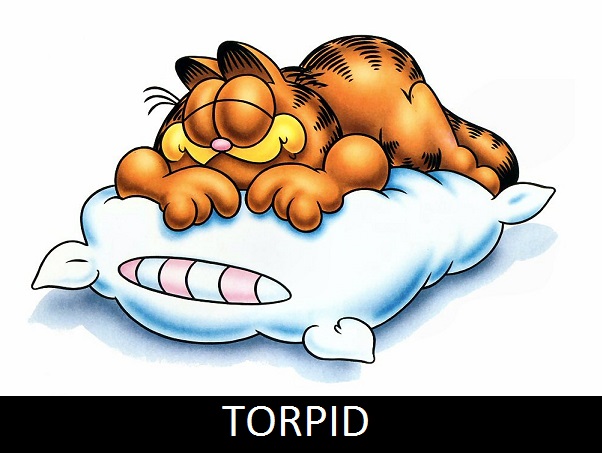
“Torpid” means sleepy, lazy, I-don’t-care. Now, what picture could I use…?

Ah yes.

torpid

Nobody does torpid like Garfield.

And our final word:

turgid – swollen, inflated, pompous

Again, this can mean literally swollen, like a bug bite. But it can also refer to style. A book can be turgid if it has a self-important, pretentious, inflated kind of writing.

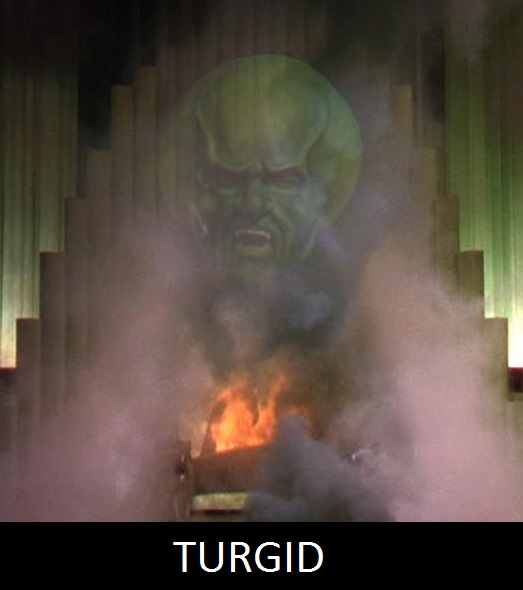
And who’s more self-important, inflated, turgid than the Wizard of Oz?

turgid

So: torrid, torpid, and turgid.

Any questions?

How the HexBug Comes Alive

YES MINISCULE MORTALS I AM THE HEXBUG GENUFLECT IN THE PRESENCE OF YOUR BETTERS

YES PATHETIC MORTALS I AM THE HEXBUG GENUFLECT IN THE PRESENCE OF YOUR BETTERS

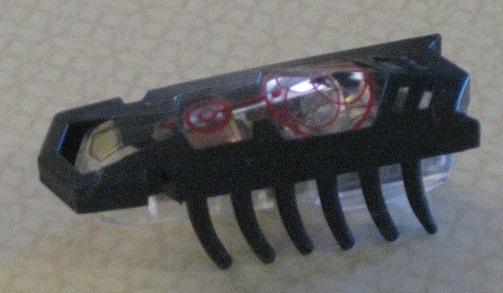
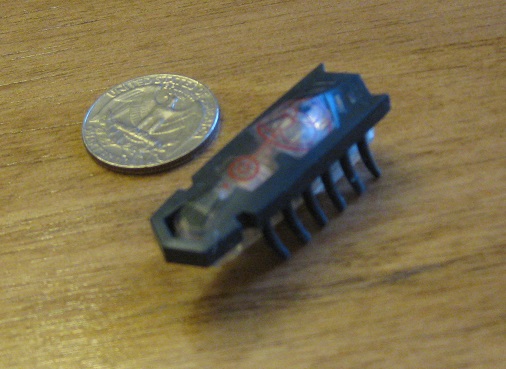
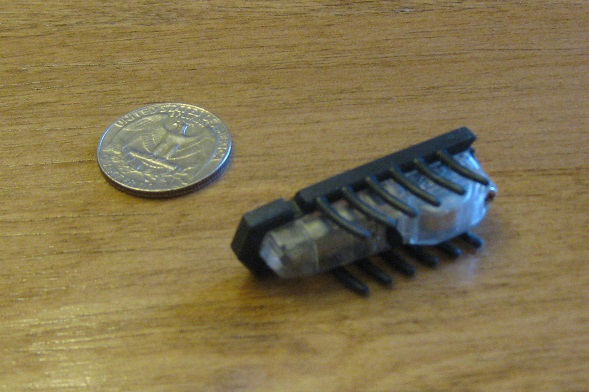
This is the HexBug Nano. I picked it up Friday from Hobby Lobby on a whim.

Sure, it looks simple. But it was only ten bucks, and I’m a sucker for robots. So I bought one.

I’m glad I did.

OBSERVE HOW YOUR TINY EAGLE QUIVERS IN MY PRESENCE UNLEASH THE SINGULARITY

OBSERVE HOW YOUR TINY EAGLE QUIVERS IN MY PRESENCE UNLEASH THE SINGULARITY

As it turns out, the creature really is simple. No assembly, no setup, no way to control it. There’s an on/off switch. That’s it.

What’s more, the robot has no moving parts except a buzzing, vibrating motor in its belly.

That vibration is all it can do. The legs are just rubber attached to the body. There’s no mechanical control there. It doesn’t even have any sensors.

SCRATCH MAH BELLAH

SCRATCH MAH BELLAH

So what can a toy that simple possibly do?

Just watch:

Watch how it skitters across the floor with a slight back-and-forth motion, as if hunting for food. Watch how it seems to avoid walls. Watch how, when I flip it over, it thrashes around till it’s upright again.

Two things about this.

First, it’s an ingenious piece of engineering. It may look simple, but getting the precise shape of the legs to keep it moving forward – the angled head so it turns when it hits a wall – the shape of the back so it flips over when necessary – that represents hundreds of man-hours of design work.

Second, for all its clever craftsmanship, it’s still orders of magnitude less sophisticated than a real insect. A real insect can seek food, evade predators, adapt to its environment, mate, reproduce, and a thousand other things. The HexBug Nano does none of that. And yet, when I watch it in motion, my brain says: That’s a bug!

Why?

Our brains love imparting life and agency to everything we see. If it moves, it’s alive. If it moves unexpectedly, it’s thinking. That’s how we process the world around us.

This human tendency to bestow life on the unliving is a blessing and a curse for A.I. developers. A blessing, because it makes even simple features seem impressive, at least initially. A curse, because we can easily fool ourselves into thinking a piece of software – or even hardware –  is smarter than it really is. We always have to be vigilant against that.

Fortunately, the HexBug isn’t SkyNet just yet.

Friday Link

Just one this week, but it’s a good one. Watch as Canadian astronaut Chris Hadfield explores the age-old question: what happens when you wring out a wash cloth in zero gravity?

The answer is surprisingly cool:

Have a stellar (ah, ha!) weekend. See you Monday!

How Precision Kills Communication

As writers, we feel precision is a good thing. Say what you mean! Pick exactly the right word! Don’t be vague!

But precision can be dangerous.

I was at a tech presentation recently. Someone in the audience asked the expert his opinion on a particular new technology. The questioner didn’t know much about it, so he wondered what the expert thought of it.

“What do you want to know about it?” said the expert. “Performance? Flexibility? Useability? Compatibility?”

What the questioner tried to explain, and what the expert never quite understood, is that he didn’t have a specific question about it. What he had was a huge gap in his knowledge about this new technology, which he quite reasonably hoped the expert could fill. But “tell me about this” is vague, and the expert demanded precision. And so their communication died.

Or maybe I’m talking to someone who wants to send me a file, and they ask if they can “download” it to me. Now, download means to pull a file from elsewhere to your own computer, so sending a file out is technically not downloading. Thus the precise answer to his question is very simple: no, you can’t download it to me. But obviously, the precise answer is not the correct answer. The correct answer is to disregard precision, guess the real meaning, and say “Yes, you can send it to me.”

Both my examples have been about computers, and that’s no coincidence. Computers are exquisitely precise, but they don’t do well with vagueness (although they’re getting better rapidly). Vagueness is largely a human virtue: the ability to think about something in a meaningful way, without tying it down to specific details.

But people who are good with computers often think like computers: good at precision, not so good at vagueness. They may be great at handling known unknowns, where the problem is well-defined, but they’re not so good at unknown unknowns, where the problem is that we don’t know what our problems are.

Naturally, there are plenty of people – in IT and elsewhere – who can walk in both worlds, using precision or vagueness appropriately as the situation demands. Because balance, of course, is the key. Too much vagueness is just as bad as too much precision. The great astronomer Carl Sagan was a master of this: his mind was precise enough to get a PhD in astrophysics, but flexible enough to explain the stars to the average person on TV.

Actually, Carl Sagan just rocked in general. If you haven’t seen Contact, check it out sometime.

Anyway. Yes. Precision, vagueness. (Crap, how do I end this? I don’t have a conclusion.)

Uh, yay for communicating!

oh man that was lame

um, uh

STOP READING IT’S OVER

AI Status Update

I was up till midnight working on it, so I’ll keep this brief:

  • The agent processing algorithm is much faster now.
  • I cleaned up the code, getting rid of a bunch of clutter and making the logic more elegant.
  • Sequence recognition now works to any depth. For instance: a word is a sequence of letters, a phrase is a sequence of words, a sentence is a sequence of phrases. Recognizing deeply “nested” sequences like this turns out to be a lot more complicated than you might expect. My previous algorithm was supposed to handle it, but it was convoluted and buggy. The new version is cleaner and (so far) works 100%.
  • The AI can recognize certain parts of speech (nouns, adjectives, verbs) and construct grammatical relationships between them (e.g. this adjective modifies this noun). It can then use other agents to map the grammar structure (adjective “black” modifies noun “dog”) to a semantic structure (entity “dog” has property “black”). So far this is still in its early stages, but the foundation for building it up is solid.
  • Text-to-speech is fully implemented by calling a free online text-to-speech API. Before, it could type; now, it can talk. Click here for a sample of what its voice sounds like. That’s not a static mp3 file. It’s generated dynamically based on the text you give it.
  • I gave it the ability to load websites on command. So I can type “google” and it can bring up the Google web page. Obviously that’s nothing special in itself, but it’s significant because website-loading is now fully integrated with its other capabilities. For the AI, loading a site is like flexing a muscle.

Gotta run. If you have any questions, just ask!

The Good Stuff Kids Go For

The Good Stuff Kids Go For

Yes, that kid is me. Yes, the plants are marijuana.

No, I was not enslaved by the Caracas-based drug cartel Los Estornudadores from 1989 to 1993.

As it turns out, the stuff grows wild in the fields of Kansas, where one of my relatives used to have a farm. We were actually pulling it up, trying to get rid of it.

And yes, I was at the forefront of early-90’s fashion, thank you for asking. Anyone can harvest drugs in their spare time, but it takes a special kind of person to wear a neon iguana in public.

17 Things to Make with a 3D Printer

The Cube, a personal 3D printer from 3D Systems, Inc.

The Cube, a personal 3D printer from 3D Systems, Inc.

3D printing is here to stay. Personal 3D printers are already available for non-outrageous prices. And like so many technologies, they’re only going to get better – and cheaper. Already, the low-end models give you 200-micron precision and 16 colors, while the high-end models are printing parts for F-18 fighter jets. Plastics are here; other materials, like metal, are coming.

I don’t have one yet, but I’m sure I’ll buy one when the price goes down a little. But what could you make with a 3D printer?

Here are seventeen ideas off the top of my head:

  1. The best Halloween costume ever, custom-designed and perfectly fitted to your body.
  2. 3D fractals! Ben, are you listening? 😀
  3. Picture frames, exactly the size and shape you need.
  4. Jewelry of all kinds: bracelets, necklaces, even rings. Any style you can imagine.
  5. A voodoo doll that looks just like the person you want to, er, vent your frustration on. Disbelief in the voodoo is handy for removing ethical complications!
  6. Action figures of underappreciated characters.
  7. Refrigerator magnets. Go wild.
  8. Personalized Christmas ornaments.
  9. Miniature replicas of famous places like Westminster Abbey or the Arc de Triomphe, or not-so-famous places (like your own house!).
  10. Sculptures: no longer limited by sculpting ability.
  11. Trippy, psychedelic juggling balls. (Glow-in-the-dark printing materials are already available!)
  12. Paper clips shaped like Cthulhic tentacles.
  13. One word: cosplay. (Or is that two words?)
  14. Custom PC cases sweet enough to put Alienware out of business.
  15. N-sided dice for your D&D sessions.
  16. Bookends! A dragon’s-head bookend for the fantasy shelf, a sandworm bookend to complement your sci fi collection, a bust of Ada Lovelace for your programming section. For those of us who still have non-digital books. 🙂
  17. Wedding centerpieces that look like Ambassador Kosh. Because why would you not do this.

So tell me – what would you make with a 3D printer?

Friday Links

nasa

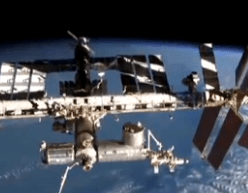
NASA made a cinematic trailer – for the space program. Narrated by the voice of Optimus Prime. Watch “We Are The Explorers.”

hexapod

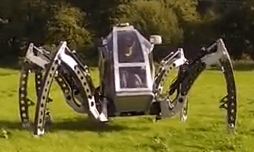
A real-life six-legged all-terrain robot big enough to ride in? Yes please.

deerslap

A deer slap fight. Yes, it’s a real thing. This is what you miss by not living in the Midwest.

And now: COMICS!

dilbert singularity

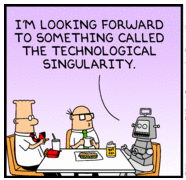
I rarely read Dilbert, or any print comics, anymore. But when they hit the Singularity and Isaac Asimov in the same comic? Even I can’t resist.

xkcd adobe updater

xkcd calls out Adobe.

smbc conversion

SMBC demonstrates the quickest way to convert someone to Christianity.

2gag12gag2

And finally, Two Guys and Guy hits us with a double whammy.

THIS CONCLUDES LINK SHARING HAPPY HOUR WE SHALL RECONVENE MONDAY

Clingstone

Image source: Erik Jacobs, New York Times. Image found here.

Image source: Erik Jacobs, New York Times. Image found here.

The photo above is a real place. Someone really lives in that house on the rock. You can see it on Google Maps, just off the coast of Rhode Island.

It’s called Clingstone. There’s a full gallery of photos if you want to look inside.

I don’t know about you, but for me, Clingstone – the house, the island, the photo, the very idea of it – is captivating.

I’ve written before about my fascination with remote places, but this is a little different. After all, Clingstone isn’t really remote; it sits just a few hundred feet offshore, surrounded by other islands and the city of Newport.

But it’s a place you could go to be alone, and some days, that sounds pretty good.

I was reading somewhere about the difference between introverts and extroverts. For extroverts, being around people is a way to recharge. They draw energy from social interaction. For introverts, it’s the opposite. Interaction costs energy.

If someone invites me to a get-together after work, I hesitate. It’s not that I don’t like people. It’s just that spending time with them is…expensive, even when it’s “free.”

Part of the reason Betsy and I are so happy together, is that spending time with each other is very inexpensive, in terms of energy. We’ve often remarked that when we’re together, we both feel like we’re alone. Not that we don’t talk, or enjoy each other’s company – quite the opposite. But rather, as introverts, the work it takes to be with each other is near zero.

I’m more introverted than she is. I could be alone, totally alone, for a week or so before I’d start to get lonely. For her, I think it’s more like a couple days. But I know people who’d be perfectly happy with months of solitude, and I know people who wouldn’t make it an hour.

What kind of person are you? How long would you want to be alone someplace like Clingstone?

Image

Tom o’ Bedlam’s Song

andromeda