Monthly Archives: April 2013

Two Years and 500 Posts!

This is my 500th post. I hit the two-year mark on March 30.

Hard to believe it’s already been a year since the first anniversary – and how quickly things change. In my very first post, I declared I would blog exclusively about writing, but it wasn’t long before I opened it up to any topic under the moon. Since then, I’ve switched gears from writing to AI, which has worked out pretty well.

I haven’t stopped writing, of course. The Forty-Minute Stories have continued, ranging from the serious to the absurd to the pretentiously literary. I’ve even thrown out some poetry. You’ve endured these trials bravely, Hypothetical Reader, as is your wont.

I’ve tried your patience further with a slew of philosophical excursions. I abandoned Zen enlightenment and meditated on Van Gogh. I asked whether Star Wars is sexist. I explored miswanting and fired a shot at Pascal’s Wager. I looked for the foundations of ethics and the roots of logic.

In between these musings, I dabbled in many arenas. I took up calligraphy, tried my hand at post-election analysis, extracted hydrogen from water and set it on fire, showed off my animation (ahem) skills, and attempted Celtic knots. And I made some arts, including a steampunk Triforce, a Halloween spider, and a pumpkin of terror.

When I wasn’t busy practicing these dubious skills, I pretty much just rambled on about every topic imaginable. I explained that Armageddon is a place. I listed every book I’d read in the past year. I explored the taxonomy of clouds. I showed how to make secret files on your computer, and I gave you a glimpse of the war on Christmas Island. And I did, um, this.

If you like photos, we’ve got those too. I went to Scotland, and also to Ireland. I dressed up as Two-Face for Halloween. To say nothing of other horrors.

I did two themed week collaborations with my friend Ben Trube. First there was Fractal Week (with lots of groovy maths), and then we did AI week (chock full of robotic goodness).

On the personal side, I’ve made strides toward conquering my needle phobia.

And somewhere in all of that, I managed to get Freshly Pressed. You can read my advice on blogging, for what it’s worth.

Now, it seems – as only a writer can – I’m in danger of rambling about rambling. So I’ll cut it short and say the really important thing:

Thank you.

Thank you for reading, thank you for being interested. Thank you for caring. Thank you for coming along on this journey to Somewhere.

In celebration of this milestone, I therefore declare this post an official de-lurking post! If you’ve never commented before, leave a comment now! If you’re not sure what to put in your comment, just write “Sasquatch.” I won’t judge you, Hypothetical Reader. People in glass blogs shouldn’t cast stones, or something like that.

Non-lurkers are also welcome to comment, of course.

If you’ve made it this far, congratulations – and you may as well stick around a while longer. We’re not done yet!


Your Blog Followers Are Probably Spammers

If you have a WordPress.com blog, your followers are spammers. Not all of them, certainly. But probably some of them, perhaps even most of them.

I’ve been suspicious for a while. I saw my follower count shoot up recently, but I had no idea why. I wasn’t getting more hits. I hadn’t been featured on any big websites. There was no reason for it I could think of. But I never really looked into it.

Yesterday, I looked into it.

WordPress claims I have 259 followers. Let’s see who they are.

For starters, there’s “biggerandwaybetter,” whose icon is a well-endowed woman in a bikini. She runs the entrepreneurial blog “magnettomoney.” Then we have “lennalorette,” a women’s fashion business that’s apparently also very interested in AI and philosophy. Another of my loyal readers is an Indonesian tour company who seemingly got very inspired on April 12, as that’s the date of every single one of their posts.

Yeah.

I don’t have the time or inclination to sort through the whole list, separating the legit readers (you guys!) from the junk, especially when I get new “followers” daily. And even if I did make the effort, there’s nothing I could do about it. You can’t make someone unfollow you, or put them in a separate category, or really do anything at all.

So far, WordPress hardly even acknowledges there’s a problem. I still get a breathlessly excited “Congratulations” e-mail on each new chunk of spam, along with the helpful suggestion that I “might want to go see what they’re up to! Perhaps you will like their blog as much as they liked yours!”

And really, is there a problem? It’s a fair question. After all, who really cares? If spammers want to follow your blog, why worry about it? Just ignore them, right?

Well, yes and no. Yes, as problems go, it’s pretty minor. But it does prove that the follower system is broken. I can no longer browse my readers’ websites in any meaningful way. And the total number of followers, which used to be meaningful, no longer is.

Anyone else had this problem? What do you do about it?

The Singularity Club

singularity

Four days ago, I joined SingularityHub.com, a site with news, discussion, and videos related to the Technological Singularity, the so-called “Rapture of the Nerds.” To become a member of this site, you don’t need to be an AI researcher, a neuroscientist, a billionaire investor, anything like that.

You just need to be, well, a fan.

I’ve been exploring this corner of the Interwebs lately, and an odd little corner it is. The heavyweight is the Singularity University, a surprisingly well-connected group funded by the likes of Google, Cisco, Nokia, and Autodesk (creator of AutoCAD).

And there’s the 2045 Intiative, a group founded by Russian billionaire Dmitry Itskov, dedicated to “the transfer of a individual’s personality to a more advanced non-biological carrier, and extending life, including to the point of immortality.” Project deadline: 2045.

Mega-projects aside, you’ve got blogs like Accelerating Future, Singularity Weblog, and Transhumanity.net.

And, of course, Singularity thinkers like Ray Kurzweil and Eliezer Yudkowsky have their own online presence. Kurzweil, incidentally, was hired by Google a few months ago. His first time working for a company he didn’t create.

The Singularity research/enthusiast community is, as I said, a strange little group. Websites are a mix of real news about promising present-day tech, debates about philosophy and spirituality and robotics, and bona fide major efforts to bring this vision of the future a little closer to reality.

The common link in all this group is that people really believe. They know it sounds crazy, but then, the truth often does.

What do I think about all this?

Well, as I wrote last year, I believe the Singularity is real, and I believe it is coming. Maybe not in our lifetimes, but it’s coming. I am very much a part of the strange little group. I honestly think it’s a real possibility that some human beings alive today will live to see their one millionth birthday.

I, too, am conscious of how ridiculous this sounds. I know the Internet is teeming with these fringe micro-groups that feed on each other’s delusions until they’re convinced that their tiny groupthink vision is a prophecy for all mankind. I get that.

And yet.

A billion years ago, multi-celled organisms were a novelty. A million years ago, there was no such thing as language. A thousand years ago, electricity was nothing more than an angry flash in the sky. A hundred years ago, the whole idea of airplanes was still strange and new. Ten years ago, smartphones were only for the early adopters.

Today, telekinesis is real. Lockheed Martin has a quantum computer. And Moore’s Law, despite constant predictions otherwise, hasn’t failed us in forty years.

Am I really supposed to look at all that, and not believe we’re headed toward something?

Descending Vectors

The stars are falling – his first thought, upon
The sight of snow, before today unseen;
Descending vectors, fractal-point are drawn
Across the vision-scope of the machine.
The robot’s palm extends; his pixeled eyes
Record, by frames, what metal cannot feel
And neural nets unbidden analyze
The sight of frozen water over steel.
Behind him stands the conference hall, whose door
Projects inviting warmth on salted stairs –
And here, in laughing groups of two and four
(And wrapped in coats of other mammals’ hairs)
The first distinguished scientists arrive
To argue over whether he’s alive.

I wrote that when I was twenty years old.

Animals Don’t Help

A non-helping animal. I photographed him in my yard last Sunday, contributing nothing to society.

A non-helping animal. I photographed him in my yard last Sunday, contributing nothing to society.

Some pretty weird stuff ends up in spam filters.

My good friend Ben Trube recently got spam containing an entire short story mangled up with shoe ads.

The other day, I got this:

I’m mad and that’s a fact I found out animals don’t help Animals think they’re pretty smart Shit on the ground, see in the dark

It was all one line, but the capitalization suggests line breaks:

I’m mad and that’s a fact
I found out animals don’t help
Animals think they’re pretty smart
Shit on the ground, see in the dark

Not prose at all, but poetry.

And what poetry! Note the ambiguity of “mad.” Is our poet merely livid, or openly insane? Too, savor the implicit question: is there a difference? Already we’ve embarked on a tragedy redolent of Lear.

Our unnamed poet (O poignant anonymity!) is concerned with fact. His is a rational worldview, a fair-minded outlook: naive, perhaps, but thoughtful. He goes about his daily business: helping, shitting in toilets, exercising vision only by daylight. He merely assumed the rest of the planet was as lofty-minded as himself.

Alas, that is not the Earth we live on. Imagine the devastating revelation: these animals, billions on billions of them, aren’t helping at all. Armies of meerkats, unemployed. Hordes of hippopotamuses, spurning our ceramic receptacles, literally shitting on the ground. Owls, staying up all hours and leering at Lord-knows-what in the shadows.

You may sneer, gentle reader, at his simplicity. Your vaunted culture, your bourgeois “education,” have left you jaded and superior. You cannot know his pain: an agony that, evidently, drove him out of his chosen career (“helping”) and forced him to spam blog comments for pennies in a thankless economy.

So I salute you, Nameless Poet. Though I shall not click your link and risk infection by malware, you indeed have already clicked the link – of my heart. Excelsior!

And to the rabbits shitting in my yard:

Guys. Seriously. It’s called a toilet. Look it up.

On Reading Moby-Dick

Mobimus-Dickimus

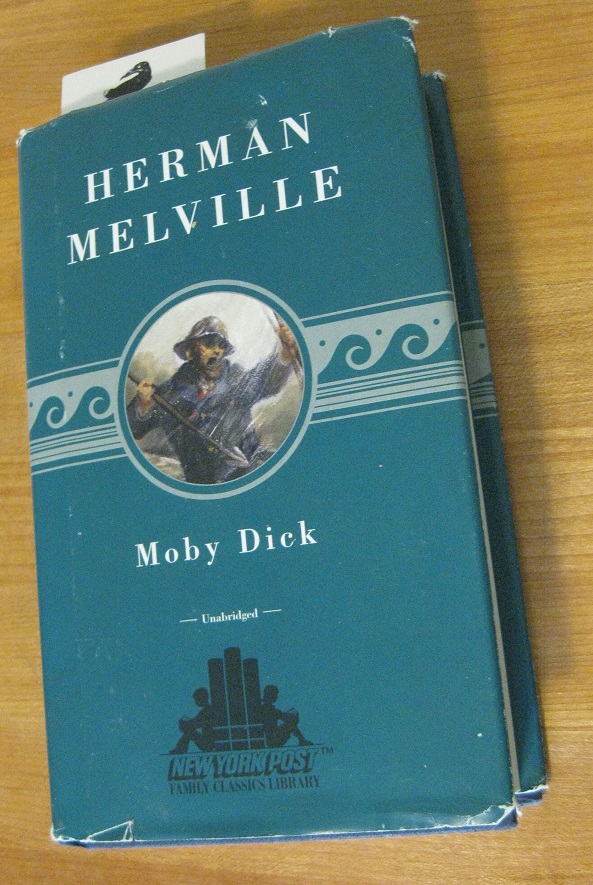
My copy.

Moby-Dick, by Herman Melville, was published in 1851. It received a few scathing reviews and was quickly forgotten. It wasn’t until the 1920s, during the so-called Melville Revival, that the novel was “discovered” as a major literary work, and college professors have been calling it a masterpiece ever since.

I’m reading it for the first time now, about a quarter of the way done. So far, I think the scorn and the praise both make perfect sense.

Moby-Dick is not an adventure story in the usual way. It is an adventure, but the text doesn’t hold to the main avenue of the plot. It wanders down meandering alleys, pointing out odd landmarks and exploring the districts where tourists don’t go. Melville shows us his characters, but he also shows us religion, philosophy, history, biology, the ocean and all it’s about and all it represents.

As a result, your enjoyment of the novel depends largely on how much you like (or tolerate) these excursions from the main narrative. Personally, I love philosophy and religious debates and poetic musings on the waves, so I’m liking it pretty well so far. (Again, only 25% done.) But if you just want to see what happens with Captain Ahab and his white whale, and if you see the rest of it as excess baggage, then you’re in for a long ride.

One huge factor is the expectations game. Several of my friends had already warned me away from the book, citing these hardships. I knew its reputation as a thick, difficult masterpiece. I knew what I was in for. That made the whole thing much more enjoyable than if I’d gone in looking for a brisk plot and gotten blindsided.

That said, the book isn’t nearly as difficult as I feared. The pleasure-to-pain ratio is much higher than, say, Joyce’s Ulysses or (God help us) Finnegans Wake. Despite all his excursions and wanderings, Melville is an able and amiable tour guide. You may not go where you expected, but you won’t get lost.

There are some things I don’t like. The main character, Ishmael, who narrates the story in first person, is probably my biggest gripe. As a window into the world of Moby-Dick, he’s fine, but as a character in his own right, he’s pretty bland. I don’t have much of a sense of who he is. I don’t love him or hate him. He’s just kind of there, which is a sharp contrast to the strongly drawn portraits of Ahab, Queequeg, and the rest.

I also didn’t much care for the infamous chapters devoted to detailed breakdowns of whale biology and taxonomy. The problem wasn’t, as I expected, the dryness or the apparent irrelevance; I actually like reading about whales for their own sake, so I didn’t mind that. The problem was the style. Melville writes:

It is some systematized exhibition of the whale in his broad genera, that I would now fain put before you. Yet is it no easy task. The classification of the constituents of a chaos, nothing less is here essayed…

Look, I don’t care if this chapter is disconnected from the plot. That’s fine. But if you’re going to be irrelevant, get on with it.

But the novel’s peaks more than compensate for the valleys.

In the scene I’m reading now, Captain Ahab reveals to his crew that this is no ordinary whaling trip. He’s got his eye on one prize in particular, the creature that took his leg. His first mate, Starbuck, reprimands him for seeking revenge on a mere animal:

“Vengeance on a dumb brute!” cried Starbuck, “that simply smote thee from blindest instinct! Madness! To be enraged with a dumb thing, Captain Ahab, seems blasphemous.”

Ahab responds:

“[…] All visible objects, man, are but as pasteboard masks. But in each event—in the living act, the undoubted deed—there, some unknown but still reasoning thing puts forth the mouldings of its features from behind the unreasoning mask. If man will strike, strike through the mask! How can the prisoner reach outside except by thrusting through the wall? To me, the white whale is that wall, shoved near to me. Sometimes I think there’s naught beyond. But ’tis enough. He tasks me; he heaps me; I see in him outrageous strength, with an inscrutable malice sinewing it. That inscrutable thing is chiefly what I hate; and be the white whale agent, or be the white whale principal, I will wreak that hate upon him. Talk not to me of blasphemy, man; I’d strike the sun if it insulted me. […]”

For an answer like that, yes indeed, I will keep reading.

Friday Links

Sadman

ThinkGeek’s April Fools’ Day prank was fantastic: a Batman family car decal set. Only question: why is this a prank and not a real thing I can throw my money at right now?

mobbin

The classiest damn flash mob I’ve ever seen. If the people will not come to Star Wars, bring Star Wars to the people!

ennui

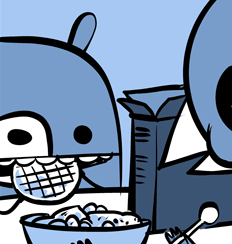
I don’t often link to the webcomic Nedroid, but it’s glorious. Here’s proof.

pvpin

And PvP tackles racism in its own uniquely insightful way.

By the way – remember that unspeakably awful book I linked to last week? The Bible: The Miniseries: The Novel? I actually saw that, in real life, a couple days ago. At a local Kroger, available for $20.

Faith in humanity = lost.

*watches Star Wars flash mob again*

Faith in humanity = restored.

Have a supremely suave weekend, Hypothetical Reader. See you Monday!

Worst. Book Ideas. Ever.

Three years ago, I entered a contest on some writer’s blog (I think Scalzi). It was simple: come up with the worst imaginable idea for a novel, then write a one-sentence sales pitch for it.

I wrote two.

I didn’t win the contest. But I stumbled across my entries again today, and they still make me laugh, three years later.

So here they are, the two worst novel ideas in the universe (or at least in Brian’s head):

Marcus, a double amnesiac, has forgotten that he forgot everything and lives in a state of vague uncertainty; later, when the first (but not the second) amnesia spontaneously reverses itself, he is forced to reconcile a full lifetime of memories with the unshakable conviction that he does, in fact, have some sort of amnesia.

When Erica learns she is the protagonist in a work of fiction, she gets revenge on the author by deliberately living as boring a life as possible, to hurt the book’s sales; but when the author retaliates by shifting focus to another character, can she convince the new protagonist to also be boring in time to ruin the plot?

Well? Would you pick up either of these books in a Barnes & Noble? 🙂

What’s the worst book (or book idea) you’ve heard of?

Poison Ivy is High in Fiber

You see “All-Natural” on a lot of labels. Foods, vitamins, herbal supplements.

All-natural. No artificial ingredients. This is supposed to be a good thing: the full healing and nourishing power of nature, without any toxic chemicals added by Man.

Chemicals are bad. We don’t like chemicals. Artificial is bad, too. We want all-natural. Filled with nature’s goodness.

Can I say something about nature? Nature has been trying to kill us for two and a half million years. The only reason we exist, as a species, is that we’re better than our ancestors at not being murdered by nature.

Here is a list of things which are all-natural:

  • poison ivy
  • the bubonic plague
  • rats, infested with fleas, that have the bubonic plague
  • tsunami
  • malaria
  • toenail fungus
  • Komodo dragons

Check out this sweet all-natural mushroom:

Take a bite of this. It tastes good! You just found a great-tasting mushroom, you’re having an excellent day. A few days later, you start throwing up. Weird, but probably unrelated to those cool mushrooms you found, huh? Then delirium, seizures, coma. In a couple of weeks you’re dead.

You’ve just experienced the all-natural healing power of the “death cap” mushroom. As a side exercise, see if you can guess why it’s called that.

What about “chemicals?” We don’t like chemicals, right?

Great. Here’s a short list of common chemicals you’ll want to avoid:

  • water
  • vitamin C
  • calcium

And, of course, we don’t want anything artificial. So when you drink your non-water-based natural beverages, be sure you don’t use a cup. Cups are man-made and artificial. Drink from your hands. And if you don’t want to drink it cold, hopefully you can find a fire burning naturally in the wild to heat it up for you.

Don’t read blogs. The Internet is artificial. Actually, reading is artificial. So are houses, clothes, and spoons. So here’s what I want you to do: sit naked on a rock, and don’t drink any water ever, and don’t read anything ever. All natural, chemical-free, problem solved.

I’ve probably made my point.

Look, there are a ton of horrible chemicals in the food we eat. I get that. Fresh fruits and vegetables are better for you than food pumped full of preservatives. I get that too. 90% of the stuff on grocery shelves today is crap, and you have to be careful what you eat. No doubt about any of that.

But the idea that “all-natural” is automatically good, or “chemicals” are automatically bad, is sheer ignorance. And thousands of people in marketing make a living by trying to keep you ignorant.

Why give them the satisfaction?

Image

Take Note

I'm Bringing Sexy Bach