‘As to poetry, you know,’ said Humpty Dumpty, stretching out one of his great hands, ‘I can repeat poetry as well as other folk, if it comes to that—’
‘Oh, it needn’t come to that!’ Alice hastily said …
-Lewis Carroll, Through the Looking-Glass

‘As to poetry, you know,’ said Humpty Dumpty, stretching out one of his great hands, ‘I can repeat poetry as well as other folk, if it comes to that—’
‘Oh, it needn’t come to that!’ Alice hastily said …
-Lewis Carroll, Through the Looking-Glass
‘So much obliged!’ added Tweedledee. ‘You like poetry?’
‘Ye-es, pretty well—SOME poetry,’ Alice said doubtfully.
-Lewis Carroll, Through the Looking-Glass
And now for this week’s episode of Brian Complains Like a Bitter Old Man (currently in its twenty-fifth season).
Have you ever gotten a bill where the due date says “Due Upon Receipt”? Why do they do this? It’s silly, it’s unhelpful, it doesn’t make any sense.
I get it: they want their money as soon as possible. Everyone wants money as soon as possible. It’s money.
But a due date isn’t for when you want something, it’s for when you need something. That is, it’s the point after which bad things start to happen.
So are they saying that you absolutely must pay the bill as soon as you get it? Of course not (and that would be awfully rude if so).
Can you wait a week to pay it? Almost certainly. Can you wait six months? Almost certainly not. Is there a point between those two extremes where they will start to get upset that you haven’t paid? Yes, and that point is called the due date, and they know when it is, so just tell us when it is.
Argh.
Rant over. Please continue your day.
Posted in Uncategorized
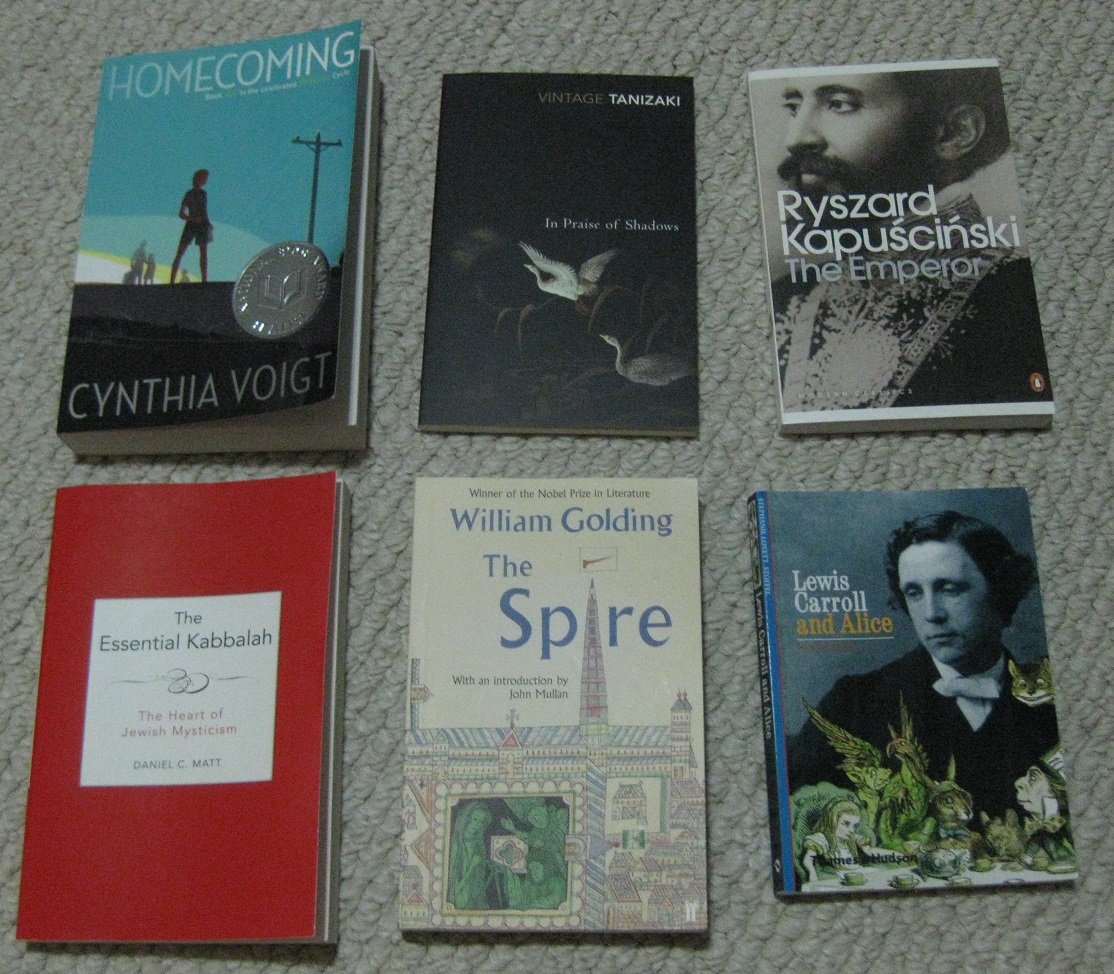
One of the best things about vacation is having time to read. I finished six books in the past week.
Homecoming by Cynthia Voigt. A novel about four kids – ages thirteen, ten, nine, and six – abandoned by their mom in a parking lot, who must travel hundreds of miles with very little money, and without being discovered by authorities (who might split them up to put them in foster homes). This book is amazing, one of those rare stories that starts strong, stays good through the middle, and has a satisfying ending. Good characters, fascinating insight into the dynamics, relationships, and power structures that kids will form with each other when left to their own devices. Ultimately it’s a book about family, but with none of the syrupy sweetness that normally implies. My highest recommendation.
In Praise of Shadows by Junichiro Tanizaki (translated by Thomas J. Harper & Edward G. Seidensticker). Nonfiction about how darkness – the literal kind, a lack of photons – is aesthetically superior to bright light in architecture, art, fashion, and other areas. Tanizaki argues that traditional Japanese aesthetics honored darkness, whereas modern and Western trends have lost the old subtlety of shadow. It’s an intriguing idea, but sadly, the book is mostly just Tanizaki rambling illogically about how everything was better in his day and these young’uns and for’gners are ruining the country. He starts by explaining how he spent tons of money trying to remodel a modern house into the old style, to meet his sense of aesthetics, then explains that Japanese culture embraces shadow because they can accept life as it is and don’t need to change everything. A short book, but shorter if you don’t read it, which is what I’d suggest.
The Emperor by Ryszard Kapuściński (translated by William R. Brand & Katarzyna Mroczkowska-Brand). Nonfiction about the last years and downfall of the final Emperor of Ethiopia, Haile Selassie. A fascinating look inside an imperial court that was largely disconnected from reality, concerned mostly with maintaining its own power and image, warping the truth 1984-style to do so. Courtiers had absurd jobs; the sole duty of one man was opening doors for the Emperor (a more difficult job than you might think, due to fastidious protocol), while another man was charged with cleaning dignitaries’ shoes when the Emperor’s lapdog, Lulu, peed on them. The pettiness of the power struggles, the way everyone fawned over the Emperor like a god, the terrible danger that hung constantly over all of them – it’s a whole other world, recreated with some masterful detective work by the author.
The Essential Kabbalah by Daniel C. Matt. An introductory essay to give context, followed by selections from various Kabbalah texts, designed to give a newbie like me some idea of what Kabbalah is all about. (I’m researching the subject as one of the many sources for Crane Girl). If you’re wondering, Kabbalah is Jewish mysticism, using meditation and other techniques to approach a direct experience of the Divine. Its function is similar to Zen Buddhism, Sufi Islam, and Christian monasticism, though its form is very different, relying heavily on a structure of ten interconnected points called “sefirot” that collectively give insight into the nature of God and humanity. It’s an interesting little book.
The Spire by William Golding. A novel by the author of Lord of the Flies. This story is about the dean of a cathedral who orders a vast tower and spire built at the cathedral’s peak, even though the master builder says it’s unsafe and everyone else in the world says it’s a terrible idea. (Spoiler alert: it is.) While there are some glimmers of quality here, I thought it was pretty bad overall. The Spire retains and exaggerates all the flaws of Lord of the Flies (overly thick allegory, characters who feel more like symbols than people, trying too hard to Say Something Important) but has none of its virtues (clarity, strong plot, likable protagonist, the sense of a profound message). In The Spire, it’s often hard to tell what’s going on, and there’s little reason to try. My vote: skip it.
Lewis Carroll and Alice by Stephanie Lovett Stoffel. A nice little biography of Carroll, packed with photos and reproductions, supplemented with selections of Carroll’s lesser-known writing (like Sylvie and Bruno) at the end. Enlightening and enjoyable. The book did portray Carroll in a very positive light, so much so that I sometimes wondered about bias, but I don’t know enough about the man to judge for myself. Side note: the publishers didn’t bother to put the author’s name anywhere on the front or back cover, which seems like a real slap in the face.
The Maze Runner by James Dashner. A Young Adult sci-fi dystopian novel, in roughly the same vein as The Hunger Games, about a bunch of boys trapped in a giant, mysterious maze from which they must escape, overcoming all sorts of deadly horrors. Except that Hunger Games is fast-paced, tightly written, and engaging, whereas Maze Runner is slow, full of awkward sentences, and spends a long time explaining stuff while nothing much is happening. I read the first few chapters, got bored, and skimmed through the rest to see what the big secret of the maze was. It turns out to be a huge surprise – if you’ve never read any other science fiction, ever. Honestly, I’m not sure how this became a bestseller. It isn’t just that I didn’t like it, it didn’t seem like something that would have wide appeal in general. C’est la vie. (Not pictured in photo above because I didn’t take it home with me from England.)
Read anything good lately?
Betsy and I are back from a week in the UK – primarily Oxford, with day trips to Cardiff (the capital of Wales) and Birmingham.
Pictures! Click to enlarge.

Christ Church Cathedral, part of the Christ Church college in Oxford University. Stunning architecture here, Gothic windows and tall pillars, that photos (or at least my photos) can’t adequately capture. The word “hallowed” comes to mind. One of my favorite parts of the trip. Incidentally, the Christ Church dining hall was used as the Hogwarts dining hall in the Harry Potter movies, and the resemblance is obvious once you get there.
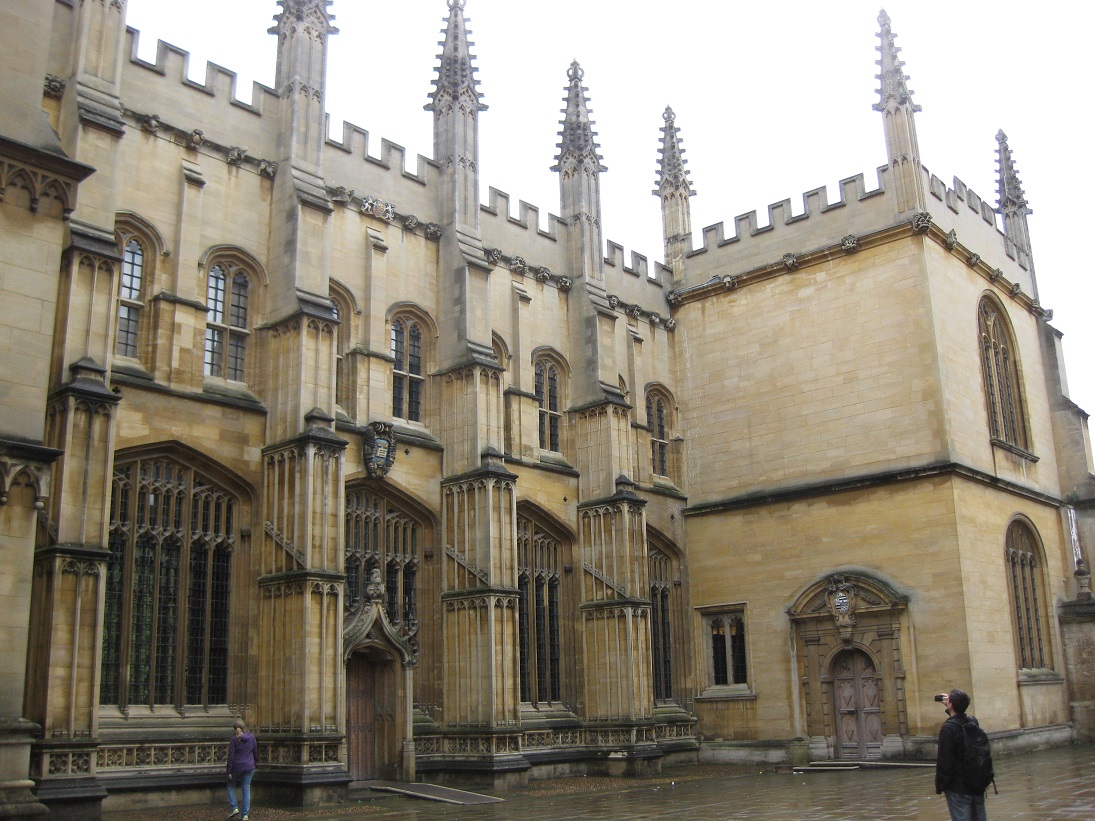
Oxford University summed up in a single image: ancient looming buildings, gray weather, and tourists. Except that makes it sound awful, whereas Oxford is actually charming and full of stories.
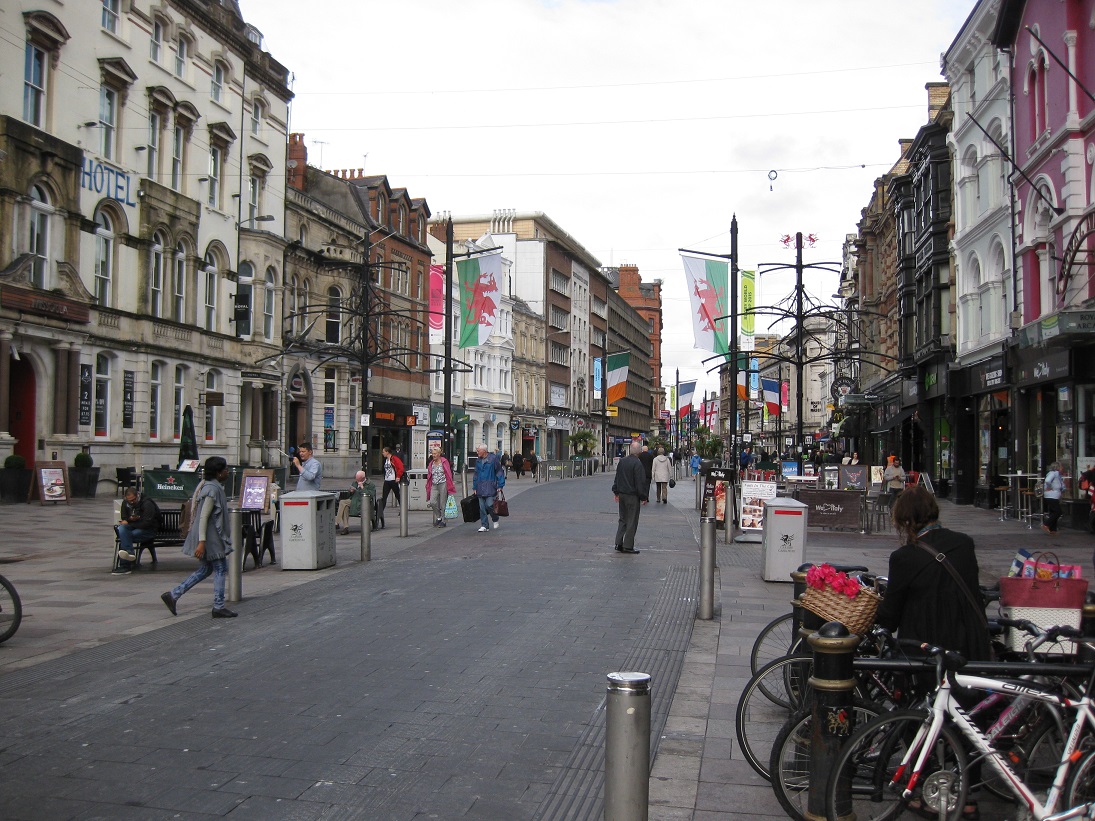
Cardiff, Wales. From the eight hours or so we spent there, Wales doesn’t seem – superficially – too different from England. You do see a lot of Welsh flags everywhere, much like Texas is full of Texan flags (but isn’t that different from Oklahoma). Those green and white flags with the red dragons, those are the Welsh flags. Also, lots of signs are in English and Welsh, which is interesting (linguistically) and annoying (practically).
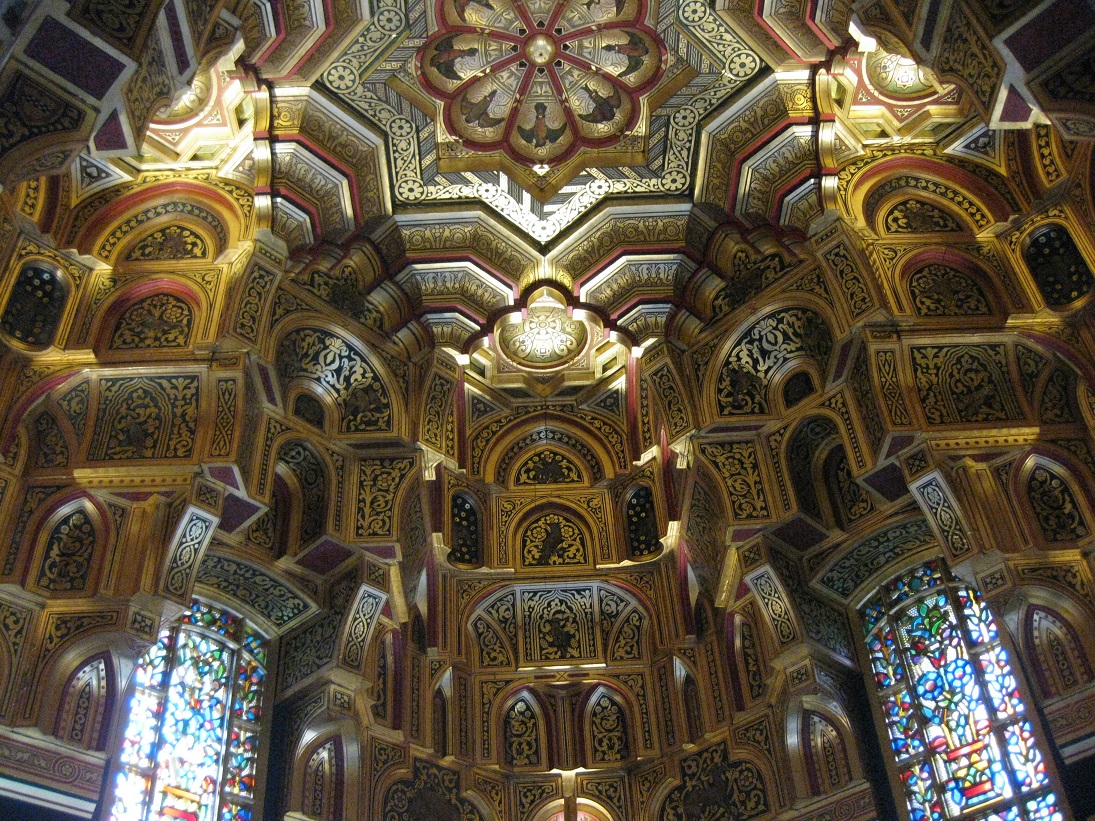
The so-called Arab Room in the old residence area of Cardiff Castle (“Castell Caerdydd” in Welsh).

The central keep of Cardiff Castle, almost a thousand years old, surrounded by a nearly dry moat. Beautiful, but the ancient spiral staircases are hard stone and so incredibly steep that I’m surprised people don’t die on them every year. Or, who knows, maybe they do.
We did see a lot more in Cardiff than just the castle. Among other things: I was captivated by Cezanne’s painting “Provençal Landscape” in the museum; we stopped at a Forbidden Planet store, where I found (but didn’t buy) Claudia Christian’s autobiography Babylon Confidential; and we had a fabulous dinner at a place called Pie Minister, complete with a tall glass of Milk Stout.
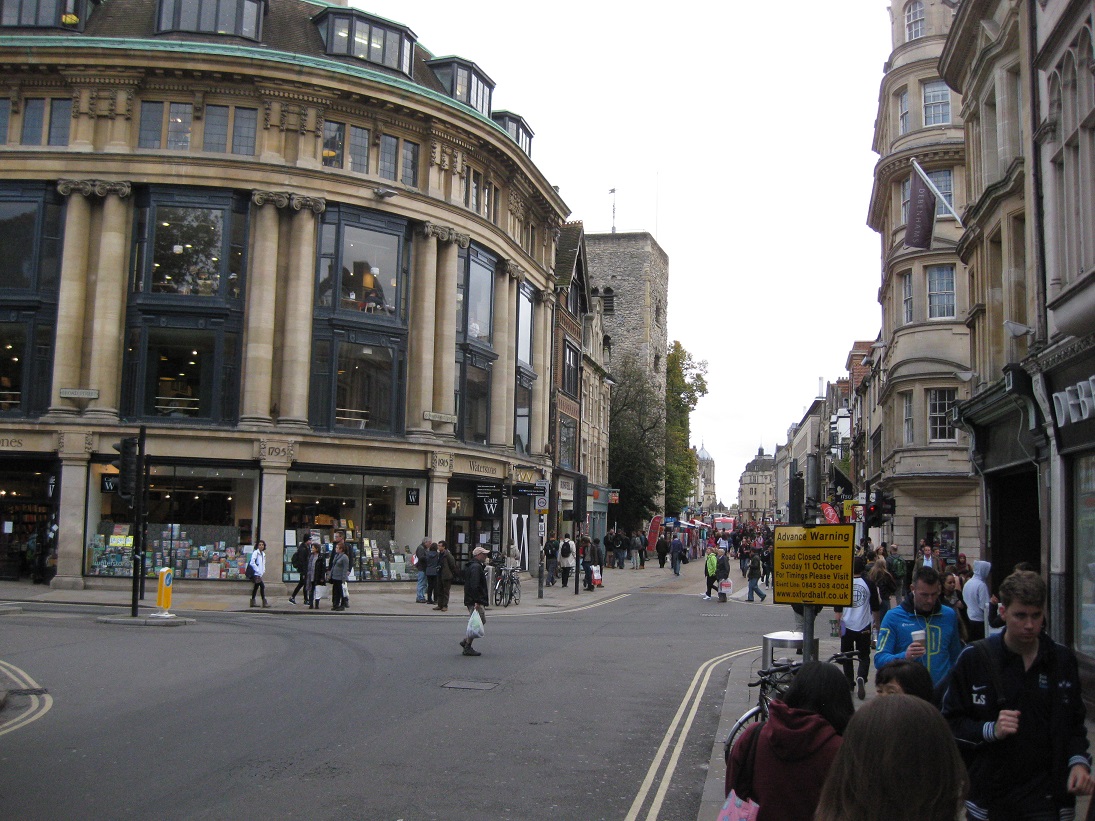
A typical street scene in Oxford, near our hotel. That’s Waterstones book store on the left. Oxford is very much a walking city, with many whole streets set aside for pedestrians. I was surprised at the sheer volume of foot traffic. Getting around in the city consists largely of dodging other people – which is tricky, because they’re also trying to dodge you, and if you both dodge in the same direction, then neither of you has dodged anything and you have to try again.

St. Martin’s Church in Birmingham. Here, as in so many other places in the UK, I’m struck by the juxtaposition of the solemn and ancient with the sleek and modern. On the left is the Bullring, a huge multi-level shopping center, while on the right (not visible in the photo) is the Rag Market, an open-air shopping area that’s fun to explore, but which sells, uh, mostly crap.

A house boat on an Oxford canal, evidently owned by someone with a literary bent. The whole city is crammed full of literary stuff, which is hardly surprising: the university has been home, at one time or another, to Lewis Carroll, J. R. R. Tolkien, C. S. Lewis, the Oxford comma, and the Oxford English Dictionary, to name just a few (not to mention the Harry Potter connection I mentioned before). Incidentally, this particular stanza is from the poem “The Temeraire,” by Herman Melville. American poetry, represent!

An original first-edition copy of Alice’s Adventures in Wonderland, in the Oxford University Press Museum. This tiny museum is open to the public by appointment only, so Betsy and I and another couple – four in all – were the only ones there aside from our guide, the friendly and knowledgeable Dr. Martin Maw, Archivist for the Oxford University Press.

The Oxford English Dictionary was an early example of crowdsourcing, long before “crowdsourcing” was ever a word. Countless word enthusiasts from all over the country sent in words, definitions, examples from literature, and etymologies. Above are handwritten notes from authors Thomas Hardy, Kenneth Grahame, and J. R. R. Tolkien. A fascinating little museum, at least for people like me.
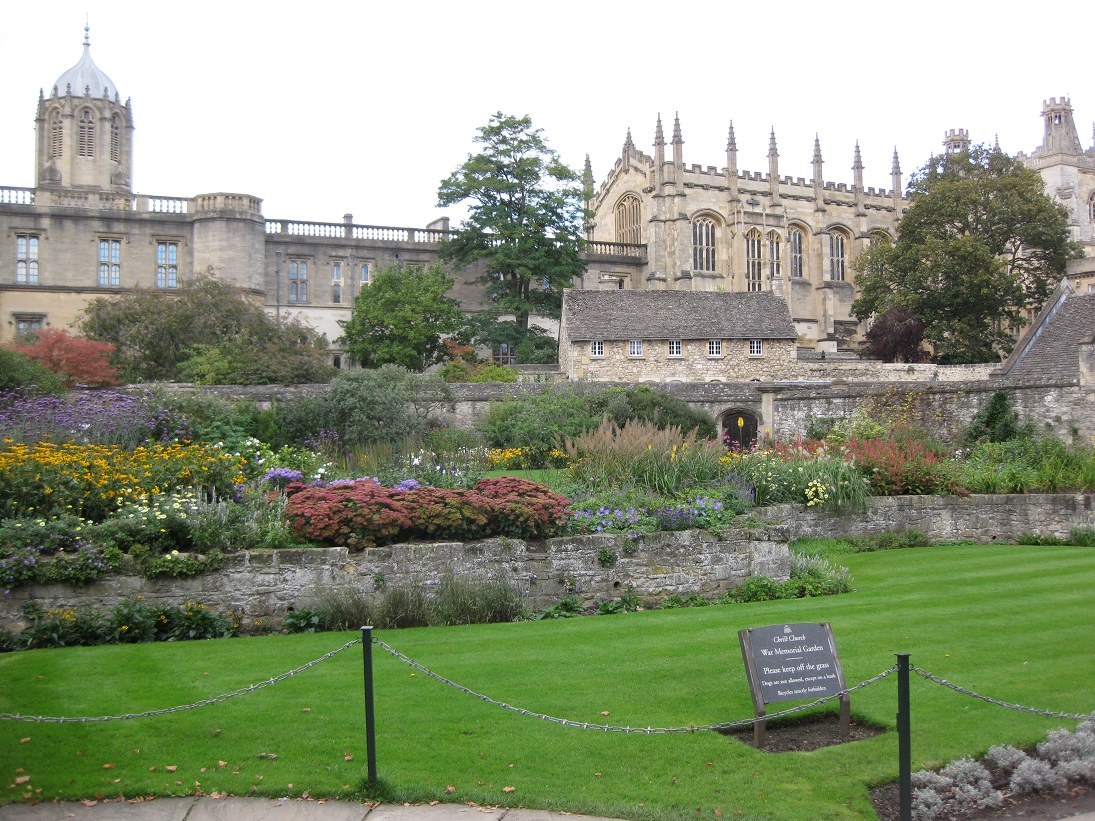
Another view of Christ Church, Oxford, beautiful outside as well as inside. That’s Tom’s Tower in the background on the left.

A couple of souvenirs. That’s Alice on the left, of course, a print of one of John Tenniel’s original illustrations, which I bought from Alice’s Shop on St. Aldate’s Street. On the right is Willow, from that Forbidden Planet in Cardiff, an anniversary gift from Betsy. Alice and Willow: two ladies who know a little something about the dangers of magic (and dreams).
Anyway, Betsy and I did lots of other stuff too, but this post is already pretty long and I’ve gotta get moving. How was your week?
Posted in Uncategorized
Apple CEO Tim Cook calls digital privacy “a fundamental human right.” I haven’t followed Apple closely enough to know if that’s a real commitment or just smoke and mirrors. But even if it’s the latter, it’s a good sentiment and a good thing to add to the public discussion, especially when other tech giants suggest from time to time that privacy is over, or doesn’t matter anymore.
A study finds that the benefits of talk therapy for depression have been overstated. Even more interesting (to me), the problem was not in any particular study, but in the larger system of scientific publication. Studies that find an effective treatment (i.e. talk therapy works) are more likely to get published than studies that don’t, leading to a systemic selection bias. As always, the filter matters. To quote Mr. Spock: fascinating.
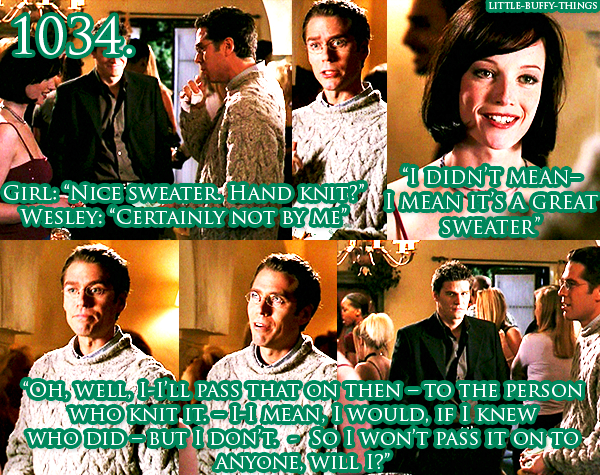
Finally, a little snippet from Angel that pretty much sums up my attempts at flirting in college:
The best thing about marriage is being with Betsy. But the second-best thing about marriage is that I don’t have to try and pick up ladies anymore. Because, damn.
That is all. Have a frabjous weekend!
#246: 9/8/2015
“Penny Lane” flows from
my dark, reticent speakers,
calling on old homes.
#247: 9/8/2015
Just like poetry,
wildfire surges and consumes,
guided by stern tools.
#248: 9/8/2015
Like castles of old,
today’s fortresses stand fast,
founded on pixels.
#249: 9/8/2015
Flowers are patient.
No meetings, nowhere to go,
sun-touched and sky-soft.
#250: 9/8/2015
Each new beginning
carries a whiff of failure.
Therein lies the test.
#251: 9/8/2015
Pair of sandwiches
await, mute, oblivious,
their executions.
#252: 9/8/2015
Betsy and Brian
take afternoon walks, explore,
whisper together.
#253: 9/8/2015
Little plastic Thor
stands in my kitchen, god of
thunder and pastries.
#254: 9/9/2015
Heavy ambition
means light sleep, furtive hours
snatched like fireflies.
#255: 9/11/2015
Morning by morning
Nature marks her round canvas –
blind, but full of light.
#256: 9/11/2015
Deep in the basement
what creeps on unfinished walls?
Here there be dragons.
#257: 9/13/2015
Washer and coffee,
heater and Betsy and I
stir, yawn, and arise.
#258: 9/13/2015
What fathomless hand
has scoured our firmament? Where
did it take our clouds?
#259: 9/14/2015
Day of laziness.
Mind creeps, craving and fearing
useful energy.
#260: 9/15/2015
One more day adjourns.
I draw up tomorrow’s plans,
hoping I can build.
#261: 9/16/2015
Rough air, placid earth,
pearls of dew, flames of the sun.
Four-element day.
#262: 9/17/2015
Today’s proud giants
loom on streets, rectangle heads,
selling svelte perfume.
#263: 9/18/2015
Present will be past,
future will be past. This, our
deepest mystery.
#264: 9/19/2015
This close to midnight,
scent of tomorrow seeps in,
warning, beckoning.
#265: 9/21/2015
Fresh week, fresh journeys,
morning by morning, grasping
unsullied secrets.
#266: 9/21/2015
Ah! Thumbprint cookies,
each stamped with Betsy’s sigil,
filled with love and jam.
#267: 9/22/2015
Stories spin like plates,
flouting doubt and gravity,
magically mundane.
#268: 9/23/2015
Early morning rise,
grasping dawn cold-fingered till
it evaporates.
#269: 9/24/2015
Whose songs are these? Whose
hymns chant at midnight, whose notes
whisper midday myths?
#270: 9/25/2015
“Draft”: a word that means
text to edit, or cold ale.
Hmm … coincidence?
#271: 10/1/2015
Who can synthesize
laziness and energy,
can invent all things.
#272: 10/1/2015
In the barefoot world,
none dream of cotton cocoons.
Socks are miracles.
#273: 10/1/2015
When am I grown up?
Will I get a plaque when I’m
not the child I was?
#274: 10/1/2015
All you need is love:
two of us wearing raincoats
when I’m sixty-four.
#275: 10/1/2015
Listen! Rushing ants
scout the earth’s secret places,
scribbling obscure maps.


 Brian D. Buckley