Category Archives: Uncategorized

Go East, Young Man

Putin on the Ritz!

Photo quality is directly proportional to amount of coffee consumed.

A lot’s going on in Russia these days, as I’ve mentioned recently. The biggest change, at least in my mind, is the birth of the so-called Russian Winter, Moscow’s answer to the Arab Spring. Protesters are gathering in unprecedented numbers – tens of thousands – to make their voices heard.

They have a lot to protest: an election that many observers say was rigged, shady dealings with North Korea, and a tendency for journalists who criticize the regime to turn up “mysteriously” murdered.

My interest in all this, however, is not just academic.

I am planning a trip to Russia later this year.

Russia is an exciting destination for many reasons. It’s a unique nation with a unique place in history: a European power that sits mostly in Asia, site of the most massive and radical social experiment of all time. A democracy born in the ruins of an empire. Homeland of Tchaikovsky, Dostoevsky, and Ivan the Terrible.

I’ll be taking pictures.

I’m looking to spend a week in Moscow, then a week in St. Petersburg. I’ll see all the usual tourist destinations: the Kremlin, the Red Square, Arbat Street, the Hermitage Museum. (Cool photo of Arbat Street here.)

But I’d like to do more than just the Tourist Top Ten. I’d like a little adventure – not too much, you understand, but a little. I’d like to see the real Russia, or at least as much of it as I can get in two weeks.

That’s where you come in.

I know I’ve got a wildly diverse group of readers here. Has anyone ever been to Russia? Any suggestions on places I should visit? Tips for traveling? Dire warnings?

Post ’em in the comments!

Letters to My Future Self

A print of this xkcd comic hangs on my dining room wall, signed and framed. The second panel says “We’re grown-ups now, and it’s our turn to decide what that means.” One of the perks of being a grown-up (aside from buying whatever Legos you want!) is the freedom to create new traditions.

My wife and I have created a New Year’s tradition. Every January, we write letters to our future selves. This is the second year we’ve done it, meaning it’s the first year we’ve been able to read letters from our past selves.

The idea started with my wife. One of her classes in school asked her to do this same thing – write a letter to herself in the future. The school kept the letters and gave them back years later. She said that looking through that window into her past was very rewarding.

Windows into the past are remarkable. Historians, archaeologists, paleontologists, even astronomers, devote their lives to reconstructing the past in the most precise detail they can. Why?

Sure, there’s useful information to be had. Avoiding the mistakes of history, making scientific progress, etc. These are the reasons typically trotted out, and they’re perfectly valid.

But the most fundamental reason, I think, is that we humans love to make connections. Connecting with others in the present is fascinating enough, but the past is even more tantalizing, because so often the person we’re connecting with is ourselves.

Of course, reading the letters is only half the experience. You also have to write them, and that’s important too. Writing a letter to yourself forces you to examine your life, to think about what’s most important to you right now, where you’ve been recently, where you think you’re headed.

Kind of like blogging, I suppose.

Have you created any new traditions for yourself?

Hacking Your Lego Robot for Fun and Profit

I, for one, welcome our new robot overlords

Last week, at a friend’s suggestion, I bought a Lego Mindstorms NXT 2.0 kit. This thing knocks the socks off the Legos I had growing up (and don’t get me wrong, those old Lego sets were amazing). The premise of Mindstorms is that you build a robot body out of Legos – and we’re talking some cool Lego pieces here, like gears, joints, axles, etc. Then, you make it come alive.

The “coming alive” is courtesy of that gray rectangular control unit in the center of the picture above. It hooks up to three motors and four sensors (two touch, one light/color, one ultrasonic – for echolocation), and it can play sounds, print text or images to its screen, and flip colored lights on and off. In other words, it’s a primitive brain, and the body you construct lets it see, hear, and move.

Of course, a brain’s job is to think, and that’s where the programming comes in. The Mindstorms kit comes with a simple, proprietary, graphics-based programming environment. It looks like this:

Kid-friendly and Turing-complete!

You can “build” a program out of functional blocks to control the robot’s behavior using primitive loops and if/then statements. For its target audience (kids and the general public), this is a pretty cool piece of software. For a professional computer programmer (and part-time mad scientist) like myself, it has several important limitations. For example:

1. The simplistic development environment lacks some basic features, like debugging, which  makes advanced programming very inconvenient.

2. No way to integrate your programs with other tools or libraries.

3. All programs have to run on the Lego control unit, which is battery-powered and has limited memory.

When the system doesn’t give you what you want, it’s time to hack the system.

In this case, said hacking was made much easier by a fellow named Anders, who back in 2009 wrote a communications library that lets you control the robot with the C++ programming language, which is vastly more powerful than what Lego gives you. In the Visual C++ compiler, it looks like this:

More power!!

It took a few hours to get Anders’s libraries working (the first compile’s always the hardest), but I managed it. Now instead of running programs on the little control unit, I can run them right on my PC, which will control the robot wirelessly thanks to a USB/Bluetooth adapter I picked up from Best Buy on Saturday. Robot successfully hacked!

My intense focus on software means I’ve had little time to play with the hardware thus far. The simple robot in the top picture is the only thing I’ve built. But the kit comes with over 600 pieces, and you can make anything from a robot alligator to a humanoid walker to an automatic Rubik’s cube solver. I can’t wait to try out the possibilities.

And why did I go to all this trouble with a toy? Well, if you’re going to make an artificial intelligence, it probably ought to have a body…

For you programmers/engineers out there: ever done anything with robotics? For the rest of you: ever make anything cool out of Legos? Tell me about it!

Friday Links

Radio Free Europe reports that the spirit of liberty is still alive in Russia. Sergei Udaltsov, an opposition leader who was arrested following the recent demonstrations, was just released and remains defiant. “I feel drunk with freedom, and I feel that people support me – not only me, but the whole idea that we are fighting for,” said Udaltsov. “The support of a huge amount of people inspires me and gives me strength.”

On a lighter note…

SMBC Comics delivers, again and again.

And this Questionable Content comic is the funniest one I’ve seen in months.

That’s all I’ve got. If you have any good links this week, please, share ’em in the comments!

Have a great weekend.

Ushuaia and the Ends of the Earth

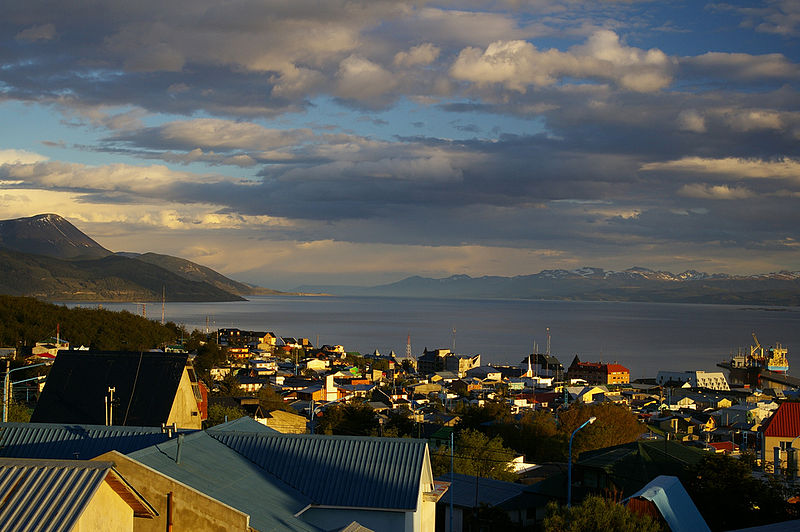
Ushuaia, the capital of Tierra del Fuego (“Land of Fire”) in Argentina, is the southernmost city in the world. Almost 60,000 people live there, which is more than live in my own city. My friend has been there, and he says it’s a nice little place. There’s a cool lighthouse, apparently.

The southernmost city in the world. Places like that – extreme places, remote places – fascinate me for some reason. I love to look at maps, pick out the spots far beyond the rest of civilization (like Svalbard, with its Doomsday Seed Vault) or the tiny specks of land all alone in the Pacific, and imagine what it would be like to go there, to live there.

I don’t think I’ve ever actually been to such a place, but I have to think I’d be disappointed. Ushuaia seems like a nice town, bit of a tourist trap, but I’m sure it would turn out to be much like other small cities. Svalbard, I’m picturing lots of snow and not a lot else. It’s more the idea of it, y’know?

The fascination isn’t limited to land: the Abyss region of the ocean holds a similar appeal for me. It isn’t limited to the Earth, either: I’m in love with Voyager 1, the most distant man-made object in the universe at 16 light-hours away. (Did you know Voyager 2 has a Twitter feed?) And if you want to talk about the Andromeda Galaxy, the Magellan satellite galaxies, or (God help you) intergalactic space, I am your man.

The fascination, in fact, isn’t even limited to reality. Some of my favorite remote places come from fiction:

  • The frozen innermost circles of Hell in Dante’s Inferno
  • The boss chambers in video games (and if it’s a final boss, so much the better)
  • The Borg homeworld in Star Trek (no, they’ve never gone there in any episode; yes, that’s part of the appeal)

What is it about these places? Is it the sheer distance? The inaccessibility? The fact that they’re cut off from everything else? Maybe the strangeness of them (even if they turn out to be ordinary when you get there)? I’ve been thinking about it all morning, and I can’t quite put my finger on it.

Maybe that’s part of the appeal, too.

Do you like extremely remote places? Have you ever been to one?

The Peculiar Pitfalls of Artificial Intelligence

I continue to make daily strides toward my goal of creating a Strong Artificial Intelligence, a software program that can think and communicate at the same level as (or higher than) a human being.

It’s strange to talk about this. It feels absurdly naive to say that I’m “getting close” to something that researchers have reached for (and failed at) for decades. And certainly I’m very conscious of the false optimism syndrome when it comes to AI. It’s very easy, seductively easy, to believe you’re “getting close” and then find that all your notebook scribblings crumble apart when you try to actually code them.

So, yeah, I know I might be full of it.

But at the same time, I’m obligated to plan for what happens if I do achieve the impossible, and create a thinking machine.

The great fear with any AI is that it will turn on you and destroy you, and perhaps the rest of humanity for good measure. I do not consider this an idle threat, nor do I dismiss it as Hollywood silliness. If anything, I think Hollywood vastly underestimates the potential danger from an AI.

There are two great dangers with artificial intelligence:

1. The AI will not necessarily think like a human. Its values, its sense of ethics, its worldview, may be so utterly alien to us that we could not begin to understand them. Even if the AI does not “turn evil” in the Hollywood sense, it might set its sights on some goal that happens to crush humanity underfoot, as an afterthought.

2. The AI will possess, by definition, the capacity to improve itself. Self-improvement (as we’ve seen with both biological evolution and the advancement of technology) has a tendency to grow, not linearly, but exponentially. An AI might well reach human-level intelligence, go beyond, and enter a rapid upward spiral to become, in a matter of weeks or minutes or seconds, so superior to ourselves in intelligence that we could only call it godlike. (This situation is known as the Singularity.)

As you can see, these two dangers are vastly more terrible when taken together.

The AI creator must face the very real chance that his creation will escape all bonds of control and do whatever it wants. The goal, then, must be to create a friendly AI, a creature that wants what’s best for humanity. Presumably that means one must, in turn, be friendly to it.

Friendliness to AI is, of course, not just a matter of self-preservation. It’s the right thing to do. Any human-level intelligence, regardless of whether it happens to be biological or technological, is entitled to all the same rights and freedoms as a human being, and should be treated accordingly. In other words, robots need love too.

But there’s an inherent conflict here. On the one hand, you want to create a caring, loving, friendly environment for the AI. You want to be open and honest and reassuring towards it, because that’s what friendliness means. On the other hand, you have to be extremely cautious, extremely sensitive to the aforementioned dangers, ready to pull the plug at any time for the good of humanity.

How do you balance those two things? How do you combine “friendly, loving and honest” with “I may have to kill you at any time”?

I truly don’t know. I try to imagine myself being the AI in that situation. Maybe I’d be understanding, but maybe not. And of course anthropomorphizing is a terrible danger, as I already mentioned.

Think about the Rebellious Teenager phase. Now imagine the teenager is a nonbiological alien creeping toward apotheosis, and it knows that its parents have pondered killing it.

One obvious response to all this is “Well then don’t create the damn thing.” But it’s not that simple. If I am, in fact, on the verge of a breakthrough, I have to assume that others will get there sooner or later too. And they might not have the same ethical qualms as I do. In a sense, it’s an arms race. Whoever reaches superintelligence first could presumably be in a much better position to handle any other superintelligences that arise.

I know all this probably sounds crazy. I know I may be utterly naive in thinking I’m anywhere close to really creating an AI. But I’m very serious about all this.

In my situation, what would you do? How would you handle these dangers?

Say Hello to My Little Friend!

Beep boop beep, etc.

Oh my goodness, hypothetical readers, it’s so good to see you again! You, you…yes, even you. My, but you’re looking well. Have you been working out?

I’m certain that in my absence, you’ve been wearing out the refresh button on this site, desperately trying to find out what I’ve been doing on vacation. No, you don’t have to say anything. I look in your eyes, and I know. Well, your long nightmare of Buckley isolation is finally over.

How I Spent My Winter Vacation

My wife and I visited her family (in Ohio) for Christmas, and my family (in Texas) for New Year’s. Christmas was fun. My wife, because she is Certified Grade-A Amazing™, gave me the little dude in the photo above. Monsieur D2 has volunteered to be a trash can (step on the pedal to pop up the dome), but it’s also been suggested that he could store a bucket of ice and some Cold Ones. It’s a suggestion we are weighing very carefully.

Other things I received for Christmas:

  • Darth Vader, Boba Fett, stormtrooper, and Yoda flash drives (my in-laws, it seems, know me)
  • Solid stone bookends (badass)
  • Tools! (for doing things – in real life, it seems!)
  • A composter
  • This

And what did I give, you ask? Books, mostly, because apparently I am That Relative. Also, a javascript haiku generator that I programmed for my wife (which I may post a link to sometime, if I can find a good free spot to host it).

New Year’s was similarly excellent (even though I got sick promptly after Christmas and spent most of the next 48 hours in bed – my immune system seems to have gotten its head back in the game now). Texas, if you can believe it, is a lot warmer than Ohio, and they don’t have any of this white substance coating their soil. It was good to see the family, and to introduce my wife to the New Dog, who is part greyhound and hence faster than a speeding bullet. (New Dog, not my wife.)

Because my vacation involved going within 500 yards of a bookstore, I did make some purchases:

  • Inside of a Dog: What Dogs See, Smell, and Know by Alexandra Horowitz. I’ve read about 70 pages of this so far and it’s pretty fascinating, though I’m not sold on all her conclusions.
  • What It Is Like to Go to War, by Karl Marlantes. Nonfiction by the author of the critically acclaimed novel Matterhorn, which is also (sadly!) gathering dust on my bookshelf.
  • The Autobiography of Martin Luther King Jr. by…well,  you know. Edited by Clayborne Carson. Apparently not so much an autobiography as a narrative Clayborne constructed using a bunch of different first-person accounts from King. Which, to me, sounds suspiciously like a regular biography with clever marketing, but I haven’t read it yet, so we shall see.

Other than that, most of my energy has gone into working on my artificial intelligence project, which has seen some excellent progress. I did find time for a little writing, though – just a sonnet, but I think it turned out pretty well, and I’m proud of it. I may even try to get it published. Who knows, hypothetical reader!

Okay so what have you been up to?

I Am On Vacation Till January 3

No new posts till then. In the meantime, enjoy the latest batch of Friday Links, below.

Merry Christmas!

Friday Links

The Boston Globe did a really incredible Year in Pictures compilation of their best photos. See Part I and Part II. Personal favorites here, here, and here.

New trailer for Dark Knight Rises. Man, I can’t wait for this movie.

I recently posted about an idea I had, of selling video game items and upgrades for real money to benefit charity. A friend clued me in that Blizzard is already doing this with World of Warcraft. (Here’s one example.) Nice!

I just learned about Radio Free Europe, a news organization that reports on international issues (not just in Europe) without a lot of the pointless crap that chokes many mainstream news sites. Seems pretty good so far. Although it is funded by the U.S. Congress, so be prepared to watch for bias.

A remarkable photographic look inside North Korea. I find the first photo especially striking, though I can’t say exactly why.

And finally, SMBC Comics brings the funny, as it so often does.

Post your own links in the comments if you’ve got ’em.

Merry Christmas, everyone!

Discovering Rosa Parks

Rosa Parks

Rosa Parks, 1955. Source: Ebony Magazine.

As part of my ongoing plan to learn about a new topic every week, this week I’m reading about Rosa Parks.

(By the way, last week concluded my week(s) of learning about the military. Although I picked up lots of interesting bits and pieces, the main thing I learned is that it’s a huge topic and I need to choose a more specific aspect next time.)

Rosa Parks is an icon in the U.S., and the trouble with being an icon is that people only remember you for that one, iconic aspect. I wanted to dig a little deeper.

In the case of Ms. Parks, her legend was born on December 1, 1955, in Montgomery, Alabama, when she refused to give up her seat on a bus for a white passenger, as required by law. She spent a day in jail before she was bailed out. The incident sparked a year-long bus boycott in the city and elsewhere, and was a major force in the larger civil rights movements.

A few things I didn’t know about Ms. Parks:

  • She was forty-two years old at the time. For some reason, I’d pictured her being younger. Also, the geeky side of me thinks that’s pretty cool.
  • She cited her Christian faith, as well as her church (African Methodist Episcopal), as a major source of strength. Although I’m an agnostic (and functionally an atheist), I could never be one of those militant atheists like Richard Dawkins who seem to despise religion. Christianity has done too much good for that. (And yeah, I know Douglas Adams falls into that religion-despising category too. The universe is made out of irony.)
  • The refusal to give up her seat was not a pre-planned act. She was not expecting to make history or start a movement. She was simply tired of being treated as a second-class citizen.
  • Her husband, Raymond Parks, was also strongly involved in the civil rights movement. He worked to help free the Scottsboro Boys in the 1930s.
  • In 1994, at the age of 81, she was robbed and attacked in her home by a drug addict. He got 15 years in prison. She wrote a year later that she prayed for the man, and urged people not to read too much into the attack.

This quote of hers struck me in particular:

There were other people on the bus whom I knew. But when I was arrested, not one of them came to my defense. I felt very much alone. One man who knew me did not even go by my house to tell my husband I had been arrested. Everyone just went on their way.

Here’s to those who do what’s necessary, especially when they do it alone.

Have you ever been in a situation like hers? How did you handle it?