Category Archives: Uncategorized

The Hedonic Treadmill

If you’re an unpublished author, possibly there is something in your brain that says: “Man, if I could just get that first novel published, then I’d be happy. I’d finally, finally feel successful, vindicated, and satisfied; nay, I would walk around in a continual state of semi-orgasmic bliss, because that is what published authors do.”

Well, I did a quick survey of my Published Author Friends (all eighty-five of them) and it turns out they’re not quite in a continual state of semi-orgasmic bliss, but they’re really close. The only problem is, that first novel didn’t sell quite as well as they’d like, and they’re hoping the next one will do better. That, and a few more good reviews. Then they’ll be happy.

You’re smart people, so I won’t belabor this point: unpublished envies published, published envies successful, successful envies movie deal, movie deal envies movie-that-doesn’t-suck deal, Stephen King envies William Golding, and the whole little world goes round. Happiness is always just one step away – if only X, if only Y – and you’re never quite actually there.

This phenomenon is called the hedonic treadmill, and it’s been on my mind a lot lately.

It isn’t just about writing, of course. All life is like this. It’s most blatantly obvious in advertising: every shiny, NEW product is the the thing that will finally make you happy. Buy this NEW cologne, and suddenly you’ll have an exciting life full of fast cars and sexy ladies. I want to walk into their advertising office brandishing a copy of last year’s ads shouting, hey! What about that cologne? Wasn’t that one supposed to get me fast cars and sexy ladies? If the last one worked as advertised, why would I need this new one? Hey, Armani! Your advertising claims are not internally consistent!

(Note: I have never actually bought cologne. Possibly this is why I drive a 2006 four-cylinder base-model Honda Accord.)

Here’s the thing, though: we’ve heard all this before. Success and happiness are transient, learn to live in the moment.

Right?

Let me ask you something. Have you ever really tried to live in the moment? I don’t mean just to enjoy a sunset, or try to be happy with the person you love, although these are wonderful things. I mean have you ever really tried to shift your entire outlook on life so that you’re no longer focused on the future but actually just drinking in the present, accepting it fully no matter how much it may sometimes suck?

I have. And it’s hard. Really, really hard. Like, depressingly hard. It’s a constant effort, and every time you fail at it – which is roughly two hundred times a day – you feel like a failure. Or maybe that’s just me and the bizarre workings of my brain.

I think I’m starting to ramble. My point is this: the hedonic treadmill is a no-win game, living in the moment has its own problems, and any trade-off or “balance” between these two will have some of the problems of both.

So, uh (tries to act casual) anybody got the secret to happiness in life? Leave it in the comments!

Congratulations! You’re Getting Worse

I don’t think I’ve told you this before, hypothetical reader: I can juggle. Not, you know, well, but if you give me three tennis balls I can keep them in the air for a good while, and do various tricks (reverse cascade, tennis, shower) that generally make me drop one quicker. I can do two in one hand; I can even, for brief, glorious moments, do four in two hands. This is the extent of my skill.

If you’re (let’s say) a normal person, you can pick up standard three-ball juggling in a matter of days. If you’re me, and your hand-eye coordination was surgically removed when you were eight months old to be stored in a Coordination Vault for Peter Parker to tap in his final confrontation with Venom, well, it takes…longer. I struggled for weeks to get the hang of it.

It was very frustrating, but not just because of the slowness. I’m a pretty patient guy, and I can handle slowness if I’m expecting it. It was frustrating more because I didn’t get better steadily; I would get better, then worse, then better, then worse again. After weeks of practice, I would have days where I felt like I’d learned nothing at all.

Improvement is not an 80’s movie montage where you start out bad and gradually just get better. Improvement is the f***ing stock market. You know the market overall is going to go up long-term; but in the short term, there are days, weeks, months, years, where you’re just going to nosedive. This is part of the process. Getting better means getting worse.

(Side note: thanks, Congress! Your recent demonstration of this phenomenon was both instructive and timely. You can stop now.)

I’m sure you will be shocked – shocked! – when I tell you that writing is the same way. You’d like for every story you write to be better than the last, each successive sentence a spiraling staircase toward the summit of success (and alliteration). What you get instead is the stock market. For instance, I think the story I wrote three weeks ago – “Scissors With Running” – is better than the two I’ve written since. Is that frustrating? Well, yeah, a little. But it’s part of the game. It’s all part of the game.

Also, one time I went outside in bare feet in winter and juggled snowballs. That doesn’t really fit the metaphor. That just means I have an undiagnosed mental illness. Ha ha! No, but really.

See you tomorrow!

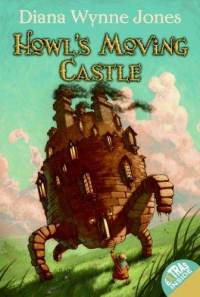
Howl’s Moving Castle Postmortem

Howl's Moving Castle

I’ll start with a slightly morbid confession: I heard about Howl’s Moving Castle because its author, Diana Wynne Jones, died. It happened four and a half months ago, and there was this flood of articles about what a wonderful author she was, and all the happy childhood memories she had created for people. She – and this book – received so much praise that I thought I’d better take note. I added it to my list.

(I should probably clarify at this point that the “Postmortem” in the blog post title refers merely to the book. No need to be any more morbid than necessary.)

Anyway, about a week ago, I finally began reading Howl’s Moving Castle, with high expectations. Maybe too high.

Because I’ll be honest: I lost interest and stopped reading halfway through.

To explain why, I’ll start by explaining what’s good about the book, because it does have a lot going for it. It opens with this wonderful first sentence:

In the land of Ingary, where such things as seven-league boots and cloaks of invisibility really exist, it is quite a misfortune to be born the eldest of three.

This suggests a world full magic and adventure, and on that score, the novel pretty much delivers. In addition to the seven-league boots (which you get to see in action) there is a Witch of the Waste, a fiery demon, a lively scarecrow, and of course the wizard Howl and his moving castle. So worldbuilding really wasn’t a problem.

The characters were good too. The main character, Sophie – who starts off as a young girl and gets transformed into an old woman – is fun to read, especially when you see how much her external change influences her thinking. Howl is also well-done: powerful enough to be intimidating, flawed enough to be human. I found myself caring less about Sophie’s sisters, but they were minor characters so it wasn’t a big deal.

Good world, good characters, and – I’ll add – good writing in general. So what’s left?

Ah, yeah. Plot. Or rather, lack of it.

The problem with the book, and the reason I stopped reading, is that there just isn’t that much going on. Let’s see, we’ve got the Witch of the Waste, who placed the aforementioned hex on Sophie; but the Witch doesn’t rear her head again for a while, and Sophie seems pretty much fine with her curse, so that’s not a big deal. We’ve got Howl himself, who also turns out to be much less scary than we’re initially led to believe. We’ve got an animated scarecrow who chases them a couple times but doesn’t really do anything. And we’ve got Howl courting one of Sophie’s sisters, which upsets Sophie quite a lot but doesn’t seem to matter to anybody else (including the sister).

A non-scary witch, a non-scary wizard, a non-scary scarecrow, and a non-problematic love affair. Unfortunately, this is pretty much it in the plot department – or at least it was halfway through the book, where I stopped reading.

I’ve mentioned before that I have a history of disliking beloved stories. American Gods did nothing for me especially, The Name of the Wind seemed tiresome, and I loathed The Last Unicorn. I’d say Howl’s Moving Castle was better than those three, but in the end, it just felt like it didn’t have any get-up-and-go. No disrespect, of course, to any of those authors, Diana Wynne Jones included; I simply didn’t love the books.

Have any of you read it? Care to share your own feelings?

Personally, I’m on to Margaret Atwood’s The Blind Assassin, which is beautifully written but seems to suffer from the same problem: no forward motion to the plot. I’m only about fifty pages in, so I’ll give it more time.

Friday Links

Happy Friday, hypothetical reader! I was crazy tired yesterday but I think I’m a little better this morning. Coffee will help. Mmm, sweet, sweeeeeet legal addictive drugs…

First up this week is Blake Butler, with 22 Things I Learned From Submitting Writing. He’s talking mainly about the short story market, about the long grind of gradually turning rejection into acceptance. The whole post is great, but I really love #9: “If you really want to publish a book one day you will publish a book. The time that you spend getting there is kind of wonderful. Don’t cut it short. The emotional range is valuable.” Listen up, peeps: I really want to publish a book!

We all know Harry Potter is a little punk. Magician David Copperfield finally calls him out, accusing J.K. Rowling of stealing his own life story for her books. Which is pretty funny, considering Copperfield himself stole his name from a Dickens character. (The video’s a joke, of course. Er – I hope. Gulp!)

Send a lot of text messages? Ha! That’s so mainstream. Back in 1890, they were text messaging before it sold out and got all popular.

INTERN has an insightful post about the meaning of success as a writer. Success is a slippery thing; you can feel like you’ve made it (or are failing to make it) at any level from unpublished to Nobel laureate. If you believe you’re unsuccessful, ask yourself if you really are. Think about what you’ve accomplished instead of just what’s next, because there will always, always be a Next Thing.

Finally, not related to writing, but if you like Star Trek (or just general epicness) then I implore you, I beseech you, watch this Lazy Song music video featuring Leonard Nimoy. I simply cannot imagine you will be disappointed.

Truly, I have no more to give you. Go forth and hit that weekend like it was looking at your sister!

Flash Fiction: “Bald Pregnant Women With Bras and Unstoppable Telepathy”

Mr. Wendig challenged his readers to write a story about something you’d find at a flea market. Word limit: 1,000.

A friend at work challenged me (for reasons best unexplained) to write a story titled “Bald Pregnant Women With Bras and Unstoppable Telepathy.”

I searched my soul. Could I do both at once? Was it possible to write a flea market story that also had that title?

Spoiler alert: yes.

Bald Pregnant Women With Bras and Unstoppable Telepathy

With a belly full of McNuggets and three hours till Sociology, I was precisely the target audience of the sprawling, newly-arrived flea market. It was a warm Monday afternoon, and dozens of tents covered grassy Franklin Square, each with a sign lovingly crafted by its own resident marketing genius:

GIT R DUN – DIY solutions for every household project from tracheotomy to taxidermy

PAIGE TURNER’S LIBRARY – Exquisite literary classics, sold by the pound

CELEBRITOPIA – Every single object you own should feature LeVar Burton’s smiling face

The KITSCHY CRAP tent drew me in with sheer honesty.

I examined a leopard-print salad shooter, a MacGyver mousepad, and a gumball dispenser shaped like Argentina (!) before a bemused repulsion led me to a VHS wonder entitled Bald Pregnant Women With Bras and Unstoppable Telepathy. 1972, PG-13, 99 minutes of cinematic glory.

The proprietor’s FUCK DA PO-PO wrist tattoo doubtless signified a prior stint as a middle school guidance counselor. I brandished the video at him.

“The hell is this?”

“The hell does it look like?”

Sixty seconds later, he had my two dollars, and I had possibly the greatest B-movie treasure this side of Plan 9 From Outer Space.

I watched it that very night. It was accurately titled. Vodka helped.

***

At 2 a.m. a voice in my head spoke my name.

Marcus.

“Grrrrnggghh?”

Marcus, I want to talk.

“Wuzzit?”

Are you listening to me?

I sat up slowly. “Who are you and also what the fuck?”

Marcus, I know perfectly well you watched that documentary.

“Documentary? You mean you’re actually a – ”

Yes.  I’m a bald pregnant woman with unstoppable telepathy.

“And a bra?”

That’s personal.

“You’re in my brain.”

Marcus, we need to talk. About us. Sometimes I wonder if you’re giving me the support I need.

“And you are…?”

Crystal.

“Krystal?”

With a C.

“You heard the K?”

I’m in your brain, dumbass.

“You sure are.”

Marcus, promise you’ll never leave me.

“Is your last name ‘Meth?’ Cuz that would be really funny.”

That’s hurtful. I’m not speaking to you anymore.

“Darn.”

No more Crystal.

Certain questions simply cannot be answered at 2 a.m. “Am I schizophrenic?” tops the list. I fell back asleep.

***

Most of Tuesday passed telepathy-free, and I chalked up Crystal to a ramen-induced hallucination. That evening found me on my couch watching a Futurama rerun, my non-imaginary girlfriend Megan curled up comfortably on my lap.

Marcus.

“Crystal?”

Megan stirred. “What?”

Who the hell is Crystal?

“Who the hell is Crystal?” echoed Megan.

Only one way to have this conversation without seeming crazy. I held my cell phone up to my ear.

Quiet about your other women. I’m Amber.

“Sorry, Amber. You sound a lot like Crystal.”

“Who the fuck is Amber?”

I raised my hand in a gesture that was either placating or papal.

Can you get me a jar of pickles from the store?

“Isn’t that your husband’s job?”

I’m divorced, dickweed, thanks for asking.

“Why are you bald?”

Do you really not know how telepathy works?

“Is that a serious question?”

Vlasic. Kosher. After you buy them I’ll give you my address.

“Is your last name ‘Bock’? Cuz – ”

Fail me and die.

Amber was out. I glanced around. Megan was out too.

I don’t even like Futurama.

***

Wednesday was rough. Samantha’s persistent soliloquy – Will it hurt? How much will it hurt? I bet it won’t even hurt that much. Oh God, I’m going to die – severely hampered my Riemann sums. Over lunch, I assured an invisible Jada that her boobs looked just fine, earning a Scrooge face from the decidedly male McDonald’s cash register professional. I skipped English Lit entirely as a preoccupied Clara expounded on the relative merits of Fisher-Price and Little Tikes. By 5:00 I knew what the word “Desitin” meant.

Thursday was worse.

***

I reclined on Jim’s futon as he scrutinized his Corona Lite.

“So Megan hasn’t called you back?”

“Jim, do you think it’s possible to stop telepathy?”

He didn’t even blink. “Depends. If it’s Star Trek, and the telepath’s a Betazoid, then you can stop it by, like, being a Ferengi.”

“This isn’t Star Trek.”

“What is it?”

Bald Pregnant Women With Bras and Unstoppable Telepathy.”

Unstoppable telepathy?”

“Yeah.”

“And you’re trying to stop it?”

“Ideally, yes.”

He swigged. “Marcus,” he said, “you’re an idiot.”

***

For sheer surreality, few things exceed being accosted by a bald pregnant woman on a crowded campus lawn.

IRL, Amber was five foot negative one, very third trimester, and wielded a pink leather purse roughly the diameter of her unborn child. She was rocking some serious Patrick-Stewart-grade baldness. I would describe her emotional state as “dissatisfied.”

“You want to play this game with me?”

My adrenal glands experimented with their “overdrive” setting. “Amber, I just checked Walmart. They’re fresh out of Vlasic. I can look again next week.”

“You’re a lying sack of shit. You don’t think I’ll cut you? I’ll fucking cut you. I’ve got shit in this purse you can’t even imagine.”

“Amber, I hesitate to suggest this, but I’m reasonably sure I can outrun you.”

“YOU MOTHERLESS GOATSUCKER YOU THINK YOU CAN KNOCK ME UP AND THEN THROW ME TO THE CURB WHILE YOU’RE FUCKING SOME OTHER LITTLE SLUT – ”

“Dill?”

“Yes please.”

Fifteen minutes later, I returned with her prize.

“Amber, I deeply respect your inexplicable super powers but I think you are a terrible person.”

“Stuff it. I’ve been this way for nine months. You could be free tomorrow.”

“Go on?”

“Someone else watches the video, the curse transfers to them.” She waddled away.

Freedom!

But who (besides me) would voluntarily sit through the film in question?

I needed someone who would keep watching a screen no matter how bizarre, how senseless, how unrelentingly awful it might be.

Suddenly I knew.

***

“It’s open.”

Old buddy of mine. I stepped into his apartment. “Hey, man. Can you take a break from C-SPAN for a second?”

Sadism in The Silmarillion

For those who don’t know, The Silmarillion is basically J.R.R. Tolkien’s version of the Bible. (Okay, Tolkien was a Christian, so his version of the Bible is, you know, the Bible. But stay with me.)

The Hobbit and The Lord of the Rings make a lot of references to people, places and events from thousands of years before the story. Those references aren’t just extra details Tolkien thought up on the spot. They’re part of a vast mythology he constructed and revised throughout his life. After he died, his son Christopher gathered his notes and edited them into a cohesive story. That’s The Silmarillion.

All of which is a long way of saying that if you like Tolkien and you haven’t hit the big S yet, it’s  flippin’ sweet. Like the real Bible, it’s dry in places, has a lot of names to keep track of, and may be tough to get through on your first time reading. But it also features origin stories for Gandalf, Sauron, and, you know, the entire universe. So that’s a pretty good time.

As I read it, I pictured Tolkien as a kid, carefully setting up all his toys. You go here, you go there, this is your name, okay, and you’re related to this guy, and these two guys are friends. The beginning is like that. And then at a certain point he looks around and says “Everybody ready?” and goes RRREEAAAAAAAAAAAHHH and starts tramping around like Godzilla, kicking dudes over and knocking down cities. After that, the rest of the book is basically the whole world going to hell, over the course of a couple hundred pages.

I’m not gonna lie, it’s pretty cool. There are balrogs and dragons and everything.

I mention this because I think lots of writers fail here. They get the first part right: they set up their world with meticulous details, figure out the characters and what they’re like and who knows who, they draw maps, they establish backstory. But then they don’t do the second part. They lose their nerve and throw out a couple of softball conflicts, but never get in there and really start tearing shit up.

I’m not saying every story has to feature an apocalypse (although it would be nice), but you’ve gotta make it real. You’ve gotta put your characters into some real trouble, some trouble that seems impossible to handle, and then you’ve gotta throw out something else on top that makes the first trouble seem like a trip to Happy World. You’ve got to throw out some serious, Morgoth-level sadism.

(For those wondering: Happy World? Actually kind of a creepy place.)

So what’s up, hypothetical readers? Any Silmarillion fans in the hizzouse?

Words Fail Me

You’ve played Tetris, right? Tetris is strange because you can’t actually win. The blocks keep piling up, and no matter how good you are, they eventually reach the top of the screen. When you start a game of Tetris, the only question is how well you’re going to fail.

If you didn’t understand that – if you thought there was some way to Win At Tetris – you might be disappointed by that failure. But if you realize that there are only varying degrees of failure, you may feel less frustrated when you get to Game Over…and, more importantly, you may be more likely to play again.

Writing is like that. It is almost impossible to Win At Writing – to successfully translate any piece of your soul into a sequence of letters. Novelist Hari Kunzru talks about “the disappointment that this finite collection of words is all that remains of your infinitely rich idea.” I’ve heard many writers describe finishing a novel (or poem or story) as “giving up” – that is, you reach a point where you just decide to stop fiddling with it, because it’s never going to be perfect.

This built-in failure is a daily, visceral experience for me, because it happens every time I write a blog post. When I’m finished, I always read over what I’ve written and think, well, that’s okay. That’s not really it, not quite the glowing spark that was cartwheeling around in my brain, but it’ll do. I’m not bitter or frustrated about it. It’s just a thing that happens. Words fail me. More generally: words fail. But they do the best they can.

The thing is, there do seem to be occasional exceptions to this rule. You do sometimes read something and think, yeah, that’s it, he absolutely nailed that. It’s hard for me to imagine a more perfect expression of entropy than “Ozymandias,” or a better image of unraveling society than “The Second Coming.” I’ve even had that experience myself, sometimes, of writing something and actually thinking, that was exactly what I was trying to say.

I think, though, that this dead-on perfection can only occur in poems and short passages. Anything as long as a novel is bound to fail at some level. So maybe writing novels is like Tetris, whereas poems are more like Super Ghouls ‘N Ghosts. Really hard to beat, but theoretically possible.

I’ve never actually played Super Ghouls ‘N Ghosts. I kind of want to do that now.

All right, that’s all I’ve got. Have a good day. Fail better.

Hemingway Just Got PUNKED

Maybe you’ve heard this before: Ernest Hemingway’s friends were all like, “Hey, I bet you can’t write a complete story in just six words,” and he’s all “Oh it’s on now,” and he comes up with the following:

For sale: baby shoes, never worn.

And then his friends were like “Oh no he didn’t.” But he totally did.

Of course, Hemingway wasn’t the first to attempt the six-word story. Julius Caesar beat him to the punch by two thousand years:

I came, I saw, I conquered.

Now, you might argue that the Hemingway story is probably apocryphal. Or you might point out that Caesar’s story was only three words in the original Latin, and may be apocryphal too. Whatever. Point is, a lot of folks seem pretty taken with this whole business of writing a story in six words.

Well, listen up kids, you’re in Buckley’s world now. I’m going to tell a complete story in just five words. In fact, I’m going to tell three stories in five words each, just because I can.

You ready for this? Let’s get it done:

1.
Kill me again. Dare you.

2.
Lathered. Rinsed. Repeated. Still single.

3.
infinitely looping stories are like

Oh. Oh, yeah. That felt good.

All right, hypothetical readers, what’s up now? Ready to boycott The Sun Also Rises now that you’ve tasted the genuine magic? Want to punk Hemingway with a five-word story of your own? Going to punk me with a four-word story? Leave it in the comments!

Friday Links

Welcome, hypothetical reader! Take your shoes off, this is a holy place. What? No, I’m kidding. Track in the mud. Can’t get any dirtier than it already is. This is about to get real, people. It’s link time.

First, a quick update on Chuck Wendig’s weekly writing prompts. I’m excited to report that Chuck picked my story “Scissors With Running” as one of the top five stories for the Uncharted Apocalypse challenge (no, really!) and he is graciously giving me a copy of his eBook “250 Things You Should Know About Writing” as a prize. Awesome – thanks, Chuck! This week’s challenge is The Flea Market, and I plan to give it a shot.

In other news, amid all the tearful eulogies on Borders, here’s one author who isn’t sorry to see them go.

A great post on dealing with rejection. I tend to think of rejection as something that happens to writers who haven’t “made it” yet, but James Moran reminds us that established, successful writers can be rejected even more than newbies. If writing is the life you want, you’re going to get rejected, full stop. Embrace the chaos.

I’m OCD about grammar, and this comic totally calls me out on it. Love it.

Okay, this is kind of crazy: I’ve actually considered making this website myself, and today I found out someone else has done it for me. A list of all the books with titles that come from lines in Hamlet? Yes please. David Foster Wallace’s Infinite Jest is probably the most famous of these.

Stephen King explains how Lord of the Flies influenced him as a kid. When King talks about writing, I listen, and this was fascinating reading for me.

Check out the worst sentence of 2011.

Here’s a list of the best authors by state in the U.S.A. Very interesting stuff. I didn’t know Lois Lowry is from Hawaii!

That’s all I have for writing links. In the non-writing-related category we have…

Like all the best Onion articles, this one is funny and sad and true: “Last Male Heir To Bloodline Watches Movie Alone On Laptop.”

Want an interactive panoramic view of the Space Shuttle Discovery’s flight deck? Of course you do.

NPR says a Denver newspaper has hired a professional marijuana critic. NPR would say that. Those commies!

And finally, courtesy of Nathan Bransford: this photo from ComicCon is perhaps the most awesome picture I have ever seen. That is all.

Have a terrific weekend; failing that, don’t burn your house down; failing that, toast some marshmallows on the smoldering ruins of your homestead. Mmm…s’mores.

See you on Monday!

Flash Fiction: “Everything But Rachel”

The story below is based on another of Wendig’s weekly prompts. This week: write something about unicorns! Limit is 1,000 words again.

Everything But Rachel

“There is only one road…” he murmurs, but the words burn his cracked lips and he can’t say it all. He finishes in his mind:

There is only one road as there is only one pilgrim. You must give up everything but Rachel.

Here the road is no more than a trail, winding across the rocky wasteland. Broken gray stone extends forever all around, a petrified ocean. A black sky flickers with flame. Vast, impossible, swirling pillars of darkness migrate across the waste. He is far, far from home, from Rachel. He has followed this road a long, long way: longer than all the roads on all the continents in all his old, half-remembered world. He follows still. This is the Master-Road, the template by which other roads are made, and what is there to do, but follow?

But someday he will reach the end of this road, and then he will kill the Polymancer. And perhaps – he plays this game hourly, savoring the delusion – perhaps it will be today.

You must give up everything but her.

“But I have,” he murmurs painfully, a sound that is barely a sound. I have sacrificed…

For comfort, he runs again through the litany of what he has lost.

His body, of course. That’s an easy one. That cruel-eyed mass of talons and scales bit him three weeks ago, and now slowly, slowly, the poison is spreading through him. It started at his left ankle, and it’s blackened that whole leg. The skin is all tender scales, pink underneath. Now his other leg blackens, and a patch has formed on his left hand. Slowly, but all too quickly, it spreads. In a month he will die. He smiles weakly at the thought. The end of the road.

His weapons, too. He lost the scimitar…when? Before the poison bite, certainly. And the knives, someone has stolen those, in some village where he spent the night. The road wound through villages, too, ages and ages ago.

His own name, sacrificed, gone from memory. He fancies it began with a “C,” but that’s something he’s invented – just another game. He does not know his face. He raises his fingers and feels the rough beard at his chin, but this awakes no memories. That’s all right. Identity is a burden, and that sacrifice was easy. Rachel knows his face, Rachel knows his name. That is enough.

Follow the road, pilgrim. Kill the Polymancer.

He wonders how he will kill the Polymancer like this, when he can barely walk. The pillars of dark slide lazily on the horizon, fifty leagues distant in the dry air.

You must give up everything but her.

Still he walks. He reaches into his pants pocket, pulls out the brass pocketwatch. It has long stopped ticking, stopped answering when he winds it. The dust and the grime. But the back is engraved with a name: Rachel.

Rachel. The warmth of brown fingers on his arm. The dark and curling hair. Laughing in the kitchen, crying in the rain, running across the yard to greet him. Rachel, the reason for the road.

He crests a hill, as he has crested countless others, and he stops once more to survey the land ahead. Always he hopes, at last, to see the Dark Castle of the Polymancer up ahead, the sable towers, the savage keep. But this view is like all the rest: only more rock, and more dust, and the fire in the sky and the pillars of darkness that whisper mockingly. He catches his breath. For the thousandth time his legs threaten to halt. For the thousandth time he forces them on again. There is only one road –

He stumbles, crashes on the rough black stone below. Pain flares in his chest. A rib broken, surely. His mouth moves, forming the scream but not setting it free.

Slowly – slowly – he stands.

“What else do you want?” he cries, not for the first time, a voice raw with thirst but steady as the miles behind. “What else is left – to sacrifice – ”

The unicorn appears.

No motion, no sound: only now there is a unicorn, where none stood before. If he is dreaming again, it is at least a new dream.

The unicorn is white and stark and stern, and he sees no weakness in it, and he knows it has come for him. He staggers, remains standing. Now the words are silent, a bare motion of lips: “What else is left – ”

The unicorn stares at him. He catches in its eye another dream, a dream’s dream, a vision of the future:

The Polymancer, red robes billowing, angry as the pillars of darkness and deadly as the sun. Himself – a rough face he hardly recognizes – climbing rocky steps inside the dark castle, struggling, failing. A cruel light from the Polymancer’s hand. As he watches himself falling, he already knows he is dead.

Thus the road will end. He will fail. He will die.

In his heart, the last embers of hope go cold. Nothing, nothing remains.

Nothing but her.

He laughs. His broken rib blazes with the motion, breath sears his throat, but he laughs and laughs. His legs shake as he mounts the beast, adjusts himself wearily on its bare, rough back.

Now he looks up around him, sees once more the final plain: the shuddering pillars, the flickering sky, the endless ocean of rock, and all ahead and behind the eternal, impassive road. He looks down at the unicorn and its solitary spike, the lone weapon glistening in that strange lightning, beautiful and deadly where it shines peerless as fire on the waste.

“On,” he whispers, and the unicorn leaps forward, carrying him down the road with tireless legs, lowering its terrible horn, never blinking those twin obsidian slivers, never hiding their benevolent lies.

Onward to Rachel.