Category Archives: Uncategorized

Zenterpretation

One of the beautiful things about writing is that it’s a dynamic creation between writer and reader. Everyone creates a different world in their mind, everyone sees things in a story or poem that you never envisioned when you wrote it (just ask your beta readers).

I’ve mentioned before that I’m getting back into Zen lately, both reading about it and actually practicing. Of course, when you think about something a lot, you start to see it everywhere. I’ve noticed more and more quotes – from songs, poems, movies, everything – remind me of Zen, especially when snatched out of context. So yesterday I compiled a list of all such quotes I could think of.

I’d wager that few, if any, of these people had Zen explicitly on the mind when they wrote (or spoke) the words, but what’s a little subversive interpretation between friends?

The stars are far brighter
Than gems without measure,
The moon is far whiter
Than silver in treasure:
The fire is more shining
On hearth in the gloaming
Than gold won by mining,
So why go a-roaming?
O! Tra-la-la-lally
Come back to the valley.
-J.R.R. Tolkien, The Hobbit

There is another world, but it is in this one.
-Paul Eluard

And you will know the truth, and the truth will set you free.
-Jesus (John 8:32)

To see a World in a Grain of Sand
And a Heaven in a Wild Flower,
Hold Infinity in the palm of your hand
And Eternity in an hour.
-William Blake, Auguries of Innocence

‘Tis the gift to be simple, ’tis the gift to be free
‘Tis the gift to come down where we ought to be,
And when we find ourselves in the place just right,
‘Twill be in the valley of love and delight.
When true simplicity is gain’d,
To bow and to bend we shan’t be asham’d,
To turn, turn will be our delight,
Till by turning, turning we come ’round right.
-Joseph Brackett, Simple Gifts

Do, or do not. There is no try.
-Yoda

By this all men will know that you are my disciples, if you love one another.
-Jesus (John 13:35)

Let it go
Let it roll right off your shoulder
Don’t you know
The hardest part is over
Let it in
Let your clarity define you
-Rob Thomas, Little Wonders

I am he as you are he as you are me and we are all together.
-John Lennon, “I Am The Walrus”

My candle burns at both ends
It will not last the night;
But ah, my foes, and oh, my friends –
It gives a lovely light!
-Edna St. Vincent Millay, “First Fig”

How I love the simple things,
The simple things just are.
-Rebecca Lynn Howard, “The Simple Things”

The miracle is this – the more we share, the more we have.
-Leonard Nimoy

Yes! let the rich deride, the proud disdain,
These simple blessings of the lowly train;
To me more dear, congenial to my heart,
One native charm, than all the gloss of art.
Spontaneous joys, where nature has its play,
The soul adopts, and owns their first-born sway;
Lightly they frolic o’er the vacant mind,
Unenvied, unmolested, unconfined:
But the long pomp, the midnight masquerade,
With all the freaks of wanton wealth arrayed, –
In these, ere triflers half their wish obtain,
The toiling pleasure sickens into pain;
And, e’en while fashion’s brightest arts decoy,
The heart, distrusting, ask if this be joy.
-Oliver Goldsmith, “The Deserted Village”

If you can’t do it in Fortran, do it in assembly language. If you can’t do it in assembly language, it isn’t worth doing.
-Ed Post, “Real Programmers Don’t Use Pascal”

Okay, that last one’s not really Zennish. Just seeing if you’re paying attention.

You tell me: are there any quotes you’ve given special meaning, beyond their original context?
Hahahaha

Okay, this is going to be fun.

The Intern is currently doing “International Sh*tty First Draft Week,” where authors post excerpts from the sh*tty first drafts of their now-excellent finished novels. I figured I’d participate.

Sadly, I don’t have some wonderful, finished, published book where I can take you “behind the scenes” with an early version for comparison. In the spirit of the week, though, I dug deep into my personal archives and found (drum roll please)…Transfer of Power, my very first novel, which I wrote back in high school, a full decade ago.

I use the term “novel” loosely. MS Word puts the total word count at 47K, and I never bothered to revise much after the first draft. Sure, it’s awful. But it’s also the first time I ever sat down and wrote something remotely novel-length start to finish, so it still has a place in my heart.

Doesn’t mean we can’t laugh at it together, though. Allow me to present…the opening of Transfer of Power.

Chapter 1

“The Drii have taken our land!” shouted Marrott.  “The Drii have captured our towns, they have terrorized our children, and they have made us prisoners in our own country!  They take our money, and give us nothing in return!  They leave us our kings to sit on the throne as they please, so long as they dance to the music of the Drii whenever their leader makes his wishes known!  They do all this, and we sit back like idle cowards, watching it as if it were a play!  What’s wrong with us?” he demanded.  “Why have we grown complacent?  Since when is it all right to complain and curse our oppressors while we run to do their bidding at a moment’s notice?  Since when?”

Marrott was not a young man by any means, but his age did not seem to have hampered his spirit in any noticeable way.  He flung his arms into the air as he spoke, beating his fist into his palm.  His thin gray hair flew around wildly in contrast to the peaceful surroundings, but nobody thought this unusual; they were used to Marrott’s speeches against the Drii by now.  For the most part they agreed with him, but the main problem – as in all oppressed communities – was that nobody was unhappy enough to overcome their fear and muster the courage to fight their oppressors.  This sentiment was voiced by a member of the crowd.

A young man in the back stood up.  “What you ask would throw Kylar into war the likes of which has not been seen since our grandparents were children!  Would you have us oppose the Drii in the open, then?  Would you bring them down upon us like an iron hammer, to take not only our freedom and our money, but our lives as well?  Our lives are not bad, Marrott!  We need not send our friends and our brothers to die for a concept which is abstract at best!”

“Abstract!” snorted Marrott.  “Freedom?  Abstract?  Yes, it is.  As is truth, and justice, and hope, and fear, and pain, and love; but those are the things which shape our lives!  There is a price to pay for everything.  I am not afraid to die.  Are you?”

There was a murmur in the crowd at that, and faces turned to see the man’s response.  People enjoyed a show, and this was exactly the kind of duel of wills they loved.  “What I fear,” the man said through clenched teeth, “is people like you; people who are afraid to face the truth.”  He sat down, though.

Marrott smiled.  “The truth is all around us,” he said.  “The entire world is composed of truth.  The only lies are those we make to fool ourselves.”  He looked around.  “It’s getting late.  Those who haven’t yet forgotten what freedom is like may hear me speak again on the same time and day as always, next week.  Thank you for coming.”  He bowed slightly, and walked off.  With that, the crowd dispersed.

Sixteen Simple Rules For Writers

1. Keep in tune with the publishing world by reading blogs, following agents on Twitter, etc. Also: avoid anything that distracts you from writing, especially the Internet.

2. Learn from the classics. Also: the classics violate most of the writing advice you get, and would be largely unpublishable if written today.

3. Write every day, no matter what, even if you don’t feel like it. Also: take vacations now and then, or you’ll go crazy.

4. Don’t obsess over the rules of the querying process. Also: the rules of the querying process are staggeringly complex, vary from one agent to the next, and will determine the success of your career.

5. Make your protagonists realistic and believable, and let your writing celebrate the beauty of all human life. Also: your protagonists have to be strong and active or nobody will like them.

6. Your novel should be deep, subtle, and complex. Also: to make your novel marketable, you should be able to sum it up in one sentence, and you should write the novel with that sentence in mind.

7. You can’t trust your instincts about your own work, so you need to get your manuscript critiqued. Also: when listening to critique advice, trust your instincts.

8. Don’t send off your novel until it’s your best work. Also: don’t sit on one novel forever.

9. Don’t say “there was,” avoid passive voice, avoid adverbs, and use only the “said” dialogue tag. Also: craft a voice for your writing that’s uniquely you.

10. Use all forms of social media (Facebook, Twitter, blogs, Google+) to promote yourself, even if you don’t want to, because that’s what authors need to do. Also: if you’re not passionate about social media, it will show, and using it for self-promotion will fail.

11. Remember you are unique and special. Also: remember you are not at all unique or special.

12. Pour your passion and soul into your writing; base it on your own ideas, feelings, observations, and life. Also: don’t take critiques personally, because they only criticize your work, not you.

13. Show, don’t tell. Also: telling uses fewer words than showing, and you should use the fewest words possible.

14. Don’t be redundant. Also: if you only say something once, the reader will forget it.

15. Give your readers something fresh and unusual, something outside of everyday life. Also: write what you know.

16. Listen to writing advice. Also: don’t listen to writing advice.

There…hope that helps!

Friday Links

Our hyperlink farmers have been working hard all week, harvesting raw HTML and sifting through it for the choicest morsels. And there you sit, like some emperor at your computery throne, sparing a glance at their efforts here and there, clicking occasionally on what pleases your imperial fancy, waving the rest away. Well, I hope you’re happy.

Er – I mean – thanks for reading my blog, and here are some links. 🙂

First up, since yesterday’s post was a story written for Chuck Wendig’s weekly challenge, I’ll link to his new challenge for this week: unicorns. I’ll give it a shot if I have time!

You’ve probably already heard that Borders is officially liquidating. I actually got an e-mail from them this morning, in which their CEO Mike Edwards says thank you and talks about “the true and noble cause of expanding access to books and promoting the joy of reading.” Whether he wrote that himself or copied it from someone in PR, it sums up the way I feel about book stores too. There’s no Borders in my town, so I rarely shopped there, but I’m still sorry to see them go.

Turns out, Borders owes some publishers a lot of money, and they won’t be getting it all back. Penguin alone is apparently owed over $41 million. Fewer bookstores, more cautious publishers – sounds like a great time for a new author to break in!

Here’s a nice little post about rejection statistics. The author looks at some numbers for literary agent Weronika Janczuk and concludes “If you query Ms. Janczuk, your chances of getting an offer are about 1 in 2000 (all things being equal, which of course, they are not.)” That last point is important: the long odds aren’t odds, they just tell you how many other queries you’ll leave in the dust if your writing is good enough.

INTERN announces International Sh*tty First Draft Week (asterisk hers). Next week she will feature authors who reveal excerpts from the sh*tty first drafts of their successful work, and on Friday, she’ll ask all her readers to contribute their own sh*tty first drafts. Who knows…I may see what kind of contribution I can dig up.

This comic is pretty much how I feel about my own writing ability.

Moving on to non-writing-related links…first, you’ve probably heard about the famine in Somalia. I’d encourage you to donate to Doctors Without Borders, or some other worthy organization. Even $5 or $10 would help.

This – well, this is just really cool. The Internet of Things.

And finally, this comic makes me happy and sad and smarter at the same time. (Warning: although that particular comic is safe for work, the rest of the archive is not. Click responsibly.) I love SMBC.

Truly, that is all I have. Here’s hoping that your weekend shines with the ineffable quintessence of the transcendent – or, failing that, here’s hoping your weekend is pretty good! See you Monday.

Flash Fiction: “Scissors With Running”

Every week, Chuck Wendig (a.k.a. “The Bearded Blitzkrieg,” a.k.a. “Wendiggedon”) issues a challenge to the universe: write a piece of flash fiction according to his specifications, share it on his blog, then browse the other submissions and see how different writers responded to the same prompt. This week’s challenge is called An Uncharted Apocalypse – write about the end of the world happening in some way that’s different from the usual cliches (nuclear winter, zombie outbreak, etc.). 1,000-word limit.

I’d never done it before, but this week’s challenge sounded interesting, and I had a little free time, so here we go. And it occurs to me, for all the time I spend blathering about how to write fiction, I’ve never actually posted any of my own fiction before. So, enjoy. It was a fun prompt, and I had fun writing it. Hope it’s fun to read, too.

Without further ado, the story:

Scissors With Running

Dr. Wermann held up a Florence flask half-full of some mysterious purple liquid, swishing it ominously. “Behold!”

Dr. Hall raised an eyebrow, which made him look like a bearded Mr. Spock. “I’m beholding. What is it?”

“I call it: SAAMFAS.”

“Well, I’m glad you explained.”

Dr. Wermann giggled. He looked like a beardless Dr. Hall. “Self-Awareness And Motor Function Actualization Serum.”

“I’m not convinced you know what all those words mean.”

“Mock if you must, Dr. Hall, but any substance my serum touches will become both conscious and capable of motion. SAAMFAS is a bring-it-to-life potion, a Frankenstein froth, a miracle mash for transmuting any useless lump of dead matter into a sentient, ambulatory creature!”

“Poppycock,” said Dr. Hall.

“It works,” said Dr. Wermann.

“It works,” said the Florence flask.

Dr. Hall blinked. “I heard you the first ti – ”

The Florence flask slipped out of Wermann’s hand and fell straight to the table’s oak surface (which fortunately was not very far) and hopped straightaway – clink, clink, clink – toward the cluster of fellow Florence flasks at the far end. “Viva the Florence flask nation!” it cried. “Viva Florentium!”

“Yes,” muttered Wermann. “Any matter the serum touches. I suppose that would include its container.”

“You didn’t test it?”

“Thought experiments only. Like Einstein.”

“Um,” said Hall.

The energetic Florence flask busily splashed its own contents over its lifeless brethren, and soon it faced a veritable convocation of compatriots. “Viva Florentium!” it cried.

“Viva Florentium!” echoed the assembly.

“Death to the Erlenmeyer flasks!”

“Death! Death to the Erlenmeyer flasks!”

As Wermann and Hall lifted their eyebrows to uncharted altitudes, the horde of glassware galloped to the other end of the table and shoved the unsuspecting, unanimated Erlenmeyers straight off the edge. Crash! Crash! The Florences cheered in victory.

“Now to the supply closet, to grant the spark of life to our comatose brethren!” crowed Florence Prime.

“Yes! The supply closet!” howled the glassy mob.

“I can take you there,” said the table, which had apparently caught a few drops of SAMFAAS itself. “Only promise you’ll save a little serum for my furniture friends.”

“I can help you make more!” squeaked the scrap of paper on which Wermann had written the SAMFAAS formula – another recipient of the serum’s widespread accidental benevolence.

“ONWARD TO DOMINATION!” cried all at once, and the table trotted out.

The two scientists remained in the empty room with the Erlenmeyer shards, some of which had begun to quiver.

“Well,” said Wermann, “that wasn’t ideal, I suppose.”

***

In a matter of minutes, each and every object in the Planck Laboratory had got its own individual spark of je ne sais quoi. Moreover, the colossal container congregation had memorized the SAAMFAS formula; and so they synthesized additional serum even as they initiated an exodus from the compound, spreading the garrulous gospel to the wider metropolitan area. Wermann and Hall likewise exited the edifice, but found themselves largely unable to cope with the cresting crisis. Within hours, a sizable chunk of the city of Chicago found itself suddenly self-aware, and the Florence flasks worked hard to make more SAAMFAS.

“Death to the Erlenmeyers!” the cried again; but a few of the conical containers had got hold of the serum themselves, and the war began in earnest.

***

Their rivalry went viral, as it were, and an ever-expanding radius of cognizant objects set about assaulting their neighbors. In dozens of book stores, volumes of Nabokov made valiant stands against invading Stephenie Meyer tomes. In hundreds of houses, plush recliners waged war against the ottoman empire. In outlying caves, stalactites and stalagmites entered moist combat in the dark. Nikes stomped Adidases even as thousands of deciduous trees clashed with their coniferous counterparts.

“Really we ought to have stopped the initial flask,” opined Wermann.

Hall regarded Wermann with what can only be described as exasperation.

***

The predicament became a pandemic. First Illinois, then the Midwestern United States, and finally all of North America fell under the terror of talking, traveling thingamajigs. In St. Louis, a conspicuous arch declared itself arch-nemesis of Hoover Dam, and went west in conquest. A panoply of pesos in Mexico went after the dominant dollar, one courageous coin at a time. Countless feckless human beings fell in the crossfire, downed by Sacagaweas and Mexican money, trampled by moving monoliths, felled by fiery flasks. The President attempted to issue a statement and received for his trouble a merciless microphone mauling. The serum spread.

***

Forty-three days after Zero Hour, Everest polled the Himalayas and found unanimous support for teaching those sons of bitches the Alps a lesson they might not soon forget. They leaped free of their geological groundings and began an unforgettable trans-Asian migration. From a human perspective, the mountainous melee was not – how you say – win-win.

Meanwhile Hall and Wermann survived in a bunker which had serendipitously escaped sentience.

“I feel this is largely your fault,” suggested Hall.

“Observe,” ordered Wermann. “As ever more of the world becomes saturated with SAAMFAS, gradually the planet itself will become self-aware.”

“Oh good,” said Hall.

***

Earth awoke.

Cautiously it took stock of its situation. It was a spherical rock about forty thousand kilometers around; so far so good. Lots of tiny little things cavorted all over its surface, shouting and shuffling and generally causing a nuisance. Less good, but still relatively minor: a tiny irritating layer between the mellow mantle and the amiable atmosphere. All around lay the vacant void, which even SAAMFAS could not animate.

Earth widened its gaze.

Earth pondered.

Earth reached a conclusion.

“If that punk-ass moon thinks it is going to tide up my ocean for another 4.5 billion years,” said Earth, “I will lay down Newton’s Second Law of Motion up in this piece.”

***

Michael Bay died smiling.

The Number One Sign of an Amateur Writer

First, the usual disclaimer: as an unpublished, unpaid writer myself, I am by definition an amateur. However, I’ve been writing seriously for a decade now, and I flatter myself I’m edging closer to professional-quality work. At any rate, I have a blog, which surely qualifies me to dispense all manner of dubious advice.

Let’s get to it.

For me, the number one sign that I’m reading an amateur is that their writing is loose. Not, like, morally loose (“Give me back my semicolon, you hussy!”). What I mean is, it could be tightened.

Which, you might be saying, is a pretty crappy definition. So let me give an example.

Read this sentence: “We would be looking to hire someone who has the ability to help us by contributing his or her talents in the area of project management.” What’s wrong with it?

It feels…wordy, doesn’t it? Like you’re wasting a lot of breath (ink? pixels?) to say something pretty simple. So think about how you’d rewrite it with fewer words.

No, really, give it a shot. What would you say? The current word count is 26. How low can you go?

I can get it to five: “We need a project manager.”

Maybe you say that’s cheating; I removed the word “hire,” which might not be clear from context, and I said “need,” which could imply desperation. Okay, then, we’ll go with seven: “We’d like to hire a project manager.”

We can quibble over details, but the point is, the original sentence was more than three times longer than it should have been. That’s what I mean by “loose.”

Loose writing is everywhere in the business world, but that’s only because it’s everywhere everywhere: blogs, personal e-mails, you name it. Usually it’s not as extreme as the example above, but it still makes for exhausting reading. I’d say the number one best exercise for a new writer is to reread what they’ve written and think, “How can I say this with fewer words?” Or, to say that with fewer words: “What can I cut?”

Serious writers do this already, of course, but even for professionals it’s tricky. When I read novels, I constantly see places the writing could be tightened. That doesn’t mean I’m better than those authors, it just means that every writer has their own blind spots. Other authors can and do find plenty of loose spots in my writing.

You tell me…what red flags alert you when you’re reading something iffy?

Five Lessons From Firefly

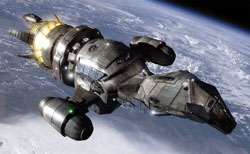
Serenity

Recently, my wife and I became the last two humans on the planet to finish watching the TV show Firefly and its companion film, Serenity. My verdict? Pretty much the same as everyone else’s: a lovely, epic little show, and it’s a shame it couldn’t have been a lovely, epic big show.

As a writer, I am also a scavenger, pawing over others’ creative works with dirty fingers for any nuggets of nourishment I can salvage. I thought the writing in Firefly was excellent, and the show has been rattling around in my brain for a while now, so let’s see if I can’t come up with five takeaways from Joss Whedon’s short-lived endeavor:

1. Characters are the foundation. The backstory’s intriguing, the plot turns and twists, the worldbuilding is thoughtful, the ship is cool. But the heart of Firefly is its characters. They’re active: they have strong opinions and strong feelings they aren’t afraid to follow. (Or rather, sometimes they are afraid, but they act anyway.) They’re consistent and distinct: you get a feel for exactly who each person is, and you know that if they change, there will be a reason. And they’re all bottled up on a tiny ship together, which makes for plenty of interesting conflict.

Can you do a good show that’s founded on a plot or an idea, rather than characters? Yeah, you can. But I think it gets tricky, because then you’re trying to make the people obey the needs of some other element, and it can be hard to make that believable.

2. Good vs. evil is murky. You don’t always know who’s right and who’s wrong in Firefly. The Alliance isn’t always bad, the captain isn’t always good. (I mean, okay, the Reavers are pretty much always bad, but stay with me.) The important thing, I think, is that you have somebody to root for. Even if the audience isn’t sure where they are ethically, as long as they’re on somebody’s side, they can stay engaged. Importantly, though, Firefly doesn’t sweep the ethical issues under the rug – it all gets talked about.

3. Story comes before message, always. I love Star Trek: The Next Generation a lot, but I admit they would sometimes do this really irritating type of episode where the whole point is for the characters and the audience to Learn Something, such as Don’t Hurt The Environment, or Civil Liberties Are Important. Firefly, thankfully, avoids this. Yeah, there are lessons, and sometimes they’re even made explicit; I’m thinking of the Jaynestown episode, in which Mal opines “…every man ever got a statue made of him was one kind of sumbitch or another.” But the lessons never come at the expense of the story.

4. Diversity isn’t just a corporate buzzword. One of the beautiful things about Firefly was how different everyone was: race, age, and gender being the obvious ones, but also of background, personality, class, and pretty much every other way that people can vary. This is a good thing – not because Diversity Is Special, but because it makes the characters more interesting, characters being the foundation and all.

5. Early reviews were not kind. Firefly is perhaps the most beloved sci fi show of the past decade, so it’s easy to forget that not everyone was a fan at first. According to Wikipedia (the source of all knowledge), “Tim Goodman of the San Francisco Chronicle felt that the melding of the western and science fiction genres was a ‘forced hodgepodge of two alarmingly opposite genres just for the sake of being different.'” He went on to call the show “a vast disappointment.” Others criticized it too, for various reasons. Remember, it’s a long road to love, and bad reactions early on can often give way to warmth as the audience slowly “gets it.” (Or not. The story’s gotta be, you know, good.)

Seen Firefly? Any thoughts worth sharing? Leave ’em in the comments!

Fancy Mug: A Parable

Alas! How woeful is the life of an artist, subject to scorn and mockery alike. Some would even say “mockery” is a subset of “scorn” and the Woeful Artist is being redundant. Yea, troubled indeed, this path I have chosen! Hark, now, whilst I regale you with a True-Life Story of Sorrow.

Like many of you, I rely on caffeine to guide me through the morning, a comforting angel made of sweet, sweet chemicals. But this angel, she is fickle, and to summon her requires a vessel. So it is the habit of me and my officemates to bring in coffee mugs to contain the nourishing spirit.

I possess a modest assortment of such mugs; but being a kindly soul, I sometimes admit a new one to my cabinets, if it please me. And a few weeks ago, whilst in Hobby Lobby, I happened across methought the manliest coffee mug I had ever seen:

Fancy Mug

But what did my co-workers say about this wonder, this veritable tower of masculinity? Would you believe, dear hypothetical reader, they mocked? They dubbed it Fancy Mug, and threatened to smash it (literally) on the hard, pointy rocks of reality (metaphor). Woe, say I, woe!

If you, too, are a Struggling Artist, you know all too well the pain of a Dream Derided. The beauty in one’s mind receives no meet greeting from a cold and pedestrian world. Oft times, the Artist, being of delicate temper and questionable fortitude, may find it most expedient simply to crumple under pressure, abandon the dream, and give over to the dreary path prescribed by the jeering crowd.

Did I, you ask, give over to the aforementioned pressure, and select a container more amenable to the sneering crowd?

Nay, good hypothetical reader, nay, a thousand times nay! Forsooth, I embraced Fancy Mug, held it aloft, and turned back those contemptuous darts with a heedless laugh and a jovial disposition! For oft may it be that a name given in scorn remains as a laurel. And as for me, I shall hold up Fancy Mug, drink deep from the hot black caffeinated goodness of my dreams, and recite the time-honored creed of Artists from time immemorial:

HATERS GONNA HATE

Have an excellent Monday and an outstanding week.

Friday Links

This week we’ll drive straight into the links without any preamble. Well, except for that sentence, I guess that was a little bit of a preamble. And that one. And that one. And that – ahhh infinite loop it’s all going dark

*Deep breath.*

Last week I mentioned, with the high grammatical standards you’ve come to expect, that Borders “done got bought.” Apparently that deal was not as final as it originally sounded, and is now falling through. At the moment, the most likely prospect seems to be liquidation, i.e. no more Borders book stores.

It seems J.K. Rowling has not been sitting idly on her throne of cash. She says she’s been hard at work writing ever since Deathly Hallows was published. The new works include a non-fantasy book for adults, as well as “a political fairytale for slightly younger children.” Admittedly the young children who love politics demographic has been under-served of late.

Snookie is coming out with another novel, to be titled Gorilla Beach. I feel this news is like a Zen koan. It cannot be grasped with the intellectual mind; it simply is.

I’ve had critiques on the brain a lot lately, so this post about how to avoid over-polishing a manuscript really resonated. The gist is that if you try to take all advice, you end up watering down your vision. I think that’s true. On the other hand, “I’m being true to my vision” is often just a crutch to support defensiveness and unwillingness to change, so you have to be very careful.

On a more philosophical note – wait, come back, philosophy is good for you, dammit! Er – anyway – the legendary Nathan Bransford has a great post about the nature of stories. In everyday life, the mind constructs stories as a barrier between itself and the great, terrifying abyss of actual reality. This is the closest I’ve ever seen Nathan come to writing something “dark,” so check it out.

Finally, in the category that I know is everyone’s favorite – “Not Related to Writing but So Funny I Had to Share” – I present: Stealth Dad.

Hope your weekend is rewarding, deeply fulfilling, and tasty. See you Monday!

Dark Roads

Congratulations are in order. Just last Thursday, author Natalie Whipple announced she had signed a two-book deal with publisher HarperTeen. In other words, she sold her novels. More importantly, she sold her first novels, meaning she’s finally achieved what I’m still working toward: her books are going to appear on shelves! Awesome.

(Incidentally, Natalie also critiqued the opening chapters of The Counterfeit Emperor for me, quite a while ago. Small world, as the Jovians say.)

However! Chances are, you have never heard of Ms. Whipple before today, so this news probably doesn’t mean a lot to you. What I want to talk about instead is this post, which she wrote back on December 1, 2010 – when she had an agent but no publisher, and things were looking far less hopeful. The whole thing is worth a read, but I’ll quote you the highlights (or lowlights, as it were):

This is the silent torture of those who’ve been out on sub[mission] for a long time. You’re not supposed to talk about it. You’re not supposed to admit to people how much it hurts. You can’t complain, because you have an agent and you should be grateful and so many authors would kill to be where you are. So you end up feeling guilty on top of sad, because as those passes pile up it does hurt. It shouldn’t, but it does.

And this:

Fifteen months, and I have not sold a book. I have watched some of my friends get agents and deals within this time. I hate to say it, but it hurt occasionally. And soon I will be seeing these books also come out before I sell. You start to wonder if you’re any good. You start to wonder if you made the right choice writing something different. You wonder what more you could have done when you’ve already worked so hard.

I’ll refrain from quoting the entire post, but suffice it to say that 2010 generally was the Year of Suck for her, for a lot of reasons. But she kept going, down a dark road with no obvious light at the end, and now she’s published. And I think that even if she had never managed to sell these books, she would’ve written more and kept trying until she got what she wanted.

Soon the name Natalie Whipple will be on Barnes & Noble shelves and Amazon web pages and all over the place, and newer, less successful authors may be tempted to look at her name with envy. She’s done it, she’s successful, why can’t I be like that? But it’s important to remember that the people we envy have, for the most part, been down the same dark roads that we have. Jealousy is natural, it happens, but jealousy doesn’t achieve your dreams for you. You only get there by pushing yourself onward, day by day, no matter what, even if you don’t see a light down the road.

Just last night I finally submitted my short story for Machine of Death volume 2. (A whole two days before the deadline!) They say they’ll announce their decisions October 31, which is a long time to wait. I have no idea if they’ll accept me or not. If they do, I’ll be thrilled.

If not, f*** it. I’m like the Terminator. I’ll keep on coming.