Just Act Normal!

I used to be a big Garfield fan as a kid. Out of the countless hours I spent reading every Garfield book I could get my hands on, this comic stands out clearly in my mind over a decade later.

Jon says, “Tell me, Garfield, when you walk, do your right and left legs travel together, or do you use your opposing legs?”

Garfield looks down at his own legs, eyes widening with revelation. He thinks, “I’ll never walk again.”

Isn’t it a remarkable paradox that the subconscious brain can do certain things flawlessly – until the conscious brain steps in? You can do it, as long as you don’t know you’re doing it. Effort makes you fail.

The same thing happens when a nurse is taking your pulse, or doing any other routine check, and tells you to “breathe normally.” How the hell do you breathe normally once you’re thinking about it? That’s a task for the lizard brain, not the human brain.

This comes up in other, more important ways too.

I live in a small town. It’s a nice place, with nice people, ideal in a lot of ways. But it’s not very, um, diverse. We have white Protestant Republicans and white Catholic Republicans, and for the most part, that’s about as deep as the differences go. And if you look at the particular part of town where I live and work, people are all pretty much in the same economic bracket too.

So when I run into someone different – race, background, whatever – something bizarre and rather silly happens.

The lizard brain points out, with no particular interest, that this person is different from me. Immediately the so-called “higher” brain functions take over, supplying all sorts of useful information, like “You may be unconsciously biased toward this person and not even realize it,” and “You should really try to fight any subconscious bias you may have,” and, most helpfully of all, “Just act normal!”

Thanks, brain. Appreciate that.

The result of trying to be cool is that I’m a little stiff, a little weird, a little formal. That’s what I get for thinking.

Does anybody else’s brain pull these kinds of antics?

Don’t Blog About How Your Blog Sucks

No, really. Don’t.

I see this from time to time, mostly with younger bloggers. People write things like, “I know my posts have been crap lately,” or “It doesn’t matter, nobody’s reading this anyway.” They trash what they’re doing while they’re doing it.

Think about the message this sends to your readers. They came to your website for no other reason than to read your words, which is a remarkable thing. They came because they expected to find something valuable. Are you really going to tell them they’re wrong?

I understand the temptation. I know what it’s like to feel that your writing isn’t any good, that your readers are wasting their time, that you don’t have “enough” readers, or followers, or commenters, or people linking to you (whatever “enough” means). I know these feelings very, very well. And your blog is an expression of self, so I get that you want to put those feelings out there.

But don’t.

If you want people to listen to you, you have to project confidence. If you expect yourself to keep writing, you have to have confidence. Nobody wants to board a sinking ship. Even if you only have three readers, write like you have a thousand. Make them feel they’re part of something special, something worth their time. Fake it till you make it.

This idea may not sit well with some of you. My generation is very open with its feelings. If we’re upset or depressed or excited, we want to share it with the world, and some people confuse over-sharing with honesty. But honesty isn’t about broadcasting your raw, unfiltered emotions. It’s about honoring a contract of trust. You can be honest with your readers without drowning them in angst.

With that in mind, I suggest two possible approaches for handling your self-doubt.

First, don’t blog about it at all. You can still talk about it, to your friends or your family or whoever, just don’t do it on your blog. Let your readers remain blissfully unaware.

Second, blog about it professionally. Choose your words with care. Write about your feelings without trashing yourself, the work you’ve created, or (God help you) the people kind enough to read it.

You can say “I struggle with these kinds of thoughts” without saying you’re worthless. You can say “I probably should’ve researched that last post more carefully” without saying it was crap. You can say “By this time next year I hope to have 100 followers” without saying your website’s a ghost town.

If this sounds like soulless corporate business-speak, well, it is – just a touch of it. But there’s a reason businesspeople talk that way. It’s because business is about getting shit done. A little veneer of professionalism won’t squelch your primal artistic bird-spirit, trust me. It might even get a few more people to read about it.

Do you notice many bloggers doing this sort of thing? How does it make you feel as a reader?

Starstuff

Wish you were here?

A section of the Omega Nebula, three light years wide. Taken by the Hubble Space Telescope (NASA). http://commons.wikimedia.org/wiki/File:Omega_Nebula.jpg

Back in December, my dad threw down the gauntlet.

He was talking about the life cycle of stars, and the fact that all the building blocks of our world – carbon, oxygen, nitrogen, iron, etc. – were created in the hearts of supernovae. [CORRECTION: Strictly speaking, this is not true. The elements I named are actually the product of stellar fusion rather than supernovae per se. Supernovae are responsible for even heavier elements, like uranium. Ahem. Carry on.] The stars themselves forged the elements that make us up today.

Or, as Carl Sagan put it:

…we who embody the local eyes and ears and thoughts and feelings of the cosmos, we’ve begun, at last, to wonder about our origins. Star stuff, contemplating the stars. Organized collections of 10 billion billion billion atoms, contemplating the evolution of matter, tracing that long path by which it arrived at consciousness here on the planet Earth, and perhaps, throughout the cosmos.

But my dad said that although this view of the world is very beautiful, you don’t see many poems written about it. Let’s face it, most poets just aren’t that into astrophysics.

Or, as Richard Feynman put it:

Our poets do not write about it; our artists do not try to portray this remarkable thing. I don’t know why. Is no one inspired by our present picture of the universe? This value of science remains unsung by singers: you are reduced to hearing not a song or poem, but an evening lecture about it. This is not yet a scientific age.

You can see where this is going. Dad challenged me to write a poem celebrating the beauty of our stellar origins. For the right price, I accepted. I wrote the sonnet below on the last day of the year.

Starstuff

From stars we come, and to the stars return.
My hands, my wife, my Chevrolet, Milan,
The weathered heath, the dew-encrusted fern,
Aurora borealis and Cezanne:
Ambassadors of one ancestral realm
Where all, their duty done, alike retire –
One mother’s children drive one vessel’s helm,
And keep, in hearts and hulls, a common fire.
When downstairs in the stillness of the dark
My desperate chains of thought hold sleep away
And green electric digits glowing stark
Denote the drowning of another day,
I listen to the rush of distant cars
And tell myself I hear the song of stars.

In spite of its flaws, I like it pretty well, and was thinking I might send it off a few places, try to get it published.

Unfortunately, the first line was bugging me. I wasn’t sure I’d invented it; I thought I’d heard it elsewhere before. A little Googling revealed I was right.

From the stars we came. To the stars we return. From now, till the end of time. We therefore commit these bodies to the deep.

-Captain John Sheridan, Babylon 5

I’m not sure whether this would be considered plagiarism in the strictest sense, but I know the line isn’t my own work, so I don’t feel right keeping it. Unfortunately, I can’t think of any replacement that sounds half as good and still fits the rest of the poem.

So, lacking any other home for it, I’ll put it here.

I’m not sure I really fulfilled what Feynman had in mind with his quote above. I think he was talking more about celebrating the spirit of scientific inquiry, whereas I focused more on the vision that spirit revealed. But then, Feynman was kind of a dick, so I don’t especially care. My dad liked it, which means a whole lot more to me. And I’ll venture to say it might have made Dr. Sagan smile, too.

By the way, as a prize for this endeavor, my dad gave me a totally kickass Monty Python’s Holy Grail mug, shaped like, well, a grail. Good things come to those who write. Just sayin’.

What inspires you?

Friday Links

Feeling sick today so I’ll keep this brief:

Kim Jong Un looking at things, a Tumblr.

When to use i.e. vs. e.g. as explained by Sasquatch.

Need someone to do stuff, or perhaps…things? An intriguing business model.

Have an excellent weekend!

Monument to the Revolution

Near the small town of Podgarić in Croatia, literally in the middle of a field, stands the creature above. Macedonian sculptor Dušan Džamonja built it in 1967, commissioned (presumably) by the Communist government in charge of what was then Yugoslavia. It was called “Monument to the Revolution of the People of Moslavina,” a World War II memorial and a symbol of Communist pride.

But Croatia has had another revolution since 1967, the Communists are out, and the years have transformed this object from a political statement into a surreal work of art. Now it rests sans context in the hills, a modern-day Ozymandias, a brooding monster orphaned from its homeworld. You can see it for yourself right here on Google Maps.

Lots of other bizarre Yugoslav sculptures still dot the landscape. The website Artificial Owl showcases all sorts of cool abandoned man-made stuff. Our planet is full of these unknown wonders.

What treasures have you found off the beaten path – sculptures or otherwise?

Three Grammar Mistakes Smart People Still Make

Y’all are a smart bunch of readers. You know it, I know it. No shame in admitting that.

But we also know that Grammar, she is a tricky mistress, and it’s easy to make mistakes. Even when you’re smart.

The three errors below are sneaky and show up everywhere, even in documents that are well-edited otherwise. The good news is, these mistakes are easy to fix. Read and learn.

1. Every day vs. everyday

“Every day” acts like an adverb, while “everyday” is an adjective. I drive to work every day (adverb), so it’s an everyday occurrence (adjective).

RIGHT: Every day I’m shufflin’.

WRONG: Everyday I’m shufflin’.

I see this a lot in ads. “Working hard to help you. Everyday.” Cringe.

2. One hour vs. one-hour: when to use hyphens

If you wait for one hour, that’s a one-hour wait. Hyphens are for turning the phrase into an adjective. If you’re not using the phrase as an adjective, leave the hyphen out.

If you do the work up front, then it’s up-front work. Combine the words when using as an adjective, leave them separate otherwise. Same rule as every day vs. everyday, actually.

RIGHT: Gilligan went on a three-hour tour.

WRONG: Gilligan went on a three hour tour.

(Update: forgot to mention in the original post, but there are also a lot of other situations where hyphens can be used, besides turning a phrase into an adjective. Just so there’s no confusion.)

3. Till vs. ’til

I used to think that till was for gardening (“she tilled the soil”), but for talking about time, you had to use ’til since it’s a short form of until (“I’ll wait ’til he gets here”).

Wrong.

Yes, till can refer to tilling the land, but it’s also a perfectly good word for talking about time. Till is not a shortened form of until. Rather, till and until are two valid ways of saying the same thing, and ’til is not really correct.

I say “not really correct” because, if enough people make the same English mistake, eventually it just becomes standard English. These days, almost everyone writes ’til even though till is better, and even the dictionaries are starting to come around. So I guess the main point isn’t so much that ’til is wrong, but that till is right.

RIGHT: I kept reading the blog until he brought up grammar.

RIGHT: I kept reading the blog till he brought up grammar.

LESS RIGHT: I kept reading the blog ’til he brought up grammar.

This concludes today’s episode of “Brian rants.” I’ll turn it over to you. What grammar mistakes drive you crazy?

My “Best” Blog Post

I’ve written about the size of the universe and the foundation of ethics. I’ve reviewed the oldest story in the world. I’ve cooked up poems and stories of my own. I’ve even self-selected a “Best of Buckley” section, over on the right sidebar.

And guess which post gets the most hits?

This one right here: 28 Words to Use Instead of “Awesome.”

When I say it gets the most hits, I mean it’s not even close. Yesterday alone, that single post (from six months ago!) accounted for over 20% of my raw hit count.

28 Words to Use Instead of “Awesome” is old and doesn’t give a shit. It is the Betty White of blog posts.

Why?

Because if you go out to The Google and type in “words to use instead of awesome,” that page is the #2 result. And let me tell you, a surprising number of people are searching for exactly that. Watching these young’uns improve their English warms my frosty heart.

Two things we can learn from this.

First thing. As an artist – and, more generally, as a creator of stuff – you really can’t predict which of your creations will catch on, and which will die. Popularity isn’t random, but it seems damn close sometimes. Embrace the chaos. Create your things, scatter them over the Internet, see what takes root. And as you’re waiting for those roots, remember that popularity does not equal quality.

Second thing. If I thought popularity did equal quality, then 28 Words would be my “best” blog post. I might be tempted to do a lot more posts like that one, just to ramp up my hit count. Of course that would be silly, because then I wouldn’t be growing a community of readers, I’d just be making a bunch of one-off posts that people would find, read, and never return to again. Yet it seems to me that corporations often do something similar. They get so focused on the raw numbers, the performance of their “metrics,” that they lose sight of what really makes sense for their business.

Thus sayeth Buckley, anyway. Although me giving business advice is like Moses starting a tech blog. Take anything I say with a grain of Lot’s wife.

(Too soon?)

If you blog, have you been surprised by which posts are the most popular?

And I have to ask: did anyone out there start reading this blog because they found 28 Words to Use Instead of Awesome?

How Anki Will Make You Smarter

So flashcards are pretty sweet, right? You have something you want to learn: vocabulary, state capitals, times tables, whatever. You write down the info on pieces of paper, you quiz yourself, bam! Magic. Straight from the paper into your brain.

But flashcards have their problems.

For one thing, it’s a pain to buy the blank cards, write the facts on them, and keep track of them. Using flashcard software instead of physical cards will fix that.

The more basic problem with flashcards is that they don’t do well with large amounts of data. If you just review all of them over and over, you’ll spend most of your time studying facts you already know pretty well, while the tough ones don’t get enough attention. On the other hand, if you remove the easy ones and only review the hard ones, then the “easy” ones gradually fade from your brain.

Enter Anki.

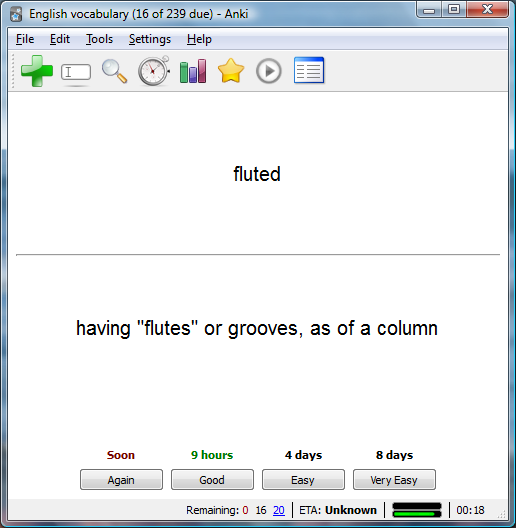
Fluted? What about banjoed?

Anki is free, open-source software that offers a smarter way to do flashcards. At Anki’s heart lies a card scheduling algorithm that intelligently decides when to show cards based on how well you know them. The first time you say a card is “good,” you’ll see it again the next day. If you say it’s “good” a second time, then it’ll wait several days. The next time will be even longer, until pretty soon it’s convinced you know it, and you won’t see it again for months.

On the other hand, if you ever miss a card, it will reset the timetable and focus on that card again until you have it down.

If you happen to agree that flashcards are pretty sweet (there has to be someone else out there, right?) then Anki is very sweet indeed. You can get it on your smartphone, too. It supports all kinds of character sets, so you can do Russian, Chinese, etc. For the mathematically inclined, it also supports LaTeX. You can even insert pictures.

Of course, as smart as Anki is, flashcards still have certain limitations. As I said a few weeks ago, repetition alone is a weak foundation for memorizing something. They key to making data stick is to use it in multiple ways, to come at it from several different angles. It’s tough to get that from flashcards.

But you have to learn information before you can use it, and for straight-up computer-to-brain data transfer, it’s tough to beat Anki.

You can download Anki from its homepage, right here.

Have you tried any cool, free software lately? Tell me about it in the comments!

Friday Links

If my post about the logical problems with ethics got you fired up, head on over to Ben Trube’s blog and read his rebuttal. Ben, I may not agree with you, but I truly respect your epic beard. Good day sir!

Meanwhile, it seems J.K. Rowling is working on her first adult novel. No, not that kind of “adult.” Details are still scarce – we don’t even know the title yet. All we know for sure is that it won’t involve Harry, Hermione, Hogwarts, or Hagrid.

If you’re into physics (and really, who’s not?) you may have heard the buzz a few months back about faster-than-light neutrinos. Turns out, it was really just a loose cable! Who could’ve possibly predicted this? (Answer: physicists.)

Speaking of cables, this may be the funniest Amazon review I’ve ever read. “Great cable, but too fast.”

Webcomic roundup: excellent showings this week from SMBC, xkcd, Questionable Content, and even Dilbert.

EVERY DAY I’M SHUFFLING: a probabilistic analysis.

Ladies and gentlefolk, have an unparalleled weekend.

Forty-Minute Story #4

“You’re angry.”

“Yes.”

“I can tell when you’re angry because your nose turns the color of an overripe rutabaga.”

“Yes.”

“Well, I think my PR manager should project a calmer presence.”

“Noted.”

“Now hold on, don’t tell me. I’m going to try and guess the reason you’re angry.”

“Guess quickly, Nigel, new reasons are arriving.”

“Is it because I didn’t call you on Tuesday?”

“I recite a special prayer of gratitude to Our Savior Jesus Christ every time you fail to call me.”

“Is it because I sometimes experience involuntary, but not entirely unsatisfying, lucid dreams concerning the late Amelia Earhart?”

“What? No. What?”

“Is it because, at approximately 4:00 yesterday afternoon, I convened a press conference to announce that NigelCorp would cease production of integrated processors and convert its factories entirely to the manufacturing of rhinoceros hygiene accessories?”

“You’re getting warmer.”

“Is it because I thereafter led a live Sumatran rhinoceros, emblazoned with the NigelCorp company logo, onto the stage, and serenaded it with my own rendition of Paul Anka’s ‘My Way,’ in violation of federal copyright law, the Washington Convention, and basic human decency?”

“You are now extraordinarily close.”

“Is it because the rhino took a dump on the inside of your Volvo convertible?”

“Five guesses, Nigel. That’s quicker than usual.”

“I try.”

“You don’t.”

“It’s important in these situations to find room in your heart for gratitude concerning the blessings you still retain. Consider the remarkable happenstance that the rhino oriented herself so as to defecate entirely inside your Volvo whilst remaining entirely outside the same. It could have been much worse.”

“Nigel, right now I’m struggling to find room in my heart for oxygenated blood. You know why I’m here.”

“You want an apology?”

“Not in the slightest.”

“You want a new Volvo?”

“You’re getting warmer.”

“You want a new Volvo, and also, eight million dollars?”

“Three guesses that time. I’ll note it in my journal as a new record.”

“I’ll make the arrangements.”

“Thank you.”

“Gratitude is good for the soul, isn’t it?”

“Go to hell, Nigel.”

“I’d rather stay here. See if you can get it delivered.”

“I’ll do what I can.”