
Why Thanksgiving Is My Favorite Holiday

As a child, I belonged to the Worldwide Church of God (which I just learned has changed its name to Grace Communion International…weird). We were Christian, but we observed a lot of the Old Testament holidays, like Passover and the Feast of Tabernacles. We also shunned a lot of mainstream holidays. For doctrinal reasons, I was not permitted to celebrate Christmas, Halloween, Easter, or Valentine’s Day.

So, unlike most people, I don’t have many special childhood memories of Christmas or Halloween, which seem to be most Americans’ favorite holidays. But we did celebrate Thanksgiving.

I love Thanksgiving for a lot of reasons. Of course, I love seeing my family, and I love all the food. I also love that it’s a distinctly North American holiday, and that it’s the perfect capstone for fall.

I also love the sheer simplicity of it. No decorations, no costumes, no goofy mascots, no parties, no songs, no presents, no cards. Thanksgiving is like, “Man, just get your family together and make a bunch of food. It’ll be a good time.” And you know what? It is.

And finally, I love what Thanksgiving represents. I think the spirit of gratitude is one of the most important and underrated values of modern society. I’m agnostic now, so the idea of giving thanks to God is less meaningful for me. But the act of appreciating what you have is as important as ever. If you don’t value your blessings, you lose them.

Also, we don’t really care about football. So, there’s that.

What does Thanksgiving mean to you?

Why Pepper Spraying Kids in the Face is a Bad Idea

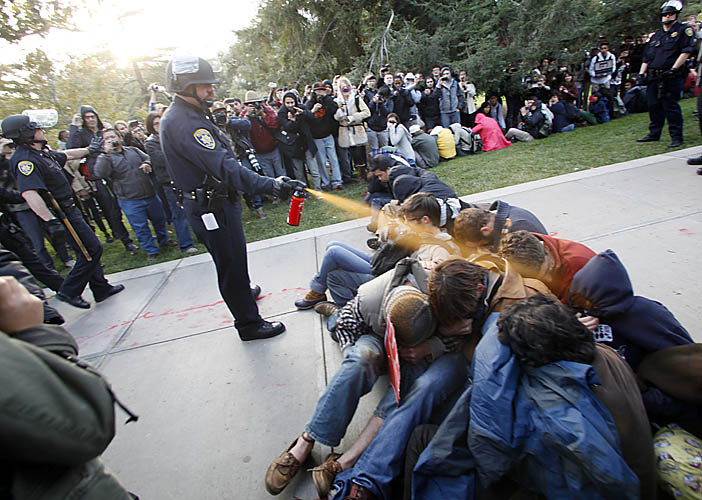
In case you haven’t heard, some seriously bad shit is going down at the University of California-Davis.

The video above is more than eight minutes long, but the first 30 seconds will show you all you need to see. A line of student protesters is seated peacefully on the ground on the campus of their own university. A police officer walks up and down the line, deliberately and repeatedly dousing the crowd with pepper spray. This happened on Friday.

In the wake of this fiasco, it seems like all the right things are happening. The campus chancellor has apologized. The university president is taking steps to ensure this doesn’t happen again. The officers involved are being investigated for disciplinary action. The press has blown the whole thing wide open. The students are right back in the same place, protesting again. All this is as it should be.

The absurdity of a police action like this is mind-boggling. Forget for a moment the basic and obvious ethics of using chemical weapons on someone for sitting on the ground. Forget the massive PR debacle that anyone could have predicted. Let’s focus for a minute on the biggest reason this attack doesn’t make sense:

You’re on the same side.

In a democracy, police and protesters are working toward the same goal. Both roles exist to serve the people, and both roles are absolutely essential. If either ceases to function, the entire system crumbles.

Pepper Spray

We see the most extreme manifestation of this Government vs. People mentality happening all around the world. Syria’s dictator has already killed four thousand demonstrators, with no sign of stopping. Egyptian protesters are gearing up for a second revolution, after their first one earlier this year didn’t bring about the changes they needed. In Burma, things are so bad that when an opposition leader runs for Parliament, it’s international news.

Obviously the situation in all three of those countries is far, far worse than anything going on at UC Davis right now. But that’s where the path leads, if left unchecked.

If necessary, I’ll take to the streets too. I’ve done it before.

Skynet in the Basement

In the past week I’ve been working on designing an artificial intelligence. Now, normally when people say they’re working on AI, they mean some particular AI-ish sub-problem, like text-to-speech or chess-playing or facial recognition. In typically quixotic fashion, however, I’m going straight for the top: a Strong AI, a software program with human-level intelligence.

This isn’t the first time I’ve worked on this problem. Strong AI is an appealing project to me for a lot of reasons. For one thing, it blends nearly all my interests: computer programming, language, philosophy, theories of consciousness, ethics, even Go. It’s also deceptively simple; it just seems like it shouldn’t be that hard, though of course nobody’s ever done it before. And, because nobody’s done it before, nobody really has any idea how to do it, which means the field is wide open. All very exciting, provided you’re geeky enough. (Check.)

Part of me says I’ll never get anywhere with this stuff, but another part can’t help planning for what happens if I succeed. I take very seriously the theory of the Technological Singularity – the idea that machine intelligence, after reaching a certain critical threshold, might grow exponentially and leave humans so far in the dust that all we could do is hope it doesn’t squish us. I’ve got some ideas on how to deal with that, too.

I’m running out of time this morning, so I’ll cut this short. Let me ask, have you ever worked on an AI? Or, if someone else built an AI for you, what would you do with it?

Friday Links

I came across a blog by a Canadian woman living and working in Mozambique. In her latest post she talks about some Mozambican school kids, and how excited they were to receive pictures of…well, I’ll let you see for yourself.

This comic summarizes my feelings on every economic issue in this country.

And this one pretty much sums up my thoughts on the First Amendment.

And finally…there are a lot of reasons to be recommend a book. Maybe it gave you some practical advice. Maybe it touched you spiritually. Maybe you liked the writing style. Or maybe…it just has the greatest book title ever created.

Have a good weekend, everybody!

Hidden Wars

A couple days ago, while having the brake pads replaced on my silver four-cylinder base-model 2006 Honda Accord, I found myself in a waiting room with hours to kill and a lot of magazines to read. I came across a recent TIME article that really got me thinking.

The article says that, in the U.S., the divide between soldiers and civilians has never been bigger. Many outside the armed forces are ignorant of even the most basic details of how the military works, what it’s currently doing, and what daily life is like for service members. Meanwhile a lot of soldiers grow more isolated from the country they serve.

The percentage of Congress that’s made up of veterans has dropped from 77% in the 1970s to 22% today.

The article got my attention because I’m part of the problem. What do I know about the military? I know we’re in Afghanistan, and pulling out of Iraq. I know we were involved with the Libyan air strikes and that we’ve sent “advisors” to help fight the LRA. But…specific details of how the Afghanistan war is progressing? Knowledge of the military command structure? An understanding of what everyday life is like for a soldier? Things I can do, as a civilian, to help those who are risking their lives? On all those subjects, I’m hazy at best.

This is a big deal. Democracies rely on the people to be informed about what their country is doing. In the U.S., I see a population increasingly distracted by entertainment, increasingly apathetic about what their guns are doing and why. And it seems to me that this is how democracies fall.

I mentioned recently that I’ve started learning about a new subject every week. This week was Mozambique. I think sometime soon I’ll take a week and learn more about the armed forces.

How much connection do you feel to your country’s military, and how well do you understand them?

Emancipation of the Blog

When I started this blog, I had a very clear direction in my mind: I wanted it to be entirely about writing.

I had always been frustrated when I visited author blogs in the past. I was reading these blogs because I wanted to know more about what it’s like to be a writer. I wanted writing advice, insight, practical help. Instead I got pictures of pets, political rants, and book promotions. Sure, I thought, it’s their prerogative, they can write about whatever they want, but I’m going to be different.

For over six months now, I’ve kept pretty close to my goal. But it’s not as easy as I thought.

I feel like most of my posts these days fall into one of three categories: (1) talking about my own writing, (2) discussion or advice about writing technique, and (3) “inspirational” posts. (“Inspirational” is in quotes to keep me from gagging.)

But here’s the deal. (1) Most of the time, the status of my own writing is “Yep, still working on [insert story name].” (2) I’m just not experienced enough to trust my own writing advice yet. (3) There are only so many ways to say “Ignore your inner demons and keep writing no matter what.”

Of course, I can also talk about things I’ve read, other book-related topics, etc. But the point is, the well is running dry. I still have literally dozens of ideas for posts about writing, but few that I’m excited enough – or have done enough research – to actually create.

I want to be excited about this blog. Otherwise, I’m wasting my time and yours. Besides, I’ve been down that road before, and trust me, it sucks.

So, by executive order, this blog is hereby liberated from the shackles of Writing About Writing. It is now free to cover any topic I’m excited about. BAM, bitches!

Now obviously, “any topic I’m excited about” very much includes writing, so I don’t expect those posts to stop. They just have a little competition now. It’ll be good for ’em. It’ll keep ’em honest.

What say you, citizens? Will you miss the single-minded, borderline-OCD focus on books, or are you glad to read about something new for a change? Are you not entertained?!

Lessons from Mozambique

I'm on a BOAT

Mozambican fishermen. Photo by Steve Evans.

I’ve started a new project, as I frequently do. Every week I’m going to pick a different topic – anything that interests me – and learn about it all that week. Maybe I’ll get tired of it eventually, and if so that’s fine, but it’s a lot of fun for now. I’ve started with Mozambique.

I’ve already learned a lot, both from the Internet, and from a book I found at the library, This is Mozambique by Ian Michler. For instance, I learned that Mozambique was a Portuguese colony until 1975, and also (this shocked me) that Portugal itself was a dictatorship until roughly the same time. The book also has a bunch of great photos, and I do like me some pretty pictures.

However, this is a writing blog, so I have to talk about the writing. I’ve noticed something about the writing style in the book that bothers me. I’ve seen it in a lot of other books too.

This passage is a good example:

The Mozambican people have a wonderful sense of revelry with weekends being a time for song and dance.

When I read sentences like that, something seems wrong, though it isn’t always easy to pinpoint. To bring it into sharper focus, I’ll rewrite it to be about my own home – Ohio, USA.

The Ohio people have a wonderful sense of revelry with weekends being a time for song and dance.

I’d say the sentence is still true. We party on the weekends, no? But when the sentence is about me, it becomes clearer that it’s…condescending, somehow. Like he’s talking about a specimen he discovered. It’s so generic as to be almost meaningless. The feeling is that of an adult praising a child: “Good for you!”

What kind of music do they play? What does it sound like? Is it uniquely Mozambican or is it more widespread? Is it religious or secular?

Or take this passage:

Mozambicans are proud of their roots. The Makonde, who inhabit the far northern regions of the country, still dance in colourful costumes and masks, and carve as they always have, although the traditional art of tattooing the face and body is dying out.

They’re proud of their roots – but what do “colourful costumes and masks” tell us about their roots? What do the costumes signify? Why do they do it? Without that information, it’s just an exotic curiosity, something to smile about. Nobody would ever visit a Catholic church and write that the Catholics “are proud of their roots” and “still perform rituals in elaborate costumes and hats” without mentioning what the point of it all is.

In this case, details aren’t just good writing, they indicate respect. Details mean you care enough about your subject to really get into it, because it isn’t just a curiosity – it actually matters.

Fundamentally, I think the issue is learning about people versus learning from them. This book wants you to learn about Mozambique, which is not in itself a bad thing. But without a real sense of what’s going on – what it all means – it’s difficult to learn from Mozambique.

For instance: after a decade-long war of independence and another decade-long civil war, they’ve still managed to emerge as one of the fastest-growing economies in the world. How are they doing it? Is it a model for others to emulate, or is there a dark side to their rapid growth? Etc.

Don’t get me wrong, I give the author tremendous credit for writing the book at all, for taking the time to travel all over the country and take the pictures and make the effort. It’s more than I’ve ever done. I just think the writing style – and possibly the viewpoint – need some work.

What do you think? Do the passages I quoted seem condescending to you? Have you come across writing like that in other places?

A Guide to Carrots

carrot

Carrot – Long, pointy. Traditionally orange. Good with Ranch dressing.

caret

Caret – A proofreading mark to indicate that something should be inserted into the text. Also used in math as an exponent symbol, for example, e=mc^2.

carat

Carat – A unit of mass for gemstones. One carat = 200 milligrams. “Carat” is one of the “four C’s” in diamond-buying, the other three being cut, clarity, and color.

karat

Karat – A measure of purity for gold alloys. 24-karat gold (written 24K) is pure gold. 18K gold is 18 parts gold for every 24 parts of the alloy, that is, the alloy is 75% gold. Just to be extra confusing, some countries spell this word as “carat” too.

And you thought there/their/they’re was bad. Friggin’ English!

Friday Links

Writing Links

Did you know? God has a memoir. And Walmart isn’t interested.

One author loves Moby-Dick so much he wrote an entire book just trying to convince you to read it. In his words: “it’s as close to being our American Bible as we have.” Melville’s masterpiece is still languishing unread on my shelf at the moment, but I’ll get to it eventually.

English: we need some gender-neutral pronouns already. Let’s get on that. Dinosaur Comics is totally calling you out.

Non-Writing Links

In case you haven’t heard: Jimmy Kimmel asked parents to tell their kids they had eaten all their Halloween candy, and videotape the responses. You’ve never seen so much crying. It’s schadenfreuderrific!

Here’s a video of a moth beating its wings in slow motion. That is all.

Some science news: a few of those universal constants may not be as constant as we thought.

And finally today – it turns out there is something called “chap hop,” which is Victorian hip-hop. Steampunk rap, in other words. People. Why didn’t you tell me about this? Here’s Professor Elemental launching another salvo in his ongoing feud with Mr. B, The Gentleman Rhymer:

My plans for the weekend revolve around the mutually contradictory ideals of finally getting caught up on my To Do list, and chillaxing. What about you?

Fun Fact: I am a Robot

Square Eyes

Fun fact #2: this image was not digitally altered.