It’s Not Easy Being Snooty

And I should know. I’ve wielded plenty of snootiness in my time.

See, to be a proper snoot (a.k.a. snob), it’s not enough to dislike a book, movie, show, or whatever. Everyone has preferences, everybody dislikes things. No, to really snoot it up, you must believe that certain works – even certain categories of art – are utterly worthless, completely undeserving of any attention whatsoever.

After all, the more you admit that a work you dislike has merit, the more you erode your essential snooty nature.

That’s tricky, though. Because as a snoot, you probably aren’t intimately familiar with the work you disdain. And that, in turn, leaves you open to snoot-derailing stealth attacks (SDSAs). You can pronounce that “sodas,” or really, any other way you want, because I only made up the name just now.

I love SDSAs. Here’s how they work:

  1. Find something the snoot thinks is worthless (let’s say Family Guy).
  2. Pick a quote or scene from it you know the snoot will like. Tailor it to your audience. (“I read a book about this sort of thing once.” “Are you sure it was a book? Are you sure it wasn’t … nothing?” “Oh yeah.”)
  3. Tell the quote to the snoot, but don’t give the source. If done correctly, the snoot will laugh (if it’s a joke) or otherwise acknowledge its quality.
  4. Tell the snoot where the quote comes from. An abrupt change in subject may follow.

Is it petty of me to do this? Probably. But it’s just so much fun.

Transcendence: A Bad Dream

Each week, we’ll look at another example of what I call a “moment of transcendence” – a scene from a show, a passage from a book, or anything else, that I find soul-piercingly resonant: joyful, sad, awe-inspiring, terrifying, or whatever. These moments are highly subjective, so you may not feel the same way I do, but nevertheless I’ll try to convey why I find the fragment so powerful. I hope we can enjoy it together.


A Softer World is an odd little webcomic. I used to read it all the time, and then stopped for some reason. I just found out today that they’re done making them, but the archives are still online.

It isn’t really a comic in the normal sense. Instead, they take a photo, split it into panels (usually three), and add some text. There aren’t characters, plot, or dialogue per se. It’s just something funny or sad or different. ASW is artsy and weird, in a good way.

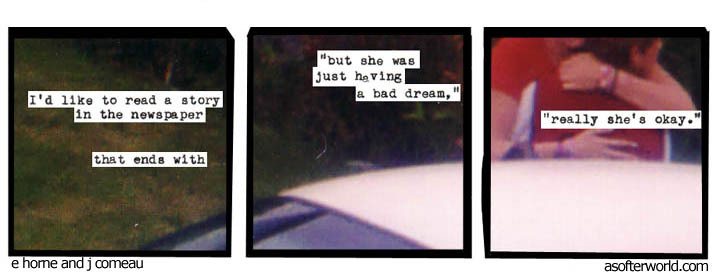
This one is my favorite. It doesn’t have a date, but I’m estimating circa 2004.

shesokay

Everyone – even people with safe and happy lives, like me – everyone gets so used to the ubiquity of pain and sadness that it simply becomes standard, part of the world, part of the mental model. It’s bad, but you expect it. You could call this jaded or cynical, but if so, it’s the baseline cynicism you need to get by as an adult, or as a child older than three.

You know how your windows get dirty, and you don’t even realize how dirty they are till someone wipes a circle on one of them? Suddenly you realize what clean glass looks like, and then for the first time you understand how dirty the rest of it is, has always been, which you never knew till now, even though you’d been looking at it all along.

That’s what this comic is for me. It’s not saying we should be naive or ignore pain or anything like that. It’s just saying “Look, this is where we are. This is how far we are from what we hoped it would be.” Not depressing (at least to me). Just true.

In Slaughterhouse-Five, Kurt Vonnegut imagines a soldier’s epitaph as “Everything was beautiful and nothing hurt.”

In my favorite episode of Buffy, “After Life,” our recently resurrected heroine describes what death was like:

I knew that everyone I cared about was all right. I knew it. Time didn’t mean anything, nothing had form. But I was still me, you know? And I was warm. And I was loved. And I was finished. Complete. […] I think I was in heaven. […] Everything here is hard, and bright, and violent.

The Tower of Babel is supposed to be a cautionary tale. But that heaven, I think, is worth building a tower to.

Friday Links

I came across the word apotropaic yesterday. It means “designed to avert evil” – for instance, garlic when it’s used to repel vampires. But I’m thinking, if you use a word like “apotropaic” for something as simple as averting evil, you might be averting some readers too.

(Merriam-Webster adds that there’s an adverbial form: “apotropaically.” As in, “I shall be using this garlic apotropaically.” Dude, you gonna get bit.)

Also, in the unlikely event that you haven’t yet seen the sweet, sweet new Star Wars trailer, well, here’s the sweet, sweet new Star Wars trailer:

See you Monday!

Romance, Horror, and Ice Cream

I was thinking yesterday about genres of fiction: romance, horror, mystery, etc. It’s easy to think of genres as being like ice cream flavors – just different varieties of the same thing, no more than a matter of taste. But in fact, genres differ in more fundamental ways.

Here’s a (non-exhaustive) look at how various genres stack up.

Romance is the most restrictive of the major genres, enforcing both a plot and a reader emotion. The plot is that two people are attracted to each other, go through a rocky courting process, and finally end up together. The emotion is a happy ending (and a general warm-fuzzy throughout, despite some turbulence). It doesn’t matter how much romance a novel may contain – if it doesn’t have both of those things, the plot and the emotion, then it is by definition not a romance novel.

Mystery is also restrictive, but not as much as romance. Mystery enforces a plot – a crime happens, usually a murder, someone spends the book gathering clues, and finally solves it – but not an emotion. A mystery can feel any way the author likes and still be a mystery.

By contrast, horror enforces an emotion (fear) but not a plot, which I would argue is even less restrictive. You can write about anything you want as long as it produces that feeling.

Science fiction has no restrictions on plot or feeling. A sci fi story can be any type of story at all, as long as it contains the right elements: advanced technology, aliens, futuristic stuff, whatever. If that sounds broad and vague, well, it is. Stories as wildly divergent in tone and structure and theme as Dune and Doctor Who and Hitchhiker’s Guide to the Galaxy are all considered sci fi, just because they have the right elements.

Then you’ve got historical fiction, which doesn’t enforce plot, feeling or particular elements, but only setting: it has to evoke a distinct sense of time and place. The Western is a curious animal, a proper subset of historical fiction which likewise has a setting requirement.

Finally, you’ve got fantasy, which vies with mainstream (non-genre?) fiction as the most inclusive branch in existence. Fantasy makes no demands on plot, emotion, particular story elements, or even setting. The only thing fantasy requires – the only thing – is that you think outside the box of what’s physically possible. In effect, the restriction is that you’re not allowed to restrict yourself. (The subgenre of sword-and-sorcery fantasy – which is what many people think about when they hear “fantasy” – is more restrictive.)

Obviously, most of these genres can and do overlap.

You can like or hate any genre you want. That’s fine. But you should understand that saying “I like mysteries” is fundamentally different from saying “I like fantasy.” The former is saying “I like to hear a particular story type retold in a new way.” The latter is saying “Let’s see what kind of crazy this author has cooked up.” The sky is not even close to the limit.

And I do like me some crazy.

The Best Excuse

You’ve only to say “I fear I cannot accept your kind invitation, because of the Norman Conquest,” I shall quite understand: shan’t be offended a bit.

-Lewis Carroll, letter to a friend, 1884

Who could argue with that?

Blog, Toil, Tears, and Sweat

I’ve been blogging for over four years now, and I’ve discovered something curious: there’s essentially no relationship between how much work I put into a post, and how popular it is.

For instance, my most popular post – more popular than all others put together – is this little list of words to use instead of “awesome.” It’s gotten 87 comments (and counting). I probably cranked it out in about half an hour.

Meanwhile, my story “The Witch and the Dragon” took two weeks of feverish work to write, and is 28,000 words long, spread over sixteen posts. It’s the best long fiction I ever wrote in my life – and I’d honestly be surprised if any single person actually read it, much less gave feedback.

I understand why this happened, of course: the “awesome” article is quick, clickable, and (hopefully) useful, whereas the story is long, requires an investment of time and energy, and has a niche audience.

And I’m not complaining. Because, you see, I do the same thing with other people’s work. Robert Frost, for instance, cranked out “Stopping By Woods on a Snowy Evening” in a few minutes, as a break from working all night on the long poem “New Hampshire.” And now, “Snowy Evening”? A rock star. That second one? Never heard of it till I looked it up just now.

Of course, it can go the other way. Tolkien spent over a decade on Lord of the Rings, and now it’s sold upward of 150 million copies. I’m not saying that writing effort is useless, or that it’s never rewarded. But the connection between effort and reader acclaim is … tenuous.

But that’s okay. To paraphrase Marcus Cole from Babylon 5:

You know, I used to think it was awful that readers were so unfair. Then I thought, wouldn’t it be much worse if readers were fair, and all the terrible sales of my books were because they actually deserve them? So, now I take great comfort in the general hostility and unfairness of the public.

Amen, Marcus.

Friday Link

An Atlantic article on “The Rise of Buffy Studies” – why academics have been drawn to write “hundreds of scholarly books and articles … about Buffy’s deeper themes.” Two things worth slaying: vampires and ignorance.

Have an impeccable weekend!

How I React When People Want to Read Me Their Poems (part 2)

‘As to poetry, you know,’ said Humpty Dumpty, stretching out one of his great hands, ‘I can repeat poetry as well as other folk, if it comes to that—’

‘Oh, it needn’t come to that!’ Alice hastily said …

-Lewis Carroll, Through the Looking-Glass

How I React When People Want to Read Me Their Poems

‘So much obliged!’ added Tweedledee. ‘You like poetry?’

‘Ye-es, pretty well—SOME poetry,’ Alice said doubtfully.

-Lewis Carroll, Through the Looking-Glass

DUR

And now for this week’s episode of Brian Complains Like a Bitter Old Man (currently in its twenty-fifth season).

Have you ever gotten a bill where the due date says “Due Upon Receipt”? Why do they do this? It’s silly, it’s unhelpful, it doesn’t make any sense.

I get it: they want their money as soon as possible. Everyone wants money as soon as possible. It’s money.

But a due date isn’t for when you want something, it’s for when you need something. That is, it’s the point after which bad things start to happen.

So are they saying that you absolutely must pay the bill as soon as you get it? Of course not (and that would be awfully rude if so).

Can you wait a week to pay it? Almost certainly. Can you wait six months? Almost certainly not. Is there a point between those two extremes where they will start to get upset that you haven’t paid? Yes, and that point is called the due date, and they know when it is, so just tell us when it is.

Argh.

Rant over. Please continue your day.