Transcendence: Beethoven’s Seventh

Each week, we’ll look at another example of what I call a “moment of transcendence” – a scene from a show, a passage from a book, or anything else, that I find soul-piercingly resonant: joyful, sad, awe-inspiring, terrifying, or whatever. These moments are highly subjective, so you may not feel the same way I do, but nevertheless I’ll try to convey why I find the fragment so powerful. I hope we can enjoy it together.


“I don’t know anything about art, but I know what I like.” Swap out “art” for “music” and this describes me perfectly.

I like Beethoven. Most of his work goes way over my head, but I get feelings when I listen to it, and sometimes – even more shocking – ideas!

With Beethoven’s Symphony No. 7, there’s this part about 21 minutes in. I’ll play it for you. This 25-second clip is from Wiener Philharmoniker, directed by Leonard Bernstein.

I listen to this, and it feels like a vast empire falling apart, pillars crumbling, brave men and women making desperate stands and being overwhelmed. But more than that, it feels like destruction that must happen, even if no one person wants it to: not just bad events, but the blind and hidden force of which those events are but a symptom. I think of what W. B. Yeats must have meant when he wrote:

Turning and turning in the widening gyre
The falcon cannot hear the falconer;
Things fall apart; the centre cannot hold…

My last novel, The Counterfeit Emperor, was in large part an attempt to capture that essence. Not sure it worked, but it gave me something to shoot for.

Schroeder would be so proud.

Image

And I Almost Forgot This

not sagan

Friday Links: Special Pluto Edition

By now you’ve probably heard about New Horizons reaching Pluto (and immediately leaving – how rude!). Naturally, nasa.gov has the hookups on all your Pluto science and photo needs.

NPR has a nice mission-to-Pluto tribute, complete with a video that includes Ray Bradbury reading a lovely poem, a couple good photos, and another video that neatly summarizes the mission in sixty seconds.

The Onion summarizes what we’ve learned about Pluto.

Stephen Colbert interviewed Neil deGrasse Tyson, a.k.a. the Planet-Killer, about our latest triumph. Here’s a brief, hilarious excerpt. The full interview is just as hilarious, and enlightening too, featuring a handy explanation of how a gravitational slingshot really works.

Another cool video – a short film called “Wanderers” – not explicitly tied to our ninth (ex) planet, but still beautiful, and featuring the voice of Carl Sagan.

And finally, an “astronomically correct” version of “Twinkle, Twinkle, Little Star.” Created with help from Zach Weinersmith, the guy who does SMBC comics.

For those of you still bound to Earth, have a frisson-inducing weekend!

The Great Bible Read

I’ve never read the Bible all the way through.

Sure, I’ve read parts of it – Genesis, Exodus, the Gospels, Acts, Revelation, and others. I’ve read about it endlessly, heard countless sermons, had countless discussions. But I’ve never sat down and gone cover to cover.

Really, this is odd. I was raised Christian. My wife and my best friends are Christian. I find the Bible fascinating culturally, historically, theologically, philosophically, symbolically, and linguistically. It is unquestionably the foundation of Western literature. And I love books the way some people love Monday Night Football.

This gap in my reading is especially awkward when you consider that I have read core texts of three other religions: Islam (Quran), Taoism (Tao Te Ching), and Hinduism (Bhagavad Gita). Although, to be fair, the Quran and the Bhagavad Gita are both much, much shorter than the Bible, and the Tao Te Ching makes the Nancy Drew mysteries look wordy.

I’ve long felt this was a project I ought to tackle, but the time never seemed right. Lately, though, as I’ve been doing research for The Crane Girl – which is heavily steeped in religious symbolism – it’s been growing ever more apparent that, if I’m going to do it, I should do it now.

I asked Betsy if she’d be up for taking the challenge with me, and she agreed. So we’re doing a chapter a day – a slow but sustainable pace, ideal for both of us, that will have us turning the final page in about three years.

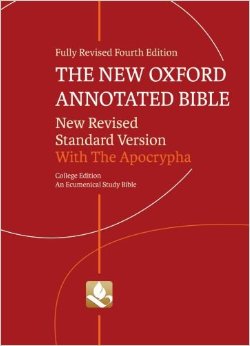
Our Bible of choice:
oxford bible

The translation is the New Revised Standard Version (NRSV). More than just a translation, however, this is the New Oxford Annotated Bible (fourth edition) – a study Bible designed for close, critical reading, complete with introductions for each book, copious footnotes, maps, family trees, alternate translations, and so on.

I can tell you now, having this kind of extra information makes a huge difference. We’re only ten chapters into Genesis, and already I’ve discovered so many details I never noticed before. It’s almost like reading a whole new book. (I’ll also be comparing notes with the NIV translation now and then, especially for difficult passages.)

You’ll notice the cover says “With The Apocrypha.” As used here, “apocrypha” is a broad and non-derogatory term that covers all the books that are in the Catholic Bible but not the Protestant (like Tobit, Wisdom of Solomon, 1 & 2 Maccabees) and books from that belong to the eastern Christian canon but not to the Protestant or Catholic canons (like 1 Esdras and 3 Maccabees). The idea is simply to read the entire Bible, broadly understood, rather than the Bible of any particular group.

How do I approach a task like this? How should I read? In general, I want to be both critical and open.

Critical, because this is an extraordinarily difficult and complicated text, used for moral and spiritual guidance by over two billion people. Such a work deserves serious analysis if it’s written by humans alone, and even more so if written by God.

Open, because there’s a lot to be learned from the Bible, and not just academically. I can’t imagine anyone seriously arguing otherwise. Yes, there are parts that I think are ugly, wrong, and evil. But there are other parts that are beautiful, profound, and enlightening. I’m not Christian, and I don’t expect to be converted by this reading, but it would be foolish to shut any door permanently.

I believe I have a soul. Not necessarily an immortal soul, or a soul independent of the physical brain, or anything mystical per se; but certainly there is something inside me, inside everyone, with the capacity to reach upward, no matter what we may find there. Why not give it a chance to grow?

I’ll be posting my thoughts as I read, Postmortem-style: the good, the bad, and the curious. These posts can be simple one-way lectures if you like, but I’d much rather they be discussions. Comments, as always, are welcome.

Here’s hoping we make it past Exodus!


The Matryoshka Box

Ever have something happen to you, where you look at it and think, “Okay, where’s the camera”? (Well, probably not, because you have a smartphone, and they all have cameras, sooo…)

Anyway.

Last week, Betsy got a gift from her aunt in the mail. It arrived in a big cardboard box. Inside that was another box. Inside that…

Well, I’ll just show you the picture. Packaging on the left, actual gift on the right.pieSomewhere, some lucky cardboard salesman got a promotion.

Incidentally, the gift itself is a ceramic pie dish. In the center is written:

(√-1) 8 ∑ π

That is, “i eight sum pi,” or “I ate some pie.” Go ahead, chuckle. You know you want to.

I’m not sure which pleases me more, the fact that I have this dish, or the fact that it’s now the second pi-related pie dish we own. That’s right – this is my world.

I Saw the Sign

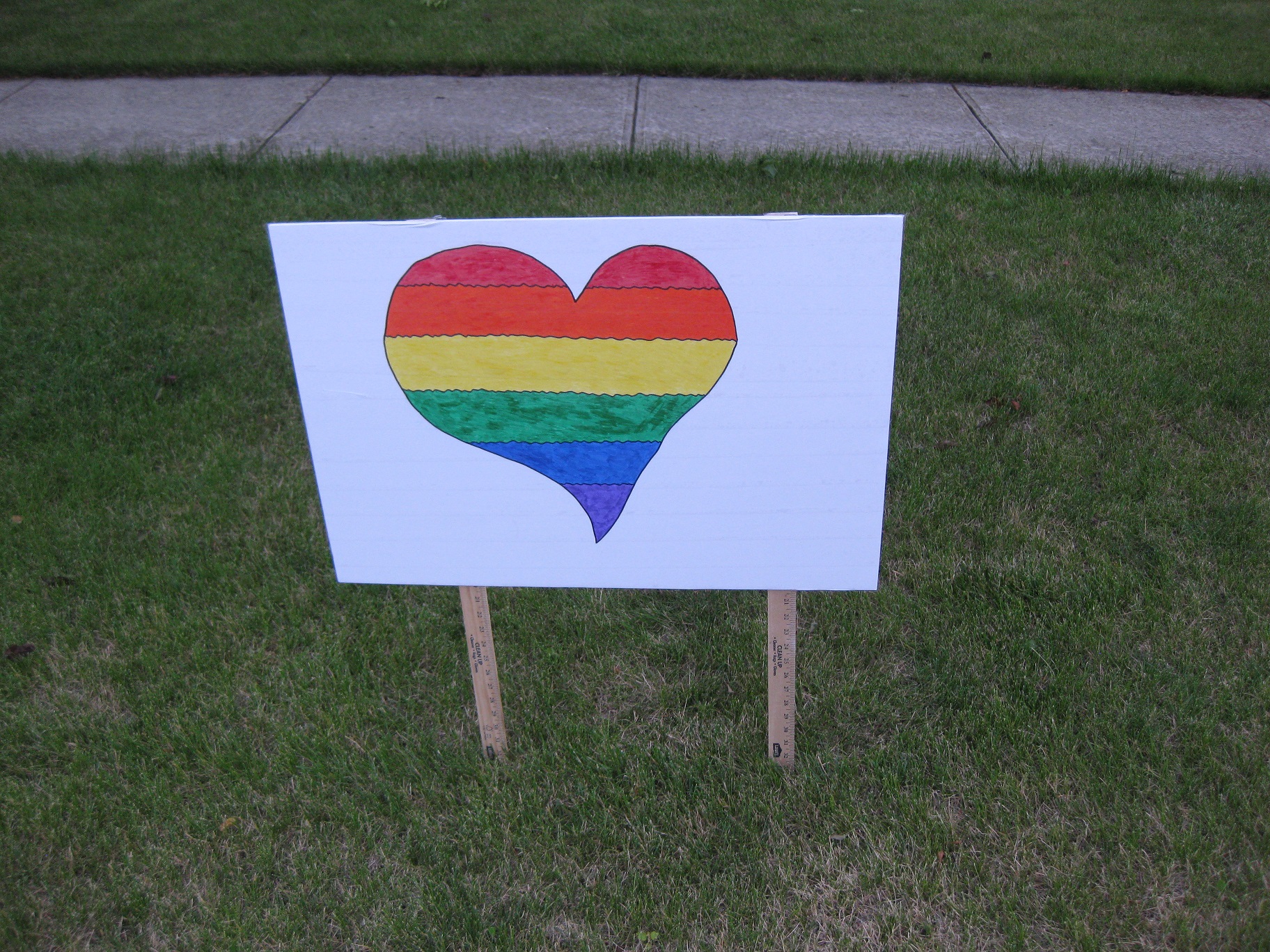
As you may have gathered, Betsy and I were pretty excited about the legalization of gay marriage, and we tried to think of some way to express our excitement. Betsy suggested a rainbow flag, but we decided we’re too lazy to maintain a flag properly. So I ended up getting some markers and making a sign. We put it up in our front yard about two weeks ago:

rainbow-heart(We have since moved the sign back behind the sidewalk – since having it that close to the road technically violates local law – and replaced the flimsy rulers with a sturdier base.)

We intended the sign primarily as an expression of our happiness, secondarily as a message (moral, and – to a lesser extent – political). It was not meant to be hateful or anti-Christian, especially since Betsy is Christian herself. We simply put up a sign on our own property, without hurting anyone else. Theoretically, no problem.

However, this isn’t exactly San Francisco. Ohio as a whole is fairly bipartisan, but that’s because the city blue just about evenly balances the country red. We’re in a pretty conservative neighborhood. Not 1950s Alabama conservative, but conservative enough.

I honestly had no idea what might happen. I figured it would be a kind of social experiment, and I was a bit nervous. Not that I thought something would happen; I just thought it might.

As it happened, our next-door neighbor came out, along with her young son, as I was putting up the sign. She is herself a lesbian, so I wasn’t too worried about offending her with this particular message, and indeed, she was happy to see it. We talked a little while, a neighborly conversation that drifted from “Exciting news, huh?” to “Do you have Amazon Prime?” and “Did you know Amazon will donate money to your choice of charity, free, if you just type ‘smile.’ in front of ‘amazon’ in the URL?” And we parted ways.

No other direct comments for a few days. And then, as I was going outside to get the mail, our neighbor from across the street called out, “Brian?”

This is it, I thought. We’re going to have the “Can you take that thing down?” conversation. I smiled and crossed the street to talk to her.

We don’t know these neighbors particularly well. (We don’t know any of our neighbors particularly well; we’re introverts.) I had spoken to the husband a few times, and he was always very friendly, but I don’t think I’d ever talked to the wife before.

And then she started to tell me how incredibly happy she was that we’d put up the sign, how she couldn’t believe it when she saw it. As she told me this, she cried – I mean a tear literally rolled down her cheek. You never know what kind of influence you’re having on other people.

These are the only two direct conversations we’ve had about the sign. I will mention, though, that my other next-door neighbor – who I think is pretty conservative – has remained very friendly to me.

So has there been any negative response? Actually, it’s hard to say.

A lot of people walk their dogs around our neighborhood, but they’re very good about cleaning up after them. In the five years before we put up the sign, I can recall zero times we’ve found dog poop in our yard. In the few days after the sign, we found it twice. Coincidence? Maybe, but the odds seem against it.

Also, one morning we found the sign uprooted and lying flat on the grass. It had been planted very firmly in the ground, so it’s hard to see how the wind could have pulled it up – and, if the wind had been strong enough for that, wouldn’t it have blown the thing more than a few inches away? That one I’m pretty sure was deliberate, but it only happened once.

All in all, people have been pretty positive.

At the risk of getting all sappy, I think it’s true what Jon Stewart says – the culture wars are overstated, overblown, and largely fueled by the media. Yes, people have real – and deep – differences in belief. But for the most part, it seems like we’re capable of being friggin’ adults about it.

What a concept, right?

Transcendence: Iroh’s Tale

Each week, we’ll look at another example of what I call a “moment of transcendence” – a scene from a show, a passage from a book, or anything else, that I find soul-piercingly resonant: joyful, sad, awe-inspiring, terrifying, or whatever. These moments are highly subjective, so you may not feel the same way I do, but nevertheless I’ll try to convey why I find the fragment so powerful. I hope we can enjoy it together.


One of the great things about going to a large university like Ohio State is that you get a lot of visits from cool guest speakers. About a decade ago, I got to hear a talk by James Earl Jones. A lot of the audience (myself included) came because we were Star Wars fans, and he was very polite, but it was clear that he was way past the whole Darth Vader thing. He said that his main interest now was “simple stories, simply told.”

I’ve been thinking about that phrase today.

Avatar: The Last Airbender has so many moments of transcendence, it’s hard to pick just one. But it occurred to me this morning that most of those moments require a good knowledge of Avatar‘s complex plot to be fully appreciated.

Not so, however, with the Tale of Iroh, a self-contained four-minute story within the episode “Tales of Ba Sing Se,” season two. It contains no spoilers, it has nothing to do with the larger plot, and it’s only got one main character: the old man named Iroh.

I apologize for the quality of the clip below, which is cropped and shown mirror-image by the video uploader. It was the best I could find, and it’s good enough to get the story across. The video should start at 3:13, which is where the Tale of Iroh begins.

If you can’t see the embedded video, here’s a direct link.

Note: the video is cropped and mirrored to prevent YouTube from discovering that it is, technically, a copyright violation, just as my showing it here is, technically, a copyright violation. However, since I’m giving the show free advertising, not hurting their sales, not profiting myself, and not claiming credit, I don’t have any ethical qualms about showing it. I’m not sure how long this particular link will remain functional, though.

Anyway – I don’t have a lot of commentary. The story speaks for itself, I think. The dialogue is clunky in places – dialogue was never Avatar‘s strong suit – but I think it’s quite lovely regardless (and even better if you’re familiar with Iroh’s character).

Simple stories, simply told. I think this may be the kind of thing Mr. Jones was talking about.

Friday Links

This news is about a week old, but here it is anyway: Iceland’s Pirate Party wins repeal of blasphemy law. I’m not sure which is crazier – that the Pirate Party apparently has some legit influence in Iceland, or that Iceland had a blasphemy law in the first place. Before this change, it was a crime to “ridicule or insult” the teachings of a legally recognized religious community, under penalty of fine or imprisonment. Bizarre.

Even more bizarre is the Orwellian response issued by the Catholic Church of Iceland: “Should freedom of expression go so far as to mean that the identity of a person of faith can be freely insulted, then personal freedom – as individuals or groups – is undermined.” One would hope this is not the official position of the Vatican.

Also, SMBC sums up my thoughts on language more perfectly than I ever thought was possible.

Have a resplendent weekend.

Job Deets

I mentioned last week that I had gotten a job. I know a little more now, so here are the details.

I’m working for a small publishing company called Pen-L. It’s run by Duke and Kimberly Pennell (hence the name). My job is proofreader, which is similar to copyeditor. I check grammar, spelling, punctuation, word usage, and consistency, and I verify facts and correct awkward sentences.

I’m considered an independent contractor rather than an employee. But I’m their only proofreader currently, and they need me to go through a book every two weeks, so I stay pretty busy.

Right now I’m almost done with my first manuscript, a Western. I’ve learned all kinds of new terms: “spondulicks” are money, a “long nine” is a type of cigar, and “horrification” is a real word that means just what it sounds like. I’ve also learned about Buffalo Bill and the Battle of Little Bighorn.

And I’ve had to figure out some odd little linguistic puzzles. For instance: if a character says “Course, that’s all in the past,” using “Course” to abbreviate “Of course,” should you put an apostrophe before the word or not? After all, you are technically cutting out letters, and it does sorta look right. Ultimately, though, I figured that words are added and removed all the time without sticking in apostrophes, so this should be no different. (A recent Chicago Q&A agreed with my choice. And yes, the Chicago Manual of Style has a monthly Q&A, and yes, I get an e-mail every time they do. This is my world now.)

Rather than a salary per se, I get a percentage of the sales of every book I edit, with no upper limit. So the more manuscripts I have under my belt, the more potential income I’ve got.

The other day, I told my friend Paul that I’ve finally achieved my dream – I’ve found a way to get paid for reading books and criticizing people. All jokes aside, I’m enjoying the work so far. It’s pretty close to what I thought it would be, and I seem to be doing reasonably well at it.

And yes, Ben, this does mean I’ll be even slower than before about copyediting your book. Just remember the old Stones song.

English Riddle

…and I use the word “riddle” loosely.

How many apostrophes are in this quote?

So when this corruptible shall have put on incorruption, and this mortal shall have put on immortality, then shall be brought to pass the saying that is written, Death is swallowed up in victory.

O death, where is thy sting? O grave, where is thy victory?

Hint: it’s not zero.

If anybody gets this, they probably need to go outside more.