Postmortem: Inside Out

hq

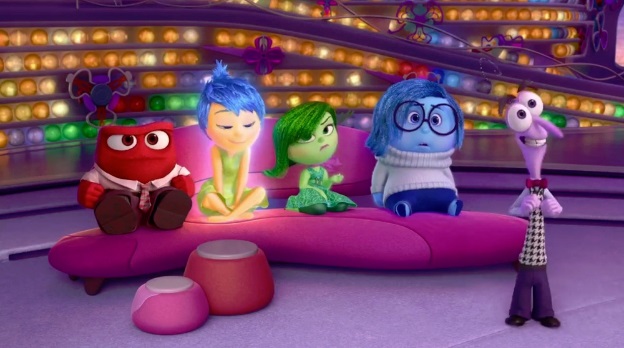
Anger, Joy, Disgust, Sadness, and Fear, living it up at Riley HQ.

Warning: Spoilers.

Say what you will about Rotten Tomatoes – when a movie scores 98%, it’s usually pretty damn good. Pixar’s latest offering, Inside Out, scored 98%, so Betsy and I saw it, and I can confirm it’s pretty damn good. For my money, it’s tied with The Incredibles for best Pixar film. And that’s saying something.

The premise is simple. Every person’s mind can be visualized as a mini world, overseen by the personifications of five main emotions: Joy, Sadness, Anger (Lewis Black!), Fear, and Disgust. Our hero, an eleven-year-old girl named Riley, has these little guys in her head like everyone else. Of the five, Joy is the leader – or at least first among equals – and the other four all share her goal of making Riley happy.

When Riley and her family move from her hometown (in Minnesota, eh?) to San Francisco, she does her best to cope. It’s a struggle, but she’s a positive kid – Joy has done her work well.

And then one day, Joy and Sadness get yanked out of Headquarters. To get back, they’re forced into a journey across the vast expanse of Riley’s mind. Meanwhile, Riley is left with only Anger, Fear, and Disgust running the show. She has lost the capacity for both happiness and genuine sadness. Her life spirals rapidly. Her relationships break down. She stops caring about anything. Finally, she loses the ability to feel any real emotion at all. She’s dying inside.

They never spell it out, but it’s abundantly clear what’s happening. Riley, an eleven-year-old girl, is sinking into clinical depression.

And if you think that’s heavy, how about the conclusion of the film: that mere happiness is not the goal of life; that sadness and joy are symbiotically linked, like yin and yang, and neither can exist without the other; that Riley can only grow up by accepting that sadness is a fundamental part of who she is.

Pretty adult stuff for a Disney cartoon. I mean, when they bust out the PG rating, you know shit has gotten real.
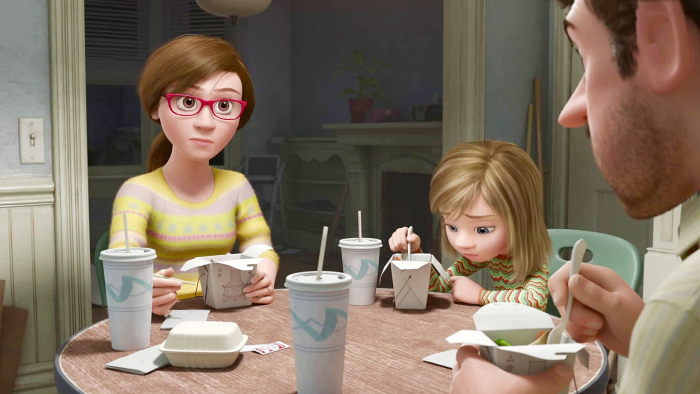
What's happening to our daughter?

What’s happening to our daughter?

Of course, despite its moments of darkness – and there are many – Inside Out is basically a happy movie, bursting with color, energy, cleverness, humor, and the exceptional polish and attention to detail we’ve come to expect from all of Pixar’s work. And sprinkled in with the humor are genuine insights, as when  a character casually explains that the contents of two boxes – Facts and Opinions – are always getting mixed up, and nobody really bothers to sort them out properly.

Complaints? Well, I have a few minor ones. I think Inside Out‘s vision of the mind places far too much emphasis on feeling, with almost no weight given to reason-based thought. I also got annoyed with the movie sometimes for leaning a little heavily on cliches, as when Riley’s father is shown to be obsessed with sports, emotionally clueless, and concerned with whether he’s angered his wife by leaving the toilet seat up.

But these are small problems, the kind of “problems” that all movies have, merely because you can’t please everyone all the time. The upshot is that Inside Out is utterly brilliant, and if you’ve ever liked anything Pixar has done in the past, I highly recommend this one.

I was planning to end the post here. But yesterday, I came across a negative review of the movie on NPR, by philosopher (and critic?) Alva Noë. Now, obviously reviewers are entitled to their opinions, and I don’t make a habit of writing rebuttals. But in this case I was drawn to respond, because (1) I ordinarily respect what NPR has to say, (2) Noë’s criticisms seem patently absurd, and (3) Inside Out is just so friggin’ sweet.

As befits a philosopher, his main gripe with the movie is philosophical:

Riley is not a person, she is a robot, a complicated vessel whose actions and intentions are controlled by persons — emotions and memory workers — inside of her. Riley is no more an agent in her own right than is, say, a ship an agent in its own right.

He adds that “there is something downright terrifying about this nihilistic conception of ourselves as zombie puppets living in a confabulated universe.”

This criticism seems to misunderstand the basic premise of the story. Of course Riley is controlled by the “persons” inside her – because those persons, collectively, are her mind. The Self is not a single, monolithic whole; it’s composed of various departments and tendencies operating in tandem, which together make up the core of Who You Are.

If having a body controlled by a mind makes you a “zombie puppet,” well, I’ve got some bad news for everybody on the planet. And if Noë thinks Inside Out is nihilistic, I’d hate to see his reaction to Requiem for a Dream.

His other criticisms include:

  • Riley, with her “boy’s name” and love of hockey, is basically a male character, allowing the film’s creators to avoid having to depict a real girl. Yes, because no real girl could like a traditionally masculine sport or have a unisex name. If only she had been named Annabelle and played with Barbies, that would have been a victory for feminism.
  • What should we make of the fact that Anger and Fear are portrayed as male, while the other three emotions are female? Well, mathematically speaking, you have two genders and five emotions, so it’s literally impossible to avoid reducing one of the genders to two or fewer emotions. Would Noë have been happier if Fear were female? If Joy were male? Is there any way to reduce a gender to two or three emotions that won’t cause offense if you take it too seriously?
  • Why is there no racial variation in our internal population? Judging by his reaction to the gender variation, I’m guessing racial variation would be a no-win scenario too. A black man as Anger? No, that would be offensive. What race should be Fear? How about Disgust? What magic combination could please a critic like this?
  • Nothing much happened in the story. Correct. Aside from Riley moving to a new city, having a breakdown at school, cutting off contact with her friend, losing her connection with her parents, running away from home, returning for a cathartic reunion, and learning a profound lesson about what it means to be human, all while the characters inside her head are undertaking an epic journey whose stakes are the soul of our protagonist – aside from all that, nothing much happened.

Maybe it’s telling that, throughout his review, Alva Noë never managed to spell the director’s name right – he called him “Pete Doctor” instead of “Docter.” (To NPR’s credit, the spelling has since been corrected.)

Or maybe he just needs a copyeditor. Hey, Alva. I know a guy.
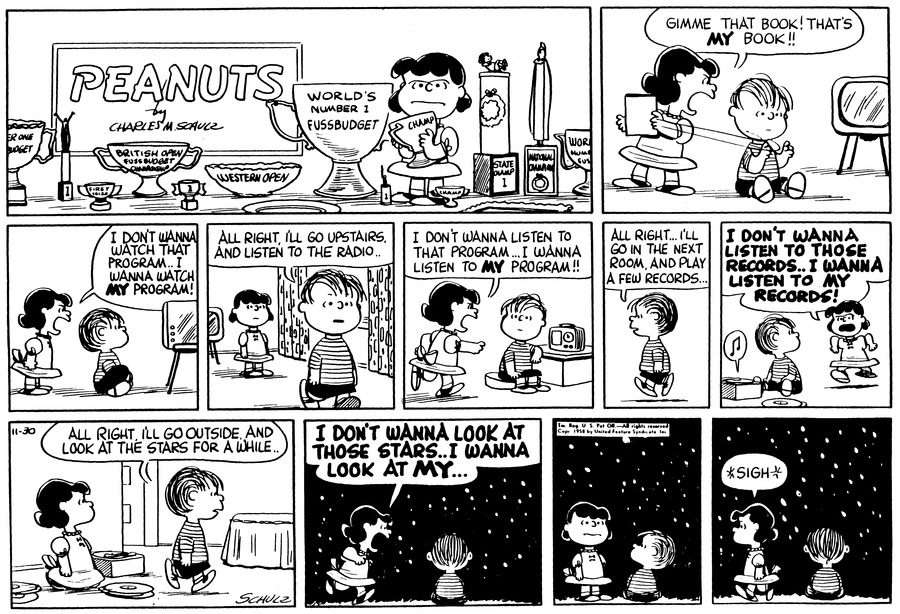
Transcendence: Lucy’s Stars

Each week, we’ll look at another example of what I call a “moment of transcendence” – a scene from a show, a passage from a book, or anything else, that I find soul-piercingly resonant: joyful, sad, awe-inspiring, terrifying, or whatever. These moments are highly subjective, so you may not feel the same way I do, but nevertheless I’ll try to convey why I find the fragment so powerful. I hope we can enjoy it together.


My favorite comic strip of all time is a Peanuts I discovered in one of my grandma’s old books. I found it years ago, and it’s stuck in my brain very distinctly ever since. But despite all my searching, I could never find it again.

Recently, I became determined to track it down. I fired up my browser, went to the Peanuts archive, and simply began clicking through the comics, in order, one at a time. The brute force method.

Finally, I found it: November 30, 1958. Here it is. Click to enlarge.

Peanuts created by Charles Schulz. Official archive at Peanuts.com.

Peanuts created by Charles M. Schulz. Official archive at Peanuts.com.

Poor Lucy. She’s so sure that life is about winning – about what she has. She can’t defeat Linus, because he’s out of the game. Linus has decided that life is about what he is.

The comic reminds me of a scene from Tolkien’s Return of the King that’s stuck in my brain for years. Sam and Frodo have made their way into Mordor, enduring pain and horror, with a long and doubtful road still ahead. All around, the darkness of Sauron’s kingdom seems overwhelming. And then:

…peeping among the cloud-wrack above a dark tor high up in the mountains, Sam saw a white star twinkle for a while. The beauty of it smote his heart, as he looked up out of the forsaken land, and hope returned to him. For like a shaft, clear and cold, the thought pierced him that in the end the Shadow was only a small and passing thing: there was light and high beauty for ever beyond its reach. His song in the Tower had been defiance rather than hope; for then he was thinking of himself. Now, for a moment, his own fate, and even his master’s, ceased to trouble him. He crawled back into the brambles and laid himself by Frodo’s side, and putting away all fear he cast himself into a deep untroubled sleep.

Sauron, like Lucy, is obsessed with power and possession. Not for the sake of the things themselves – he has long since lost any capacity to appreciate the beauty of what he takes – but so that no one else can have them. Only, the world is vaster than he knows. He cannot take the stars.

Carl Sagan expresses much the same idea when he writes about the famous Pale Blue Dot photograph, which depicts Earth as a single pixel:

The aggregate of our joy and suffering, thousands of confident religions, ideologies, and economic doctrines, every hunter and forager, every hero and coward, every creator and destroyer of civilization, every king and peasant, every young couple in love, every mother and father, hopeful child, inventor and explorer, every teacher of morals, every corrupt politician, every “superstar,” every “supreme leader,” every saint and sinner in the history of our species lived there – on a mote of dust suspended in a sunbeam.

Is it any wonder that the Buddha achieved enlightenment upon seeing the Morning Star? (Which, technically, is a planet, but work with me here.)

Linus was born around 1950, so he’d be sixty-five by now. I wonder what’s on his mind these days.

Haiku 365: June

#153: 6/5/2015
Fierce sun and soft moon,
bloody gold and chaste silver.
Yang still chases yin.

#154: 6/5/2015
Windows on childhood
sit, framed and shielded by glass,
like mute time machines.

#155: 6/5/2015
Sandwiches, pickles,
A/C. Who says a picnic
has to be outside?

#156: 6/5/2015
Whose comet is this?
What stern celestial empress
calls this omen hers?

#157: 6/5/2015
Where does the light go
after you flip off the switch?
Can I keep a ray?

#158: 6/6/2015
Scent of kitchen paint,
fresh cabinet doors, new hinges:
Rhapsody in White.

#159: 6/7/2015
Sunday: Kroger aisles
full of colors, cereal.
Toddler grins at me.

#160: 6/8/2015
Slow gray phantoms drift
in nameless herds, crossing our
stern Ohio sky.

#161: 6/9/2015
By morning, those old
ghosts have ambled on. Bluer
heavens shyly wake.

#162: 6/10/2015
The song of black storms
slithers over virgin land,
weeping tornadoes.

#163: 6/11/2015
Low helicopter
rattles our placid windows,
grumbles, passes on.

#164: 6/12/2015
Ah! Banana bread
on a clean plate, fresh coffee.
Exquisite Friday.

#165: 6/13/2015
Dabbing off brief tears
in the cool dark; haven’t laughed
that hard in a while.

#167: 6/14/2015
Soft carpet footfalls,
spinning leaves: faucet drips as
hours like scrapbooks fade.

#168: 6/15/2015
Launch of the new week.
Sunday’s countdown is over,
fresh ambitions rise.

#169: 6/16/2015
Tabula rasa,
thoughtless mind. Sable coffee
percolates the void.

#170: 6/17/2015
Nine decades of song,
Fred Astaire to Eminem,
congregate in bytes.

#171: 6/18/2015
Nations of carpet,
an Everest of oak shelves.
Spider soldiers on.

#172: 6/19/2015
Fresh frantic morning.
One by one, sober plans duel
daylight obstacles.

#173: 6/21/2015
Bruschetta and wine,
children and servers, gather
for the matriarch.

#174: 6/21/2015
Journeys and journeys
convey us afar and home,
questing and resting.

#175: 6/22/2015
Typing with hands cold
from cold water. Fingers, chilled,
seek kinetic heat.

#176: 6/23/2015
CHUG, washing machine’s
morning anthem: CHUG, water
overturns earth, CHUG.

#177: 6/24/2015
Lucy and Linus,
chaos and order, children
old as time, born fresh.

#178: 6/25/2015
Tempus fugit: hours
flee my embrace, promising,
never tarrying.

#179: 6/29/2015
Ecstatic! New job,
marriage equality. W00t:
two red-letter days.

#180: 6/29/2015
Still awaking from
late night, minimal slumber.
Neurons sputter, yawn.

#181: 6/29/2015
All the dewy world,
dark with dreaming, lit with day,
stirs in its cool nest.

#182: 6/29/2015
Movies with Betsy.
The Royal Tenenbaums, Spy,
Good Night and Good Luck.

#183: 6/30/2015
Time for something new.
No rough beast has come; this hour
belongs to humans.

What Do These Three Quotes Have in Common?

Quote #1:

Rollin’ in hella deep,
headed to the mezzanine
Dressed in all pink
’cept my gator shoes, those are green
Draped in a leopard mink,
girl standing next to me
Probably should’ve washed this,
smells like R. Kelly’s sheets.

Quote #2:

I personally believe that U.S. Americans are unable to do so because, uh, some, uh, people out there in our nation don’t have maps and, uh, I believe that our education like such as in South Africa and, uh, the Iraq, everywhere like such as, and, I believe that they should, our education over here in the U.S. should help the U.S., uh, or, uh, should help South Africa and should help the Iraq and the Asian countries, so we will be able to build up our future.

Quote #3:

Be the change you wish to see in the world.

What do all three of these quotes have in common?

The answer, of course, is that Mohandas Gandhi never said any of them.

That’s right. The most famous Gandhi quote in the world (or at least the US, anyway) – the one gracing T-shirts, bookmarks, and every other piece of merchandise we can slap it on – didn’t actually come from the man himself. Apparently it’s from his grandson, Arun Gandhi, who was paraphrasing.

According to the New York Times, the actual quote is:

If we could change ourselves, the tendencies in the world would also change. As a man changes his own nature, so does the attitude of the world change towards him. … We need not wait to see what others do.

Now, to be fair, that’s a roughly similar sentiment; and the shorter version is easier to remember, more elegant (in my opinion), and still contains a powerful idea.

But still, if you’re going to quote the Mahatma, shouldn’t you at least get the words right?

Brief Summary of the Life of Pluto

5,183,702,446 BC – AD 1929 – chillin’

1930 – 2005 – everyone’s staring at me

2006 – 2014are you kidding me

July 14, 2015 – the hell is this thing supposed to b – AH! paparazzi! no pictures, no pictures!

2016 – 7,335,918,204 – ennui

I Got a Job!

woo

After more than a year of unemployment, I have a job again. A real copyediting job with a paycheck and everything. If you want to know how I’m feeling, look up ecstatic in a thesaurus: euphoric, elated, rhapsodic, joyful, thrilled…

We’re still working out a few final questions, and I haven’t officially signed the contract yet, so I’ll refrain from posting full details just now. In the next week or two, probably.

In the meantime, my new editing responsibilities already have me very busy, so I don’t have time for my usual Monday transcendence post. Blog posts in general may be shorter and/or sparser than normal for a while as I get up to speed.

It’s a good problem to have.

Later, peeps!

Achievement Unlocked: Marriage Equality

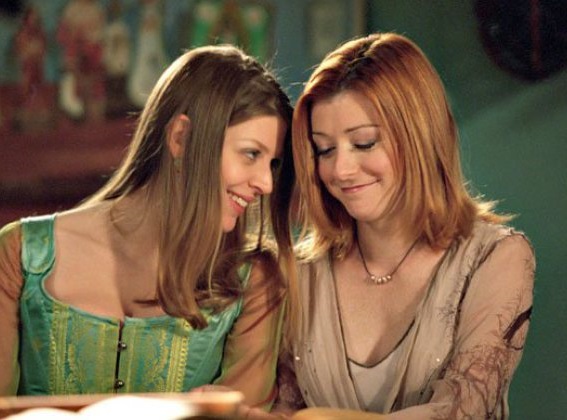
willow tara

george and brad

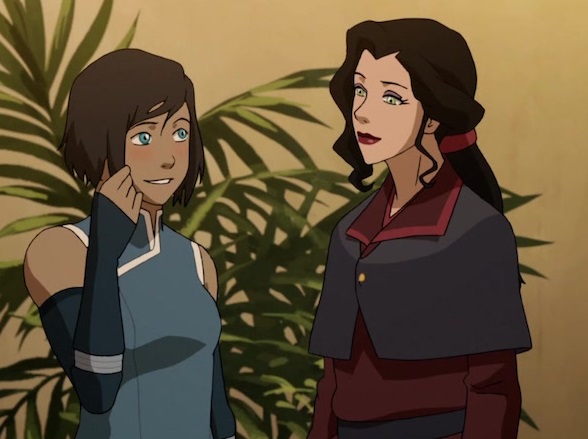
korrasami

sirs ian and patrick

success

Friday Link

In nearly fifty years, in over seventeen thousand strips, there’s only one Peanuts strip where we actually get to see the Little Red-Haired Girl – and then only in silhouette. The date is May 25, 1998, less than two years before the end.

Have a meritorious weekend!

Shooting Brennivín

The beverage in question.

The beverage in question.

A couple years ago I was drinking rather heavily, mainly as a reaction to my good friend Señor Depresión. Not to the point of alcoholism, but certainly more than was healthy. To halt this worrying trend, and for a few other reasons, I gave up drinking entirely for about nine months. Then I tried re-introducing a small, controlled amount: one drink per week.

That worked very well. And yesterday, after talking to my psychiatrist, I’ve decided to increase my weekly allotment to two.

Not coincidentally, yesterday evening Betsy and I finally tried the Brennivín.

Brennivín is the national liquor of Iceland, and we brought home vast quantities from our trip last October. (If you can’t tell from the photo, each bottle is a few inches tall; total quantity: 100 mL, or 3.3 oz.) But we had never gotten around to actually drinking the stuff, in part because I was still operating under my personal Prohibition at the time.

Also, I really, really didn’t think I would like it. I hate the taste of almost all hard liquor (especially vodka), and Brennivín has a reputation for being especially nasty (and supposedly tastes like vodka). Witness a typical reaction to trying it for the first time: those are the kind of faces you make when someone says they’re voting for Donald Trump. Not to mention, I can tell you from personal experience that cuisine ranks at the very bottom of reasons to visit Iceland.

But I am all about trying new things, especially foreign things, and we’ve had this stuff sitting around for eight months now, and I wanted to celebrate. So I did a whole shot – almost the entire bottle – and Betsy had a sip.

Betsy’s reaction was similar to the woman’s in the video – and Betsy enjoys liquor more than I do. So imagine my surprise when I did the shot and liked it.

I mean, it wasn’t fabulous or anything, but better than any vodka or whiskey I’ve ever had. A curious taste, not actively unpleasant. A nice burn going down.

So: try new things! There’s a small chance you will like them. And if you don’t, you can always record your disgust and post it on YouTube for the amusement of others.

The Mouse

As all readers know, I am a soft-hearted tree-hugging hippie liberal (except that I’m not a hippie and I rarely hug trees). So it may not surprise you that our house runs a catch-and-release program for most invaders.

Spiders, in particular, are captured and ushered outside; the same clemency is generally extended to centipedes, beetles, and (when possible) even flies. Mosquitoes, bees, and wasps forfeit their lives on account of their biological weapons. You see the boundaries of my beneficence.

This week, though, Nature raised the ante. We had a mouse.

I went to the kitchen around midnight on Sunday to see what was making the noise. I found it there on the stove, frozen. For a minute we watched each other. Finally I approached, and it dashed behind the microwave.

No sightings Monday, but then yesterday it dashed across the kitchen floor and ended up in the basement. I knew what I had to do.

I already had a no-kill mousetrap from an earlier, unsuccessful attempt to capture a visitor (it ended up finding a way to die on its own). This time, however, I had better luck. I baited it with peanut butter and went down every couple hours to check. By the afternoon, I had a mouse.

He was a cute little guy, tiny, smaller than I had thought when I saw him in the kitchen. Wide black eyes, gray fur, twitchy whiskery nose. I put on gloves to pick up the trap, in case he tried to bite me through the air holes (which he didn’t). He acted calmer than I expected, though I claim no particular expertise on the interpretation of rodent body language.

I took him out back behind the fence and opened one of the little trap-gates.

He didn’t notice right away – I had to tap and tilt to get his attention. When he did come to the gateway to freedom, he didn’t dash off instantly like I expected. He slowly, cautiously sniffed his new environment, half in the cage, half out. For all I know, he had never been outdoors before.

Finally he took his first careful steps out of the trap – and made a beeline for the nearest cluster of weeds, and disappeared.

Who knows, maybe an owl ate him last night.

Some people hate mice (and spiders, too) and I don’t blame them for that. But personally, I don’t get that much interaction with Nature. So when Nature comes visiting me, I find it awfully convenient.