Exclaves!

Map courtesy of Google.

Map courtesy of Google.

So here’s the deal. There’s a little piece of Russia between Poland and Lithuania. The area is known as Kaliningrad Oblast. It’s not a “territory,” or a “special administrative region,” or a “protectorate.” It’s straight-up, 100% legit, a full-fledged part of Russia.

It’s just not, you know, attached.

Little bits of extra territory like this – not islands, but pieces of land hanging out with other countries – are called exclaves. And they’re hardly unique to Russia.

Spain has a town inside of France that’s “separated from the rest of Spain by a corridor about 1.6 km (1.0 mile) wide.” (Thanks, Wiki.) And at the risk of sounding obscene, there’s a little bit of Italy in Switzerland.

Why am I fascinated by exclaves?

There’s something so oddly casual about them. It’s like Russia – already the largest country in the world – managed to slip one by on the map-makers when they weren’t looking. “Hey, it’s no big deal, don’t worry about it. Poland and Lithuania, they’re totally cool. It’s just a million Russians hangin’ out with our western brothers and sisters. Forget about it.”

And I’m not the only one who’s raised an eyebrow on discovering this little easter egg on their world map. This drawing sums up my feelings perfectly.

But lest I be accused of showing unfairness toward the Russians (hi, Vlad!) I should point out that the United States has an exclave of its own. No, I mean besides Alaska.

Take a minute to read about the Northwest Angle, a chunk of Minnesota (1,500 square kilometers, population: 120) just chillin’ above the 49th parallel. She and Canada, they’re having a fine time up there.

But hey, listen, it’s totally cool. Really. Don’t worry about it.

Can’t Talk, Writing

I found a sweet new way to revise. I used to copy my old draft to a new file and make changes there. Now I split my screen, put the old draft on the left, and write a new copy on the right, starting with a blank file. Granted, “write a new copy” is just copy & paste for the parts where I’m satisfied with the old version, so functionally it works out to the same thing. But it feels different, and I’m lovin’ it.

The first sentence of my new draft is:

The Lady Rana Serago sat twelve years alone in a deep dungeon.

Thoughts? Suggestions?

Comparisons with your own revision process?

Anyway, leave me a comment and I’ll read it in a few hours. Too busy writing at the moment. 🙂

Friday Link

Capture

“Horrific FLESH-EATING PLATYPUS once terrorised Australia! Aboriginal tale says chimaera was result of non-consensual rat/duck tryst.”

Sometimes, the headline says it all.

Go Time

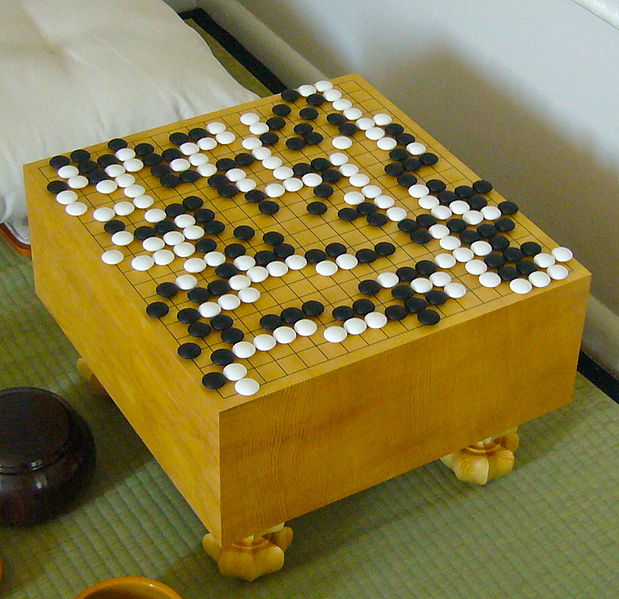
Goban

My all-time favorite game is called Go.

Go is a strategy game. Two players take turns making moves on the board. It originated in China around 2,500 years ago, which makes Go quite possibly the oldest game in the world still played in its original form. Coincidentally, it was invented around the same time as Buddhism, although in a different place (Buddhism was in India).

The closest Western equivalent to Go would be chess, but they’re not really all that similar. For starters, as you can see, the board is a lot bigger (although smaller versions exist to allow for quicker games). Also, instead of moving pieces around, you start with an empty board and take turns placing pieces. Once placed, a stone doesn’t move, unless it’s removed by capture. It’s all about territory, about making good shape and surrounding your opponent.

If chess is a battle, Go is a war.

Go is the reification of the phrase “easy to learn, hard to master.” The rules are profoundly simple and can be picked up in a matter of minutes, but learning to win takes a lifetime. In my opinion, there’s a primal elegance to Go, as if someone had taken the pristine beauty of logic and converted it directly into a game.

As you can tell, I’ve fallen in love.

I discovered Go in high school and played it with my friend Pat. Since then, I’ve rekindled my interest sporadically, usually for a few weeks or months at a time. The problem has always been finding opponents – there just aren’t that many people in my part of the country who are very excited about Go. (Yeah, you can play online, and I have, but it’s not quite the same.)

But just last week, two of my friends got back into the game as well, and we’ve started up a weekly, very informal, three-player “tournament.” We’re all about the same strength, so we learn from each other (and mock each other) constantly. It’s a hell of a lot of fun. It’s forcing me to improve quickly, because if I don’t practice, how am I going to dominate next week?

Life is good.

By the way, if you’re interested in learning more, you’ll find that googling “Go” isn’t the best way to find results. The Korean term is “baduk,” and searching for that is generally more effective. You can also start at the Beginner’s Page of Sensei’s Library, a dedicated Go wiki.

What’s your favorite game?

Wednesday Haiku

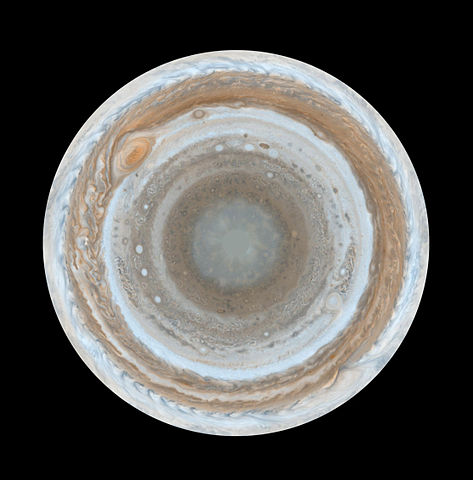
Planets all are eyes.
The universe watches you.
Return the favor!

The Proust Questionnaire

Here’s something I found just yesterday. Apparently in late 19th-century France, there was a survey that was supposed to reveal your true nature. (Hey, people had to do something before Facebook.) Marcel Proust didn’t invent the survey, but he did take it, so it bears his name today.

It seems that several different versions of the survey existed, but roughly speaking, the questions were:

  • What do you consider your greatest achievement?
  • What is your idea of perfect happiness?
  • What is your current state of mind?
  • What is your favorite occupation?
  • What is your most treasured possession?
  • What or who is the greatest love of your life?
  • What is your favorite journey?
  • What is your most marked characteristic?
  • When and where were you the happiest?
  • What is it that you most dislike?
  • What is your greatest fear?
  • What is your greatest extravagance?
  • Which living person do you most despise?
  • What is your greatest regret?
  • Which talent would you most like to have?
  • Where would you like to live?
  • What do you regard as the lowest depth of misery?
  • What is the quality you most like in a man?
  • What is the quality you most like in a woman?
  • What is the trait you most deplore in yourself?
  • What is the trait you most deplore in others?
  • What do you most value in your friends?
  • Who is your favorite hero of fiction?
  • Who are your heroes in real life?
  • Which living person do you most admire?
  • What do you consider the most overrated virtue?
  • On what occasions do you lie?
  • Which words or phrases do you most overuse?
  • If you could change one thing about yourself, what would it be?
  • What are your favorite names?
  • How would you like to die?
  • If you were to die and come back as a person or thing, what do you think it would be?
  • What is your motto?

I’m using these questions for character interviews as I’m working on The Crane Girl. I’ve been impressed with how well they work. I’ve tried the questions for two of my main characters so far, and I understood them both far better afterward.

Creating strong, deep characters has always been my biggest weakness as a writer, so this is an especially valuable tool for me. I’m going to use it for my other major characters as I continue.

By the way, I’ve found it useful to “talk” to my character and find out their life stories first, before launching into more personal questions like the ones above. (Where were you born? What were your parents like? Did you go to school? What was your relationship with your teachers? Etc.) That way, I have some context for the questionnaire, rather than inventing answers in a vacuum.

Of course, every writer’s process is completely different. I need tools like character interviews because I struggle with character-writing, but for those who write characters naturally, this would probably be overkill.

For me, it’s plot that seems to come naturally. I don’t use any special tools there (aside from an outline), and I haven’t needed to. No doubt there are tools to help with plot as well, but I haven’t worked with them much yet.

Do you use any special tools in your writing or pre-writing? Or does it all just come out naturally?

Postmortem: Avatar

In general, when someone describes a movie or show as “fun for the whole family,” they are lying. You’re lucky to get “fun for children and boring for adults.” If you’re unlucky, you get “fun for nobody.”

Rare exceptions do exist: movies like The Lion King or Beauty and the Beast or Toy Story. Kids’ stories where your appreciation only deepens as an adult.

On such story is the three-season cartoon Avatar: The Last Airbender, which I finished recently. (Note: do not confuse with James Cameron’s Avatar or M. Night Shyamalan’s horrific The Last Airbender. The former is unrelated, and we like to pretend the latter never happened.)

The world of Avatar: The Last Airbender features the four ancient elements: Earth, Air, Fire, and Water. (Evidently molybdenum hadn’t been discovered yet.) For each element, there are people who can “bend” it. Earthbenders can send rocks flying through the air, firebenders can breathe flame, and so on.

The Avatar, a child named Aang, is the only one who can bend all four elements. The story of A:tLA centers on Aang and his friends as they defend the world from a power-hungry Fire Nation bent on conquering everyone.

It’s a cool idea, but as any writer knows, the idea is the easy part. The challenge is in the execution. Fortunately, that’s just where Avatar shines.

Like Babylon 5, another of my favorite shows, Avatar was conceived with a fixed arc from the beginning. The writers had a story to tell, and it had a definite start, middle, and end. This shows in the tightness of the plot, which moves along briskly and brims with foreshadowing.

The world-building is no less impressive. Each of the four elemental nations is based on a real-world culture. The Water Tribe, for instance, is modeled on the Inuit of North America. The Airbenders are reminiscent of Tibetan monks. Much of the world is based on Eastern philosophy, fashion, or lifestyle in one way or another.

But the characters are the heart of the show. Aang himself is a bundle of paradoxes: a ten-thousand-year-old child, a humble demigod, fun-loving but occasionally grim as death, the most kick-ass pacifist you’ll ever meet. Meanwhile a Water Tribe boy named Sokka, a non-bender, offers comic relief that’s actually funny while still being a believable character. Prince Zuko of the Fire Nation is as brooding and whiny as Hamlet, while his tea-loving uncle Iroh is simply one of the best characters in any show, ever.

And then there’s Katara.

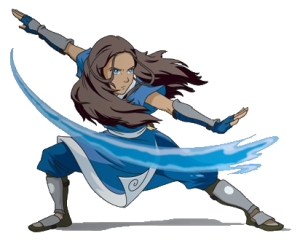
She’s the girl waterbending in the picture above. Katara is an excellent character – strong, compassionate, decisive, vulnerable, fascinating. She’s a rare example of a female character done right, and in a kids’ show, no less. Too often, women and girls in media fall into one of two categories: passive love interest for the hero (like Padme in Episode III) or sexy kickass uberhero (like Black Widow in Avengers). Katara, amazingly, is a woman who is also a genuine human being. She has friends, but a mind of her own; she’s in love, but that’s not her defining trait; she’s strong, but she’s weak sometimes too.

I’ve written before that Star Wars, although I love it, is sexist. Avatar: The Last Airbender is not sexist, and that’s remarkable in itself. It doesn’t (usually) beat you over the head with its feminism. It’s simply an excellent show that happens not to be gender-biased. It’s one of the best things I’ve ever seen on TV.

Don’t get me wrong, it’s still a kids’ show. It’s still goofy and colorful, so don’t go expecting Breaking Bad.

But when I have kids, I can’t wait to show them Avatar. And I can’t wait to sit down and watch it right beside them.

Friday Link

rps

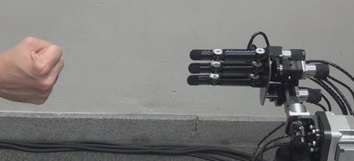
The Singularity has arrived! Or at least, a robotic hand that can beat you at Rock, Paper, Scissors every time. Next up: THE SINGULARITY!

Turning Whovian

I’ve seen a total of three and a half Dr. Who episodes in my life. This is entirely the fault of my friend Paul, who’s been following the Doctor for as long as I’ve known him.

First was the one where everybody has gas masks stuck on their faces. Second was the Van Gogh one. And then last night, I saw “Blink,” the episode that introduced the Weeping Angels.

The gas masks were okay. The Van Gogh one was very good. “Blink” was brilliant.

God help me, I think I may be turning into a Dr. Who fan.

Wikipedia informs me that the list of Whovians includes Her Majesty Queen Elizabeth II, Peter Jackson, George Lucas, Joss Whedon, Patrick Stewart, Neil Gaiman, Stephen King, Jimmy Wales, Matt Groening, Tom Hanks, and Bob Dylan. It’s hard to argue with an invitation to a club like that.

One Dr. Who fan not listed on Wikipedia is my dad. He used to be a Doctor devotee before I was born, and he’s told me several times about the cheesy effects, the cheesy acting, the cheesy dialogue, and the genuine emotion that somehow transcends the cheese factory. Somehow we never did watch an episode together (our focus being more on Star Trek and Babylon 5), but apparently the fascination is genetic.

Anyone else out there dabbled with the Doctor?

Wednesday Haiku

Image source: Luc Viatour / www.Lucnix.beImage found here

Image source: Luc Viatour / www.Lucnix.be
Image found here

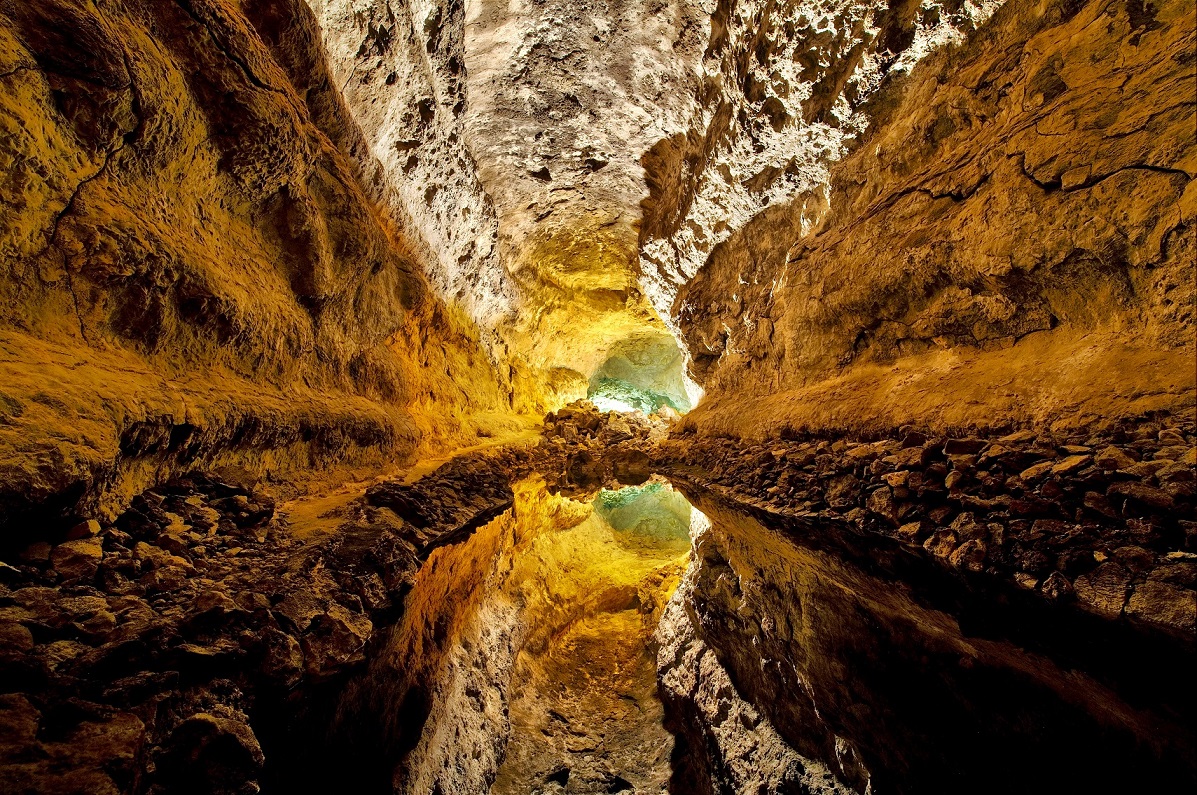
Miners delve for gems
Rubies polished, paid for, kept
What does the Earth hoard?