Tag Archives: Fiction

Alvennore (part 3 of 4)

Warning: strong language.

I made the trip that same day, in my crater buggy, the blue barrel of sulfur bouncing behind me under its straps. Sulfur was a luxury on Alvennore, though you wouldn’t know it from the smell. It was the main ingredient in a fertilizer that could be mixed with the soil to attract an odd but delicious kind of fungus, the only edible thing that grew on this inhospitable world.

It was my last barrel.

Two years ago a drifter had wandered onto Hildy’s property and tried to steal something. She had hunted him down and blown a hole in his chest with her chem-pistol. Sure, the guy had it coming, but I’ve never forgotten the wild look in her eyes that day, a look that said she was capable of anything.

I knew I was getting close when I smelled the incense in the air. She rushed out of her compound to meet me as I approached, twirling as she ran.

“Rogan!” she cried. “I had a vision you would come!” She wore a strange, dirty patchwork dress, with denim and corduroy and all other fabrics and colors worked into the garment. She reeked of incense.

“Hildy. I came like you asked. I came to pray.”

She cocked her head. “Now why would you lie to me?”

“I’m not lying, I want–“

“Of course you are. You’re not interested in God. You came because you want something.”

I frowned. “Did your vision tell you that?”

“My vision?” She giggled. “But that’s silly. Nobody owns visions. Won’t you come inside?”

I followed her into the compound, dodging the strings of beads and stepping around the piles of knickknacks she had everywhere: crystals, old yellowing newspapers, bizarre glowing sculptures. I tried to steady my breath, in spite of my nervousness. Hildy was dangerous as that storm to the south, and not half as predictable.

“What’s new?” I said.

“Every day of my life I’m alone,” she said casually, no anger in her voice yet. “But you know that, Rogan. Nothing is new. Why are you visiting, if not to pray?”

“I…um, I need to borrow a medi-spanner.” No need to mention the sulfur just yet, though she had surely seen it on the buggy.

“Well! That’s easy, of course.” She rooted under a pile of junk and retrieved the device, holding it up. “Ta-da! What do you need it for, anyway? Something happen to Dana?”

I restrained a wince as I heard the name. I had the lie prepared already. I felt bad about it, but I couldn’t risk letting her know the truth–not even about Dana. I didn’t want things to get…complicated. If you knew Hildy, you’d understand. “Yes, she dropped a cargo crate on her big toe. I don’t think it’s broken, but she’s in a lot of pain.”

“Aw, that’s too bad.” She grinned and waggled the spanner in her hand. “But why are you lying to me again, Rogan? Much more of that and I’ll start getting annoyed.”

“I…I don’t know what you mean.” It seemed things were getting complicated anyway.

She stepped forward. The spanner was only a meter away now. “I heard you screaming. After you left, I saw where you buried her. I’m not an idiot. Do you think I’m an idiot, Rogan?”

“I…” I swallowed. I tried to act like a confused, grief-struck husband. It wasn’t very hard. “No. I’m sorry. It was my toe that got hurt, not hers. I just didn’t want to say anything yet…”

“Shhh.” I thought she would ask how Dana had died, but she only took another step closer. “I understand. I understand. Like I said, I had a vision.” Another step. The spanner was in reach of my arm.

“You need something from me.” Her voice went soft. “And I need something from you.”

Oh, no. She had to be kidding. “No…I didn’t…”

“Rogan.” Whispering now. Another step, and we were practically touching. She took my arm. “Don’t speak. I understand.”

Did I dare just grab the spanner and run? Who knew what weapons she had lying around? I had a chem-pistol in my left boot, but I wasn’t sure how much good that would do; she might be too crazy to threaten. Even if I got away, it was no good. Obviously she knew where I lived, and we were the only humans for kilometers in all directions. That couldn’t end well.

Yet if I spurned her advances, no matter how gently, I would never get the spanner. I was sure of it. And I needed that spanner.

I decided to do a bad thing.

I let her kiss me.

She kissed me a long time, her lips dry and cracked, her breath smelling of basil and something else I couldn’t identify. I endured. At the end, I pulled away just a few centimeters.

“You know her spirit hasn’t left yet,” I whispered.

It was a desperate ploy, the only thing I could think of. Hildy was a Mallitonian, and she’d told me before of her belief that the dead remain behind for seven days before passing on to whatever netherworld Mallitonians believe in. But she was so mercurial, I had no idea if she would care about this. I held my breath and waited.

She examined me sharply, but finally sighed and nodded. I exhaled. “But don’t keep me waiting,” she ordered. “That harridan will be gone from this world at midnight, and I want you, Rogan, I want you then.”

I nodded hastily, not trusting myself to speak lest she catch me in another lie. I grabbed the spanner and fled as quickly as I dared.

* * *

I washed Hook’s wound with a wet rag, carefully scraping away as much of the crusted ichor as I could, laying bare the wide crater and the long, slim gash beneath. Each rag became filthy at once, and I tossed each into a bucket and picked up another clean one. As I cleared away this mess, the smell was terrible, like rotten fruit. I kept silent, to keep it from trying to turn toward me. All throughout this procedure its single leg stretched and folded restlessly, but it made no other motion.

Next I ran the spanner over the wound, starting with the long crack and finally running concentric circles around the big gash, gradually layering the shell tissue. When I finished, the wound was completely gone, replaced by a surface that was irregular but whole.

I sat down beside the beetle, laid the spanner on the rock, and sighed.

“I’m sorry,” I whispered, softly so as not to disturb it.

“I shouldn’t have thrown the rock. I need you and you need me, because we’re both trying to do the same thing: survive. You killed my wife, but you didn’t know what you were doing. Might as well get mad at the sky for a lightning strike. Hell, I guess even Hildy’s just trying to survive.”

Idly I picked up a pebble and tossed it aside.

“Christ, what am I going to do about Hildy? She expects me to go back there tonight–at midnight, I guess–and…and…” I shook my head. “I promised her I’d give her what she wanted, but I can’t, of course. I can’t. Even if I wanted to, even if I could make myself do it, you know I’d hear Dana’s voice the whole time–”

I twisted my mouth to keep from getting emotional again. Gradually the feeling passed.

“But if I say no, she’ll lose it. Even more than she’s already lost it. Who knows what she’d do? A man’s got to sleep sometime.”

There was a third option, of course. I had a chem-pistol. I could make my Hildy problem go away. But that wasn’t an option at all. I couldn’t be a murderer, couldn’t admit to thinking about it–not even to a beetle.

“You didn’t know what you were doing,” I said, more softly. “I can’t exactly use that excuse, now can I?”

I heard a scraping sound. I figured I’d gotten too loud, that it was trying to move again, but I was wrong. Hook was doing something else entirely.

Slowly, with unmistakable purpose, Hook’s single leg extended and dragged across the ground, moving back toward its body, scraping a single dark line in the reddish rock.

I waited, but no further marks were forthcoming. The hieroglyph lay where it was left, inscrutable and alone.

I thought again of the beetle’s strangely advanced nervous system, the ill-understood capacities it might possess, and wondered what it could be trying to tell me.

Alvennore (part 2 of 4)

Warning: strong language.

Next day I went outside planning to harvest lichen, but once I felt the cool air, collector in hand, I knew I couldn’t return to the old routine. Not yet.

I went back to see the beetle.

I thought it might have bled to death in the night–or else it would be gone entirely, an evaporated phantom from my impossible nightmare. But it was neither. Impossibly, offensively, it remained just as I remembered, gigantic and alive.

Its sole remaining leg had ceased its frantic spasms and now sagged limply against the ground, like a relic of some obscure ritual. Its other leg sockets had stopped oozing gore. It seemed at peace. It watched me eyelessly, feathery antennae leaning as it caught my scent on the dusty air.

I stood tired, empty, and looked at it without malice. “What am I going to do with you, you son of a bitch?” The first words I’d spoken all day. They hurt my throat, but it was good to talk.

And then I noticed the smell.

The pungent odor that made me wrinkle my nose wasn’t coming from the creature itself. Looking around, I discovered the source nearby: a runny white pile of dung on the rock, knee-high, already semi-crystallized under the morning clouds. Elephant beetle shit.

My science training kicked in, and I identified the chemical I was smelling. Ammonia. The creature was excreting ammonia. Quickly I ran through some compound diagrams in my head. If I pre-loaded the organiprocessors with sodium oxide from the soil, then fed in the ammonia…

Yes. A viable fuel source. A way to survive without Dana’s help. And without Hildy’s, for that matter.

I strode back and looked the beetle square in its eyeless face. I was staring at an immobile, never-ending supply of energy.

“I need to keep you alive.” My voice seemed to rush out on its own, my thoughts lagging behind. “Water won’t be a problem. Our well has never run dry in three years. Food is trickier, since I can’t exactly catch slagworms for you, but I suppose I can figure out something for you to eat.”

I started circling the creature once more. “What about those legs? Guess you’ve healed up okay. Will they regrow? Do I need to worry about you running off? But if they don’t grow back, if you’re stuck this way, sooner or later either the worms or another beetle will get you at night. Either way, I need a cage for you.” I paused. “But it’ll have to be somewhere that Hildy won’t find you. God only knows what kind of visions she’d have about that.”

It listened to all these requirements in silence, slowly opening and closing its giant mandibles. It was an ugly, ugly thing. But I sympathized. I was feeling ugly myself.

I left it there and went back to the compound for supplies.

* * *

The spot I chose was a rough depression in the rock, fifty meters behind the compound. Rock formations ringed the depression, forming a high-walled natural bowl that would both keep my captive from escaping and hide it from Hildy. I loaded half a dozen forcebeam generators into a trailer, hitched the trailer to my dune tractor, and carted them out to the ring.

I planted the first one into a low spot in the rock, where the natural enclosure wasn’t steep enough to act as a cage. Its tip fused with the rock, leaving a meter-long metal rod sticking up in the middle of the gap, crowned with a little circular control panel. A few taps on this panel, and a shimmering purple wall shot out on either side, twice my own height. I cranked a dial, fading the forcebeam to discreet invisibility.

A similar procedure filled the other gaps, forming a very adequate jail. The whole thing took less than twenty minutes. As with yesterday’s digging, the activity helped my mood. For a while, working in the cloudy daylight, I could almost forget the rawness in my eyes, could almost ignore the constant icy weight that lurked inside me, still creeping toward some release I couldn’t yet see.

After I finished, I inspected the jail inside and out, searching for holes in my defenses. I rapped my hand against the forcebeam barriers, testing their strength, feeling the tingling resistance that grew more solid the harder I pushed. Finally I was satisfied.

Jittery with nerves, I drove the dune tractor back to where the beetle still sat waiting, patient as a stone. I backed the trailer up to it, lowered it to the ground, then got out to ponder the question I still hadn’t solved.

“If I were a handicapped elephant beetle, how would I get into a trailer?”

It was a joke without humor, my voice dead as the rocky wasteland that surrounded me. But the beetle’s antennae perked up, noticing. Then it did something utterly astonishing.

It extended it sole remaining leg, stabbed the ground, and slowly dragged itself forward. It extended again, this time grabbing at the edge of the trailer, and dragged itself again. I watched as three more such motions got it entirely onto the flat surface. Its antennae brushed the trailer’s front rail.

The beetle sat silent, waiting.

“You can move,” I said.

I was surprised that the single leg alone could bear the weight of the gigantic carapace. I was even more surprised it had managed to figure out this entirely new method of locomotion. As for the way it had done exactly what I wanted it to, as if sensing my thoughts, I could form no explanation for that whatsoever.

It was the work of ten minutes to drive the trailer and deposit it, beetle and all, in its new home. I reactivated the entry barrier and stood outside for a moment, staring at the thing where it remained placid, an innocent murderer. It flexed its claw coolly.

“Captain Hook,” I murmured, and didn’t realize till the words were out that I had given it a name.

I drove the tractor back to Hook’s original resting place and got to work collecting the dung. Right away I carted it to the nearest organiprocessor, a little device in a metal hut a short way from the compound. I held my breath to avoid the stench as I shoveled the stuff into the hopper. Then I pressed the button, and in ten minutes I got more battery charge than Dana and I could have gotten from lichen, together, in two whole days.

I cried for a long time, though I couldn’t have said why.

* * *
It was going to be a hell of a storm.

It lurked on the southern horizon, swirling vast and slow, sending out tendrils of darkness into the lighter clouds that fled its approach. Weather on Alvennore was slow; it was morning now, and I guessed the storm wouldn’t hit till nightfall.

Dana loved storms.

I flicked off the forcebeam generator at the entrance and walked into Hook’s cage. Hook was over at the opposite end, just sitting there. I dumped out the sack of apples in a pile.

This was the fifth day of its captivity. I had figured out by trial and error that apples were its favorite food. Hook would have nothing to do with meat, which was just as well, since that took the most energy to create. It sniffed at broccoli, nibbled at carrots, but apples were the only thing it really seemed to like. Of course, there was no genuine Earth-grown food on Alvennore–or at least none I’d ever seen–but the synthesizer made reasonable imitations of quite a few items.

“Dinner,” I said. It dragged itself slowly across the rough rock, clack-scraaape, clack-scraaape. That was the really creepy thing I’d discovered. The only time it moved was in response to my voice. Other sounds didn’t faze it. What was that about?

This morning, as it settled down to breakfast, I noticed something new. Instead of guzzling its food straight from the ground, it was spearing each apple with its hook and raising the fruit to its mouth. It ate several bites at a time, turning its morsels awkwardly with the unwieldy arm to get at all sides.

I collected the dung and took it to a container outside the enclosure, then came back to watch some more. Hook was still doing it.

“What are you doing?”

It paused, antennae twitching, ready to claw its way toward the voice again. After a time it settled down and resumed eating in the same way as before, like some enormous fussy gentleman hunched over a table. The sight was utterly absurd. I laughed. The sound was edged with a sudden anger that surprised me.

“What are you doing?” I said again, still laughing, even as I felt the rage build inside me. Dutifully Hook turned toward me and began scraping in my direction again. I backed away, leading it in a circle. “You have a brain the size of a peanut. You’re a bug, for Christ’s sake. You’re not supposed to be learning.”

Except I remembered now that wasn’t quite true. Something in the old exobiology files about elephant beetles having a surprisingly sophisticated nervous system, even some of the structures that are normally associated with telepaths.

But I had certainly never expected anything like this.

“You’re not supposed to figure out how to move with only one leg. You’re not supposed to come when I call. And now you’re picking up your food like a goddamn person…”

I tossed a pebble at it. The beetle ignored it. “Why are you following me? Huh?” I was raving now, but I didn’t care. I threw another rock, and another. “Why am I stuck with you, instead of Dana? Why am I picking up your shit while she lies buried in the ground? What am I doing here?”

I clambered to the top of a modest outcropping and lifted a heavy rock. My voice went quiet. “I know you can hear me,” I said. “If you’re so smart, why don’t you answer? Why don’t you answer, you son of a bitch?” And then, with a final roar, the question I’d been cradling inside me all week: “Why did you kill my wife?”

I sent the rock crashing down from the height of my little mountain.

With a hard crunch the rock rolled away, leaving a terrible open hole in Hook’s armor. Thick purple fluid oozed from the wound, and a long line of purple droplets sprouted from a crack that reached nearly the full length of its shell.

My ragged breath slowed. I got down from my makeshift battlement and sat on the ground.

I expected to cry again, but no tears came. The ice inside me had melted, and in its place was nothing. I sat empty and silent. The monster, who had made no sound through the whole ordeal, stopped its own motion at last and sat beside me, waiting for me to speak.

* * *

Hook’s new wound didn’t heal as its legs had, and when I checked on it next morning the whole area was a mass of dry and blackened ichor. I couldn’t bear to call to it again, but I got as close as I dared to the pincers and rolled an apple toward it. The mandibles clacked weakly, but it didn’t eat.

I knew nothing about elephant beetle biology, but I felt pretty certain Hook would die if I didn’t do something soon. What I needed was a medi-spanner to fuse the crack in the shell and cover that awful hole.

I didn’t have a medi-spanner. But I knew who did.

Alvennore (part 1 of 4)

Warning: strong language.

I found Dana’s body in the greenhouse, pale arms limp on the red-stained ground. A broad gash lay across her stomach. Smaller wounds marred her face, her arms. Her green eyes lay open. I felt for a pulse at her neck, her wrists, her heart, again and again, though I already knew she was dead.

I sat and stared, absolutely still, as ice flooded my veins. In that first terrible moment I thought only: This is real. This is a true thing that is happening.

My second thought was a learned response to the first. I can’t panic. On Alvennore, panic is how you die.

And her killer probably hadn’t gone far.

I stood slowly, legs trembling. I knew what had killed her. It was the same thing that had smashed a three-meter hole where the greenhouse door had been. Only one creature on Alvennore could do this to a person.

Focus, Rogan. If ever there was a time to keep your cool…

I found Dana’s chem-pistol a few meters away, slid out the little cylindrical battery to check the charge. Almost empty. She’d put up a good fight.

I drew my own pistol and dashed to the supply hut, a squat metal building off the main compound. With shaking fingers I assembled the chem-cannon. Longer range than the pistol, and a hell of a lot more kick.

Time to go hunting.

Even then, a part of me whispered: What’s the point? If this thing doesn’t kill you, you’ll die in a few weeks anyway. It takes two people to keep this compound running, and now you’ve only got one.

I told the internal voice to stick it and backtracked to the greenhouse, where the dune buggy was still parked. Just as I was getting in, though, I realized it wasn’t necessary. I spotted the damn thing less than a hundred meters away, sitting by a low ridge.

If you’ve never seen an elephant beetle, picture a scarab the size of your dining room table, with eight legs instead of six, and serrated pincers as big as spears. Most of the time they stay deep underground, and when they do come to the surface, they’re skittish. You hardly ever see them. But they move quick as the devil when they attack.

I approached cautiously, circling around at a safe distance, getting a look at him from all angles. Gradually I realized this particular elephant beetle wasn’t going to be hurting anyone anytime soon.

You see, chem-guns are specially designed to dissolve the elephant beetles’ chitinous exoskeletons. It seemed Dana had managed to fire off a good spray, and the beetle hadn’t fled very far before all but one of its legs dissolved. It was now flailing its front right appendage uselessly while its vast curved bulk sat immobile on the barren rock.

Good for you, Dana, I thought, but the words were empty. I felt nothing yet except a distant icy monstrosity inside, and vaguely wondered when it would reach my heart.

I came within a few meters of the beetle. Its carapace was drab green, pockmarked with long, dim scars from its fights with other males. The stumps where its legs had been oozed purple ichor like gelatin. Wide serrated jaws clacked impotently at nonexistent foes, and long feathery feelers–its only sense organ–sniffed the air incessantly, rooted in its tiny bulb of a head. It had no eyes.

Under other circumstances, I might have felt sorry for it. I raised the chem-cannon to end its miserable existence, disgust and revenge and pity all mixed up together.

Yet something held me back.

To this day, I’m not sure why I didn’t shoot. I wish I could say that I had some premonition, that I knew what role the creature had yet to play. But I didn’t. I had no idea.

Maybe I was tired, maybe I was just stupid. But I didn’t shoot. I left it there, trapped, alive.

* * *

I couldn’t go back to Dana’s body. Not yet. To put it off, I dug the hole instead.
I picked up the shovel, feeling its solidness and weight, the cool carbon handle under my callused fingers. I dug the dirt: shovel down, stomp it deeper, lift, toss, repeat.

A positronic vibro-digger could have done the job in minutes, but those use energy, and recharging them drains precious watts from the compound’s central battery.

The battery was everything, here. The compound was highly automated, and it would keep me warm, provide me food, take care of all necessities, as long as its central battery stayed charged. But that wasn’t easy. The solar collectors were useless because it was cloudy all the time. No running water in our territory meant no hydroelectric. There was plenty of wind, but the storms were so strong they destroyed the fans. So the only viable energy source was the lichen that grew on the rocks, fuel for the compound’s organiprocessors. But it took two people working all day just to gather enough organic matter to break even. Without Dana–sure, it would halve the food required and I wouldn’t need as much heat, but the primary systems still had to run. Alone, I wasn’t enough. Alone, the power would run out sooner or later, and I would freeze to death in the night.

Well, I would just have to find some other way, that was all.

I began to sweat in the chilly air. Shovel down, stomp, lift, toss, repeat.

I remembered her dragging me out at night on the rare occasions when the cloud cover parted and you could see a patch of stars, or sometimes a whole quadrant of the sky littered with radiance, a token of happier times. It’s dangerous to go out on the crags at night, so she pulled me up on top of the roof and we sat together and watched the glimmers till the clouds hid them again. I don’t know why she had to drag me. I always loved those stargazing nights with Dana. Probably I was working on some experiment that seemed important at the time.

The sun was creeping dangerously low when I finished the hole. I closed my eyes a long time. Then I walked back to the savaged greenhouse where the body of Dana lay waiting.

It wasn’t until I caught sight of her again that it all broke inside me. I dropped and clawed the dirt and screamed and shook like a child, like a lunatic, like a fresh amputee. I was all those things. I had lost my Dana. The clouds had covered my stars.

When the shrieks and shakes had worked themselves out of my body and I was tired of lying there I crept to her on my knees, looked her all over, took her face in my hands, and wept. And I lay there a while longer, holding her cold hand.

But the sun was getting low, turning red through the layer of cloud, and I had to get inside soon. I lifted her body–it seemed so heavy then, though she’d been light when I lifted her a week ago–and dropped it into the hole and covered it with dirt.

“Dana,” I said, my voice raw and broken.

I wanted to say more. A prayer, a poem, something fitting. Nothing came. Her name was my oration. After that I only stood and stared, though it was dark now, though I knew I should be inside.

* * *

When I turned to leave, a voice stopped me.

“Rogan!”

No. Not her, not now.

Only one other human being lived within thirty kilometers of us–of me–and she was no one I wanted to see right now. But when you only have one neighbor in a thirty-kilometer radius on a planet like Alvennore, it’s best not to make enemies.

“Hildy. It isn’t safe this late. You should be inside.” Instantly I regretted this; she might want to come into my compound, and I could not in good conscience refuse her, not even someone like Hildy.

“Rogan, last night’s gale was an omen.” Her voice was stern, hoarse. “The stormy season is starting early, and such things do not happen without cause. Something terrible is coming, Rogan.” A sudden gust of wind emphasized her prophecy. Through the swirls of reddish dust, I saw her eyes were white with horror.

This strangeness from Hildy was nothing new. She had visited my compound every month or two throughout the three years of my exile, usually proclaiming some new vision of woe. What started out creepy had long since turned annoying, and I was in no mood for her antics today.

“I can’t really talk right now, Hildy.”

“Come with me,” she implored, stretching out long, dirt-smeared fingers with ragged nails. “Come with me and pray. God is judging His children. We must pray for our redemption.”

I looked at her again, at her dry, quivering lips, the terrible earnestness of her eyes, and for the second time tonight I felt a spike of pity. Hildy had lived on Alvennore all alone (so she said) for the past fifteen years, orphaned as a teenager when a rock avalanche claimed the rest of her family. Her own territory was blessed with an abundance of hot water springs, a bounty of free energy that allowed her to survive by herself in this hostile wasteland. Dana and I had tried to negotiate some of this bounty from her in the past, but always found dealing with her more trouble than it was worth.

But the situation had changed, and if I couldn’t figure out some better plan, perhaps an alliance was in my future after all.

A little guiltily, I nodded. “I can’t tonight,” I said. “But soon, maybe. Sometime soon, if I can, I’ll visit you and we can pray together.”

Without waiting for an answer, I turned and walked back toward the compound. It was rude, but I couldn’t stand to talk to her any longer, not right then. After a time I heard her in the distance behind me, getting into her crater buggy and driving away.

I crawled into my bedroom module and didn’t sleep.

Forty-Minute Story: Rimshot

Ben Trube’s writing challenge: Write a story in which two characters are having a conversation in a public place, and a stranger cuts in. Or conversely, write a story in which your character cuts in on a conversation between two strangers.

Quark polished a glass. “So I told him, look, Julian, the holosuite programs come on a strictly as-is basis, no refunds. You want to fight the Battle of Hastings, great, that’s exactly what you get. Not my fault if you can’t understand what anybody’s saying.”

“Mmm.” Odo surveyed the bar.

“Now the chief’s recalibrating the Universal Translator to handle Old English. I said, you’re kidding! You can talk to any alien in the quadrant, but you can’t speak your own language? Even if it is a little out of date. Not that I mind, you understand. The suite hasn’t seen this much use since Worf discovered chess boxing.”

“I see.”

“Odo, you’re looking even more sour than usual. Personally, I’m impressed. Tell me what’s bothering you.”

Odo studied him. “Why should I?”

“Because I’m your friend! That’s what friends do. Besides, I can help.”

“Ha!”

“You forgot Kira’s birthday, didn’t you?”

The constable’s eyes shot open wide. “How did you – ”

“It was yesterday, and today you’re moping. The clues were obvious.”

“I’m not moping. Anyway, why do you know the Major’s birthday?”

“The Major? Is that what you call her on your long starlit walks down the Promenade? No wonder you’re in trouble.”

“We’re in space, Quark. Every walk is a starlit walk. And I’m not in trouble. Not exactly.”

“You’re not? What did she say?”

“She said – ” Odo looked around and lowered his voice as if imparting Federation secrets. “She said it was fine. She said birthdays are silly.”

“But?”

“But she hasn’t said anything else since then.”

“Ah. I knew it. Odo, the answer is simple. All you need to do is – ”

“Pardon me, gentlemen.” The interloper wore a dapper suit with tie and trench coat. Dress and accent suggested early 21st-century England, with a touch of…something. Schizophrenia, perhaps? “I couldn’t help overhearing. You’re having lady problems, and I happen to be something of an expert. May I offer my assistance?”

Odo scowled. “And you are?”

“The Doctor, of course. Listen – Odo, was it? You’re made out of fluid? I mean, aren’t we all, but it’s a bit more fluidy in your case, isn’t it?” The Doctor’s lip curled as he looked him up and down. “Turn into any shape in the galaxy, can you?”

“That’s more or less what shape shifters do,” Odo said dryly. “Do I know you?”

“Doubtful! But listen, Constable, the solution is obvious. Here’s what you want to do. Transform into a loaf of bread. Get on a shuttle. Actually, get on the shuttle first, then turn into bread. The key thing is that you’re bread. Follow? Now, launch yourself into the corona of the Bajoran sun.”

“And why,” said Odo, “would I do anything as idiotic as that?”

“Because you, my friend, are toast.” The Doctor clapped him on the shoulder. “Cheers!”

Forty-Minute Story: “Snow”

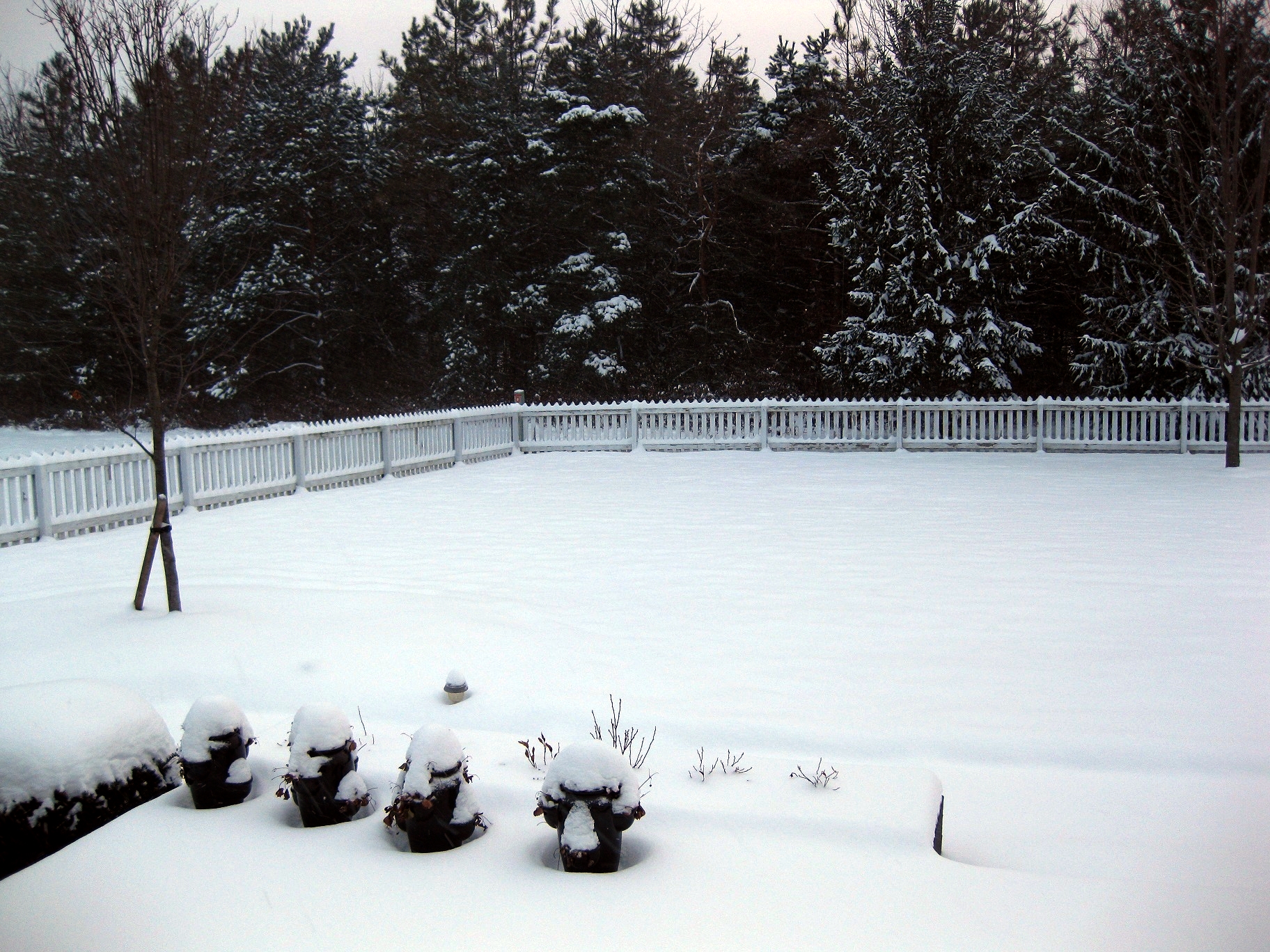
View

View from my house yesterday afternoon

She seems distracted. Looking at the snow.

“They can’t all be unique,” she says.

We’re in the family room, curled up together on the couch. On the television, Walt’s yelling at Jesse about something. She pays no attention. Fireplace off, central heat kicking. From under her blanket she’s looking at the snow.

“Snowflakes?” I say.

“Since the dawn of time, there must have been…” She cocks her head, doing the math. “Ninety-nine gazillion snowflakes. No way none of them gets a dupe. Sooner or later, we’re bound to get a repeat.”

“What happens then?”

She lights up, hands clutching at unseen foes. “Then it’s a sign!”

“A sign.”

“The end times! Snowmageddon! Hailpocalypse! Icenarok!” She punches her palm. “Bam, just like that. Snow runs out of ideas, it’s all over, baby. Hell hath no fury like a macroscopic ice crystal scorned.”

“Yeah?”

“Yeah!”

Her eyes go dreamy, and I know I’ve lost her. I bring her back with a kiss. We sit in silence for a time. More yelling on the TV. I feel like I’ve watched this scene somewhere before.

“Maybe,” I whisper, “they’re all fragments of the same giant primordial flake. When the meteor smashed the dinosaurs, it also smashed Flakezilla, and all the ones we get now are just the pieces. So in a way, maybe they’re all the same.”

She considers this. As she cogitates, she absently licks her lips, and I restrain the urge to kiss her again. I want to know what she’s going to say.

“Flakezilla?”

“Yeah.”

“That’s stupid.”

Well. I tried.

“I love you,” I offer instead.

She smiles, utterly unique.

Forty-Minute Story: The Attack

They came from the sky, and they came at night.

Some scream when you shoot them down, metal limbs shrieking to shrapnel, red occulosensors crackling to oblivion. Some wilt mournfully in the air, resigning to the hail of our bullets. Some break in half and become pairs of jerking, frenzied robotic targets.

But there are always more.

The Rain of Drones started October 2, 2017. A Monday. NASA had tracked the meteor as it sidled up to our planet, noting its proximity, triple-checking the numbers to make sure it wouldn’t hit. Nobody’s calculations expected it to slow down, break into a trillion attack bots, and descend like titanium snow for months.

Except – well, I wonder sometimes if “attack” is the right word.

Don’t get me wrong, they wreaked hell at the start. The first few that landed, each one reared up on its hind legs, planted itself firmly on the spot, and declared itself lord of everything in a one-kilometer radius. Said declaration came in the form of pulsing energy spheres blasting anything that moved. Thousands died. You don’t need to feel sorry for these things.

But I do, a little.

I get my job done. I shoot the suckers down. We’ve got jets in the air 24/7 now spinning a web of fire for the nasty little flies. We’re very good. Less than one in a thousand gets through.

They’re not a threat anymore. They just keep falling, a few at a time. There’s no pattern we can make out, no strategic targeting. Most would land in the ocean if we didn’t get ’em, just sit at the bottom, taking potshots at crabs.

One crashed in the Sahara. We can’t get close enough to capture it – the damn thing just goes crazy if you get anywhere near. We could blast it from a distance, of course, but it’s not hurting anyone out there, so we’re studying it instead.

They’ve learned plenty about the technology, the engineering, all very classified. But here’s what I’ve learned. If you leave them alone, they don’t attack.

Why?

What’s the plan? Why scatter them randomly without picking targets? Why make them so vulnerable on the way down? Why not take territory once they land?

Why do I feel so strange about blowing them apart without a fight, day after day?

Some say it’s Judgment Day, the end of everything. I figure God could’ve sat back and left that job to us, saved Himself the trouble.

Some say it’s only phase one of a bigger attack, that these are scouts to test our defenses. Except they’re not broadcasting signals, and they’re not moving. What the hell kind of scouts are those?

Everybody’s got theories.

But me?

I don’t know. I suppose if I had to guess – well, it doesn’t feel like they’re attacking. It doesn’t feel like they expected us to be here at all.

It feels like somebody’s coming home.

Two-Sentence Terrors

A recent thread on reddit asked users to write and submit two-sentence horror stories. The results were agreeably spine-chilling, featuring such laconic scares as:

You hear your mom calling you into the kitchen. As you are heading down the stairs you hear a whisper from the closet saying “Don’t go down there honey, I heard it too.”

Buzzfeed has collected their 12 favorites right here.

A co-worker threw down the gauntlet and suggested I write some of my own.

challenge accepted

  • Panting, she set the barrel to her forehead and pulled the trigger, but all she heard was a click. “No escape,” said the voice behind her, “only me.”
  • Muffin’s a good dog, but it’s been three days and he’s getting hungry. And I’m still tied to the chair.
  • I locked the door and took my wife’s hand. “We’re safe now,” I lied.
  • They all scream except for one man at the far end of the room. He must be new.
  • The nightmares are getting worse. I’ve stopped waking up.

Care to try?

40-Minute Story: The Recitation

Marissa’s young face furrowed in concentration as she stood, holding the musty book. She propped elbows against hips to support its great bulk.

“The Spell of Knowledge,” she intoned, mimicking Ada’s stern recitations. But she spared a glance out the wide window, which flooded the cramped library room with late morning sun. It was springtime, outside.

Marissa shifted uncomfortably as she bore the book’s weight. Why did all these spells have to be bound in a single heavy volume? Shouldn’t there be a better way to organize them?

“First invocation,” Ada commanded. She studied Marissa intently from the dim corner where she sat, plump hands folded on her russet robe. Marissa’s own coarse sleeves itched at her wrists, but she knew better than to try and scratch.

“H, T, T, P,” she pronounced. “Colon!” Now she raised her left arm and chopped the air twice, quickly, so as not to drop the spellbook. “Slash, slash!”

Her gestures were sloppy, she knew, but Ada said only, “Second invocation.”

Marissa hesitated. “It says ‘Optional,’ Madam.”

“You will know the long forms as well as the short.”

“Yes, Madam.” It was a brief line anyway. “Double-U, double-U, double-U.” She stabbed the air. “Dot!”

“The pronouncement.”

Sternly now, drawing out the two syllables of the word of power. “GOO-gle.”

“And the coda.”

“Dot co. Dot U, K.”

“You may sit.”

Marissa sat down more quickly than was proper, resting the book on her lap and rubbing the fire from her biceps. “How was that?” She nearly added, Can I go outside now? but thought better of it.

Ada sighed. “Dearest Marissa,” she said. “I love you like my own daughter, but I worry what will become of a girl who cannot focus her mind on these crucial tasks. You know we are the only tome-readers left in this village. Your brother is out toiling in the corn field, sweating under the sun. Without the proper daily recitations, for Fortune and Increase and even Knowledge, the crops will die and his hard work will be for nothing. Mind, I said proper recitations, with purpose and a full heart, and a focused spirit.”

Marissa slumped in disappointment. There would be no escape this morning. “Did I not read the passage correctly, Madam?”

“Correctly? Hmph! Do you suppose correctness is all a spell requires? It isn’t just the words, child. You must mean it from your toes to your scalp. But you would rather be out there, playing in the yard with your…your strange toys…”

“They aren’t toys!” Arguing never worked, but she couldn’t help herself. “They’re the pieces of an old transistor radio, from before the Worldfire. If I could just put them together right, I know I could…well, I don’t know what, but those old machines have to do something!”

Ada rose. “Do you know the story of your name, Marissa?”

“Yes, Madam.” If she was getting the name lecture, there was definitely no escape this morning.

“Your namesake was Marissa Mayer, the great sorceress. She, too, lived before the Worldfire. She helped write the Google spells, and she led the wizards of Yahoo. She had a purpose, child. A passion for her work, for her magic. Do you think she wasted her time on these, these…what did you call them? Transistors?”

Marissa bowed her head, though not with humility. She was hiding the rebellion in her eyes. But she stayed silent.

“Study the tomes, child,” said Ada. “There will be time enough later for games.”

Forty-Minute Story: A Distant World

Daktor strode into the room like a conqueror, and that’s exactly what she was. She held out her purple, scaly fingers in a gesture of command. It was important to be regal, no matter who she addressed. Even if it was a computer.

“Speak, Voice,” she ordered. “Tell me about these humans. Theirs is a distant world, but General Noth advances in their direction. I hear many conflicting rumors of their kind, and I would know the truth.”

The ship’s computer was a vaguely cylindrical mass of metal and polymer casing, enclosing such strange and mystical circuits as even Daktor dared not imagine. It spoke in a harsh synthetic tone. “Enlightened One, these creatures are no threat to your navy.”

She frowned. “I have heard of their skill. With ships, with technology. They have colonized three of the nearby systems, have they not?”

“It is so, Enlightened One.”

“How do you know they are not a threat?”

“They were a race of toolmakers, Enlightened One. They achieved nuclear fission and interstellar drive early in their history. But they have fallen.”

“Fallen – how? The technology is gone?”

“The tools remain, but the toolmakers have grown weak. They engineered such clever devices that they had no more need of toil, of skill. Pampered by their machines, they ceased to study, and they forgot how to invent new things. A few of the old builder clans remain, but it takes all their effort just to maintain the ancient ways. They do not innovate.”

Daktor smiled. “Like a thousand other worlds. Prey to their own genius. Once I have pushed my borders beyond them, I will teach them new ways. Our ways. The ways of strength.”

“So it will be, Enlightened One.”

Daktor strode out of the room like a conqueror.

A panel in the corner shifted, and two heads poked out of a supply cache, scanning the room. Their faces were not purple or scaly, but soft and smooth. Daktor would have thought they looked weak, had she been there. But Daktor had moved on.

“They bought it,” one said to the other. “Let’s move.”

———-

For those who don’t know, Forty-Minute Stories are a semi-regular feature here. I write each one in (shocker!) forty minutes or less, in the mornings before work. If you liked this one, there are plenty more.

Forty-Minute Story: Field Trip

Although Nishant stood away from the other fourth-graders, staring into space, he listened to Mrs. Carlson more carefully than any of them.

She was calling names.

“Rachel.”

“Here.”

Rachel wasn’t a good name, he thought. Not that he had anything against the girl, though Nishant did wish she’d wash her hands a little more often. Rather, it was the name itself. It didn’t feel right. It didn’t…work.

“Tom.”

“Here!”

Now Tom, that was a good name. So many possibilities. You could add an e and make one of his favorite words, tome, which meant book. Or you could switch the T to an R and create ROM, which was a Super NES game. Or maybe…

He trailed off as he noticed Rachel, like him, wandering a short distance from the group that was clustered around the school bus. With her sticky hands, she tugged at a cone on a short tree that bristled with needle-like leaves. He remembered it was called a fir – a word he had learned in Life Science only yesterday.

Fir. Now there was a word. It practically screamed with possibility.

“Nishant.”

He was vaguely aware of his name being called, but he didn’t care. He was staring at the tree. He could feel it in his mind – the tree itself, and its word. They weren’t separate things. It was all one. Fir.

“Nishant Balan!”

He’d had inklings of this before, but never so strongly. It called to him. It was itching to change.

“Nishant, there you are! Please pay attention. All right. Amy.”

All it would take was one extra letter, one extra vowel, to nudge it into…

With an awful whoosh, the tree mushroomed into a pillar of fire, licking the sky with red and orange. Rachel screamed, staggering back and clutching her face. The scream and the fire set off shouts from all the kids, and Mrs. Carlson came running over. “Rachel, Rachel, are you all right?” The three digits she tapped into her cell phone answered her own question. Rachel kept screaming.

Nishant stared, a sick feeling rising in his gut. He’d done this. He hadn’t known quite what would happen, certainly hadn’t meant to hurt anyone. But hadn’t he pushed the tree toward fire? He was responsible. What would his mother say if she could see him now? The girl didn’t look too badly injured, but she was in so much pain.

The fire was spreading into nearby trees, though the original blaze had already died down to the size of a small campfire. Nothing was left of the tree. It had been completely incinerated.

No, thought Nishant. Not incinerated. Replaced.

He concentrated on Rachel again, reaching out with his mind, feeling the pain in her hands, her cheeks. So much pain. But pain was a good word, too. Not good to experience, but good for transforming into…

The stormclouds unfurled in seconds like an apocalyptic banner, and the sky spilled torrents of rain. The spreading flames flickered and died under that colossal gray. The children surged inside the shelter of the bus.

And Rachel –

She sat up. The burn remained on her face, but she had stopped crying. Her agony had vanished. Bemused, the teacher ushered her and Nishant on to the bus as well, still speaking rapidly into the phone.

As Nishant took his seat, dripping small puddles onto the floor, he gazed out the window through the curtain of streaming water. The storm was subsiding. He couldn’t help but smile. Through the swirl of competing questions and ideas, one thought dominated his nine-year-old brain.

I need to buy a thesaurus.