Monthly Archives: January 2017

Is the March for Science a “terrible idea”?

Planning is underway for a protest rally in Washington, D.C., and across the country. Just as the Women’s March focused on women’s issues, the March for Science will promote scientific research as an indispensable guide to government policy, and will protest various anti-science actions of the current administration. No date has been set yet, but their Twitter account — @ScienceMarchDC — has about 300,000 followers already.

I’m one of them. I was excited about the march from the moment I first heard about it. I doubt I’ll be able to join them in person, but I plan to support them and spread the word.

Not everyone shares my enthusiasm, it seems.

An op-ed in today’s New York Times, written by someone named Robert S. Young, calls the march “a terrible idea.” Young is a scientist himself. What are his objections?

The biggest one seems to be that he’s against politicizing science. He writes:

A march by scientists, while well intentioned, will serve only to trivialize and politicize the science we care so much about, turn scientists into another group caught up in the culture wars and further drive the wedge between scientists and a certain segment of the American electorate.

I sympathize with his concern … a little. But I don’t think there’s much justification for it.

For starters, I’m not sure it’s possible to politicize science any more than it already has been. Scientists are already caught up in the culture wars. The wedge between them and “a certain segment of the American electorate” could hardly be much deeper.

More importantly, if “politicizing science” means that researchers — and those who feel passionately about science — are getting more involved in the political process, I think that’s a wonderful idea.

(Incidentally, this isn’t just “a march by scientists,” it’s a march for anyone who supports science. I’d guess that actual scientists will be in the minority, and that’s fine.)

Getting political has a bad reputation. The political process is widely seen as dirty, corrupt, dishonest, and ineffective — and it is all those things, to varying degrees. But it is the machinery of democracy. It is the least bad system we’ve come up with so far. Getting political means participating in democracy, and democracy, as we well know, must not be a spectator sport.

I’m always puzzled when people say things like “Actors shouldn’t talk about politics.” This has roughly the same internal logic as “Accountants shouldn’t talk about skiing.” You’re not barred from talking about something just because you aren’t an expert.

How much more, then, should scientists — who are experts in matters critical to government decisions — have at least an equal voice in public debate? If politics is dishonest, who better to shine some truth on it? Conversely, if you believe that a certain course of action will literally kill every human being on earth, how can you justify keeping out of the process that could change it?

Of course, it goes without saying that scientific research itself should be (or try to be) nonpolitical and nonpartisan. Scientific papers are about presenting data and deriving factual conclusions. Political opinions don’t belong in scientific papers for roughly the same reason that Locutus of Borg doesn’t belong on Dancing with the Stars (although, now that I say that, I’m kind of intrigued). But that doesn’t mean scientists themselves, who are humans and voters and parents and taxpayers, have any reason to stay out of an arena that affects our humanity and our representatives and our children and our tax-funded projects.

Will the march make scientists seem partisan? Probably. But then, we’re living in an age when making factual statements is a partisan act. And in fact, telling the truth has always been partisan. “Cigarettes cause cancer.” “Women and men have equal intelligence.” “The earth revolves around the sun.” These are all factual, verifiable statements that are (mostly) uncontroversial today, but at one time or another, each of these statements would have placed you firmly on one side or another of the culture wars. So if we’re in the battle anyway, shouldn’t we at least be able to march?

Young also writes:

Scientists marching in opposition to a newly elected Republican president will only cement the divide. The solution here is not mass spectacle, but an increased effort to communicate directly with those who do not understand the degree to which the changing climate is already affecting their lives. We need storytellers, not marchers.

He suggests honest, open, face-to-face conversation with those in the community who may not understand what science is all about.

And that, of course, is also a wonderful idea. So much of the conflict in politics, government, and life is fueled by misunderstanding. Conversation helps. My opinions have changed countless times over the years — for the better, I hope — and that’s largely because of conversations.

But conversations and marches are not mutually exclusive. We can do both. And we should. His argument against the Science March — that it will be a mass spectacle, likely to further polarize an already divided nation — could be applied to almost any large political rally. When Martin Luther King gave his “I Have a Dream” speech to hundreds of thousands of supporters in Washington, wasn’t that a “mass spectacle”? Didn’t that “further drive the wedge between” civil rights supporters and opponents? Yes — but it had positive effects too.

(I am not, of course, comparing the Science March to Dr. King’s speech in any way, except for the specific parallel above.)

Marches are useful. Those who already love science may get even more excited — and more likely to vote, write to Senators, or seek public office. Those without a strong opinion may do a little more reading. Elected officials will notice that a sizable chunk of their constituency feels a certain way, and isn’t shy about saying so. Even among those vehemently opposed to certain scientific conclusions — or science itself — it will at least stir up some conversation.

The op-ed is fairly thoughtful, worth reading and considering. But as for me, “politicizing science” means armoring truth to step into the fray. And I say, bring it on!


Okay, I laughed

Found on Imgur:

tubz

The top comment:

tried-it

Meanwhile, in the State Department

The Guardian reports:

The Trump White House carried out an abrupt purge of the state department’s senior leadership last week, removing key officials from posts that are essential to the day-to-day running of the department and US missions abroad.

[…] The purge has left a gaping hole at the heart of US diplomacy: the incoming secretary of state, Rex Tillerson, has yet to be confirmed and the Trump team has not named candidates to fill several levels of leadership under him.

[…] In the past, the state department has been asked to set up early foreign contacts for an incoming administration. This time however it has been bypassed, and Trump’s immediate circle of Steve Bannon, Michael Flynn, son-in-law Jared Kushner and Reince Priebus are making their own calls.

At the same time, the Chairman of the Joint Chiefs of Staff has been demoted, and is now merely an optional attendee at the National Security Council, while Steve Bannon has been added to the roster.

Look, I understand, the executive power of the United States resides in the President, and Trump has enormous leeway to do what he wants with the executive branch. But having the authority to do something doesn’t mean it’s a good idea.

Trump is gutting the executive branch of anyone who might challenge him, and he’s not being subtle about it. This is really, really bad.

…And the people respond

A couple days ago, when I ranted about Trump’s horrible new immigration ban, I didn’t really expect a lot of people to care. I figured it would blow over like everything else.

I’ve never been happier to be wrong.

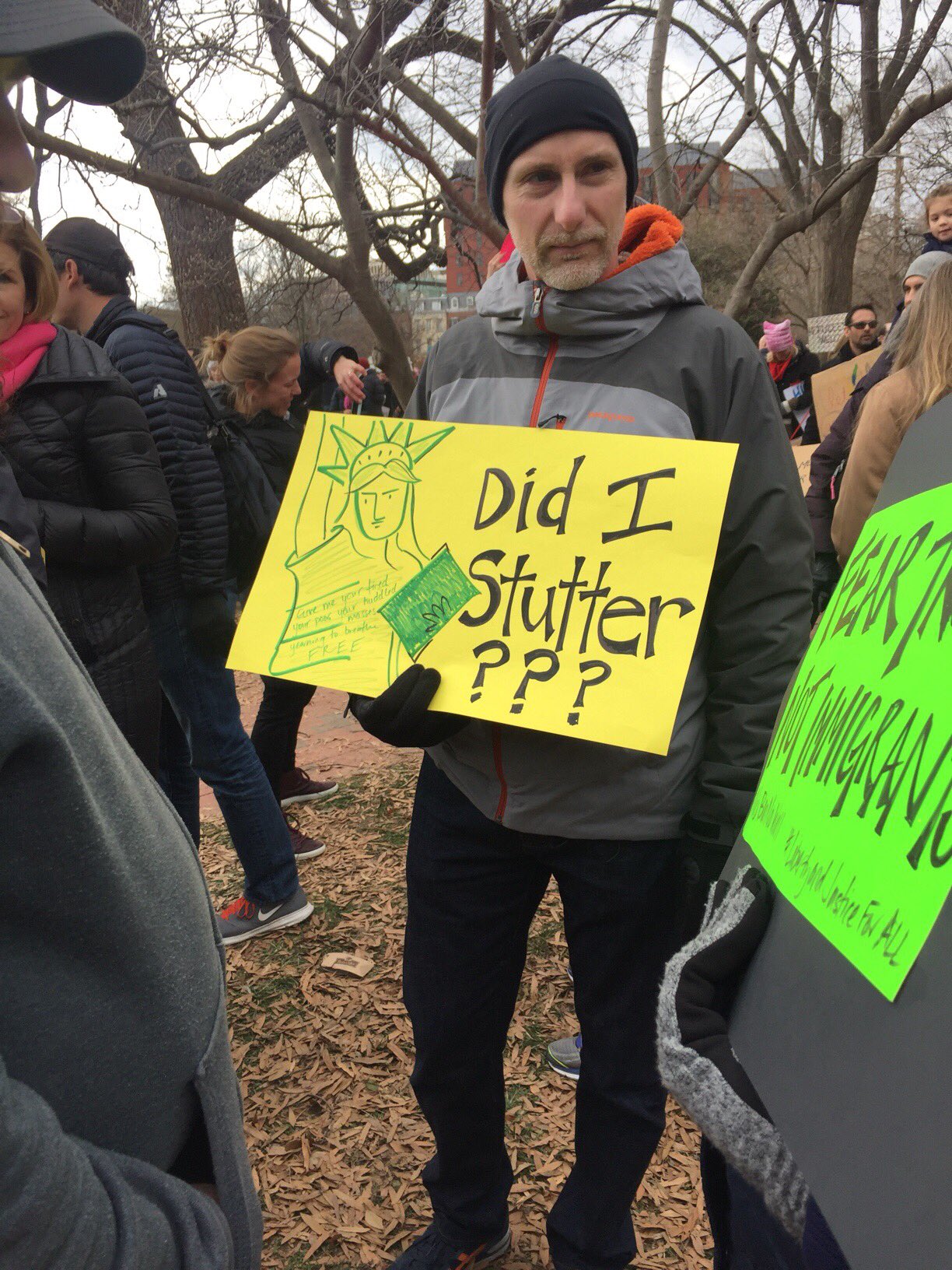
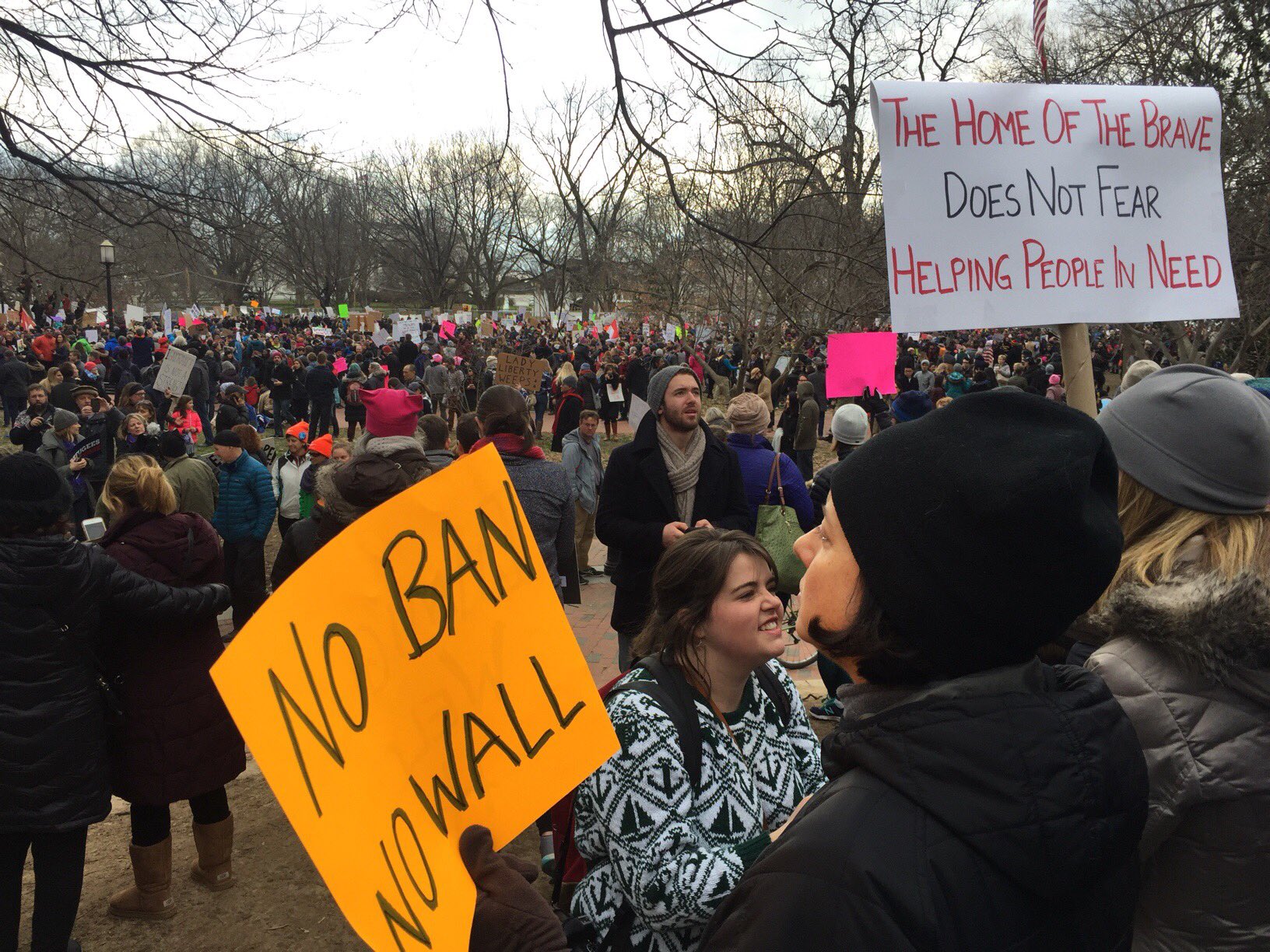
protest-3

Judge Blocks Trump Order on Refugees Amid Chaos and Outcry Worldwide

The judge’s ruling blocked part of the president’s actions, preventing the government from deporting some arrivals who found themselves ensnared by the presidential order. But it stopped short of letting them into the country or issuing a broader ruling on the constitutionality of Mr. Trump’s actions. […] Mr. Trump — in office just a week — found himself accused of constitutional and legal overreach by two Iraqi immigrants, defended by the American Civil Liberties Union.

hands-off

Outrage over Trump’s immigrant ban helps ACLU raise more money online in one weekend than in all of 2016

The ACLU said it has received more than 350,000 online donations totaling $24 million since Saturday morning. The non-profit organization that aims to protect individuals’ rights and liberties guaranteed in the Constitution typically raises about $4 million online in a year, according to Executive Director Anthony Romero. […] The ACLU now has 1 million members. Its membership has doubled since the election.

I don’t think the text quite does justice to this remarkable fact, so here’s a graph:

aclu-graph

protest-1

37 Nobel laureates and thousands of others are opposed to immigration ban

Meet the scientists affected by Trump’s immigration ban

protest-2

U.S. Senators John McCain (R-AZ) and Lindsey Graham (R-SC) released the following statement on the President’s executive order on immigration:

“Our government has a responsibility to defend our borders, but we must do so in a way that makes us safer and upholds all that is decent and exceptional about our nation. […] We should not stop green-card holders from returning to the country they call home. We should not stop those who have served as interpreters for our military and diplomats from seeking refuge in the country they risked their lives to help. And we should not turn our backs on those refugees who have been shown through extensive vetting to pose no demonstrable threat to our nation, and who have suffered unspeakable horrors, most of them women and children. Ultimately, we fear this executive order will become a self-inflicted wound in the fight against terrorism.”

Senator Mitch McConnell:

“But I am opposed to a religious test. The courts are going to determine whether this is too broad.”


protest-4

Growing Number of G.O.P. Lawmakers Criticize Trump’s Refugee Policy

[Senators McCain and Graham] were not alone in their criticisms. Senator Bob Corker of Tennessee, the chairman of the Foreign Relations Committee, said that while he supported stronger screening, the order had been “poorly implemented.” […]

Senator Cory Gardner of Colorado, the chairman of the National Republican Senatorial Committee, likewise said the order was “overly broad” and that the blanket travel ban “goes to far.” Senator Lamar Alexander of Tennessee seemed to echo those criticisms, adding that “while not explicitly a religious test, it comes close to one, which is inconsistent with our American character.”

Senator Rob Portman, Republican of Ohio, went further, questioning the hastiness of the order’s rollout and calling for a re-evaluation of the White House’s unilateral effort. “In my view, we ought to all take a deep breath and come up with something that makes sense for our national security and again for this notion that America has always been a welcoming home for refugees and immigrants,” Mr. Portman said on CNN’s “State of the Union.”

Similar concerns were voiced by some Republicans in the House. Most prominent among them was Representative Michael McCaul, the chairman of the Homeland Security Committee, who said that “it was clear” that adjustments were needed to the order, but defended it in principle. Representative Will Hurd of Texas, a former undercover C.I.A. officer, called the measure “the ultimate display of mistrust” that would “erode our allies’ willingness to fight with us” and put Americans at risk.


protest-5

Travelers Stranded and Protests Swell Over Trump Order

The White House pulled back on part of Mr. Trump’s temporary ban on visitors from seven countries by saying that it would not apply to those with green cards granting them permanent residence in the United States. By the end of the day, the Department of Homeland Security formally issued an order declaring legal residents exempt from the order. But the recalibration did little to reassure critics at home or abroad who saw the president’s order as a retreat from traditional American values.
[…] While Mr. Trump denied that his action focused on religion, the first iteration of his plan during his presidential campaign was framed as a temporary ban on all Muslim visitors. As late as Sunday morning, he made clear that his concern was for Christian refugees, and part of his order gives preferential treatment to Christians who try to enter the United States from majority-Muslim nations.
[…] Prime Minister Theresa May of Britain, who met with Mr. Trump in Washington on Friday and has sought to forge a friendship with him, initially declined to comment on the policy on Sunday when pressed by reporters during a stop in Turkey. But under pressure from opposition politicians, her spokesman later said the British government did “not agree with this kind of approach.”

protest-6

Who Hasn’t Trump Banned? People From Places Where He’s Done Business

These countries [Saudi Arabia, Egypt, and the United Arab Emirates], unlike those subject to the ban, are ones where Donald Trump has done business. In Saudi Arabia, his most recent government financial disclosure revealed several limited liability Trump corporations. In Egypt, he had two Trump companies registered. In the United Arab Emirates, he had licensed his name to a Dubai golf resort and a luxury residential development and spa. Some of these entities have since been closed, and others remain active.

Trump’s Immigration Order Jolts Iraqis, U.S.’s Top Allies Against ISIS

President Trump’s executive order on immigration is straining relations with the partner the United States needs most to reclaim the Islamic State’s stronghold in Mosul: the Iraqis. Iraqi officials were taken aback by the directive, which they learned about through the American news media because they had not been consulted first.

protest-7

How Trump’s Rush to Enact an Immigration Ban Unleashed Global Chaos

Gen. John F. Kelly, the secretary of Homeland Security, […] was still getting his first full briefing on the executive order when President Trump signed it. […] Jim Mattis, the new secretary of defense, did not see a final version of the order until Friday morning, only hours before Mr. Trump arrived to sign it at the Pentagon.

sergey-brin

A man takes a selfie with Google co-founder Sergey Brin (left), who is an immigrant from the Soviet Union, at a recent protest.

Silicon Valley’s Ambivalence Toward Trump Turns to Anger

The tech companies’ reaction was more forceful than that of other industries. Just about everyone in Silicon Valley came from somewhere else or is a son or daughter of someone who did or is married to someone who did. That list starts with the most famous Silicon Valley citizen of all: Steve Jobs, the Apple co-founder, whose biological father immigrated from Syria in 1954. […] Elon Musk, the chief executive of Tesla and SpaceX, who sits on two of Mr. Trump’s advisory committees, wrote on Twitter that the ban was “not the best way to address the country’s challenges.” Mr. Musk was born in South Africa.

protest-8

Questions multiply over Bannon’s role in Trump administration

Stephen K. Bannon — whose nationalist convictions and hard-line oppositional view of globalism have long guided Trump — was directly involved in shaping the controversial immigration mandate.

(If you’re interested, my thoughts on Bannon — from back during the campaign — may be found here.)

protest-9

Meanwhile, in other news:

Petition for Trump’s tax returns gets record number of signatures

A WhiteHouse.gov petition demanding that President Trump release his personal income tax returns has broken the website’s record for signatures. As of 4:30 p.m. on Thursday, the petition had received 369,550 signatures. That’s close to 2,400 more than the previous record holder.

Once again, that petition is here. The number of signatures is now over 432,000 and still rising rapidly.

McCain blasts Bannon placement on National Security Council

John McCain is harshly criticizing the elevation of White House strategist Steve Bannon to President Donald Trump’s National Security Council, calling the move “radical” because it minimizes the role of the chairman of the Joint Chiefs of Staff.

Because, you know, the former head of a racist, xenophobic Trump propaganda site didn’t have enough power already.

And finally, this sad and horrifying breaking news:

6 killed, 8 injured by gunmen who invaded Quebec City mosque

Multiple people were killed and others injured Sunday after gunmen opened fire on worshipers at a Quebec City mosque as evening prayers were ending in what Quebec’s premier described as an act of terrorism.

[…] The shooting is a particular shock for Quebec City, a quiet white-collar city with a low crime rate. In 2015, the city reported two murders. The metropolitan area has 800,000 people.

[…] Canada has seen increasing anti-Muslim hostility over the past year, but still nowhere near the level witnessed in the United States and Europe.

All this — the hatred, the ignorance, the hardening of hearts, the deadening of minds, the growing disregard for the truth — it has to stop. We have to stop it.

And we will.

More to come soon.

Ah, how things change…

oldtweet

(link)

Excerpt from Trump’s refugee-blocking executive order

How do we know who to let in, and who to keep out? Let our new President explain:

In order to protect Americans, the United States must ensure that those admitted to this country do not bear hostile attitudes toward it and its founding principles. The United States cannot, and should not, admit those who do not support the Constitution, or those who would place violent ideologies over American law. In addition, the United States should not admit those who engage in acts of bigotry or hatred (including “honor” killings, other forms of violence against women, or the persecution of those who practice religions different from their own) or those who would oppress Americans of any race, gender, or sexual orientation.

So we want to keep out people who…

  • “…do not support the Consitution.” Like, say, a President who’s suggested throwing out due process?
  • “…would place violent ideologies over American law.” Like, say, a President who supports illegal torture?
  • “…engage in acts of bigotry or hatred.” Like, say, a President who once proposed banning all Muslims from the U.S.?
  • “…engage in…violence against women.” Like, say, a President who brags about sexual assault?
  • “…engage in…the persecution of religions different from their own.” Like, say, a President who signed this very executive order, which orders the Secretary of State:

…to prioritize refugee claims made by individuals on the basis of religious-based persecution, provided that the religion of the individual is a minority religion in the individual’s country of nationality. [Trump has explained that this provision is designed to prioritize Christians.]

So, good news! If we can get Trump to leave the country, his own executive order should keep him from coming back in.

The Muslim ban is real. This is actually the country we live in now.

A lot of people say that if you swear all the time, it loses its effectiveness. You’ve got to reserve it for situations where it’s really warranted. I’ve tried to write my blog according to that rule.

With that in mind, take a look at this fucking bullshit.

No, the U.S. isn’t permanently banning all Muslims from coming in. Not yet. But we have institutionalized religious intolerance.

This isn’t going to happen, it has already happened.

The authors of this news article seem calmer than I am, so I’ll let them explain:

President Trump on Friday closed the nation’s borders to refugees from around the world, ordering that families fleeing Syrian carnage be indefinitely blocked from entering the United States, and temporarily suspending immigration from several predominantly Muslim countries.

So far, this is a geographical test, not a religious one — at least nominally. If that’s all it was, I’d only be regular angry: the ordinary, moderate amount of anger I feel every day when I look at the news. But keep reading.

Declaring the measure part of an extreme vetting plan to “keep radical Islamic terrorists” out of the country, Mr. Trump also ordered that Christians around the globe who are seeking entry into the United States should be granted priority over Muslims, for the first time establishing a religious test for refugees.

I don’t think I can adequately express how furious I am at the phrase establishing a religious test for refugees.

Okay. Breathe.

Out of curiosity, what are these countries we’re so concerned about?

Iraq, Syria, Iran, Sudan, Libya, Somalia and Yemen.

To be fair: These are, of course, dangerous and unstable places, and of course we should be careful about who we let into our country. (It wasn’t exactly an open-door policy before this order.) Also, to be fair: Many predominantly Muslim countries, such as Indonesia, are not on the list.

The main thing is that we prevent another 9/11 from happening. Right?

Announcing his “extreme vetting” plan, the president invoked the specter of the Sept. 11, 2001, attacks. Most of the 19 hijackers on the planes that crashed into the World Trade Center, the Pentagon and a field in Shanksville, Pa., were from Saudi Arabia. The rest were from the United Arab Emirates, Egypt and Lebanon. None of those countries is on Mr. Trump’s visa ban list.

Oh. Well, um. Hm.

Saudi Arabia was the home of 15 of the 9/11 hijackers, as well as Osama bin Laden. It is an absolute monarchy in which Sharia law dominates and women aren’t allowed to vote.

Egypt was the home of one of the 9/11 hijackers, has been racked by violence, and is run by a dictator.

Not to mention, Turkey — another predominantly Muslim country — has been racked by violence, and is run by a president with strong authoritarian leanings.

By Trump’s logic, these are also very scary places, right? Kind of weird that they’re not on this list. But then, I’m sure he has his reasons. It’s not like he has business interests in —

Oh wait, just kidding. Trump has business interests in Saudi Arabia, Egypt, and Turkey. (And, incidentally, Indonesia.)

At this point you may be wondering if there’s a complete list of Mr. Trump’s business interests. Haha, nope! Because he still, somehow, still hasn’t released his tax returns. And he’s not planning to. (Reminder: There’s a petition.) But if you’re curious, Time has a good list of the business interests we do know about (or have reason to suspect).

So, to summarize:

  • Muslims are dangerous
  • But not the ones who can help make Trump rich
  • Christians are not dangerous
  • Torture is fine
  • If you’re fleeing the ravages of war and torture, and you think the U.S. is some sort of haven of peace and liberty, you’d better find Jesus in a hurry
  • Jesus was a Middle Eastern refugee

Stay tuned. We’ll be talking about more ways to fight back in the days and weeks to come.

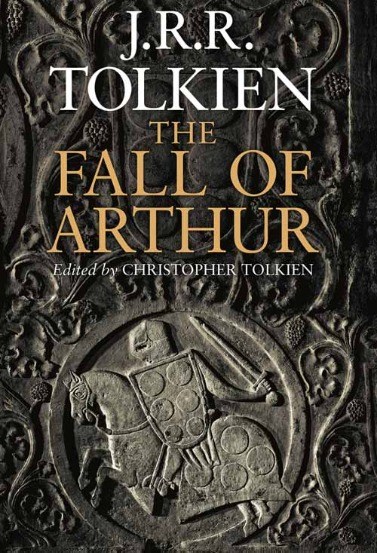
Postmortem: The Fall of Arthur

tfoa

For a man who died in 1973, John Ronald Reuel Tolkien still gets an awful lot of books published: The Silmarillion, 1977; the twelve-volume History of Middle-Earth in the 80s and 90s; The Children of Húrin, 2007; and others.

All this is possible because one of his sons, Christopher Tolkien, has devoted a remarkable amount of time and energy over the decades to combing the elder Tolkien’s voluminous notes, sketches, and drafts, which are often incomplete and hard to decipher. Christopher is 92 today, and still going.

A few years ago he came out with The Fall of Arthur. A few weeks ago I discovered it in a local bookstore. A few days ago I finished it. And it’s excellent.

The Fall of Arthur is an unfinished long poem about the death of King Arthur, the last battle with Mordred, and the downfall of Camelot, covering roughly the same ground as the final chapters of Thomas Malory’s Le Morte D’Arthur, though Tolkien draws on other sources as well. It is written in a form relatively unknown today, the so-called alliterative verse of the Old English poets, used most famously in Beowulf. Tolkien’s work has no rhyme, but a definite rhythm and structure, as in this bit from the first canto (chapter):

Dark and dreary     were the deep valleys,
where limbs gigantic    of lowering trees
in endless aisles    were arched o’er rivers
flowing down afar    from fells of ice.

That space in the middle of each line is part of the Beowulf form, too. When discussing it, Tolkien speaks of both lines and “half-lines.” The purpose of the half-lines would require a whole separate blog post (and more research on my part), but the Wiki page I linked above has some explanation.

More remarkable, from my perspective, is that this is really good poetry.

I grew up on The Hobbit and Lord of the Rings, and I thought the poetry and songs in those books was amazing — but the older I got, the less impressed I was. So I wasn’t sure what to expect here. But his use of language is just beautiful.

I think the Old English form (as opposed to the more conventional rhyming verses he uses elsewhere) pushes him to find more interesting word choices. I also love all the old words he uses, which make the poem as a whole feel both ancient and truly connected with Arthur’s world. In the quote above, “fells” are hills or heights — so “fells of ice” are hills of ice. Elsewhere, he uses “tarn,” which is a small steep-banked mountain lake. (Incidentally, “tarn” appears in the first paragraph of The Fall of the House of Usher as well.) Other examples abound.

I’ve gotta say, too, it’s refreshing to read a serious work by Tolkien that isn’t in Middle-earth. I like hobbits as much as the next guy, but sometimes I also like, y’know, not hobbits. So that was cool.

As I mentioned, the poem is unfinished — as with so many projects in his career (and mine), real life got in the way. The story ends well before the apocalyptic Battle of Camlann (the battle that puts the Morte in Morte D’Arthur). At 40 pages, the poem itself takes up less than a quarter of the full volume. The rest is mostly commentary by Christopher in the form of three essays:

The Poem in Arthurian Tradition — Which sources did Tolkien draw on for his story? The Arthur mythology doesn’t have a single canonical source. It’s a jumble of different authors and traditions and languages over a span of centuries, with some altering or expanding on earlier works, and some inventing completely new stories. Christopher offers a solid historical context for the mythology his father decided to use.

The Unwritten Poem and Its Relation to The Silmarillion — Although The Fall of Arthur isn’t a Middle-earth story, there are certain parallels. The strongest parallel is between Avalon and Tol Eressëa, the latter being the “Lonely Isle” near Valinor from The Silmarillion. Tolkien also, at some point, wrote some lines of verse — which do not appear in the main poem — featuring the Silmarillion character Eärendel:

Eärendel goeth on eager quest
to magic islands beyond the miles of the sea,
past the hills of Avalon and the halls of the moon,
the dragon’s portals and the dark mountains
of the Bay of Faery on the borders of the world.

Even putting aside the Arthurian connection via Avalon, the lines above are gorgeous poetry, in my opinion — the word choice isn’t as sophisticated as what you’ll find in The Fall of Arthur, but it’s a vivid image nonetheless.

The Evolution of the Poem — Christopher had access to earlier drafts of the main poem, and he uses them to show how his father’s ideas grew and changed over the course of multiple revisions. He presents this evolution in considerable detail, taking a full 50 pages — which is longer than the poem itself. I confess this is the only section of the book I was unable to finish. I love writing, and editing, and revision, and poetry, and textual analysis, and Tolkien, and King Arthur, but even so, there’s only so much “See how he added five lines here?” that I can stomach. Nevertheless, it’s a great resource for anyone doing serious research, and its inclusion demonstrates once again Christopher’s dedication to his father’s work.

There’s also an appendix, an essay, where J. R. R. Tolkien explains in his own words what alliterative verse is all about, and explains the Old English verse tradition more generally. I found it fascinating, but I fear I may be in the minority there.

Whew! I always start these postmortems intending them to be just a few words about the book or movie or whatever, and I always end up being reminded yet again that writing “a few words” is beyond my abilities. But that’s how it goes.

Happy weekend!

Want Trump to release his tax returns?

Then sign this WhiteHouse.gov petition.

If it gets 100,000 signatures, a White House response is guaranteed (at least, under the current rules). It already has 362,000 signatures, so we’re way past that requirement. But the more signatures it gets, the stronger the message it sends.

You may think petitions don’t do a lot, and you may be right. But since it takes about thirty seconds and approximately zero effort, there’s not a lot of downside. Let’s fire on all cylinders.

This must be how Pandora felt

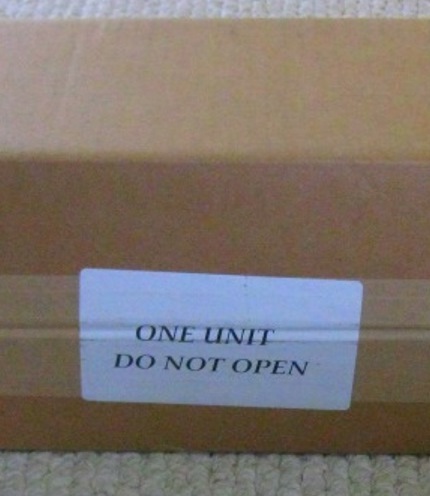
A package arrived on our front porch, and I’m so confused:

box

box2

What say you, good readers? Follow instructions? Or cry Havoc! and let slip the dogs of war?

UPDATE: It’s a Swiffer.