Category Archives: Uncategorized

Why Reading is Better than Telepathy

Your thoughts to my thoughts...

Telepathy is a pretty sweet deal, right? You reach out your hand, or maybe just stare at somebody, and suddenly you know what they’re thinking. The mere fact that it happens in every sci fi and fantasy story, ever, is proof that we all secretly wish we had that kind of power.

It may have occurred to you that reading is sort of a poor man’s telepathy. After all, you are – in a sense – reading someone else’s thoughts, right?

I’m here to tell you the opposite. Reading isn’t a poor man’s telepathy. Telepathy is a poor man’s reading. Suck it, Betazoids.

Six Reasons Reading is Better than Telepathy

6. Unlimited range. Not only do you not have to be in the same room as your target, you can even be on the other side of the planet. Those, my friend, are some powerful neurons.

5. You get more than one try. Telepaths are always saying things like “I tried to see what she was thinking there, but I couldn’t quite make it out.” If that happens in a book, you just read the paragraph again.

4. Works on dead people. Normally, to read the mind of a dead person, you have to get into all sorts of necromancy and unholy chants, and next thing you know, some phantom from the demon realm has slapped you with a hex and your apartment smells like formaldehyde. Books, on the other hand, are so kickass that the person whose thoughts you’re reading can die while you’re reading them and you won’t even notice.

3. No crazy side effects. Telepaths have to deal with all sorts of crap: nightmares, screaming victims, Freudian labyrinths, the constant chatter of people’s mental voices. Not you. As a reader, your telepathy is strictly on-demand, and you’ll never have any weirdness worse than the occasional eye strain. (Okay, nightmares may be a possibility too. I’m looking at you, Mr. Lovecraft.)

2. No invasions of privacy. Let’s face it: do you really want to live in a world where people can pick up every random thought in your head? Readers can only read what you write. It’s opt-in telepathy. How cool is that? Answer: it is significantly cool.

1. Reading is a real thing that actually exists. And you are reading my thoughts right this very second. Well done, hypothetical reader. Well done indeed.

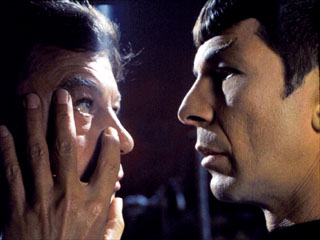
Of course, I’m still jealous of Mr. Spock for other reasons. I mean, just look at those ears. You could skewer a kabob on those things.

Have you ever wanted to be a telepath?

How to Succeed as a Novelist Without Really Trying

How to Succeed as a Novelist Without Really Trying

Discovering Hidden Brilliance

Sheridan, Kosh, and Delenn

I recently started watching Babylon 5 again. If you’re not familiar with it, imagine a show with the trappings of Star Trek: Deep Space Nine and the feel of The Lord of the Rings, plus a healthy dose of world-shattering superships. It’s a pretty good time, is what I’m trying to say.

This time around, I’m watching it with my wife, who’s never seen the show before. Introducing her to Babylon 5 presents a unique challenge. You see, all the really outstanding stuff in the show comes in seasons 3 and 4. The first season (and, to a lesser extent, the second) suffers from bad acting, bad dialogue, and a general shortage of coolness. But you can’t just skip to season 3, because you’d miss out on crucial parts of the story. Sure, you could figure it out as you went, but it wouldn’t be the same. So what do you do?

My solution was to identify a few key, plot-critical episodes from the first two seasons, then watch all of 3 and 4. So far it’s working pretty well.

My point is simple. Not every brilliant piece of art is polished on the surface. As a viewer (or reader), that means sometimes you have to dig a little to find the good stuff. As a writer, you have to do the same thing in your own work. You have to notice the hidden radiance that no one else can see. Then refine it, purify it, strip away everything that obscures that light, so that finally your readers can see it too.

Do you know any books, or shows, where the brilliance is hidden a little below the surface?

Friday Links

And, we’re back! After a perilous dip in green dots yesterday, our best agent made a daring run into the heavily-guarded Green Dot Factory and secured more than enough luminous orbs to get the cable modem back up and operational. Excelsior!

(That, or I came home and it was working again, without my doing anything. Whichever.)

Anyway! Today I have three fabulous links for you, and they are available…right…now!

First up is a post from Zen Habits called How I Changed My Life, In Four Lines. It starts with this:

Changing your life can seem an incredibly tough and complicated thing, especially if you’ve failed a great number of times (like I did), found it too hard, and resigned yourself to not changing. But I found a way to change.

I’m not sold on everything he recommends, but his basic four steps seem very sound.

Next, have you heard of Booktrack? They do soundtracks for books. What is this sorcery? Would you want a soundtrack for your book – and would you be willing to pay for a book-specific soundtrack like they offer, versus just jamming to your own mp3 collection?

Finally, Veronica Roth talks about how indecisiveness can hurt your revision. I’ve seen this happen in my own work, and Ms. Roth speaks the truth.

That’s a wrap. Have a stupendous weekend!

Experiencing Technical Difficulties

There is a critical shortage of glowing green dots on my cable modem at the moment. Apparently global demand for glowing green dots is spiking massively. BuckleyCorp apologizes for the inconvenience but hopes to return to distributing its usual propaganda tomorrow.

First Draft Complete!

I haven’t posted any fiction here in a while – it’s been a month and a half since the last one. That doesn’t mean I’ve been standing still, though. Last night I finished the first draft of a new story, untitled for now, in a genre I haven’t played with much before: science fiction horror.

The draft weighs in around 5,000 words, which is longer than I expected, the longest story I’ve written in quite a while. Per my new strategy, it’s a very rough, get-it-on-paper-before-you-hate-it draft, what Chuck Wendig might call a beach-storming draft. I’ve set myself a goal of finishing the revisions by Thanksgiving.

Once I finish the story, I’m going to do something else I haven’t done in a while: send it out for submission. I have submitted stories in the past (never successfully), but with all the work on the novel lately, I’ve gotten out of the habit. It’ll be good to get out there again, dodging rejection letters and hopefully getting my first prose publication credit.

Unfortunately, this plan means I can’t post the story on the blog. So it’s, like, a secret story. A ninja story. Yeah, that makes it seem more exciting, we’ll go with that.

And after Thanksgiving, it’s back to work on the novel.

Tell me, what are you working on these days? Sent anything out for submission lately?

You Do Not Even Have To Believe In Yourself

About six months ago, you may remember, Google put up a logo that looked like this:

Martha Graham

(That’s the static version. If you haven’t seen the animated version, take a moment to watch it now. It’s worth the ten seconds of your time.)

Personally, I think this is one of the best logos Google has ever done. So, following typical Internet logic, I clicked the pretty picture and read the Wikipedia article. The dancer’s name is Martha Graham, and after learning all about her, I promptly forgot almost everything.

One bit, however, stayed with me.

The story goes that another artist came to Ms. Graham to talk about her own worries. She “confessed that [she] had a burning desire to be excellent, but no faith that [she] could be.”

Martha’s response:

There is a vitality, a life force, an energy, a quickening that is translated through you into action, and because there is only one of you in all of time, this expression is unique. And if you block it, it will never exist through any other medium and it will be lost. The world will not have it. It is not your business to determine how good it is nor how valuable nor how it compares with other expressions. It is your business to keep it yours clearly and directly, to keep the channel open. You do not even have to believe in yourself or your work. You have to keep yourself open and aware to the urges that motivate you. Keep the channel open. … No artist is pleased. [There is] no satisfaction whatever at any time. There is only a queer divine dissatisfaction, a blessed unrest that keeps us marching and makes us more alive than the others.

I love this because it removes entirely the idea that you might not be good enough. She’s not saying you are good enough, she’s simply saying it doesn’t matter. That variable isn’t part of the equation. There is art inside you that exists nowhere else, and you must bring it out, and that is all.

This doesn’t mean you can be passive. You can’t wait for the Muse or your inner self to inspire you, nor can you merely dump your feelings on the page. Every art is a craft, and you are expected to forever push your skill to its limit. That’s what it means to “keep the channel open.” And of course, keeping the channel open is tremendously difficult.

But most artists – myself included – tend to make it even harder by piling worries and doubts on top of the work itself. Am I good enough? Will they like it? Will anyone remember this a year from now, or ten, or a hundred?

None of that is your job. It isn’t part of the equation.

Keep the channel open; make good art; give the world what it can’t get anywhere else.

Oh, and click on pretty pictures. That seems to help too.

Two Things You Didn’t Know (And Now You Do)

1. Mark Twain was born, and died, during visits from Halley’s Comet.

2. The “paragraph mark,” ¶, actually has a name. It’s called a “pilcrow.”

There. Now don’t you feel smart!

Friday Links

This week The Rumpus looks at what the Occupy Wall Street protesters are reading. You know, besides each other’s signs.

An author makes the difficult decision to stop working on a novel and start over with a new one. How do you know when it’s time?

So there is apparently an Encyclopedia of Science Fiction, which is pretty cool. The current version seems fairly limited, however. The most obvious gap at the moment is that, while there are long, detailed entries on science fiction authors, there seems to be nothing about the books themselves. Searching on “Dune” returns entries for the film, at least three separate video games, and a board game, with no apparent notion that all these were based on something or other. There is also a category for comic books, in which a search for “Spider-Man” yields no results. The site is still in beta, so hopefully it’ll grow as time goes on.

Tuesday was the 50th anniversary of the novel Catch-22. NPR talks about why the novel still resonates today.

And finally, a video called A Magazine is an iPad That Does Not Work. Watch as a toddler flips through a magazine, tapping the pages, trying to figure out why the “touch screen” doesn’t respond. Readers, I think I’m getting old.

Have a great weekend!

Your Secret Mission

You are a secret agent. Though you operate in a world of cynicism, greed, and dreary materialism, you actually work for the other guys. You smuggle in notions of poetry and purpose. You hope for hope and you love love, and someday, when the moment’s right, you’re going to open these people’s eyes. But for now, you walk among them like an ordinary peon, and nobody knows the truth.

It’s okay. I won’t blow your cover. I work for them too.

This morning, I have an assignment for you. I know you have a lot of undercover work going on, and maybe you don’t have time. If so, we understand. This is strictly optional.

Your mission, should you choose to accept it:

Look around you, right now, and pick out something that strikes you as beautiful. Then report back here and tell us what it is. That’s it – that’s all you have to do.

For me, it’s this wonderful piece my mom painted, titled “Sunburst.” I still need to hang it up.

Sunburst

It’s dark in here this morning; the photo doesn’t do it justice. But I love it because of the richness of the background, the contrast of the fiery orange with the deep blue, the brightness and the darkness, and the slightly nonrealistic style of the flowers, whimsical yet proud. And, of course, I love it because she made it.

But you don’t have to pick something like a piece of art that was designed to be beautiful. It can be some ordinary object, or the shape of a shadow, or anything. Don’t worry about what someone else would think of it. They’re the other guys. They don’t understand. We’ve entrusted this mission to you.

You don’t have to take a photo (unless you want to). Just describe what you see. Encourage your fellow agents with your success.

Ready?

Go!