Category Archives: Uncategorized

The Octopi Mumpsimus

Quick, what’s wrong with this sentence:

I saw three octopuses yesterday.

If you said ZOMG THE LETTERS ARE ALL SLANTY then you, sir/madam, are correct. Your prize is a deep but ephemeral satisfaction.

However, if you said that “octopuses” should be “octopi,” you would be oh my goodness so very wrong.

I always thought it was “octopi” too. Turns out, the word “octopus” has no fewer than three different plurals, which I list here (no joke) in order of descending correctness:

octopuses – the most obvious plural, and the one you should actually use.

octopodes – the “proper” plural, or at least it used to be. Generally considered pedantic.

octopi – some overzealous grammar nazi came up with this rule by guessing that “octopus” was Latin and took the same form as other Latin plurals (ex. “locus” -> “loci”). Somebody was wrong. Enough people now mistakenly use “octopi” that it’s actually in the dictionary, but it’s not preferred usage.

Can I first say how utterly insane it is that English has a word with three different plurals, all of which are in the dictionary, but which have a hierarchy of correctness? Or that, if there existed somebody else in the universe crazier than I am, he could probably debate the order I’ve chosen? Yeah. English. Seriously.

Beyond that, think about it: there’s a whole class of language rules where people go around “correcting” perfectly good English into bad English. “Octopuses” -> “octopi” is only one example. You’ve also got:

People who never end a sentence with a preposition, apparently because they are fans of 18th-century bishop Robert Lowth.

People who never split infinitives, apparently because they hate Star Trek. (To boldly go…)

People who say “She gave it to Bob and I” instead of “She gave it to Bob and me,” because the latter sounds less proper (even to me) for reasons I don’t fully understand.

And because English is batshit crazy, we actually have a word for this kind of incorrect correction: “mumpsimus.” Dictionary.com defines it as:

adherence to or persistence in an erroneous use of language, memorization, practice, belief, etc., out of habit or obstinacy

(The plural is “mumpsimuses,” smartass.)

Ha! Crazy, right? Man, next thing you know, we’ll have a word for people like me, who straighten out the people who make incorrect corrections. Ha ha!

Wait, this is English. Of course there’s a word for that. “Sumpsimus.” No, I’m not making it up.

Oh, English, you magnificent bastard. I can’t stay mad at you.
The One-Step Guide to Getting Published

Hi, I’m an unpublished author. I’ve discovered a one-step process for getting published. I’m on Step One.
 
Why would you go to an unpublished author for advice on getting published? You wouldn’t, of course. You’d go to Neil Gaiman. Here’s his advice: “Write. Finish things. Keep writing.”
 
Too boring? Not sparkly enough? Try Robert Heinlein instead. His First Rule for Writers is “You must write.” His Second Rule is “You must finish what you write.”
 
Or maybe Stephen King: “Talent is cheaper than table salt. What separates the talented individual from the successful one is a lot of hard work.”
 
Even a newbie like me can sense a pattern. With that in mind, I now present:

The One-Step Guide to Getting Published
1. Keep working.

It took me a long time to truly grasp this. In school I was always that kid who got straight A’s without really trying. I mean, yeah, I did the work, but I rarely worked hard. Why would I? I knew I could skate by without it.
 
Then, in high school, I wrote my first novel. It was very, very bad.
 
Turns out, writing is difficult. My original strategy – getting through it as quick as I could, and not revising – was great for high school essays, but not so much for novels. I knew I would have to try harder next time.
 
Even so, it took me a while to really understand, in my marrow, that this was it. The silver bullet. The golden ticket. The Big Secret. The panacea.
 
Keep working.
 
Maybe that seems obvious, and you’re already doing it. Phenomenal. My job here is done, nothing more to see.
 
On the other hand, maybe that seems discouraging. Maybe even depressing. You were hoping for something more inspirational.
 
But to me, “Keep working” is profoundly inspirational. Because once you realize that it really is that simple – just keep working – you’ve got a solution to every problem.
 
Can’t seem to finish that novel? Keep writing, every day. You’ll finish – I promise.
 
Finished your novel, and it sucks? Keep revising, every day. It’ll get better – I promise.
 
Got twenty rejections from twenty agents? Revise your query letter, then send it to twenty more. It’ll improve your odds – I promise.
 
Been rejected by positively every agent, editor, and assistant with a pulse? Write another book, and then another one after that. You’ll get better – I promise.
 
Burned out from all that work? Take a day off, relax, recharge. And then keep working.
 
Magic.
 
To be sure, you have to work smart. You can’t repeat the same mistakes and expect different results. So make yourself smarter. Read great books, and figure out what makes them tick. Read agent blogs and editor blogs to understand the publishing industry. Read advice from authors (like Chuck Wendig), and they’ll tell you how they did it. Get honest feedback on your writing, and take it seriously, even when it hurts. Especially when it hurts. Because it will hurt, over and over again.
 
And by all means, drink deep on whatever passion or genius or inner fire launched you into this writing thing in the first place. Because that’s what it’s all about. Without that inner fire, you might as well be scribbling a grocery list.
 
But all of it – all of it – is work.
 
Perhaps you believe you are a Special Flower, a True Genius, and this rule about work doesn’t apply to you. Well, guess what? You are a Special Flower; that is, in fact, the point. But Special Flowers don’t get a pass on the rule. See, “Keep working” isn’t about grinding down those unique and glorious dreams you have. It’s about lifting them up, making them real.
 
And if you want to talk True Genius, they don’t come much Geniuser than John Steinbeck. Here’s what he had to say:
“If I had expected to be discovered in a full bloom of excellence, the grades given my efforts quickly disillusioned me. And if I felt unjustly criticized, the judgments of editors for many years afterward upheld my teacher’s side, not mine. The low grades on my college stories were echoed in the rejection slips, in the hundreds of rejection slips.”
 
Or, try Samuel Johnson:
“Great works are performed not by strength, but perseverance.”
 
Or Ray Bradbury:
“Quantity produces quality. If you only write a few things, you’re doomed.”
 
Keep working.
 
It really is that easy. It really is that hard.
 
Go forth and write.

W00t W00t


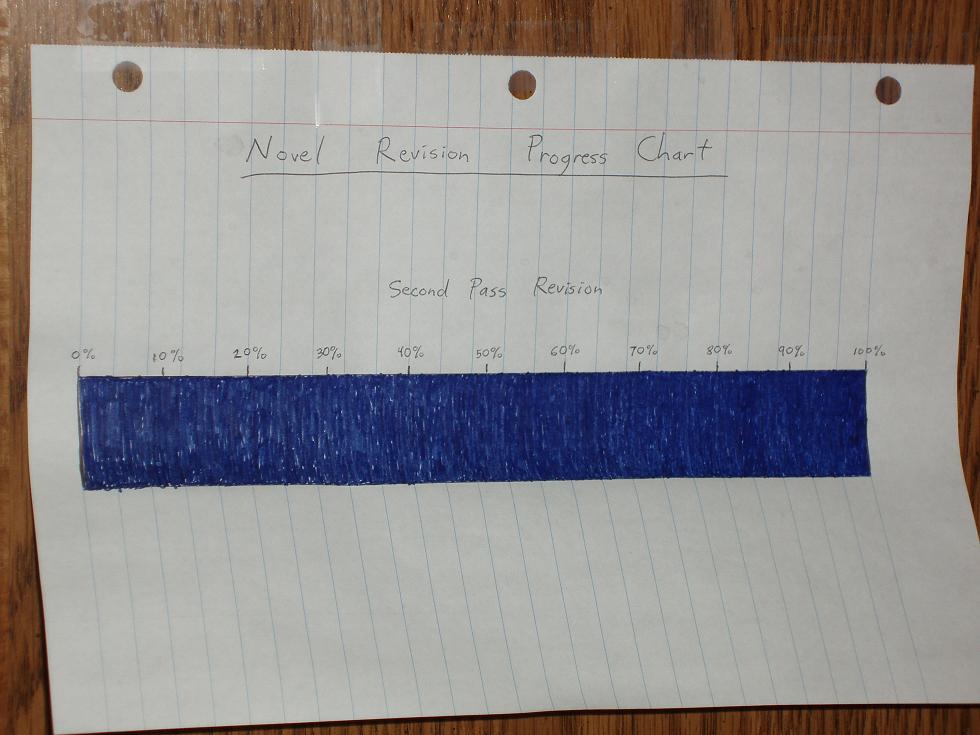
What’s this, Blue Progress Bar? You have something to tell me about my novel-in-progress?

Complete

Blue Progress Bar says: second pass revision for The Counterfeit Emperor is COMPLETE!!!

(Kids, I’m a trained writer and these are special circumstances. Don’t attempt three consecutive exclamation points at home. Somebody might get hurt.)

So, to be clear: although the second pass is complete, I still have a little revision left to do. Some info-dumps I need to break up a bit, some pacing issues to work on, some under-described passages I need to bring to life. However, I do think at this point that most of the heavy lifting – the major character adjustments, the serious plot changes – is done. Which is pretty exciting. Most of what’s left is relatively minor. I’ve promised beta readers I will have this novel ready for them by the end of this month NO MATTER WHAT. (dun dun dun)

Words before revision: 104,646

Words after revision: 111,066

So this new version is about twenty pages longer. Normally you want your manuscript to be shorter after revision, but trust me, I did cut out lots of stuff from this draft. It’s just that even more stuff had to be added.

Books, man. Am I right? Books.

Friday Links

I’m excited. Lots of really great stuff to show you this morning.

It’s hard to get people to click on links. I know; I’m picky about the links I click, too. Your time is valuable, and I completely get that. At the same time, I feel like a little kid hopping up and down because he just found a buttload of pirate treasure and he’s like omg it’s pirate treasure and you’re like man, I’ve got a hair stylist appointment in thirty minutes and I’m all but there’s a gold ruby-studded peg leg over here!!!

Anyway. Here’s what we’ve got:

I totally heart this picture because it captures the entire reason I love books so much, and hence the entire reason I blog.

This guy is drawing a picture of every H.P. Lovecraft monster ever, and he’s really good, too. (Some pictures NSFW.) If you want an example that is safe for work, here’s his amazing rendition of Cthulhu.

A friend sent me this short film called “Validation.” I am a fairly cynical guy, but I found it very touching, especially since so much of the writing and publishing process is tied up in the idea of validation vs. rejection. The film is sixteen minutes long; the whole thing is worth your time, but if you only have a couple of minutes, the beginning alone is good for a click.

Not new, but (most likely) new to you: a great Paris Review interview with Salman Rushdie. He talks about his own ongoing struggles with writing. “Writing’s too hard, it just requires so much of you, and most of the time you feel dumb. I always think you start at the stupid end of the book, and if you’re lucky you finish at the smart end.”

Great article about an author who finally got an agent after months of rejection. Stories like this are everywhere. Skill, luck, and persistence: you need two out of three to get published, and guess which two you control?

Given my recent speculation about Norman Mailer’s scumbaggery, I found this Salon article “When bad people write great books” particularly interesting. Also, it’s just cool that Salon people are taking their article ideas from my blog, which of course is the only possible explanation.

This interactive iPad version of T.S. Eliot’s poem “The Waste Land” sounds totally boss. I’ve read The Waste Land before, but most of it was over my head. A version that explains all his crazy literary references as I’m reading? Yes please. Now all I need is an iPad…

Finally, this isn’t writing-related, but a friend of a friend made this website and it’s too great not to share: Yacht-or-Not.com. It is exactly what you think it is.

That’s all the pirate treasure I have for today. Have a great weekend!

Getting My Sonnet On

Remember that 30 Days of Creativity thing I mentioned a while back? Well, I’m not creating thirty separate things this month, but I thought I’d give it a shot today. Here’s a sonnet. Enjoy.

My love: the way your irises reflect
That proper subset of the EM band
In which my photoprocessors detect
The hue of Hertzsprung-Russell’s top left hand,
Induces palpitations and prevents
Efficient operation of the spleen
And dilates chronological events
Relativistically (at least in mien).
Yet Doppler’s law (which with corundum vies
For hardness, though its luster cannot please)
Commands not only pulsars, but your eyes,
And ipso facto likewise guarantees
That selfsame blue which commandeered my heart
Must surely redshift now as you depart!

Badass Bunnies and Disapproving Ducks

Okay, seriously? Nintendo’s new console is called the Wii U? Did Satoru Iwata put fifty dudes in a room and say “You have to come up with a name even worse than the Wii?” Cause if so, one of those fifty dudes got a freakin’ promotion. To, like, Executive Director of Crappy Names.

I don’t like the name, is what I’m trying to say here.

The actual device looks pretty sweet though.

Right; to business. Yesterday the redoubtable Chuck Wendig discussed 25 things you should know about characters in fiction. It’s an excellent post, worth reading in full, but I’ll direct your attention to number 17:

Nobody Sees Themselves As A Supporting Character
Thus, your supporting characters shouldn’t act like supporting characters. They have full lives in which they are totally invested and where they are the protagonists. They’re not puppets for fiction.

This is something I’ve thought about a lot recently. To explain what I mean, I have to fill you in on my animal situation.

See, when my wife and I bought a new house back in August, our realtor didn’t mention that our yard has some kind of occult power to attract rabbits and ducks. I don’t know what it is, but this property is Rabbit Mecca, the Prime Nexus of Duckitude. It’s a freaking Easter convention out there. You look out a window, you’re going to see one of these two animals. This is the way of our world.

But, ducks and rabbits, not that exciting, right? They hop and/or waddle around, they eat some, you know, herbivore type stuff, and pretty much call it a day. Yeah?

Well, when you’ve been immersed in these creatures’ inner sanctum for months on end, it turns out there is some serious shiznit going down. Rabbits, for instance – they fight. Did you know rabbits fight? They have these crazy one-on-one showdowns where one rabbit will lunge and the other will (I truly don’t know why) just hop straight up in the air as high as its legs will take him. Which, for rabbits, is pretty high. This is the Qui-Gon vs. Maul of the rabbit world.

Ducks don’t fight (at least, not that I’ve observed), but if you really watch them, they’ve got this unbelievable attitude. They walk into your yard, and there’s a very English-gentleman vibe going on in the way they hold their bills up. They’re like, I say, what’s all this then? You haven’t mowed yet this week? Tut-tut, old chap, hardly the standard I should expect. And you’re like, come on, duck, I’ve been busy this week, why you gotta judge me that way? And then you realize you’re defending yourself to a duck.

My point is that if even ducks and rabbits have these feuds and ninja moves and hoity-toityness going on, how much more do the minor characters in books and movies and plays have their own secret worlds and private ambitions? That pizza delivery guy isn’t just a plot device; he took this job because he’s saving up for an engagement ring but he’s not sure if the girl still loves him because she keeps making comments about his uncle and she knows he hates it when she talks about his uncle because he’s actually a really good guy in spite of the drinking and…

Do you need to tell the life story of every little character? Of course not. Give them a sentence or two (or whatever is appropriate for your book) and move on. But a sentence about a Real Person will be richer, more interesting, and far more satisfying for your reader than a sentence about Supporting Character #8.

And hey – it might even change how you think about people in real life, too.

Or at least mallards.

Cover Credit Redux

This is a follow-up to yesterday’s post, “How to Piss Off a Novelist.” As you can guess from the title, I wrote that post because I was mad. Anger can be a good thing, because it means you care about something. But anger also clouds your thinking (do I sound like Yoda now?), and that’s bad. I’m not really satisfied with what I said yesterday, so I want to correct a few things.

First of all, I was talking with someone yesterday about this issue of cover credit, and she brought up a good point. If an author knows up front that she won’t get her name on the cover, and is okay with that, what’s the harm in receiving compensation through money rather than name exposure? It’s her call. For all I know, Lynn Vincent was perfectly happy not getting her name on the cover of Going Rogue, the book she wrote for Sarah Palin. I mean, it still seems kind of crappy to me, but it’s not up to me; it’s a choice each author has to make for themselves.

The bigger issue with cover credit, then, is that if you’re a celebrity, putting your name (and only your name) on a cover implies that you (and only you) wrote it, which isn’t true. To whatever extent you represent yourself as the author of the book, you are being dishonest. Some people look at a celebrity book and assume there was a ghostwriter, but many, many people don’t make that connection. You’re more or less lying to all those people.

The deeper problem, as I said yesterday, is a lack of respect for the writer’s work, a failure to recognize that the service writers provide – turning your hazy notions into a coherent, concrete product – is nontrivial and powerful. Having an idea isn’t writing; it isn’t even almost writing. Only writing is writing.

Something else about yesterday’s post. When talking about Snooki, Kardashians, & co., I did what nearly all intellectual-wannabes do: I got snarky. I threw out a bunch of smug sarcasm, like, look how much better I am than them. This is the same thing English professors do when they talk about Twilight and Harry Potter and even The Lord of the Rings, and frankly, it’s bullshit. Reading more books than somebody else (or reading more “literary” books) doesn’t make you better than them; and even if it did, people are still people, and the world could do with a little more respect.

Hell, didn’t I just say on Thursday that my entire M.O. is to assume I’m way, way better at something than I really am, then keep failing till I succeed? If I had enough money and fame that my dreams actually did turn real on my first try, who’s to say I might not also be tempted to get something published on the strength of my name, rather than my writing? I mean, I hope I’d be better than that, but it’s hard to know.

So, for my attitude yesterday, I apologize.

(I do not apologize, however, for being mad about Snooki claiming she wrote the book herself. Because that is also bullshit.)

All right. New topic tomorrow, I promise!

Second pass revision progress on The Counterfeit Emperor: 95%!!

How to Piss Off a Novelist

The New York Times has a fun article about celebrities and ghostwriters. (“Ghostwriter,” for those who don’t know, means “the person who actually wrote the book.”) Hilary Duff, Nicole Richie, the Kardashians, and Snooki have all had (or are having) novels published.

This alone does not upset me. If they have a story they want to tell, and the money to hire a ghostwriter, why not? Snooki, the article claims, admitted last year that “she had read only two books in her life.” Classic rookie mistake. It’s traditional to read at least three books before one begins writing novels. Clearly the services of a professional are in order.

No, the problem I have is with the contempt they display for the ghostwriter who does the real work of bringing their tenuous vision to life. Quoting again from the article:

When promoting their books in the news media, celebrities tend to say they did all the work. When Ms. Polizzi [Snooki] appeared on “Today” in January, Matt Lauer asked, “Did you really write this book?”

“I did,” Ms. Polizzi said. “Because if you read it, you’ll know the first page that I wrote it. Cause, like, it’s all my language.” (When pressed further, she admitted that there was a co-writer.)

Likewise with Hilary Duff:

Ms. Duff, the pop singer and actress whose novel was published in October by Simon & Schuster Books for Young Readers, said in an interview that she came up with the book’s plot and characters. She said she did not consider crediting her co-writer on the book cover instead of in the acknowledgments. “It is my story,” Ms. Duff said. “It is my book. I wrote it and she helped guide me through the process.

(Emphasis mine.)

What these quotes display is perhaps not so much contempt as ignorance: ignorance of the writing process, of what it actually means to “write a book.” Having an idea for a story, thinking up characters, inventing a plot, none of these are writing a book. Writing a book is the incredibly complex, difficult, time-consuming process of taking all those elements and fusing them into a cohesive whole.

Imagine if somebody said he was an artist. You ask, “Did you really paint that painting?” He answers, “That’s right! I mean, I didn’t actually hold the brush, but, you know, the picture was totally my idea.” How ridiculous does that sound?

There is, of course, a very simple way to thank the person who wrote your book for you: put their name on the cover. (You know, the cover? Where the author’s name goes?)

Looking at the cover of Going Rogue, for example, and judging only by the visual layout, you might by tempted to think Sarah Palin wrote it. The actual author, the much less famous Lynn Vincent, lies buried deep in the Acknowledgements section. By contrast, check out the cover of Heaven is for Real, where the person with the story to tell – Todd Burpo, in this case – is kind enough to let Lynn Vincent’s name appear where it belongs: right there on the front.

Lots of celebrities have this figured out. John McCain credits Mark Salter for Why Courage Matters. Buzz Aldrin credits Ken Abraham for Magnificent Desolation. There are many more examples, but I’m running out of time this morning.

Writing is real work. Give writers real credit.

And with that, I think my ranting is done.

Friday Links

Wow – this is Post #50 already! Time flies when you’re having fun, eh? Any suggestions for Post #100?

Anyway, I’ve got some great stuff for you today, so let’s get started.

First, some advice from the spouse of a writer, on how to Be There for your sweetie when he/she goes through the “Revision Apocalypse.” With fun sketches!

We love lists, right? Here’s a list of the top ten short stories of all time, according to…I don’t know, that blog I guess. I was intrigued to see that I recognized half the authors on the list but had never heard of, much less read, any of the stories. I think that’s an indication of how biased our modern reading culture has become toward novels.

With Big Literary People like Philip Roth proclaiming the death of the novel, I was pleased to find this neat (and accurate) summary of the issue: IsTheBookDead.com

And finally, a hilarious collection of weird stuff customers say in book stores. If you like those, there’s a Part 2 as well. Apparently she’s going to make this a regular feature on her blog.

That’s it, no tengo más. Have a great weekend, everybody!

The Joy of Hubris

When I first read The Lord of the Rings as a kid, I was absolutely spellbound. Gandalf and the balrog! Frodo and Sam! Sauron and the Dark Tower and the Ring and the Mountain of Doom! And the Ents, man – the Ents!

Amidst all that excitement, I thought something else, too: I could do that.

I could write a novel. It’s only words on a page; I totally know how to write words. Besides, Tolkien had left plenty of room for improvement. Boromir? More like Boring-mir. And all those endless pages about Gondor or Rohan or Minas whatever when I was just going Come on, get back to Frodo and Sam, I would totally leave out all that stuff.

Some standup comedian (Seinfeld, maybe?) has a joke about the black box on a plane. It always survives, so why don’t they just make the whole plane out of that stuff? This was basically my feeling about LotR. If Tolkien can write scenes of pure awesomeness (like the Ents attacking Isengard), why doesn’t he just make the whole book like that?

I didn’t attempt my own novel until high school, and it turned out just as bad as you’d expect. Discouraged? Me? No way! For one thing, I didn’t realize right away that it was horrible. That realization was a very gradual process. By the time I did figure it out, I was already on to my next writing project, and that one was going to be totally awesome. I was always just on the brink of awesomeness, perpetually on that final effort that would push my work into something amazing.

By now, of course, the rational side of my brain has figured out my place in the universe; I don’t write as well as Tolkien, and if I ever want to get that good, it’ll take many more years of hard work. But the irrational (read: crazy) side of my brain is still gleefully convinced that this is easy, this is so easy, I’m so smart, I’m so close, I’ve just gotta get there!

I think this insanity is basically a good thing.

See, somebody could have told me early on that I was crazy. (Heck, maybe they did.) Perhaps, when I was young and impressionable, they could even have steered me away from writing entirely, just by making me understand how very difficult it is. But because I was (and still am) caught up in the joy of hubris, I just kept on going, and by now I’ve figured out that I’m never going to stop.

A year ago, I read two books about Zen Buddhism that gave me a great overview of the history, the philosophy, and most importantly, the practice of Zen. I was very curious about meditation, and absolutely fascinated by the concept of enlightenment. And I thought: I could do that.

Blah blah, decades of hard work, apex of spiritual awareness, almost everyone who tries it fails, blah blah blah. My rational brain knew that stuff, but whatever. Sit and stare at a wall for thirty minutes? Man, that’s easy. I am in. I am, like, all over this enlightenment stuff. And you know what? I’m still meditating, still hoping to achieve enlightenment someday. My quest to extinguish the ego is fueled by overwhelming ignorance and pride. I’m sure Siddhartha would have a good laugh over that one.

I guess what I’m trying to say is, if you’re training to run a marathon, maybe you don’t realize right away just how crazy hard it is to run twenty-six miles. And maybe that’s all right.

Okay, Reader: is there anything crazy you’ve been driven to attempt by your own blissful ignorance? Tell me in the comments!