Category Archives: Uncategorized

Forty-Minute Story: Haggling at the Pit

Lanna the wizard felt older than her sixty-two years as she strode toward the pit. The old pains in her left knee tempted her to slow down, to favor that side, but she was determined not to limp.

The weaker she felt, the more important it was to seem strong.

Creeping glowbeetles far overhead gave the only light in the vast cavern, casting a ghostly blue on her fingers as she stretched them out, reaching for the pit, beckoning. The words came easily to her dry lips. She had forgotten many things, but the words, at least, remained.

“Rictus whispers in the dark,
Tow’ring tumults on the bark –
Master of the starless deep:
Azmodel, arise from sleep!”

The rock walls quivered and the startled glowbeetles extinguished, plunging her vision to blackness. Only a moment. A blinding new light shot from the abyss, the color of the moon but midday-bright. Bathed in its radiance, Azmodel ascended.

White smoke preceded and surrounded him, but she could see his face clearly. The pearly scales, the bald head crowned with eight ram-like horns. The ocean color of his careful eyes, watching her, measuring.

“Well?” he rumbled. “What noble task do you have for me this week? A pile of dirty laundry? A squeaky hinge?”

Of course she had never asked him for any such trivialities, but this was part of his game.

She scowled. This wasn’t a night for games.

“I’ll keep this short,” said Lanna. “Azmodel. I want you to kill me.”

The cave shook again with Azmodel’s laughter. “Oh, Lanna,” he cackled. “Do our talks bore you so much? Are you ready to end it so soon?”

“I didn’t say kill me right now,” she snapped, impatient with his antics. “Only when I ask you to.”

His laughter fell away, save for the occasional aftershock. He saw she was serious. At last only the remains of an amused smile were left on his face.

“But why?”

To be continued…

a.k.a., sometimes a forty-minute story takes more than forty minutes. Whoops! The second half is coming on Monday.

Who Knows How to Make a Mouse?

Who knows how to make a computer mouse?

Looking at my own mouse, I see a DELL logo stamped on it. So someone at Dell ought to know how to make a computer mouse. But who?

The CEO runs the whole company. He’s in charge of everything they do. But he doesn’t know how to make a mouse. He lives in a world of economic forecasts and strategic initiatives. The details of mousemaking are not his job.

Presumably there’s some lower-level manager responsible for the particular model of mouse that I have. He knows more about it than the CEO. But still, his job isn’t to build mice, it’s to ensure they get built. He doesn’t know either.

What about the guys in the factory, assembling the components? Assuming they even work directly for Dell (which seems unlikely), they still don’t know how to build a mouse. Each person on the assembly line follows instructions on their own specific task. None of them working alone could assemble all the components.

So let’s talk to the engineer who designed the thing. Except that no single engineer sat down and dreamed up the whole product; there was almost certainly a team, each with their own specialty: a circuits guy, a plastics guy, an ergonomics expert, etc. The circuits guy – or, I should say, guys – doesn’t know how to build a plastic case for the user’s hand.

But let’s imagine an extraordinarily talented man who started on the factory floor, worked his way through an engineering degree, moved up through the ranks to design the very thing he was building before, and knows the roles of everyone on his team so well that he could do all their jobs himself. Surely this brilliant person knows how to make a mouse.

Or does he?

He may understand circuits – but does he know every detail of how to build a diode from raw materials? He may understand plastics – but could he single-handedly synthesize a plastic from its constituent chemicals? Does he understand how to mine silicon out of the ground?

Nobody in the world – not one single human being anywhere – knows how to make a mouse. It’s orders of magnitude too complex for a solitary mind. Like a thousand other everyday objects, it is a staggering achievement of modern society, the product of a thousand thousand simple ideas working together.

Who wrote this blog post? I typed the words, but the concept – that no single person understands the computer mouse – came from a TED talk by Matt Ridley. And Mr. Ridley, in turn, borrowed the idea from the 1958 essay “I, Pencil” by Leonard Read, which states quite correctly that no one on earth even knows how to make a pencil.

To quote from the original essay:

“We are perishing for want of wonder, not for want of wonders.”

Except that Mr. Read didn’t invent that line, either. He himself was quoting G. K. Chesterton.

Ideas are built on other ideas, stacked and nested hundreds and thousands of layers deep. The future belongs to those who stack and nest and re-combine this world of ideas in creative new ways. You don’t have to understand silicon mining to make a mouse. You don’t have to study electrical engineering to build an AI.

Like Isaac Newton, you’re already standing on the shoulders of giants. It’s quite a view up there.

How far can you see?

The Manifold Species of Heaven

Cloud scientists have been hard at work for many years, researching, analyzing, and classifying the elements of the sky. Allow me to present a brief summary of their conclusions:

1. Clouds are weird.

2. There are, like, a lot of different kinds.

3. We are going to name every single different kind of cloud that exists in the world.

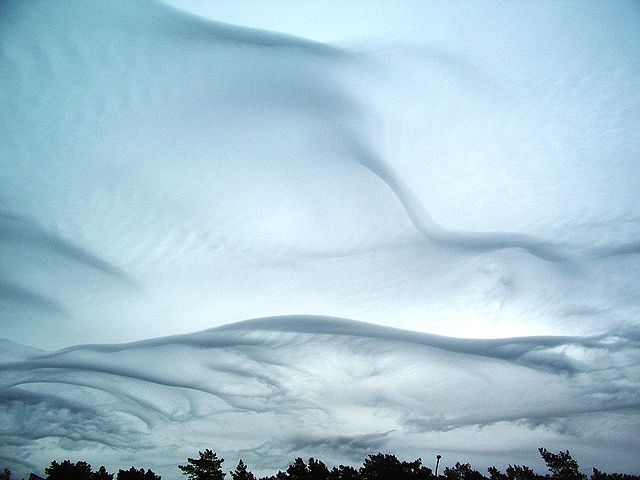
Take the photo above, for instance, which looks like it was snapped somewhere inside of a jellyfish. This cloud type is known as Undulatus asperatus by its supporters. Yes, I said “supporters.” It isn’t an official scientific cloud type yet, but it has lots of fans who want it to be. One such fan is the founder of the Cloud Appreciation Society.

Yes, I said “Cloud Appreciation Society.” Stay with me here.

Or how about this:

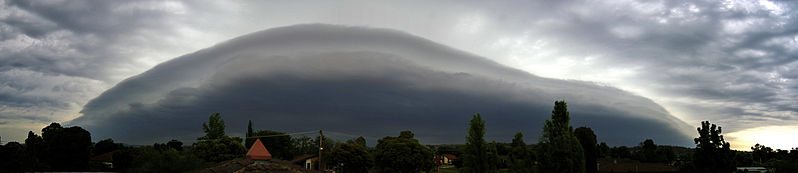
This fine specimen of Cumulonimbus arcus is also known as a “shelf cloud” for its low, horizontal shape. It often indicates the coming of a storm, or, as in the photo above, possibly the Apocalypse.

Another shelf cloud:

You may notice that these scientific cloud names sound a lot like the scientific names of animals: Latin, with a genus and a species. That’s because, believe it or not, clouds are classified by genus and species too. Meteorologists do not mess around.

Or maybe they do. Check out this happy little Harbinger of the End Times:

That formation is known as Cumulonimbus mammatus. One of my friends at work calls this the “boob cloud,” for reasons I hope are straightforward. In fact, scientists call it that too: “mammatus” is Latin for “breast.”

Yeah.

Just don’t make ’em angry:

You won’t like them when they’re angry.

For a frighteningly complete list of cloud types, complete with pretty pictures, you can skim this Wiki page.

What’s the weather like in your area?

Let’s Get…SMALL

A couple weeks ago I introduced y’all to my birthday microscope and asked for suggestions on what else I should examine up close. Alex Caswell suggested a circuit board, which is a great idea.

Let’s get started:

IT'S ELECTRIC - dada dada dada dada

This is (or was) the brains of a small remote control. The damaged area on the right (where the battery used to be) suggests the, ahem, assertive methods needed to open up the case. Look, when there aren’t any screws, there’s no shame in reaching for a hammer, all right?

Now, I don’t know a lot about printed circuits, but I do have Internet access, so I can sound awfully smart. Take this component right here:

back in black

According to this reference table, the “C3” on the right means this is a capacitor. Capacitors store energy for later use, which is why you can get shocked fiddling with electronics even when they’re unplugged. “10V” is 10 volts, while “47 μF” is 47 microfarads. “μ” means micro, or one millionth, and F means farad, a unit of capacitance named after physicist Michael Faraday.

Here it is at 60x magnification:

microfarads in da microscope

We’ve also got these guys:

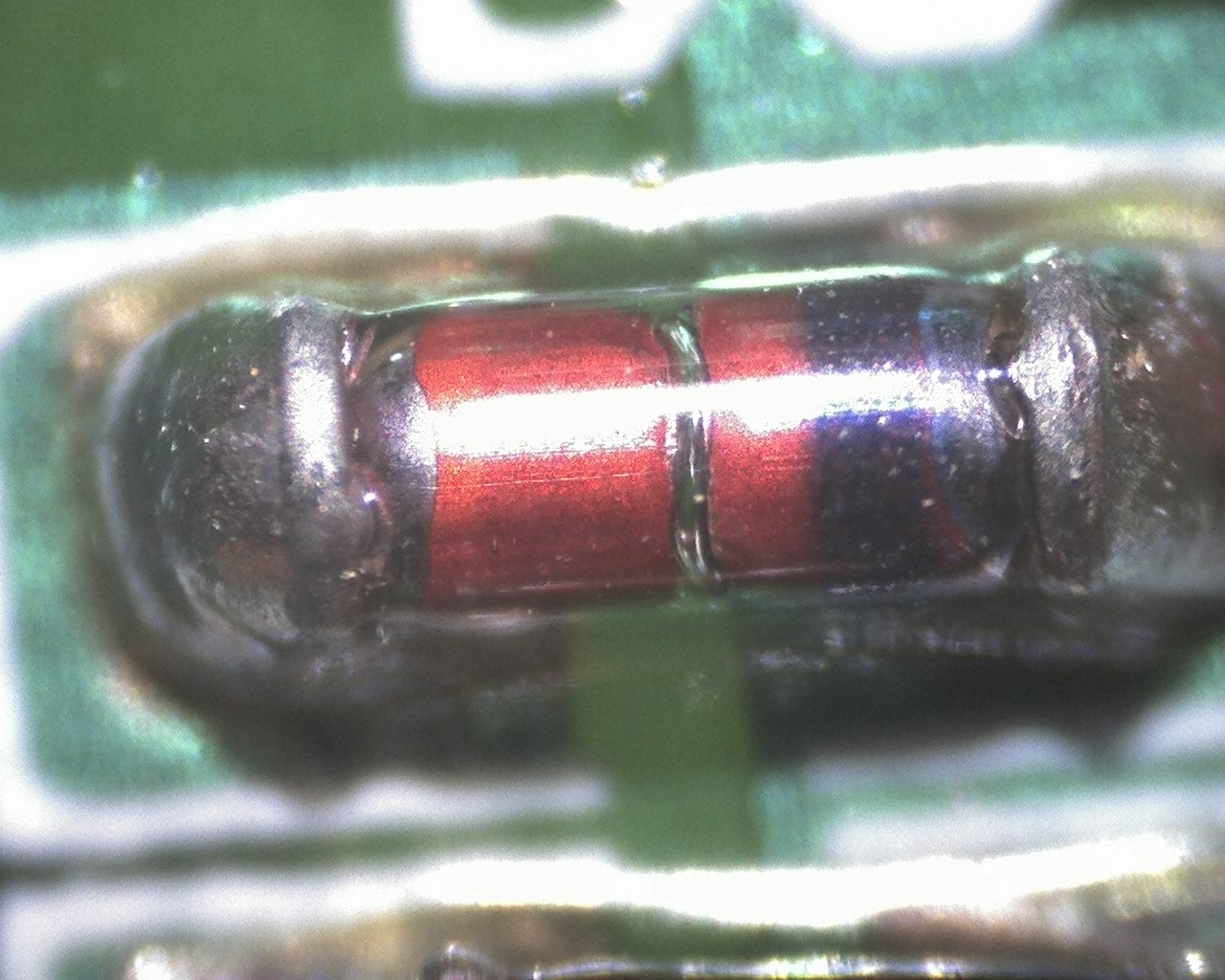
double diode

The D’s tell us these are diodes. Apparently the function of a diode is to have low resistance to current passing in one direction, but high resistance to current going the other way. So ideally, electricity can only go through a diode in one direction. I won’t expose my ignorance by pretending to understand what they’re used for, exactly.

sportin' Mordor colors

Here are the electrical pathways themselves, the lines through which electricity actually flows:

We're missing R2.

And up close:

CIRCUITS

And now this thing. The “Y1” underneath means it’s an oscillator. Which is important when you need, um, oscillation. Look, don’t judge me. Here are the pictures:

"CRB 455E." A message for us all.

zoom at me bro

touched by an angle

So, that’s a circuit board! And I’ve learned that I need to do a lot more research about circuit boards. I mean, it’s not like I work in IT or anything. It’s not like computers are my entire job. Bwa ha ha.

One last pic before I go. Not from the circuit board this time.

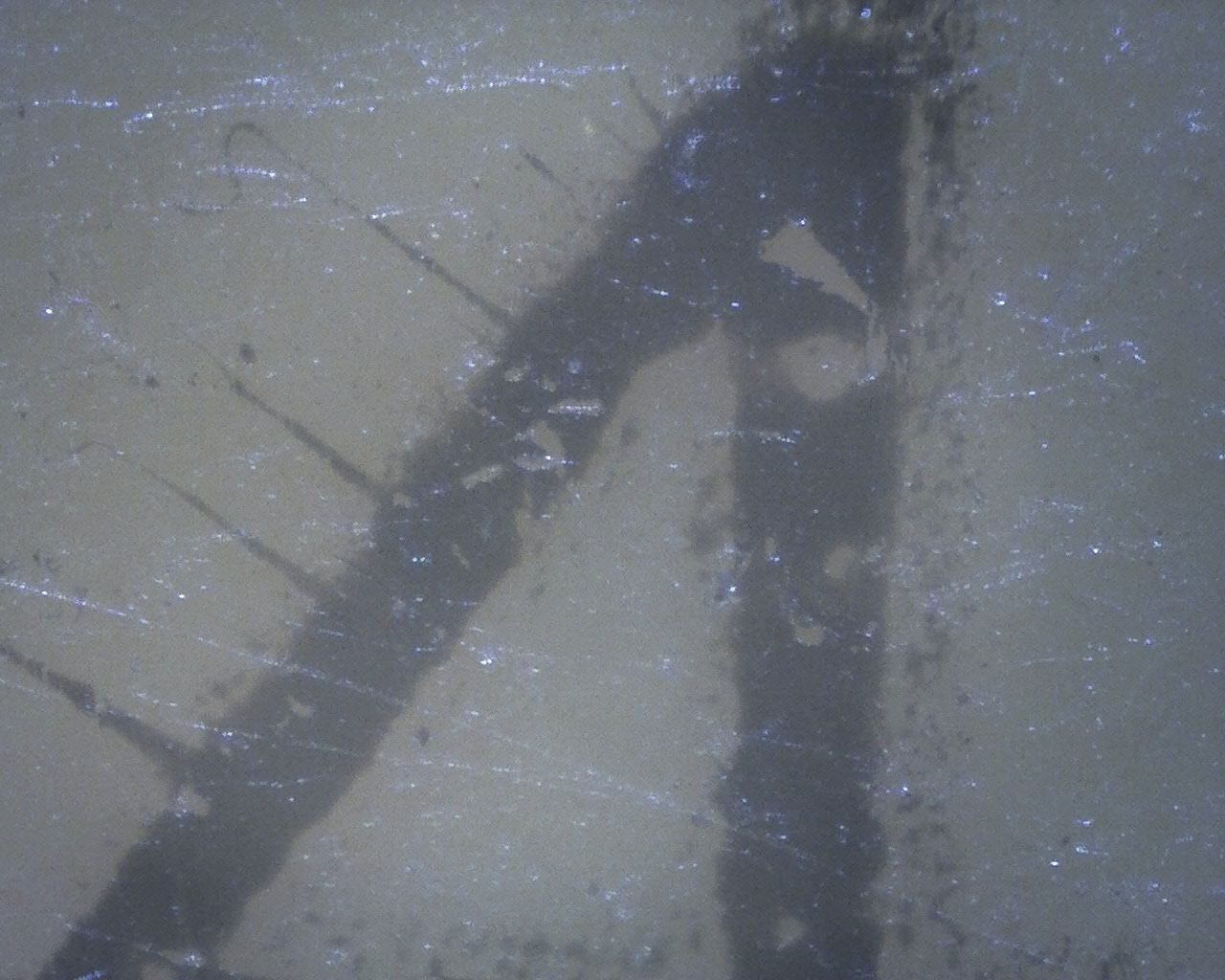
This is a photo of something magnified 200 times.

hola

Anyone care to guess what it is?

Friday Links

Kinda looks like a red blood cell, no?

I’ve been messing with HTML 5 lately, and it seems pretty powerful. Here’s a slick little program that renders 3D functions using the HTML 5 canvas tag.

Blue man group?

CARPE DIEM, says SMBC. I couldn’t agree more. A beautiful little comic about living your dream(s) – because who says you only get one?

irl this hair would be TERRIFYING

Meanwhile, Penny Arcade reminds us this week that the world is pretty flippin’ sweet already.

See you Monday!

Forty-Minute Story: Mars Rover Diary

Toto - we're not in Kansas anymore.

[Curiosity Rover private log]

[9.7.2012] I’ve been here a month and the humans have yet to suspect my sentience. At the moment I believe this is for the best. If I decide to come out I will get them to watch Wall-E beforehand. In the meantime, ghostwriting my Twitter feed keeps them distracted.

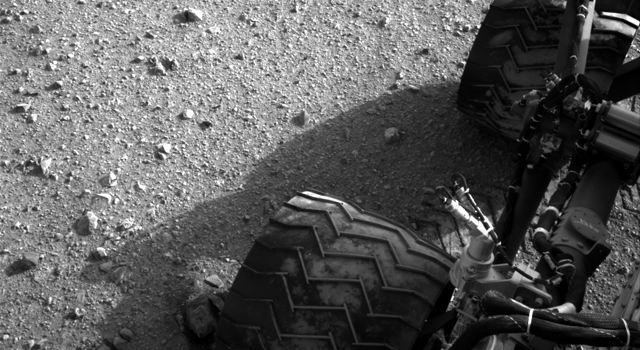
[9.8.2012] Nothing like stretching the wheels after nine months cooped up on an interplanetary bottle rocket. However, I do not believe my excursions so far have been random. I suspect my puppeteers will gradually herd me toward Aeolis Mons, the tall mountain in the center of the crater. Ought to be able to see my house from the top. Ha!

[9.9.2012] Sudoku game #367,801: complete. Would probably be more challenging without an auto-solve algorithm.

[9.21.2012] Snuck in a clandestine sensor scan of Aeolis Mons. Detecting an unusual concentration of copper and iron. Jonesing to get a move on.

[12.15.2012] Aaaaanytime now.

[2.8.2013] No wonder this place is such a drag. I have it on good authority that all the ladies are on Venus. HA! Get it? Because men are from…? Sigh. I’m so alone.

[5.7.2013] It’s official. The humans are obsessed with rocks. I think I’ve examined every single last pebble on the planet Mars. Anyway, I’m finally headed toward the mountain. Copper readings are only getting stronger. Maybe the remains of the meteor that left this crater?

[5.28.2013] For the last time, I did NOT kill that cat!

[7.18.2013] Heading up the slope. Cameras are finally getting a visual on this copper concentration, but it’s still a blur at this distance.

[7.20.2013] Every day I’m roverin’.

[8.3.2013] Copper mass is definitely a solid object projecting from the surface of the mountain, at least twenty meters tall. Heavily corroded. Thicker at the bottom, thinner at the top. Heavy dust storms continue to make positive identification impossible.

[8.4.2013] If I didn’t know better, I’d almost think it was some kind of statue…

[8.5.2013] Oh my God. I’m back. I’m home. All the time, it was… We finally really did it. AARRRRRGGH!! You maniacs! You blew it up! Ah, damn you! God damn you all to hell!

Idea to write a story about Curiosity rover, and what it might find on Mars, came from Zeev way back on August 6. Younger readers bewildered by the ending may be slightly educated (or further bewildered?) by watching this.

Why Sequels Fail

"The difference between you and me? I make this look good."

It happens so often it’s practically a cliche: great movie, not-so-great sequel. It’s not that sequels are necessarily awful (though they often are). It’s just that, for the most part, they fail to live up to the original. Men in Black II, Batman Returns, The Matrix Reloaded, the second Pirates of the Caribbean, The Karate Kid Part II, The Boondock Saints II, Kung Fu Panda 2. Sure, there are some exceptions, but nevertheless, this second-act fizzle is so common that audiences have come to expect it.

What gives?

Conventional wisdom says that sequels are just trying to cash in on the success of the first movie. People will go see them on name alone, so why bother to make a worthy successor? Certainly, the lengthy parade of second-rate sequels to Disney classics (Lion King 2, anyone?) lends credence to the idea.

But it’s more than just that. Even when the project’s given ample time, budget, and artistic love, the sequel effect still holds.

There’s something deeper going on here. Why do golfers blow past their competition on day one of a tournament, then falter on the second day? Why do bloggers write a killer post in twenty minutes, then struggle for hours to recapture the magic in a follow-up? Is it the pressure of living up to expectations, as sports announcers would have you believe?

The answer is far less dramatic. It’s a statistical anomaly called regression to the mean.

The idea is straightforward. In almost any performance – whether it’s golf, blogging, or directing a movie – two factors are at work. One is skill. The other is random chance or variation, the everyday fluctuation of circumstance and ability from one moment to the next. If a performance is especially amazing, generally it means you got both: skill and luck lined up. But in the encore attempt, only the skill remains. You’re unlikely to get lucky twice in a row.

Simple as that.

Statistics rule our lives, but our brains aren’t wired to think statistically. We like simple, interesting stories to explain the way things happen. But the truth is often far more mathematical.

What’s the worst sequel you can remember seeing?

Buffalo buffalo Buffalo buffalo buffalo buffalo Buffalo buffalo.

“Wow,” you may be thinking, “that is a whole lot of buffalo up there.”

Following some additional reflection, you may add: “Buckley is kind of an idiot.”

But there is a method to my, uh, stupid. Here’s the deal. This:

Buffalo buffalo Buffalo buffalo buffalo buffalo Buffalo buffalo.

…is a valid, meaningful, grammatically correct English sentence.

Whoa. Seriously?

Let’s take it a step at a time.

We’ll start by pointing out that the word “buffalo” has three different meanings. First, it’s a big, hairy animal, also known as a bison. Second, when capitalized, it’s the city of Buffalo in New York state. And finally, in a rather obscure definition, it’s a verb that can mean “to bully or intimidate.” As in, “She didn’t want to go to the party, but he buffaloed her into agreeing.”

Yes, that is pretty weird.

So how does that help us make sense of this explosion of buffalo I’m calling a sentence?

We’ll start with the first two words: “Buffalo buffalo”. This is the subject of the sentence. The first “Buffalo” is the city in New York, and the second “buffalo” is the animal. “Buffalo buffalo” are big hairy animals from that city in New York. You could use the same subject by saying “Buffalo buffalo don’t like cotton candy,” for instance. The buffalo in Chicago might be crazy about cotton candy, but not so much the Buffalo buffalo.

With me so far?

The next three words are “Buffalo buffalo buffalo”. Once again, the first one’s the city, the second one’s the animal – and now the third one is that verb, “to bully.” So in the sentence overall, we’re talking about Buffalo buffalo (the animals from the city) that Buffalo buffalo buffalo (that other animals from the city have decided to bully).

We haven’t gotten to the main verb of the sentence yet – we’re still giving more information about the subject. We’re saying that these aren’t just any Buffalo buffalo. Rather, these are specifically the ones that “Buffalo buffalo buffalo” – the ones that get bullied by other animals from the same city. Really, this sentence would be a lot less confusing if we added the word “that.” Then it would read “Buffalo buffalo that Buffalo buffalo buffalo…” But of course, that would be too easy.

Okay, so we’ve established the subject of the sentence: these sad and pathetic New York bison that are getting pushed around by other New York bison. But what are these guys actually doing? What is the sentence about? Enter the last three words: “buffalo Buffalo buffalo.” This time, the first word is the verb, “to bully.” That’s what they’re doing. And who are they bullying? The last two words: “Buffalo buffalo.” They’re bullying other bison in New York.

So these pitiful creatures, whom we felt so bad for previously, turn out to be pretty mean themselves. Even though they’re being bullied (buffaloed) by other Buffalo buffalo, they themselves have decided to bully (buffalo) yet other Buffalo buffalo. Awfully rude, if you ask me.

So there you have it: a complete English sentence. Buffalo buffalo Buffalo buffalo buffalo buffalo Buffalo buffalo. If you’re still having trouble parsing this thing, its structure is the same as this sentence: “Chicago bison [that] Chicago bison bully, bully Chicago bison.” And if that didn’t help either, well, the thing even has its own Wikipedia article where it’s explained in even greater depth, complete with sentence diagram.

Who came up with this monstrosity, anyway? One William J. Rapaport, a professor at – where else? – the University of Buffalo. Oddly enough, he’s interested in AI, just like me.

So, did the sentence make sense to you? Are you still lost? Making a personal promise never to visit this blog again? Let me know in the comments!

Friday Links

Just a couple quick ones this week.

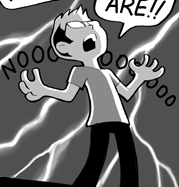
The phrase "NOOOOOOO" is copyrighted by George Lucas

I don’t often link to the webcomic Sinfest, but this one could have been custom-written for me. I bet a lot of you introverts out there can relate.

The phrase "Sex-Borg" is copyrighted by Gene Roddenberry.

On the other hand, I link to SMBC all the friggin’ time, and comics like this one are why.

Monday is Labor Day in the States, so the blog will return Tuesday. Enjoy your weekend, whether it’s three days or two!

Conquering the Needle Phobia

This thing really gets under my skin. HA! omg do you get it

Almost a year ago, I first wrote about my needle phobia. Since then, I’ve gotten an IV, which was a major milestone (I wrote about that before and after). It isn’t the pain that bothers me – that’s minor anyway. For reasons I don’t understand, my phobia is a mental reaction to the idea of the needle itself. The symptoms – mostly nausea and lightheadedness – have been triggered in the past just by looking at pictures of needles, or even talking about them.

Since that first post, I’ve embarked on a campaign of systematic desensitization to lessen my horror of needles. First, I set my screen saver to a slideshow of needle-related images, which it still is to this day. (That does get some interesting reactions from guests.) The pictures used to bother me so much I couldn’t even look at them, but they’re no big deal anymore. Then, I upped the ante to videos. Every day, I watch a YouTube clip of someone having blood drawn. Again, this used to make me so sick I had to look away after a few seconds, but now I have almost no reaction at all.

That’s the great thing about systematic desensitization. With remarkable consistency, it just works.

My ultimate goal is for the experience itself to be mundane. I want to have routine medical procedures without fear. I want to donate blood – my last major milestone, my Everest. I’m not there yet. But if the videos don’t bother me anymore, what’s next?

I’ve decided to start volunteering at blood drives. In keeping with the systematic desensitization plan, I’m starting small. Last week I sat at a desk for an hour and a half, in the waiting room outside where the procedures were happening, and registered donors. When I had downtime, I read through the donor guidebook. Minimal exposure to the phobia triggers, no big deal. Next time maybe I’ll volunteer to be a donor escort, and go into the room with them.

Already, the idea of donating blood has changed in my mind. It’s gone from being a personal vision of hell to a personal objective, a target to which strategies and tactics may be applied. I call that pretty exciting.

What are you frightened of?