When You Stop Blogging

No, I’m not quitting this blog. Far from it. But I’ve had two other blogs in the past – one that was fairly popular, one not so much – so I have a little experience.

There are two ways to stop blogging: planned and unplanned. Unplanned means you just stop, without any kind of announcement to your readers. You write an ordinary post, and it turns out to be your last because, well, you never hit “Post” again. In this case, the blog generally dies at the end of a gradual drying-up period, and the last post begins something like: “Gee, it sure has been a long time since I posted anything!”

But a planned stop means you write a “This is the End of the Blog” post. You talk about why you’re quitting and how long you’ve been thinking about quitting. You talk about the good times and the bad times. You thank your readers. And you say goodbye.

I’ve seen this end-of-blog post countless times. I’ve written it twice.

And when you announce the end of your blog, something interesting happens. People you’ve never heard of, people who have stayed silent for months or even years, suddenly leave comments. And the comments look like this:

“Wow, you’re quitting? I’m so sad! I read your blog every day. I loved it. I’ll really miss this part of my daily routine!”

It’s ironic. Many times, writers quit blogging because they think nobody’s reading, or nobody cares. They don’t find out how much people cared until it’s over.

Why am I telling you this?

It’s not a guilt trip for people who don’t comment. While I love reading the comments I get, I don’t want my readers to feel obligated. Life is short, and we have enough real obligations without adding fake ones to the list.

Nor am I saying you should never quit a blog. Sometimes it’s the right decision. In my case, it was the right decision both times. Do what’s best for you.

I’m telling you this so you understand the nature of blogging – and, more broadly, of any art you put out into the world.

Here it is. Your audience is bigger than you realize, and cares more than you expect.

We sometimes think of art as being like a picture gallery where we put up our work; people buy their tickets, take a look at it, and leave. But publishing art – especially on the Internet – is more like scattering seeds on the wind. Our creations fly to far places, all over the world. They take root in hidden crevices. They sprout flowers we never see.

Art is a long, long game. Sometimes it takes years before we see the returns. But they’re there, invisible, working their way to the surface. Be patient. Your art is growing.

Now if you’ll excuse me, I’m going to step out of this fortune cookie and drive to the office.

Have you ever been surprised by an unexpected audience that your work found for itself?

What is a Table?

Many artificial intelligence researchers like the idea of an AI based on precise data and clean logic. They want to give their AI a massive database of facts, then come up with a system of rules to let it draw conclusions from those facts.

Lions are mammals. Australia is the smallest continent. Andrew Jackson was the seventh President of the United States. A table is a type of furniture. All very neat, very orderly.

Super. But here’s a question: what’s a table?

No, I’m serious. What is a table? Can you give me a precise definition?

Let’s try. “A table is something with four legs that you put things on top of.”

Except, as John Scalzi has so effectively demonstrated, it’s possible to put bacon on a cat. The cat is not a table.

Okay, maybe the dictionary can help. According to dictionary.com, a table is “an article of furniture consisting of a flat, slablike top supported on one or more legs or other supports.”

Ah. So, something like this:

I am the worst table EVER.

No, that’s not right either. We should clarify a little more. “A table is an article of furniture consisting of a flat, slablike top supported on one or more legs or other supports, which supports nonhuman objects.”

I see. So if I buy a table and don’t put anything on it, then it’s not a table? I think we can agree that nobody looks at an empty table and says, “Hmm, I wonder what I should call that.”

People might even disagree on whether a particular object is a table, if it’s sufficiently weird-looking. Who’s right? How does that fit into our formal definition?

To complicate things even further, we can talk about a table of contents. Well, you say, that’s a totally different type of thing, we’d need a separate definition for that. Okay, then, what about the Periodic Table of Elements? Is that a totally different type of thing from the table of contents? Is it exactly the same? Maybe it’s kinda-sorta the same…so how do we formalize that?

We want to build a whole worldview based on facts, and we don’t even know what a table is.

The simple truth is that words don’t have precise definitions. They’re fuzzy. We look at something, and we just know if it’s a table, without consulting any formal definition. Our minds work with ostensive definition, which is “definition by pointing.” (What is a table? Well, it’s that.) How we’re actually able to do this is a very good question, one that I don’t have time to explore right now. But we do.

Here’s the point. Despite the best efforts of science and language, the world is not a neat, well-ordered place. It cannot be corralled into a neat, well-ordered box. Any AI worth the name will have to deal with fuzzy, imprecise, illogical concepts. There’s just no way around it.

In fact, this is a major ongoing debate in the AI community: the Neats vs. the Scruffies, the precise logical solution vs. the fuzzy uncertain solution. To me, it’s no contest. I fall 100% in the Scruffies camp. Honestly, it seems so clear that I don’t even know how it’s a question.

But then, I’m only 26 years old. I still have a lot to learn.

What do you think? You don’t have to be a computer scientist to weigh in. I’m just curious about your opinion.

On Victory

Thursday morning I wrote about a particularly fun combination: an intense needle phobia, and a procedure involving an IV scheduled for 7:30 that night.

So yeah, how did that go down?

The morning wasn’t so bad. Work was busy, so a steady barrage of phone calls and e-mails kept my mind off it. Mostly.

Afternoon was worse. I wavered on my commitment to get it done, and had to talk myself out of canceling for the second time that day. I couldn’t concentrate on what I was doing. The IV was a suffocating cloud, poisoning every thought, making it hard to breathe. I left work early, around 2:00, saying (with perfect honesty) that I felt nauseous and needed to lie down.

Things got better after that. I fired up TED.com and watched a few videos, including the ones I linked to on Friday. These were interesting, funny, and genuinely inspiring. They helped dispel the cloud.

Around 6:30 I practiced karate for ten minutes, which helped even more. (I continue to be amazed at the dramatic effect of physical exercise on my mood.) After that I did Zen meditation in the basement for another ten minutes, and managed to concentrate remarkably well, all things considered.

And then it was time.

I drove to the hospital, checked in with the receptionist, waited in the waiting room. I distracted myself by reading a magazine and walking around. After another ten minutes, the nurse came and got me.

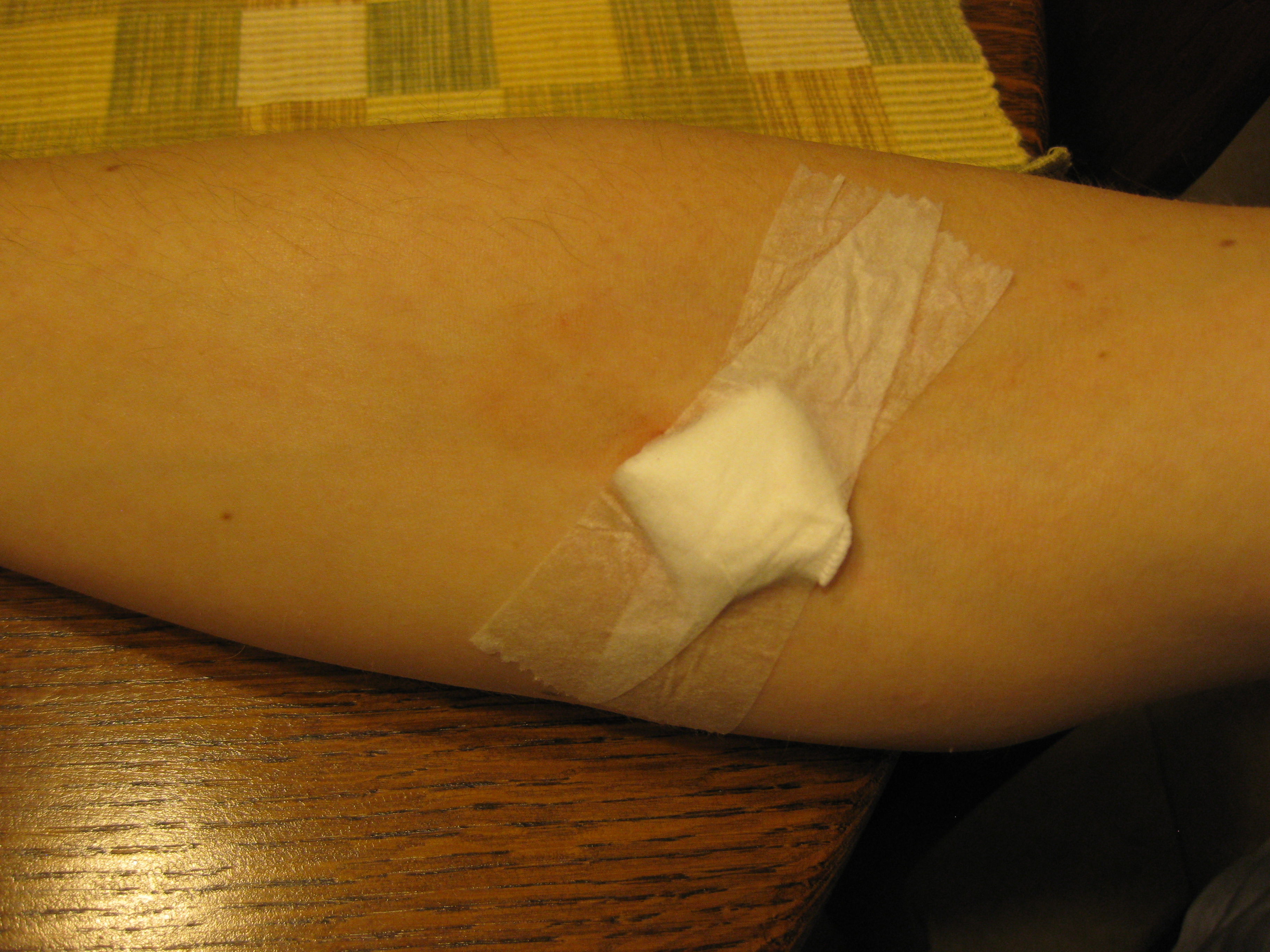
I had a plan, and I followed it. I told her about my phobia; she was very kind and understanding through the whole procedure. I tried to sound cheerful (fake it till you make it!) and I think I succeeded. I lay down on the bed and carefully avoided looking at the needle as it went into my right arm. And for the next ten minutes, as the needle stayed in, I hummed Canon in D out loud, in one fast, continuous loop, focusing on nothing else. If my concentration ever wavered, I started to feel sick again, but I didn’t let that happen very often.

It worked.

I never got any more nauseous during the procedure than I had earlier in the day. I never got spots across my vision, as I have during other procedures. And for whatever reason, I barely even felt the liquid dye going into my arm.

And then it was over.

Demonstrating my right to bare arms.

I walked around the parking lot, giving myself a few minutes to make sure I wasn’t going to black out before I got in the car. I was ecstatic. I literally laughed out loud. I felt like, if I could do this, I could do anything. Victory.

It’s remarkable how fast that feeling wears off.

Looking back now, less than four days later, already the victory feels inevitable, unremarkable. I was fine, it was no big deal. Life goes on. It’s so easy to think this way.

But Thursday morning I was terrified, and I did it anyway. And I’m pretty damn proud of that.

The whole experience also gave me a very strong incentive to start up again with the phobia desensitization. I’ve moved on from photos, and now, every day, I’m watching actual videos of people giving blood. It’s hard, but it’s getting easier. I’m going to beat this thing.

Anyway – life does go on. How was your weekend?

Friday Links

It’s a geeky Friday, people. If any of you mainstream types are reading this blog (though that’s hard to imagine), this may not be your day.

First up, this is the coolest website I’ve found in quite a while: TED.com, a collection of fascinating video lectures on a vast array of topics. I’ve watched 3D printers build human organs and mini-copter robots flying in eerie formation. The best one I’ve seen so far is this neuroscientist’s detailed account of her own stroke and the transcendent, Zen-like awe that comes from losing your sense of self.

I’ve also started listening to The Writer’s Almanac online. It’s a daily five-minute NPR segment, but the radio version plays during the work day, so I don’t get to hear it while I’m driving. Let Garrison Keillor’s soothing voice inform you about the history of the writing world, then read you a poem. It’s like after-dinner mints for your brain.

For the Trekkies: here’s Brent Spiner, the actor who played Data, doing a dead-on impersonation of Patrick Stewart (Picard). Epic.

For Zelda fans (Zeldies?): possibly the most intense marimba-based rendition of the Zelda theme song you’ll ever hear. I know, right?

That’s all for this week. A big storm’s rumbling outside, and it’s Friday. How could you ask for anything better?

Have a phenomenal weekend.

On Terror

A few months ago, I wrote about my needle phobia. The first time I ever had blood drawn, the psychological reaction was so intense that my eyesight literally blacked out for a few minutes. For no good reason at all, needles terrify me.

At 7:30 tonight, for the first time in my life, I will be getting an IV.

The procedure itself is nothing to worry about. It’s not even surgery or anything like that. Just a test they need to perform.

But the needle. In my arm. For how long? Three minutes? Five? Ten?

Yesterday I was feeling pretty zen about all this. After all, I’ve come a long way since that first blackout. I’ve had blood drawn several more times with only minor reactions. And I’ve been desensitizing myself to needles, trying to beat the phobia. I’ve had a screensaver running on my PC with photos of people getting injections, giving blood. The pictures don’t even bother me anymore.

I was planning to work my way up to watching videos, but never got around to it. Still, I should be fine, right? Zen, man.

Last night I had a vivid dream that a doctor gave me two injections. I could feel the needle going in both times. That alone was almost unbearable. In the dream, I decided that if injections were this bad, there was no way I could get an IV. I would cancel the procedure.

Then I woke up.

Sitting in the bathroom at 5:30 this morning, over the course of about five minutes, I talked myself back into doing it again.

As I write this, I am physically sick. I have a lump in my throat. I literally feel a cold spot on my arm at the place I imagine they will put the needle.

But for all that, I still have a lot of things going for me.

  • I’ve made up my mind. Resolution is hard, but indecision is agony. Knowing that I won’t back out gives me purpose and strength.
  • I’ve beaten terror before. I’ve been skydiving, which I chose to do solely because it was the scariest thing I had ever done. This is not my first rodeo.
  • I have a plan. Explain my situation to the nurse, don’t look at the needle, deep breaths, hum Canon in D, keep it zen. Plans are a good thing.
  • I’m Brian fucking Buckley. I have a black belt in karate. I’ve written three novels. I’ve jumped out of a plane. I got a 35 on my ACT. I’ve been to the National Spelling Bee twice, and I don’t give a damn how ridiculous that sounds. Fuck needles. I’m doing this.

Besides, I know too many courageous people to back out now. My wife had an awful experience her first time giving blood, but she went and did it again. I have another friend who’s given blood many times despite a phobia of her own. Another of my friends has been to Afghanistan, and not for the souvenirs. I live in a nation built on the bravery of men and women who faced fears a lot bigger than five-minute medical tests.

Not to mention, I can shamelessly milk the drama on the blog.

Out of the night that covers me
Black as the pit from pole to pole
I thank whatever gods may be
For my unconquerable soul.

On Monday I’ll let you know how it went. Carpe diem.

What’s the scariest thing you’ve ever done?

How to be an Oneironaut

Sir! There is NO sighing here! I will have to ask you to leave!

The night before last, I had the craziest dream. I was in a dark room with a pocket full of coins. If I took out a coin and rubbed it with my thumb in a clockwise motion, it would make a little gear-like noise, and then light up. I’d throw the coins into the room so I could see. The catch was that the coins only stayed lit for so long – quarters for fifteen seconds or so, dimes a little less, pennies only a couple seconds. So I had to keep rubbing and tossing coins to see my way through this room.

Bizarre. But then, nobody ever says, “Hey, I had the most ordinary and straightforward dream last night.”

What if you could control that strangeness? What if you knew you were dreaming, and could do whatever you wanted, safe in the knowledge that you could always wake up? What if you could become an oneironaut – an explorer of the dream world?

It’s possible. Difficult, but possible. Several years ago, I spent a few months pursuing this path, and I did have some success.

The state of being aware that you’re dreaming is called lucid dreaming. It’s pretty hard for most people to reach this state, but it gets much easier with practice, and with the right technique. And once you’re lucid, the only limits are what you can imagine.

How to have a lucid dream:

1. Learn how to tell when you’re dreaming. This one’s easy. There’s a simple test. Look at some text – words on a page, a sign, whatever – and remember what it says. Look away for about three seconds, and then look back. If the text is the same as before, then you’re awake. The dreaming brain doesn’t do well with precise, rational details like that. It’s important, though, that you actually wait the three seconds before looking back. Do it too fast, and the text will be stored in sensory memory, sidestepping the test.

2. Get in the habit of reality-testing regularly. In order to know when you’re dreaming, you have to start doing the reality test while you’re awake. That way you’ll get in the habit, and sooner or later you’ll naturally try it while you’re dreaming. Once you fail the test, you’ll realize you’re dreaming, and by definition, you’re in a lucid dream.

3. Keep a dream journal. A lot of people say they don’t dream, or rarely dream, but the truth is they just don’t remember their dreams. And if you don’t remember your dreams, how will you know if you’ve had a lucid one? The solution is to keep a dream journal. Anytime you wake up – first thing in the morning, or even during the night – deliberately ask yourself whether you’ve had a dream, and what it was. Then write it down, because no matter how firm the memory seems, it almost always fades in minutes or hours. With practice, this gets much easier, and you’ll often find yourself recording two or three dreams per night.

Essentially, that’s it. Using just the techniques above, I’ve managed to have several lucid, controllable dreams. Tough, but totally worth it.

There are other techniques too, including a method for directly entering a lucid dream by staying conscious through the whole process of falling asleep. (No, I’m not kidding.) Google “lucid dreaming” and you’ll get plenty of useful hits.

What are your dreams like?

6:00 Work Call = No Post

I was going to do a post on lucid dreaming this morning, but I got a call from work at 6:00 and I have to go in.

I’ll be back tomorrow. In the meantime, you may enjoy this.

And Your Chains Shall Set You Free

6 AM on a Monday morning! Woo! Another week! Let’s do it!

(I am not actually that chipper. For some reason, blogging makes me want to type things like this. Probably a sign of dementia.)

Anyway.

I’ve been thinking this morning about creative freedom. One of the great things about art is that it’s totally unbounded. The scenes you paint, the poems you write, are limited only by your imagination. Freedom’s a good thing, right?

Yeah, it is. Mostly.

But I’m struck by the way many artists actually produce better work when you take away that unbounded universe, when you box them into a creative corner.

Just look at the first Star Trek movie, Star Trek: The Motion Picture. Or rather, don’t, because it pretty much sucks. The creators had a massive $46 million budget to work with, and they poured it into elaborate special effects, ending up with long, boring sequences of the Enterprise flying through one bizarre background after another, while the plot suffocates.

Burned by the failure, executives only allowed an $11 million budget for the second film. And guess what? Star Trek II: The Wrath of Khan was a much better movie for it, with a focus on what really mattered: strong characters and a good story.

Of course, small-budget movies can still be bad, just as big-budget movies can be fantastic. But it seems to me that creative restrictions, far from stifling the artistic spirit, can actually sharpen it, give it focus.

I see it myself when I write sonnets. The sonnet is a fairly demanding form: fourteen lines, iambic pentameter, set rhyme schemes, a change in tone after the eighth line. Yet all these seemingly harsh and arbitrary rules work to the poet’s advantage. The fourteen-line limit forces you to pack in meaning, making every line count. Rhyme and meter make you reach out to interesting, unusual words you wouldn’t otherwise try. And the eighth-line volta ensures you don’t get complacent, asking that you tackle your subject from at least two different angles.

Shakespeare wrote all his plays in iambic pentameter, and you don’t hear him complaining. Probably because he’s dead, but still.

Time is another great motivator. Having just forty minutes each morning to write a post means I can’t indulge my inner perfectionist too much. I can’t toy with ideas forever, searching for just the right words. I have to hit Publish. And when I do, I often find that the most successful posts are the ones that seemed least “perfect” at the time.

Death, of course, is the ultimate deadline. Believe me, I’d take immortality pills if they sold them at Kroger. But I think the world gets much better art without them.

Just ask Shakespeare.

What do you think? Do you produce better work under a deadline, or other restrictions? Or are you blue sky all the way?

(Originally I wrote “Do you produce better wok…” Most delicious typo ever.)

Friday Links

So much fantastic stuff to share with you this week! Hold on tight, I’ve only got twenty minutes to type it all up.

Here’s a stunning photo of a praying mantis (or some similar-looking insect) with early-morning dew on its compound eyes.

A 3-D, interactive panorama of the Sistine Chapel. Beautiful.

A slow-motion video of an owl swooping in for the kill. The last few seconds, with the claws opening, are especially cool.

Did you know the Gettysburg Address was only ten sentences long? If you’ve never read it before, why not read it now? It isn’t often you can finish one of the great historical texts in a couple of minutes.

Speaking of Abraham Lincoln, check out this glorious bad-hair photo. I love how his expression says, “Take my picture, I don’t give a shit!” (Paraphrasing – naturally.)

The difference between you and me? I make this look *good.*

Also – did you know that Miguel de Cervantes (author of Don Quixote) died on the same day as William Shakespeare – but in a different calendar? Cervantes died on April 23, 1616, in the Gregorian calendar – the one we use today. Shakespeare died on April 23, 1616, in the Julian calendar, used in England at the time. Same date, ten days apart.

ALSO also, for you Trekkies out there, did you know Deanna Troi’s eyes were completely black? How did I not realize this until yesterday?!

WordPressers – we now have country stats for our visitors! There’s a link on the “Site Stats” page for the moment, though apparently it’ll be moving to the main page soon. TIL that I have a reader in Sri Lanka.

Finally, the usual webcomic roundup. SMBC nails it. xkcd nails it twice.

Have a stellar weekend. See you Monday!

Out of the Night that Covers Me

Short on time this morning, so no regular post. Instead, here’s Morgan Freeman reading the poem “Invictus,” from the movie of the same name. (The title is Latin for “unconquered.”) Enjoy!

(Update: I guess they’ve disabled video embedding for some reason, so you’ll have to click the link.)

Invictus
William Ernest Henley, 1875

Out of the night that covers me,
Black as the pit from pole to pole,
I thank whatever gods may be
For my unconquerable soul.

In the fell clutch of circumstance
I have not winced nor cried aloud.
Under the bludgeonings of chance
My head is bloody, but unbowed.

Beyond this place of wrath and tears
Looms but the Horror of the shade,
And yet the menace of the years
Finds and shall find me unafraid.

It matters not how strait the gate,
How charged with punishments the scroll,
I am the master of my fate:
I am the captain of my soul.