Tag Archives: Fiction

Story: The Adventure of the Lying Detective

I have often said that nothing brings me greater pleasure than watching the deductive powers of my friend Sherlock Holmes in action; but in all the years I have known this incredible gentleman, none of his cases ever caused me greater astonishment, or wonder at his intellectual capacity, than the one I am about to recount.

I recall the incident very well. It was a winter evening in 1889, and stirring in my soul I felt the curious mix of ennui and masochism which invariably leads me to seek out Holmes’s company. Mrs. Watson beseeched me not to go, employing various arguments and womanly enticements that I should stay, but my affections for her had always been minimal. Therefore while she was out one day shopping for herbs and remedies to make her face less hideously pale, I took up my coat and hat and went out to visit my companion.

I found him reclining in his favorite chair, examining some scrap of paper, and he looked up with a modicum of interest as I entered his flat. “Werstmann, dear fellow!”

“It’s ‘Watson.’”

“Whatever. I have been expecting your arrival. Do come in.”

“Expecting me? But how?”

“Simplicity itself. I deduced it, of course, by the sound of your footsteps as you approached.”

“But how could you know it was me?”

“By your smell,” said Holmes. “But never mind that, Watson. Your timing is convenient. I have major news to reveal, for which you will be the perfect audience.”

I could see at once that he was in one of his rare lucid moments that occasionally came between his month-long experiments with cocaine. I took a seat by my friend and endeavored to listen as best I could.

“Well, what is your news?” said I.

“My parents have been murdered,” said he.

“Murdered!” said I. “But how awful! You have my deepest sympathies, dear chap.”

“Nothing of the sort,” said Holmes. “You are being quite absurd, Watson, as usual. You know I am utterly without sympathy for any human being (excepting myself), and naturally I am glad of a chance to practice my detective skills. Hence I am elated at my mother and father’s demise.”

“Of course it seems obvious, when you explain it. But who can the murderer be?”

“Who, indeed?”

A long silence followed.

“I don’t know,” said I.

“Nor should you,” said he, “as I have not yet explained. But for once I will dispense with my habitual flourishes and reveal the criminal’s identity at the outset. The murderer is none other than you, my dear Watson.”

“What!” I cried, for on the face of things, I confess it seemed quite impossible. Such was my naïveté.

“Yes, indeed!” said Holmes, smiling in amusement at my obvious surprise. “Only two days ago I travelled to Southampton to pay them a visit, and discovered them hanging by the neck from a couple of nooses in the drawing-room. You, Watson, forced their heads through the nooses and left them to die. Rather more heartless than I have come to expect from you, I daresay.” His mirth getting the better of him, he chuckled briefly. Amusement was his second-favorite emotion, I recall, just after hubris, and just before annoyance.

“But how have you deduced that I am the culprit?”

He passed me the scrap of paper he had been examining. “Tell me what conclusions your limited faculties can draw from this evidence.”

I looked it over carefully. It was a single sheet of notebook paper. On it, in black ink, was written the following:

Sherlock,

We heard you were coming for another visit. We simply cannot abide you: your arrogance, your veiled insults, your non-veiled insults, your insufferable flatulence. As our decision to disown you and our endless entreaties to stop visiting have evidently made no impression on you, we are left with no other alternative than suicide. We can only hope that our deaths will serve as a warning to that impressionable young doctor whose name you can never remember, to cease his association with you forever.

Your former parents,

Ackerly and Elvina Holmes

“Suicide? But you said – “

“Watson,” said Holmes impatiently, “I already deduced that that side of the note is of no consequence. Can you not see I have crossed it out? Turn the paper over and look at the murderer’s note.”

I, Dr. John H. Watson, have killed the parents of Sherlock Holmes.

“But Holmes,” said I, “this is your own handwriting!”

“Not at all! Here, I will show you a sample of my own handwriting, and you shall see it looks nothing like this note.”

“But what do you mean? This is the London Times.”

“No, Watson, I have copied the London Times in my own handwriting to show you what it looks like. The fact that my handwriting looks exactly like the Times typography is only a testament to how amazing I am.”

“I see,” said I. “I must confess I never noticed it before, but your evidence admits of no other interpretation.”

“Quite,” said he. “And there is other evidence as well. There are calluses on your hands from handling the rope you used to make the nooses.”

“Actually, I have worked hard throughout my life, so it is not unnatural that I – “

“Watson,” Holmes interrupted, “when you have eliminated the impossible, whatever remains, however improbable, must be the solution.”

Holmes said this often, and it was as relevant then as ever.

“There is only one problem with all this,” said I. “I have an alibi, you see. I have been in London for the past week. Here, this is a picture of myself standing in front of Westminster Abbey, holding a newspaper that is clearly dated – “

Holmes seized the photograph and tossed it into the fire.

“What the devil did you do that for!”

“Do what?”

“Throw my picture in the fire!”

“Watson, I did nothing of the kind. But it should be no surprise that your memory is flawed, as you cannot remember murdering my parents either.”

“But I can still see it burning in the fire.”

Holmes seized a poker and stabbed at the photograph until it was quite indistinguishable from the rest of the ash. “And now?”

“I admit that I can no longer see the photograph, or provide any evidence that it existed.”

“Naturally,” said Holmes.

“Your argument is quite convincing. I would never have suspected myself of the murder, but then, I suppose that is what makes it such a perfect crime – a crime so perfect that only your exquisite mind could have yielded the solution! But tell me, what was my motivation?”

Holmes rolled his eyes. “Stupidity. Now, if you will excuse me, I must of course call the police to have you arrested. I hope you will not object, dear fellow?”

“Not at all,” said I. “Will you be posting bail for me?”

“No.”

“Quite all right. I shall give a full account of my wrongdoings. How very remarkable that you have uncovered it all! But tell me, Holmes, when they put me in prison, who shall remain to validate your impossibly inflated ego?”

“Nonsense,” said he, but I could tell I had upset him; and as the constables dragged me away, I almost fancied that I heard, coming from the direction of his door, the sound of inconsolable tears. And indeed, it was not long before he broke me out of prison and I was free once more, a testament to his abiding friendship.

[I wrote this three years ago for a friend, after I had finished reading a bunch of Sherlock Holmes stories.]

Forty-Minute Story: Reboot

The Goodtimes Jukebox was fourteen kilometers across and extended three kilometers down into the rocky crust of Titan, Saturn’s great orange moon. Every second of every day it pumped in millions of cubic meters of nitrogen and methane and ethane, churned it through eighty-three kilometers of underground pipes, sifted it through vessel after vessel and unit after unit, and finally spat out its end product.

The machine broadcast happiness, pure human happiness, to the entire solar system. All across the colonies orbiting Neptune, Jupiter, and Venus, on Mars and Luna, and even on good old Earth, 200 billion people went about their daily lives with small smiles of deep, genuine satisfaction, free from anxiety and unhappiness and fear, courtesy of the nonstop stream of 5.6-kHz J-waves broadcast direct from Titan, courtesy of the Goodtimes Jukebox.

Angie Ming was happy, sitting in a small room in the heart of the machine, surrounded by softly pulsing displays and touchscreen controls. She had been happy just about her entire life, even though she was all alone here, a leftover relic from a much larger human staff that had gradually been replaced by robotic attendants. Now she was Chief Operator of an empty room, 59 years old, with no other career prospects in sight.

None of that bothered her in the slightest.

Nor was she worried that she was about to turn off the source of her contentment. Every eleven years, the culmination of a vast internal cycle that no single human any longer fully understood, she would flip the switch and the great machine would take an hour of rest, to reboot and start up fresh for another eleven years of nonstop warm fuzziness.

Angie Ming tapped her screen for the eighth time, laughing quietly at the precautions, as she indicated that yes, she really really did want to do this. The speakers bing-ed softly, the lights flickered, and with a titanic groan that settled into a fourteen-kilometer-wide sigh, the Goodtimes Jukebox turned off its tune.

All of humanity had taken the day off work, she knew, in preparation for this scheduled calamity. They would be hunkered down at home, or in specially designed shelters where they were robotically monitored for signs of suicidal leanings. She herself felt the contentment and certainty gradually drain from her skull, the slow tightening in her chest, the heavier breath, the vast loneliness of the mechanical behemoth that had swallowed her whole. She looked at her reflection on a chrome panel, pinched the strands of gray hair with an uncharacteristic worry. For the first time in eleven years she felt rather than knew that someday – at least half a century distant, to be sure – she would certainly die.

And then she remembered Walter.

Walter, the man who had given her his surname, the man who had given up his teaching job on Io to move with her into this robotic dungeon. Who had held her hand all through the last reboot, who had smiled at her through his own pain with kind gray eyes. Walter, for whom death was no gray-haired abstraction.

Hot tears spilled down her face, and for a miniature eternity she cradled herself in her arms, as human beings were doing all across their far-flung islets of civilization. She rocked forward and back, propelled by the deep-rolling waves of grief, the last real piece of him she had left.

The screen lit up again, and slowly she raised her red eyes to see.

Reboot complete. Reactivate? Y/N

She stared, as if freshly woken from an ancient dream. She lifted her hand but did not touch the screen. She sat this way for a long, long time, feeling the question and its answer circling in her heart.

Reboot complete. Reactivate? Y/N

Forty-Minute Story: Death Princess

He’d seen dead bodies before, but this was the first time he’d seen one standing up.

He knew right away she was dead. Her skin, the color of milk, glowed faintly in the moonless midnight. Though the air was still, her long gunmetal hair and ragged white dress swayed like cobwebs in a breeze. As he approached, picking his way over the rubble of the ancient castle, he made out the gray-green glimmer of her unblinking eyes.

A voice in his head told him to run, but years of practice had taught him to ignore it. What kind of treasure hunter was he, if he ran away from surprises?

He climbed over a heap of crumbling granite and stood in the ruins of a courtyard, face to face with the dead girl. She cocked her head to the side as she watched him, like a curious dog. His hands were sweating, but he ignored that too. He’d thought she might smell like rotting flesh up close, but the air was clean.

She was holding something, and as she offered it to him, he saw what it was: a bundle of lilacs. He took them cautiously without knowing why.

“Thanks,” he said. The word sounded heavy in the still dark. “Are we trading? Do you want something?” He fished around in his bag and drew out a cheap pendant, plastered with gaudy fake jewels. He wouldn’t have gotten much for it at the market anyway. “This?” He held it out.

She wasn’t even looking. Her eyes were on the flowers, which he still clutched in his left hand.

“Oh, these? You want them back?” He held them out again, but still no answer. “What do you want?”

It wasn’t until he held them up to his nose, inhaling the lilac scent, that a small smile crossed her lips.

She had gotten the treasure she was hunting.

Forty-Minute Story: Haggling at the Pit (Conclusion)

Last week:

“I’ll keep this short,” said Lanna. “Azmodel. I want you to kill me.”

The cave shook again with Azmodel’s laughter. “Oh, Lanna,” he cackled. “Do our talks bore you so much? Are you ready to end it so soon?”

“I didn’t say kill me right now,” she snapped, impatient with his antics. “Only when I ask you to.”

His laughter fell away, save for the occasional aftershock. He saw she was serious. At last only the remains of an amused smile were left on his face.

“But why?”

To be continued…

Lanna frowned. “You’ve heard of the wizard Ranalai?”

Azmodel chuckled like an avalanche, loosing cascades of dust from the ceiling. “I know more about Ranalai than he knows about himself, but that’s not saying much, the old fool. Sits on a cushion mumbling nonsense and calling it magic, not recognizing his own daughter when she feeds him gruel and dabs up his dribble. Oh, everyone’s heard of Ranalai.”

“He is a friend of mine,” she said sternly, “and ten years ago, when he spoke a Binding you leapt to obey. Ten years ago, he was like me. And ten years from now, I will be…”

“…like him.” For a moment his open-mouthed surprise overpowered his usual, contemptuous smile. Only a moment. “I don’t envy the poor physician who had to give you that news. The outlook must be dire indeed if you’d turn to me for a…cure. Tell me, if all you want is an early death, why not have a kindly friend put a knife between your ribs?”

“Because my kindly friend would be dead herself before the knife touched my skin,” Lanna answered, with a touch of pride. “I have not been idle these sixty years. My bones are protected by more charms than the Queen, charms not easily unraveled. Not that such trivial magics are any concern of yours.”

“But you can’t command me,” he said, blue eyes gleaming through the radiant smoke. “You don’t need my services yet, and by the time you do, you’ll be too weak for the Binding. You’ll have to ask.” He grinned, revealing an army of yellow teeth. “Nicely.”

“Azmodel – ”

“What do I get in return?”

“In return?” She nearly choked on the question. “I’ll be dead, and you’ll have one less miserable wizard ordering you around. Don’t tell me you won’t enjoy that.”

“To be sure. But by then, you’ll have no more strength for commanding anyone. And I might enjoy it even more, watching you try to guess your own name. What do I get in return, Lanna?”

She sighed, too tired to hate him anymore. “What do you want?”

“The words.” He leaned close with sudden hunger, and she stepped back, feeling the heat from his broad nostrils. “Let me speak the summoning words aloud.”

“If I do, then you give your word that you’ll keep the bargain?”

“My very word.”

Bemused, she thought it over a moment, then nodded.

Azmodel drew himself to a fearful height, rising on a tower of roiling fog, unnaturally bright. He threw apart his arms and scored the rock with his massive claws. The terrible joy of his voice was unlike anything she had ever heard:

“Rictus whispers in the dark,
Tow’ring tumults on the bark –
Master of the starless deep:
Lanna, now arise from sleep!”

She arched an amused eyebrow at his theatrics. “I hope you enjoyed saying that. You knew full well it didn’t have any power.”

“Neither has a cherry,” he said, sinking back into the smoking chasm. “But it does taste sweet on the tongue.”

In another moment, he was gone.

The End

Forty-Minute Story: Haggling at the Pit

Lanna the wizard felt older than her sixty-two years as she strode toward the pit. The old pains in her left knee tempted her to slow down, to favor that side, but she was determined not to limp.

The weaker she felt, the more important it was to seem strong.

Creeping glowbeetles far overhead gave the only light in the vast cavern, casting a ghostly blue on her fingers as she stretched them out, reaching for the pit, beckoning. The words came easily to her dry lips. She had forgotten many things, but the words, at least, remained.

“Rictus whispers in the dark,
Tow’ring tumults on the bark –
Master of the starless deep:
Azmodel, arise from sleep!”

The rock walls quivered and the startled glowbeetles extinguished, plunging her vision to blackness. Only a moment. A blinding new light shot from the abyss, the color of the moon but midday-bright. Bathed in its radiance, Azmodel ascended.

White smoke preceded and surrounded him, but she could see his face clearly. The pearly scales, the bald head crowned with eight ram-like horns. The ocean color of his careful eyes, watching her, measuring.

“Well?” he rumbled. “What noble task do you have for me this week? A pile of dirty laundry? A squeaky hinge?”

Of course she had never asked him for any such trivialities, but this was part of his game.

She scowled. This wasn’t a night for games.

“I’ll keep this short,” said Lanna. “Azmodel. I want you to kill me.”

The cave shook again with Azmodel’s laughter. “Oh, Lanna,” he cackled. “Do our talks bore you so much? Are you ready to end it so soon?”

“I didn’t say kill me right now,” she snapped, impatient with his antics. “Only when I ask you to.”

His laughter fell away, save for the occasional aftershock. He saw she was serious. At last only the remains of an amused smile were left on his face.

“But why?”

To be continued…

a.k.a., sometimes a forty-minute story takes more than forty minutes. Whoops! The second half is coming on Monday.

Forty-Minute Story: Mars Rover Diary

Toto - we're not in Kansas anymore.

[Curiosity Rover private log]

[9.7.2012] I’ve been here a month and the humans have yet to suspect my sentience. At the moment I believe this is for the best. If I decide to come out I will get them to watch Wall-E beforehand. In the meantime, ghostwriting my Twitter feed keeps them distracted.

[9.8.2012] Nothing like stretching the wheels after nine months cooped up on an interplanetary bottle rocket. However, I do not believe my excursions so far have been random. I suspect my puppeteers will gradually herd me toward Aeolis Mons, the tall mountain in the center of the crater. Ought to be able to see my house from the top. Ha!

[9.9.2012] Sudoku game #367,801: complete. Would probably be more challenging without an auto-solve algorithm.

[9.21.2012] Snuck in a clandestine sensor scan of Aeolis Mons. Detecting an unusual concentration of copper and iron. Jonesing to get a move on.

[12.15.2012] Aaaaanytime now.

[2.8.2013] No wonder this place is such a drag. I have it on good authority that all the ladies are on Venus. HA! Get it? Because men are from…? Sigh. I’m so alone.

[5.7.2013] It’s official. The humans are obsessed with rocks. I think I’ve examined every single last pebble on the planet Mars. Anyway, I’m finally headed toward the mountain. Copper readings are only getting stronger. Maybe the remains of the meteor that left this crater?

[5.28.2013] For the last time, I did NOT kill that cat!

[7.18.2013] Heading up the slope. Cameras are finally getting a visual on this copper concentration, but it’s still a blur at this distance.

[7.20.2013] Every day I’m roverin’.

[8.3.2013] Copper mass is definitely a solid object projecting from the surface of the mountain, at least twenty meters tall. Heavily corroded. Thicker at the bottom, thinner at the top. Heavy dust storms continue to make positive identification impossible.

[8.4.2013] If I didn’t know better, I’d almost think it was some kind of statue…

[8.5.2013] Oh my God. I’m back. I’m home. All the time, it was… We finally really did it. AARRRRRGGH!! You maniacs! You blew it up! Ah, damn you! God damn you all to hell!

Idea to write a story about Curiosity rover, and what it might find on Mars, came from Zeev way back on August 6. Younger readers bewildered by the ending may be slightly educated (or further bewildered?) by watching this.

Forty-Minute Story: Something More

Cars run on dinosaur juice. Stories run on sparks and metamorphoses. Humans are a strange breed – animalistic machine, mechanical animal – and humans run on food/water/oxygen and checking accounts and something more. We know there is something more because we have seen them, these humans full/thirstless/breathing the wind and burning dinosaur juice in Maseratis, esteemed & invincible, svelte lips frowning peevishly at nothing.

We know there is something more, and it is not love, because if it were love then mother-of-three, married & successful, stable suburbanite errand-driving thirty-nine-year-old women bathed each day in the giving and receiving of 24-karat love would not sit upright and alone on high-thread-count blankets at 3:47 a.m. searching the strands of their personal histories for the hidden catastrophe that makes them feel dead, empty and dead, without the words to say what it means to feel empty and dead. There is something more and it is not God(s) because I have it on good authority RE: faith hope and the aforementioned, that the greatest of these is (etc.), and therefore by the transitive property of intangibles, ergo, ipso facto, quod erat demonstrandum. Which reminds me, it is also not Science/Logic/Philosophy/Reason/Owning Lots Of Books unless you prefer on cold August days when confronted with ecru-painted walls and efficient air conditioners (and the visceral epiphany that Reapers grim and otherwise come not just for great-uncles and people on glossy magazine covers but yes, you too) to be comforted by the wondrous vastness of the multiverse and the elegance of Zermelo–Fraenkel axiomatic set theory.

And so there exists something nameless which burns invisibly, but if extinguished manifests itself in an assortment of symptoms, namely: 1) the failure of synapses to pass on one to another certain convictions RE: life, liberty, and the pursuit of (etc.) 2) systemic breakdown 3) the contemplation while seated on couches of nothing in particular excepting the perception of a physical entity 0.8 cm in thickness coating the occipital lobe interfering with synapses leading to certain concomitant phenomena, namely: 1) and 2). From this we deduce that the care and feeding of invisible fires burning back an invisible darkness should not go unattended and hence we may reiterate with more than our usual conviction: have a nice day.

Forty-Minute Story: The Afflicted

The young man in the dapper charcoal suit was sitting on the exam table, hands folded calmly in his lap. By contrast, his wife – seated nearby, wearing a businesslike blazer and skirt – kept squeezing her fingers in worry as she spoke to the doctor.

“I just don’t know what to do,” she blurted. “It started a month ago. He…I don’t think he even knows that he’s doing it.”

The doctor, a grandfatherly man who had just stepped out of a Norman Rockwell painting, consulted his notes under furrowed brows and nodded reassuringly. “Well, there are some simple tests. Let’s start with this. Lisa, suppose your office building burned to the ground. What would you tell your boss?”

She cleared her throat professionally. “Environmental circumstances have adversely modified our collaboration facility, resulting in an opportunity for construction.”

“Very good, very good. And Simon?”

He frowned. “I would say that our office building burned to the ground.”

“Ohhh,” Lisa wailed. “You see, Doctor? You see?”

“All right. Now let me try something else. Simon, I’m going to say a few sentences, and I want you to repeat back, word for word, exactly what you hear. Ready?”

“Sure.”

The doctor adjusted his spectacles as he read from his sheet. “We will leverage our assets in an effort to promote efficiencies.”

“We’ll do it better.”

“Our sourcing partners have undergone a paradigm shift resulting in underutilization of resources and suboptimal return on investment.”

“Our contractors are screwing us.”

“At this time, we are prepared to offer conditional approval of the proposal you have submitted.”

“Yes.”

“Our mission is to maximize value by fostering competitive dynamics, harvesting synergies, utilizing strategic partnerships, and proactively managing information.”

Simon blinked. “I don’t think you said anything at all.”

“I want you to repeat this word. Challenging.”

“Hard.”

“Challenging.”

“Hard.”

“Challenging.”

“Hard!”

“Well.” The doctor set aside his clipboard with a sigh. “There’s no doubt about it. Simon is afflicted with the Vernacular.”

“Oh, Doctor!” Lisa gasped. “Is…is it curable?”

“In time, with certain drugs and extensive therapy, it may be possible to improve his condition. But I’d ask you to consider some alternatives as well.” He turned to his patient. “Have you ever considered art school?”

Lisa fainted.

Forty-Minute Story: Dyriel, Part 4

“What…” Dyriel’s heart faltered. “What do you want?”

“I want nothing, child. But a spell like this won’t run on good wishes and pixie dust.”

Her smile deepened into something unreadable. “You must offer me something in exchange for the laws of the universe that I am about to break.”

yay for stories controlled by maths

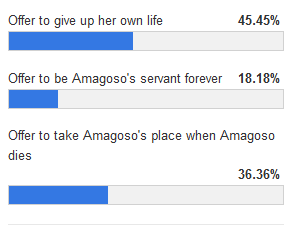
“I’ll die,” said Dyriel, without hesitation.

“Balderdash,” snorted Amagoso. “Stuff and nonsense. Your brother’s in danger, not you. It’s a harmless spell. Now, tell me what you’re willing to sacrifice.”

“You’re not listening. That’s what I’m willing to sacrifice.” Her toes tingled and she felt lightheaded, real and yet utterly unreal. “That’s how the forest magic works, isn’t it? Tooth for a tooth, life for a life. I know that’s what you want. So take it. Take my life, and save my brother.” Amagoso only stared at her. Didn’t she understand? “Quickly, before I lose my nerve!”

A grim grin crept over the hermit’s face. “You have some strange ideas about death, girl. Suppose the duke finds out his only daughter was murdered in the forest by tree people? Forget about the baron, it would be a whole new war, and your brother would lead the charge all over again. No, we’ll have no talk of anyone dying in my realm today.”

Dyriel saw the soldiers silently loosening grips on sword hilts, and only then did she realize how true the hermit’s answer was. “But if you won’t accept that…”

Amagoso waved a thin arm at her, dismissing the question. “You said what you said with the truth in your eyes. You’ve made your sacrifice. Let’s do what needs doing and get you out of my hair.”

The old woman produced a piece of parchment and a goose-feather quill. “These will save your brother.”

“Ink and parchment will save my brother?”

“You may have had a strange feeling these last few hours that your choices were not your own. My spell will simply restore that balance by giving you more choice than usual for a brief moment. Here, the quill is already inked, just read the words and circle your decision.”

Bemused, Dyriel read the question on the parchment. “How should the story end?”

But she allowed herself a slow smile when she saw the first choice:

LORD DANSON GOES FREE

Forty-Minute Story: Dyriel, Part 3

The captain’s men set their hands on their swords as the golem boomed a reply. The situation was spiraling rapidly. She had to do something quickly – but what?

Not included: "Steal golem's One Ring of Power"

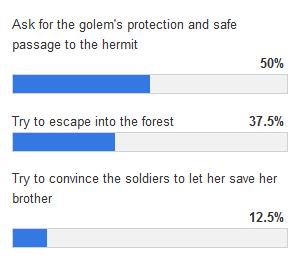
“Golem!” shouted Dyriel, and the creature fell silent to let her speak. “Golem, I beg asylum! Grant me your protection and give me safe passage to the hermit Amagoso, and I swear I’ll disturb no one in this forest. And I swear likewise,” – here she tried her best duchess stare on the captain – “that I will return to the castle this very day, of my own accord.”

The captain’s face turned purple with rage. “You dare give your allegiance to a foreign power, against your own father?”

“My allegiance is to my family!” she yelled. “No one else has lifted a finger to save my brother, so I’ll do what I have to!”

“Men died defending your brother on the field of – ”

“More will die yet if we do not – ”

“ENOUGH!”

The golem smashed his stone palms together with the sound of sudden lightning. Not only Dyriel and the captain, but all the wide forest fell silent: the songs of sparrows, the endless drone of insects. The horses, well-trained, did not rear up or panic, but several backed away uneasily.

“No one will fight in my forest today,” said the golem. “This girl will return to Glenhaven Castle in peace. But first, I will take her to see the hermit. It will be a short journey.”

The golem’s legs shrank, grew shorter, till his massive gray hands brushed the dirt. Except the hands were less massive now, losing their granite texture. The armor melted away, the eyes became less perfectly round, the face softened and took on the appearance of flesh. In a matter of moments, the giant had transformed into an old woman in a crude burlap dress, her white hair pulled back in a tight bun, her wrinkled face stern but not unkind.

The woman turned to Dyriel, whose mouth was still open in astonishment. “I am Mafti Amagoso Lecruscio,” said the woman, “and I can rescue your brother.” She glanced back to the soldiers, wispy eyebrows upraised. “That is, if these fine young gentlemen can spare a few more minutes of their time, for the sake of Lord Danson.”

Their captain frowned, but nodded mutely, seemingly impressed by this display.

Dyriel fell to her knees, nearly weeping in relief. “Thank you, Amagoso!”

“Oh?” A wry smile crinkled the edges of the old woman’s mouth. “I haven’t done anything yet, child. I said I can save your brother. But I’ve yet to hear what you might offer me in return.”

“What…” Dyriel’s heart faltered. “What do you want?”

“I want nothing, child. But a spell like this won’t run on good wishes and pixie dust.”

Her smile deepened into something unreadable. “You must offer me something in exchange for the laws of the universe that I am about to break.”