Monthly Archives: May 2013

Friday Links

Arkyd

Bill Nye, Brent Spiner, and MIT’s professor of planetary science are pumped about it. It’s being launched by the founder of the X Prize and a former NASA engineer. I’m talking about the ARKYD, the world’s first crowd-funded, publicly interactive space telescope. If you like the idea of a telescope that sixth graders, astronomers, and you can point at any corner of the sky – if you think space exploration should be exciting again – then this is a project you don’t want to miss.

wiki nearby

If you haven’t seen it, Wikipedia’s “nearby” feature is pretty sweet. It looks up articles for places that are near you, physically, as in latitude and longitude. To see it in action, you’ll have to allow your browser to send Wikipedia your location information.

spock

In 1968, a girl wrote a letter to Spock and mailed it to a teen magazine:

Dear Mr. Spock,
…I know that you are half Vulcan and half human and you have suffered because of this. My mother is Negro and my father is white and I am told this makes me a half-breed. In some ways I am persecuted even more than the Negro. The Negroes don’t like me because I don’t look like them. The white kids don’t like me because I don’t exactly look like one of them either. I guess I’ll never have any friends.
F.C.
Los Angeles, Calif.

Leonard Nimoy took the time to reply to her personally. His response said, in part:

[Spock] replaced the idea of wanting to be liked with the idea of becoming accomplished…He said to himself: ‘…I will develop myself to such a point of excellence, intelligence and brilliance that I can see through any problem and deal with any crisis. I will become such a master of my own abilities and career that there will be a place for me. People of all races will need me and not be able to do without me.’

It’s worth reading his full response.

Carl Sagan

Carl Sagan says you’re awesome, and who am I to disagree? Animated gifs don’t come much better than this.

shaft

This may be the funniest thing I’ve seen all week.

barack

The Onion reports on Obama’s ongoing Twitter feud with the Audubon Society.

twogag

Two Guys and Guy has an important lesson for writers about how to handle rejection letters.

EOF

40-Minute Story: The Recitation

Marissa’s young face furrowed in concentration as she stood, holding the musty book. She propped elbows against hips to support its great bulk.

“The Spell of Knowledge,” she intoned, mimicking Ada’s stern recitations. But she spared a glance out the wide window, which flooded the cramped library room with late morning sun. It was springtime, outside.

Marissa shifted uncomfortably as she bore the book’s weight. Why did all these spells have to be bound in a single heavy volume? Shouldn’t there be a better way to organize them?

“First invocation,” Ada commanded. She studied Marissa intently from the dim corner where she sat, plump hands folded on her russet robe. Marissa’s own coarse sleeves itched at her wrists, but she knew better than to try and scratch.

“H, T, T, P,” she pronounced. “Colon!” Now she raised her left arm and chopped the air twice, quickly, so as not to drop the spellbook. “Slash, slash!”

Her gestures were sloppy, she knew, but Ada said only, “Second invocation.”

Marissa hesitated. “It says ‘Optional,’ Madam.”

“You will know the long forms as well as the short.”

“Yes, Madam.” It was a brief line anyway. “Double-U, double-U, double-U.” She stabbed the air. “Dot!”

“The pronouncement.”

Sternly now, drawing out the two syllables of the word of power. “GOO-gle.”

“And the coda.”

“Dot co. Dot U, K.”

“You may sit.”

Marissa sat down more quickly than was proper, resting the book on her lap and rubbing the fire from her biceps. “How was that?” She nearly added, Can I go outside now? but thought better of it.

Ada sighed. “Dearest Marissa,” she said. “I love you like my own daughter, but I worry what will become of a girl who cannot focus her mind on these crucial tasks. You know we are the only tome-readers left in this village. Your brother is out toiling in the corn field, sweating under the sun. Without the proper daily recitations, for Fortune and Increase and even Knowledge, the crops will die and his hard work will be for nothing. Mind, I said proper recitations, with purpose and a full heart, and a focused spirit.”

Marissa slumped in disappointment. There would be no escape this morning. “Did I not read the passage correctly, Madam?”

“Correctly? Hmph! Do you suppose correctness is all a spell requires? It isn’t just the words, child. You must mean it from your toes to your scalp. But you would rather be out there, playing in the yard with your…your strange toys…”

“They aren’t toys!” Arguing never worked, but she couldn’t help herself. “They’re the pieces of an old transistor radio, from before the Worldfire. If I could just put them together right, I know I could…well, I don’t know what, but those old machines have to do something!”

Ada rose. “Do you know the story of your name, Marissa?”

“Yes, Madam.” If she was getting the name lecture, there was definitely no escape this morning.

“Your namesake was Marissa Mayer, the great sorceress. She, too, lived before the Worldfire. She helped write the Google spells, and she led the wizards of Yahoo. She had a purpose, child. A passion for her work, for her magic. Do you think she wasted her time on these, these…what did you call them? Transistors?”

Marissa bowed her head, though not with humility. She was hiding the rebellion in her eyes. But she stayed silent.

“Study the tomes, child,” said Ada. “There will be time enough later for games.”

Deb Stewart’s Art Show

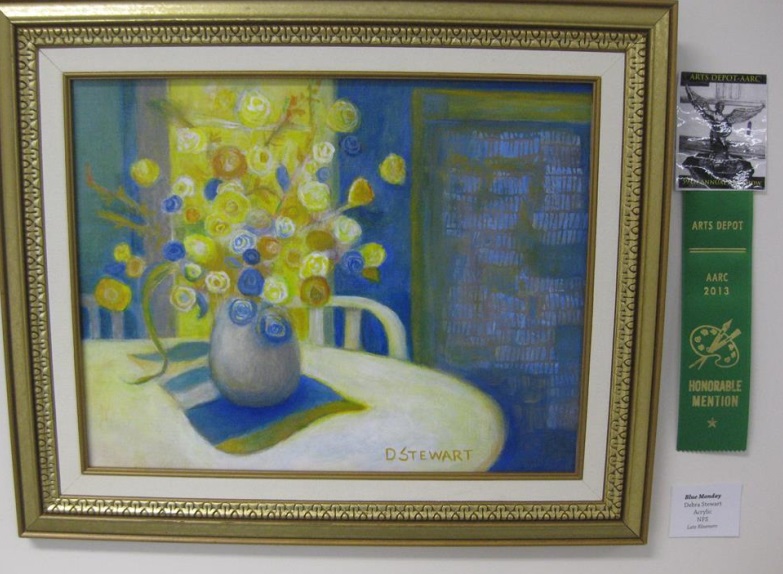
"Blue Monday"

“Blue Monday”

Deb Stewart is my mom. She’s also a painter who’s dedicated years of hard work to her art, and this month, it all paid off.

Over a dozen of her paintings were (and still are!) featured in the “Late Bloomers” art show hosted by the Preble County Art Association. On May 11, I got the chance to check it out.

As with all these photos, you can click to enlarge:

Show

Table

Looking

Center Table

Of course, the art show’s adopted mascot – Glinda, the one-eyed cat – kept careful watch on the proceedings.

Closeups of some individual paintings:

"Song of the Serpent"

“Song of the Serpent” – One of my absolute favorites. I love the explosion of color, the mysterious surrealism.

"Zinnias with Doily"

“Zinnias with Doily” – Notice the detail on the doily.

"Exuberance"

“Exuberance” – Another of my favorites. This one sold already.

Center Table Closeup

"Summer Daydreams"

“Summer Daydreams” – One of her older paintings, with a clear, crisp style. See how she uses contrasting colors (yellow and purple) to make the background interesting?

"Mixed Blessings"

“Mixed Blessings”

"Fun at the Fair"

“Fun at the Fair”

"Contemplation"

“Contemplation” – Look at the detailed texture in the upper left of the green area.

"Bloomburst"

“Bloomburst”

I can’t tell you how proud I am of what she’s accomplished.

AI: Revelations

python

For a long time, my AI strategy has been:

  • First, figure out the AI’s knowledge structure – the way knowledge is stored inside its mind. You’d think this would be easy, but the problem of knowledge representation turns out to be nontrivial (much like the Pacific Ocean turns out to be non-dry).
  • Once I know how to represent knowledge, I will begin work on knowledge acquisition, or learning.

To me, this order made sense. A mind must have a framework for storing information before you can help it learn new information.

Right?

Well, for the past week, I’ve tackled the problem from the opposite direction. I’ve pushed aside my 5,000+ lines of old code (for the moment) and started from scratch, building an algorithm that’s focused on learning.

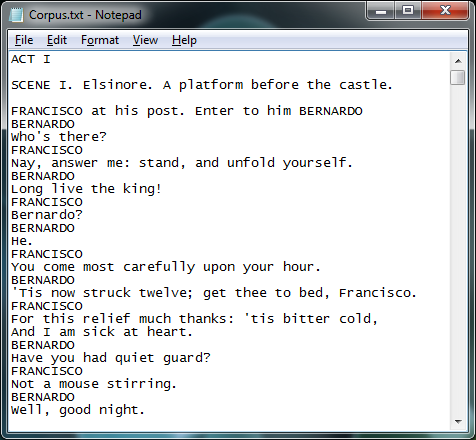
The result is a little program (less than 200 lines long) that reads in a text file and searches for patterns, with no preconceived notions about what constitutes a word, a punctuation mark, a consonant, or a vowel. For instance:

corpus

This AI-in-training makes short work of Hamlet, plowing through the Bard’s masterpiece in about ten seconds. The result is a meticulous, stats-based tree of patterns. I can examine any particular branch that starts with any letter or letters I like.

Here I’m looking at all the patterns it found, that start with “t”:

python output

The full list is much longer, but already you can see it’s picked up some interesting patterns. It’s noticed “the” and “there”, and it’s noticed that both are often followed by a space. It’s even started picking out which letters most commonly start the next word. And it’s noticed a pattern of words ending in “ther”, presumably “mother”, “father”, “together”, “rather”, and their kin.

This algorithm is cool, but rather limited at the moment. It can notice correlations between letters, and fairly simple strings, but it doesn’t do well with more complex patterns. I won’t bore you with the details, but rest assured I’m working on it.

In the meantime, AI is fun again. I mean, it was mostly fun before, but I was entering a dry spell where the work had started feeling like a chore. Every now and then, a fresh perspective helps get you excited again.

In this case, it also showed me that I had my strategy backwards. Just as you can’t build an ontology and weld on input/output later, it turns out likewise that you can’t build an ontology and weld on learning. Learning, it appears, must come first. The how determines the what.

And this new direction is fun for another reason, too.

Till recently, I’d been coding in C++. Now C++ is a white-bearded, venerable patriarch of a language: time-tested, powerful, respected by all. But it’s also a grumpy old man who complains mightily about syntax and insists you spend hours telling it exactly what you want to do.

This new stuff, on the other hand, I’m coding in Python. Python is a newer language, not as bare-bones efficient as C++ but a hell of a lot simpler from the programmer’s point of view, shiny and full of features and full of magic. And I’m new to Python myself, so I’m still in the honeymoon phase. I’m not saying one or the other is “better” overall, but right now, Python is a lot more fun.

And really, programming ought to be fun. Especially if you’re building a mind.

Memorial Day

No post on Monday, blog returns Tuesday. Enjoy your long weekend if you have one.

Friday Links

wiki

Possibly the most useful page on all of Wikipedia. A handy reference, for those times when you get confused.

spock

In case you haven’t seen it: Spock vs. Spock. That is, classic Spock (Leonard Nimoy) vs. new Spock (Zachary Quinto). Spoiler alert, n00bs get pwned.

matternet

Problem: getting supplies to many remote parts of the world is difficult. Solution: a network of autonomous quadcopters that can deliver stuff anywhere. Internet, meet MatterNet.

google style

For my programmers in the audience: did you know Google has a coding style guide? Guides for C++, Python, and more.

teh moonz

This month, we saw the brightest meteoroid impact NASA’s ever detected on the moon.

sap

Tech behemoth SAP makes a very unusual announcement. They’re looking for a few good…autistic people.

pa

I can only assume Penny Arcade has cameras in my house, because this, right here, this is me. They even nailed the cantankerous grimace.

smbc

And last of all, a word about proper parenting technique from the Internet’s leading authority on the subject: SMBC.

Stop reading, it’s over!

Is Luxury Wrong?

I’m a lucky man in many, many ways. One way I’m lucky: I have smart friends, which means I get to have a lot of interesting conversations.

A couple weeks ago, I wrote a post called The Perils of Virtue, in which I suggested that buying luxury items (even small ones, like movie tickets) could be unethical, because the money is desperately needed elsewhere. In other words, the ethical opportunity cost of luxury is very high.

Several of my friends gave good responses, and I want to examine each in detail.

Zeev commented:

Ill just use your example of buying a 20 dollar movie ticket instead of giving to doctors without borders. If you buy a movie ticket you can say that you are paying someone’s salary, supporting the movie industry and the theater industry, and growing Americas economy. America having a strong economy is incredibly important since the USA has been a tremendous force for aid/charity to people around the world. If the US economy recovers/grows the aid that it provides to the world will help a lot more than doctors without borders ever could. So one can argue that spending 20 dollars on a movie ticket is just as virtuous as donating it to doctors without borders.

I know that that example was a bit of a stretch but you get the basic problem you can run into.

In other words, the world is very complex, and who’s to say where my money will do the most good in the long run?

Another of my friends made a similar argument (IRL!), pointing out that money given to charities could be misused by corrupt charity workers, or the people whose lives you save could turn out to be war criminals, or a million other possibilities. The basic argument is, I think, the same: we can’t see the future, so how can we know the most ethical way to spend our money?

My answer is that yes, the world is complicated, and no, we can’t predict the future. But not all possibilities have equal probability. Which sounds more likely: that Doctors Without Borders has massive systemic corruption so terrible that it renders donations worthless? Or that doctors are, in fact, using the money to practice real medicine in the field? As with all decisions, we can’t be certain, but we do the best we can.

Likewise, in Zeev’s example, it’s true that growing the US economy may be a net benefit to the world. But providing medical care in poor regions also helps the world, and $20 in (let’s say) Mozambique can go a lot farther than it can in the USA.

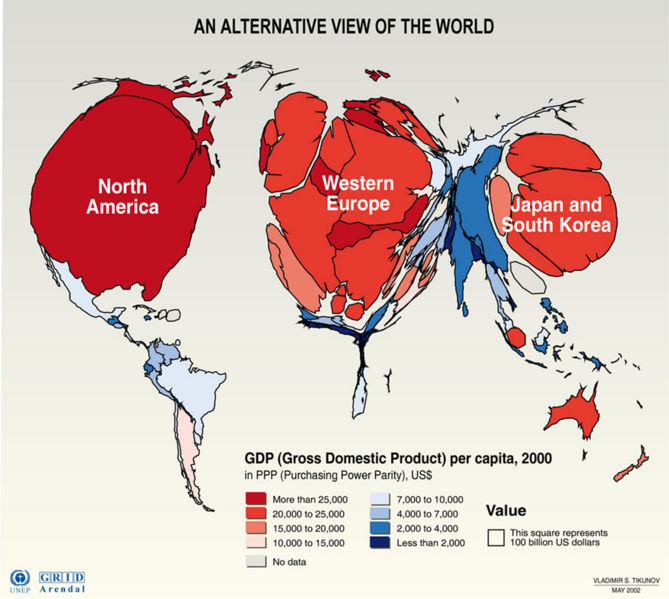
Let’s talk about that for a second. Here’s the world:

world

And here’s the world, sized according to how rich we are:

You can be forgiven if you don’t find Mozambique on that map, although its land area is twice the size of Japan.

Looking at the second map, I’ll ask again: where do we really think $20 can do the most good?

And finally, it’s true that if we save someone’s life, they may go on to do terrible things, leading to a net ethical “loss.” They could also go on to become a great leader. We simply don’t know. But if we conclude from this that saving a life is ethically neutral, I’m forced to ask what we ever meant by “ethical” in the first place.

Meanwhile, David J. Higgins wrote an entire post responding to mine. He also argues that luxury isn’t necessarily unethical. I’ll pick out his key arguments, as I see them:

As well as producing the ability to purchase luxuries, your salary is a method of ascribing value to your actions. While there are many arguments against specific pairings of salary and job salary it is, in Western world, the method most commonly used by people to measure their worth; if you work by the rule that you are not entitled to benefit from more than a basic life as long as there is someone in need then you can strengthen the unconscious belief that you are not worth your extra salary. However flawed the salary system, the larger monetary value of a doctor to a barista is a clear sign of societal worth; is the doctor immoral for not valuing his work as only equal to the barista?

Remaining with the doctor, some of the salary is a recompense for past effort: is it not ethical to have some luxuries now to balance the extreme stress of his degree and vocational training? Will we get the most skilled people wanting to be doctors, airline pilots, or judges if it brings only the spiritual benefits of service?

In other words, shouldn’t highly skilled people be allowed to make lots of money and spend it on themselves?

The answer is a definite yes. Dave’s correct that we’ll get better people in skilled jobs if society allows them luxury. But, as I was careful to say in my original post, I’m not talking about what people should be allowed to do, I’m talking about what’s ethical to do. These are very different questions.

I believe a free society ultimately benefits all, and people should be allowed to spend their money how they want (within reason). Attempts to force a whole society to behave “ethically” have been uniformly disastrous (see: communism in Russia, China, and North Korea; the Taliban; American Prohibition). But as an individual, the situation’s very different. If I see a chance to help someone, and I knowingly pass it up, I’m as culpable for that decision as for any other.

Dave makes another important point:

…relaxation is of value. Time away from doing stressful and intensive work gives the worker the ability to achieve more better work on their return. A surgeon who spends money on a great steak is getting more than sustenance; he is also undoing the damage that stress and fatigue do to his skills.

Beyond recharging, luxuries feed creativity. How often does the solution to a problem come when you are relaxing or in the shower? To say that one person deserves a month of clean water more than another person deserves a coffee is true in the abstract, but does one person benefit from a month of clean water more than they would benefit from the opportunity for creative thought that coffee brought? In many cases probably, but not always; unless we can decide in advance who will have worthwhile ideas how can we deny anyone the right to have luxuries?

I believe this is a much stronger argument, and it’s one I actually agree with. Look at Google. Their headquarters is a playground; their employees are bathed in luxury. But that luxurious environment also helps draw the most brilliant minds in the world to work for them, creating products of enormous benefit to everyone. Relaxation does feed creativity, and mental health does have enormous value that’s hard to quantify.

So yes, luxury can be ethical – to the extent that it allows you to help others more effectively in the long run.

It may sound like I’m now using the same logic I condemned earlier, arguing that luxury is fine because the future is uncertain and nobody knows what’s best. But there’s an important difference. In my view, luxury is only ethical as long as it aids you in helping others more than you could be doing without it.

A night at the movies to unwind after a day of meaningful work; a week-long vacation to relax after months of stress; these are good things. But the ethical “price” for such luxuries is that we must funnel as much time and money as we can bear into efforts (such as charities) that do the most good in the world. Failure to do so is not merely a missed opportunity, it is wrong.

I want to emphasize again that this is a very high standard, and I certainly don’t claim that I’m meeting it. I go to the movies. I buy gadgets I don’t need. So please don’t think I’m holding myself up as some kind of perfect example here. I’m not. Nor do I want to preach to you; I’m simply stating conclusions that seem, to me, inescapable.

Gotta run. Tear me apart in the comments!

Lessons I’ve Learned as an AI Developer

I’ve written before about some of my AI principles of design, as well as one of the deep secrets of artificial intelligence. I’ve even explored what Nietzsche can tell us about AI.

Here are a few more humble insights from my few years in the trenches. Like the other posts, these are just based my own experience, so take with a large grain of sodium chloride:

1. Finding a strategy for Friendly AI is crucial to surviving the Singularity, but I’m skeptical of Friendly AI based on a single overarching goal. Eliezer Yudkowsky has written a lot about the pitfalls of giving an AI a top-level goal like “maximize human happiness,” because if you define happiness as the number of times someone smiles, we could all end up with plastic surgery and permanent Joker faces – or worse. I agree, but I go a step further. I think any pre-defined high-level goal is bound to take you somewhere unpredictable (and probably bad). I think a Strong AI, like a child, has to be instructed by example: rewarding “friendly” behavior, punishing”unfriendly” behavior, as it occurs.

2. Like David Hume, I believe reason is grounded in experience. I’m doubtful that a top-down ontology (such as Cyc) can be built like a castle in the air, then “grounded” later on a robotic foundation. Cyc is an ambitious and very cool project, and I respect what they’re doing. But I don’t think it’s on the path to a Strong AI.

3. Our minds work by trial and error. We focus more on “what works” than “what’s true.” It’s hard for me to see how a Strong AI could be built from a formalized, truth-based system that starts with axioms and derives conclusions in a logically airtight way. Listing my reasons for this belief would require a whole separate post; let’s just call it an instinct for now.

What do you think? Agree, disagree? Questions?

Postmortem: Star Trek Into Darkness (Spoiler-Free)

Rumor confirmed: Spock is hot.

I’m going to say a lot of good things about this movie, but let’s get one thing out of the way first. I don’t know who’s been picking titles for Star Trek movies lately, but they are bad at their job and they should feel sad.

The last one was just called Star Trek, but you can’t just call it Star Trek, because that’s already the name of the original show and the franchise. You can’t call it “the Star Trek movie,” because there are eleven other movies, one of which is Star Trek: The Motion Picture. You can’t call it Star Trek 11 because nobody knows what number it is, since none have been numbered since 6. And now you can’t even call it “the J.J. Abrams Star Trek movie” because there are two of them.

What the Star Trek Into Darkness title lacks in ambiguity, it makes up for in utter retardedness. Darkness might actually be the single most overused, clichéd metaphor of all time. The title suggests that our heroes are in for a supreme struggle, which might be more exciting if it weren’t already the plot of every single story since Gilgamesh.

Ahem. Okay, wow. I didn’t realize I had that much title anger. Breathe, Brian.

Mmm...still has that new-starship smell.

Mmm…still has that new-starship smell.

Anyway: nomenclature aside, the new Trek is excellent. Same director, actors, and style as Star Trek 11: The Search for a Subtitle, but a general step up in both storytelling and adrenaline. If you liked the last one, you’ll like this one too.

I’ll admit, the trailer had me worried. Exciting music aside, it looked like a mess of action and CG with no discernible storyline. I’m happy to report that there is indeed a plot, and even if it isn’t the greatest script in the franchise, it gets the job done.

Besides, Star Trek has never been about the plot. It’s about the characters, and the hard decisions they make. And fortunately, the characters in Darkness are excellent.

Kirk is bold, brash, decisive, almost (but never quite) to the point of absurdity. Spock outshines even the captain in the titular Darkness: his struggle between Vulcan control and human passion is intense and utterly believable. Scotty is funny without being a joke, and even Sulu gets in some good scenes. Only Bones seemed disappointing, though I can’t really say why. All the crew felt new and old at once, in the best possible way.

And then there’s this guy:

"Into Darkness" is also the title of my semi-autobiographical indie goth rock album.

“Into Darkness” is also the title of my semi-autobiographical indie goth rock album.

As I’m staying spoiler-free, I won’t tell you who he really is, but it’s a cool moment when you find out. Regardless, the pale dark dude is eminently menacing, with a sweet deep voice that Christian Bale’s Batman can only dream about. A starship duel has never felt more like a knife fight than with this guy at the helm.

The movie is awfully heavy on CG and action. Personally I would’ve toned it down a little. Not that it made for a bad movie, but it didn’t feel as much like a Star Trek movie. But that may be just the grumpy old man in me. J.J. Abrams, get off my lawn!

Besides, if you had any doubt this was a Star Trek movie, there’s a scene near the end that will erase your worries. For newbie fans, it’s merely an excellent scene. For veteran Trekkies, it borders on sublime.

I liked Into Darkness a lot, and if its Rotten Tomatoes score is any indication, I’m not alone.

If you’re on the fence about whether to watch this one, my advice is: boldly go.

Udacity Goodness

I’m running quite late today, but in the ten minutes I’ve got, I want to tell you about Udacity.

See, as I dive deeper and deeper into the AI rabbit-hole, I find more and more that I need to understand statistics. Only problem is, I remember almost nothing from my two stats classes in college, and the textbook was so mind-numbingly dull that I don’t fancy reading it again on my own. And of course, I don’t want to spend the money to take another college-level class on it.

What’s a guy have to do to get a free college education around here?

One answer is Udacity. It’s a site that offers online video-based classes, put together by real professors. You still get college-level content, complete with quizzes and tests, but you also get some advantages:

  • No time spent commuting to class.
  • Go at your own pace. Fast-forward through the stuff you already know, take a little extra time if you’re struggling.
  • Every couple of minutes, Udacity stops and asks you a question to make sure you understand what’s going on. This constant engagement seems to work a lot better at keeping students focused than a once-a-week quiz or homework assignment.
  • Super-smart instructors, many of whom work on advanced projects at Google. (There’s a class that explains how the Google self-driving car works!)
  • Free.

The disadvantages:

  • No college credit or degree. You’re gaining knowledge, not job-hire-ability.
  • The course catalog is pretty limited right now, and what they do have is heavily skewed toward computer science. If you want to learn about Russian literature, you’re out of luck – for now. They’re growing all the time, though.

Of course, I’ve only just started my first Udacity class, so I still have a lot to learn about them. And about statistics…

Have you done much online learning? What was your experience like?