Monthly Archives: June 2013

Angry

At the moment, I’m too angry about the NSA revelations to write a full-length post. It only gets worse the more you read. After I’ve had some time to calm down, I’ll assemble something more constructive and less seething-with-rage.

In the meantime, here’s the man who gave us the story – Edward Snowden – in his own words:

The NSA, the Fourth Amendment, and You

A quick recap of events so far:

  • On Wednesday, The Guardian leaked a top secret order from the US government to Verizon. The order demanded that Verizon hand over
    all its telephone metadata for a three-month period to the National Security Agency (NSA), and forbade them from telling anyone about it.
  • In the following days, government officials of both parties (including several Senators and President Obama) defended the order. Senator Dianne Feinstein said the order was merely a “three-month renewal of what has been in place for the past seven years.”
  • The man who leaked the story has voluntarily stepped forward and revealed himself. His name is Edward Snowden, and he is staying right this moment in a hotel in Hong Kong. He claims he disclosed this information because it poses “an existential threat to democracy.” US government officials are calling for his extradition.

Since the program has been going on for years, it seems unlikely that Verizon alone would be singled out for this kind of surveillance. (Especially since a program called PRISM has been revealed as collecting much the same data from Internet traffic.) Therefore, it appears very likely that the NSA has a database – stretching back years – of many or most phone calls by Americans, even if they are to other Americans in the US.

In his defense of the program, President Obama told the American people, “Nobody’s listening to your phone calls.” Assuming the program is limited to what we’ve seen in the leaked order, Obama’s statement is technically true. The audio of the calls is out of scope. What’s in scope is the call “metadata,” which includes phone numbers, call times and dates, length of calls, and geographical locations (to the extent that cell towers can be used to determine them).

To reiterate: this is not just certain records, or a certain region, or a certain time period. This is all Americans, on an ongoing basis.

As a reminder, the Fourth Amendment to the U.S. Constitution reads:

The right of the people to be secure in their persons, houses, papers, and effects, against unreasonable searches and seizures, shall not be violated, and no Warrants shall issue, but upon probable cause, supported by Oath or affirmation, and particularly describing the place to be searched, and the persons or things to be seized.

US privacy and surveillance laws have become a tangled mess, especially since the passage of the Patriot Act, so this program is probably “legal.” But it’s hard to see how any of the relevant laws could be Constitutional. The Fourth Amendment is remarkably clear.

Most major news editorials are condemning the program as a massive overreach. A notable exception was the Wall Street Journal, which defended the NSA’s actions:

The outrage this time seems to stem from the fact that the government is widely collecting call records, not merely those associated with a particular suspect or group. But this fear misunderstands how the program works. From what we know, the NSA runs algorithms over the call log database, searching for suspicious patterns over time….

If the NSA’s version of a computer science department operates like the rest of FISA, the government is cautious to ensure that its searches are narrowly tailored and specific protocols are reviewed by FISA judges. Mike Rogers, the Chairman of the House Intelligence Committee, said Thursday that the program had helped disrupt a major domestic terror attack in recent years.

The critics nonetheless say the NSA program is a violation of privacy, or illegal, or unconstitutional, or all of the above. But nobody’s civil liberties are violated by tech companies or banks that constantly run the same kinds of data analysis. We bow to no one in our desire to limit government power, but data-mining is less intrusive on individuals than routine airport security. The data sweep is worth it if it prevents terror attacks that would lead politicians to endorse far greater harm to civil liberties.

It’s true that analyzing large datasets is not necessarily an affront to individual privacy – if that’s really all they’re doing, if nobody has direct access to the specifics of the data itself, and if there’s no way anybody ever could get access to that data. The first two are at least possible; the third is not. No system can be perfectly secure, as the NSA well knows.

Edward Snowden’s action in revealing this program was illegal. But the program itself seems to be far more illegal.

New details are emerging constantly, but from what we know now, Mr. Snowden looks an awful lot like a hero. And speaking as someone who voted for him (twice), I don’t think I’ve ever been so disgusted with President Obama.

Friday Links

Quantum

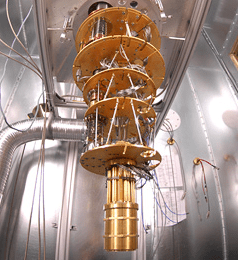
Google and NASA are teaming up to launch the Quantum Artificial Intelligence Lab, which will explore the real-life possibilities of quantum computers. The model of quantum computer they bought is called the D-Wave Two, the same beast that Lockheed Martin snagged a while back. This stuff is sounding less like sci fi all the time.

Monowi

Welcome to Monowi, a village in Nebraska with only one resident. Said resident, Elsie Eiler, “acts as Mayor, granting herself a liquor license and paying taxes to herself.” Groovy.

xkcd

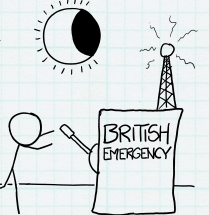
Randall Munroe, a.k.a. the xkcd dude, explores this question: “When (if ever) did the Sun finally set on the British Empire?” It turns out, Pitcairn Island is a lot more important than anybody suspected.

beartato

Finally: another installment of the brilliant but underappreciated webcomic Nedroid. People, the character above is called “Beartato.” If you aren’t sold already, I don’t know what else I can say.

This concludes our weekly installment of Ways You Can Change Your Screen’s Pixel Arrangement By Clicking a Button on Your Mouse, brought to you by Sir Tim Berners-Lee. Have an outstanding weekend.

The Centipede’s Dilemma

You may remember that about a month ago, I bought a unicycle. Since then, I’ve been practicing every day most days, and I’ve gotten a lot noticeably better. I can now get on the damn thing easily, go forward a few feet pretty consistently, and not die when I lose my balance. Trust me, for a guy like myself, these are major achievements.

Most of all, I’m starting to build some confidence. The unicycle has become less a bizarre psychological torture device, and more a thing I might legitimately ride if I could just lean forward a bit farther at the right time.

Armed with that newfound confidence, I began practicing yesterday afternoon. As soon as I got on, I shit you not, this is what my brain did:

Hey, you’re on a unicycle! You got this! You have skills now, and you’re not even worried about falling. Which is kind of weird considering that you only have one wheel, so if you lean in any direction, you’re going to fall. I mean, how do you not lean? Is that even possible? Like, what the hell are you doing right now? Oh crap we’re overthinking this just go just go just go ZOMG DISASTER

That all flashed through my brain in about eight-tenths of a second.

Instincts work fine until you think about them. This phenomenon has a name: the centipede’s dilemma, so called for the creature who could no longer walk after someone asked him how he did it.

(As I mentioned once before, Garfield had the same problem in one of my favorite comic strips of all time.)

“Centipede’s dilemma” is a funny name for this, because real centipedes are (presumably) immune. This would seem to be a uniquely human problem. Only we are so good at thinking that we’ve figured out a way to muck up the things we’ve already learned.

Have you run into the centipede’s dilemma, or “the CD,” as psychologists (probably don’t) call it?

How to Write Clearly

Incontestably, the assemblage and transmission of epistemologically nontrivial entities via the employment of syntactically legitimate morpheme formations is the sine qua non of the epistolarian’s repertoire. Pursuant thereto, the reiteration that certain injunctions inhere within the composition’s modus operandi at a near-axiomatic degree of profundity cannot but be apropos. The aforementioned corpus of prescripts comprises the following dicta, here enumerated ipse dixit:

1. To the extent practicable, eschew brobdingnagian verbiage in favor of curtate monosyllabic lexemes.

2. Concomitantly, countenance laconic locution in lieu of pleonastic turgidity. Esteem breviloquence or invite contumely.

3. Obscurity obfuscates; ergo, to fructify articulation, abjure recondite phraseology and dubious hapax legomena. Utilization of the vernacular enjoys salutary repercussions in the resultant prose.

4. Insofar as memetic dissemination retains its primacy as the substratal desideratum of sapient colloquy, perspicuity supersedes stylistic pulchritude, alleged authorial erudition notwithstanding. Plethorically belletristic disquisition remains the shibboleth of the dilettante.

5. Obviate monotony by the abnegation of bromidic vociferations, adducing solely such constructions as possess the geminate faculties of novelty and sagacity.

Punctilious observation of the foregoing adjurations ineluctably precipitates sterling fruition. Excelsior!

“Progression”

it
begins
with a spark
a single focused shining point of glorious chaotic unbounded potential
that skyrockets luminously, whirling and twirling
until, gradually, the long, slow, patient pull of Gravity
exerts its ponderous effect
as life and vision intersect
and to the heroes now it seems
That their fine nucleus of dreams
Suspended oddly in the air
Requires work to keep it there –
So (thoughtlessly at first) they play the game
And place their stellar burst within a frame
Which, for some slight expenses here and there
Will place convenient fences at the bare
Chaotic darkened borders of the net.
They try, between their orders, to forget –
But paying for the fee, some bits were trimmed
And imperceptibly the light is dimmed
And something, neither black nor filled with fire
Tugs innocently backward toward the mire
Until at last, one day the gleaming rise
Is seen the ancient way through youthful eyes –
With nothing new to say, the glimmer dies –
And so comes an ending that is decidedly unpoetic.

I wrote this in November of 2005. It may not make a lot of sense without some interpretation. I wanted to show what it’s like to pursue a dream: the initial burst of excitement, the gradual introduction of structure and organization to keep the dream going, the way parts of the dream may be sacrificed for pragmatism along the journey, and the way the initial spark sometimes gets finally buried in a mire of logistics. The structure of the poem (rhyme, meter, punctuation, capitalization, repetition) was deliberate and carefully chosen to reflect the content.

Of course, other interpretations are possible as well.

Exploring Ohio Caverns

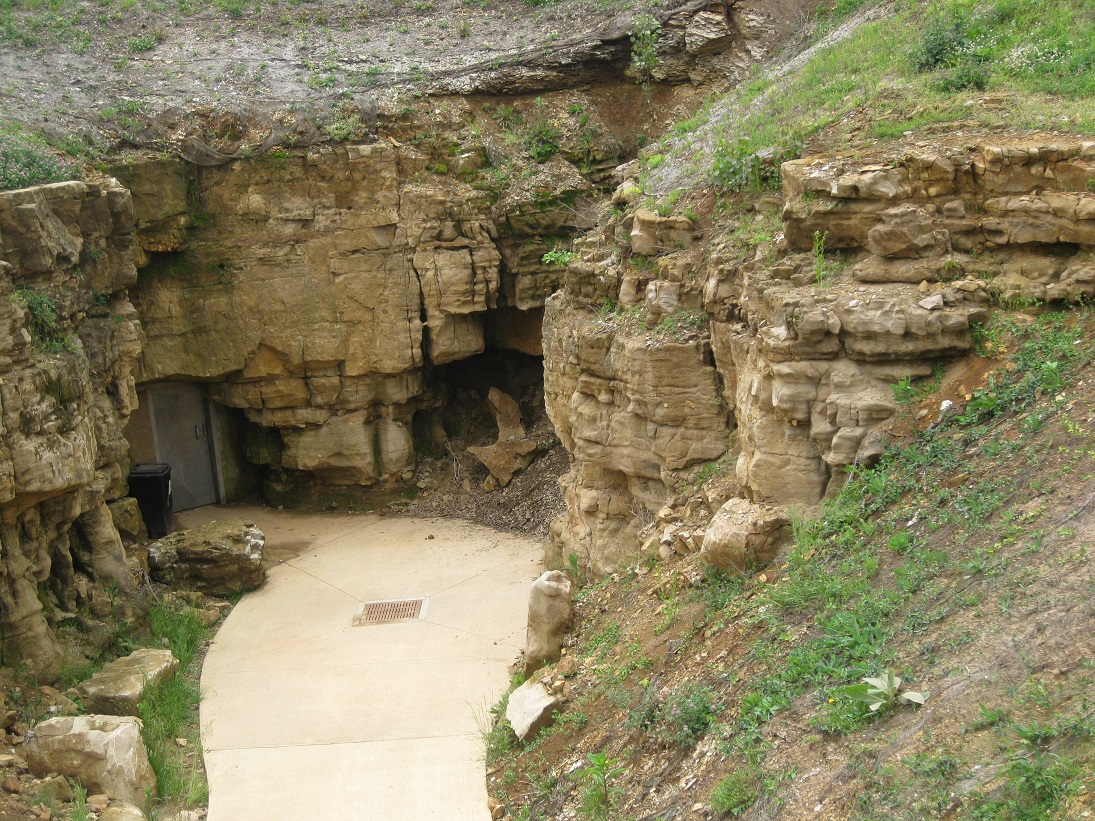
All your classier caves come equipped with doors.

All your classier caves come equipped with doors.

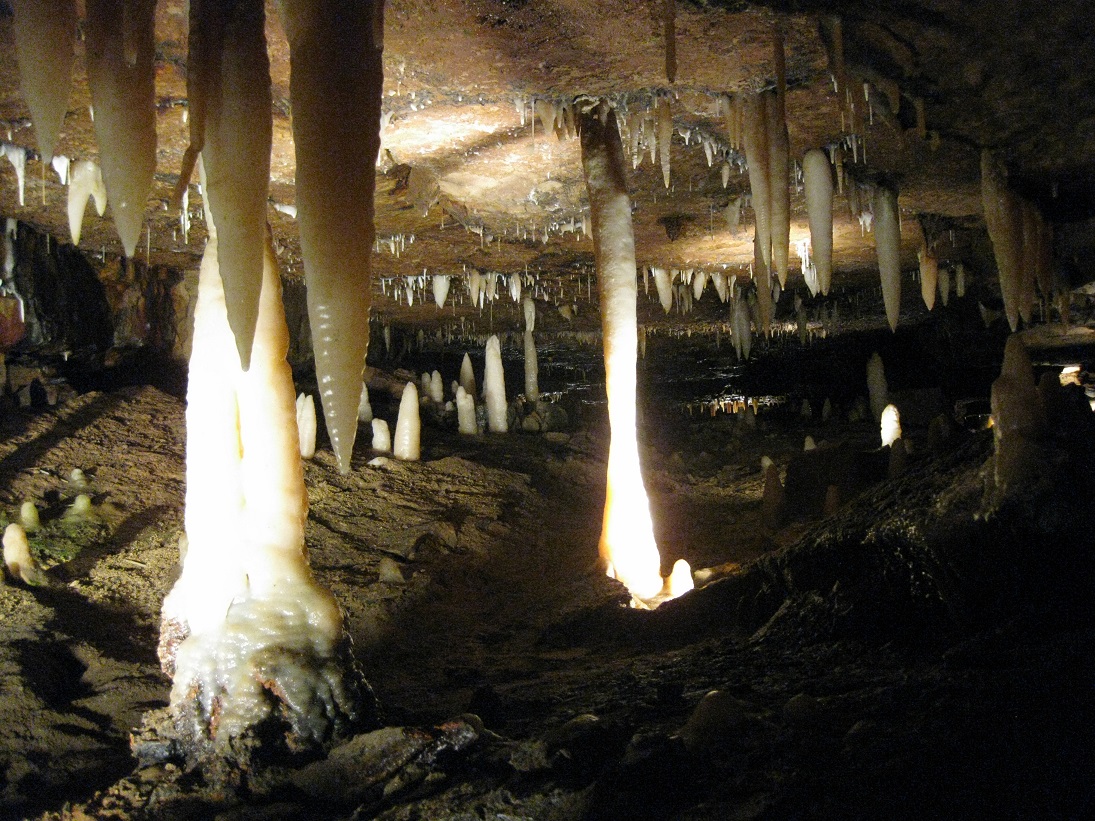
Sixty miles northwest of Columbus, surrounded by endless acres of corn, lie the Ohio Caverns. Betsy and I drove there Saturday to check them out.

The caverns are 54° F all year long, though you end up a bit colder than that, on account of the water that drips from the ceiling onto your hands, your head, and down the back of your shirt. Still, it was a welcome change from the summer heat.

Click to enlarge.

Click to enlarge.

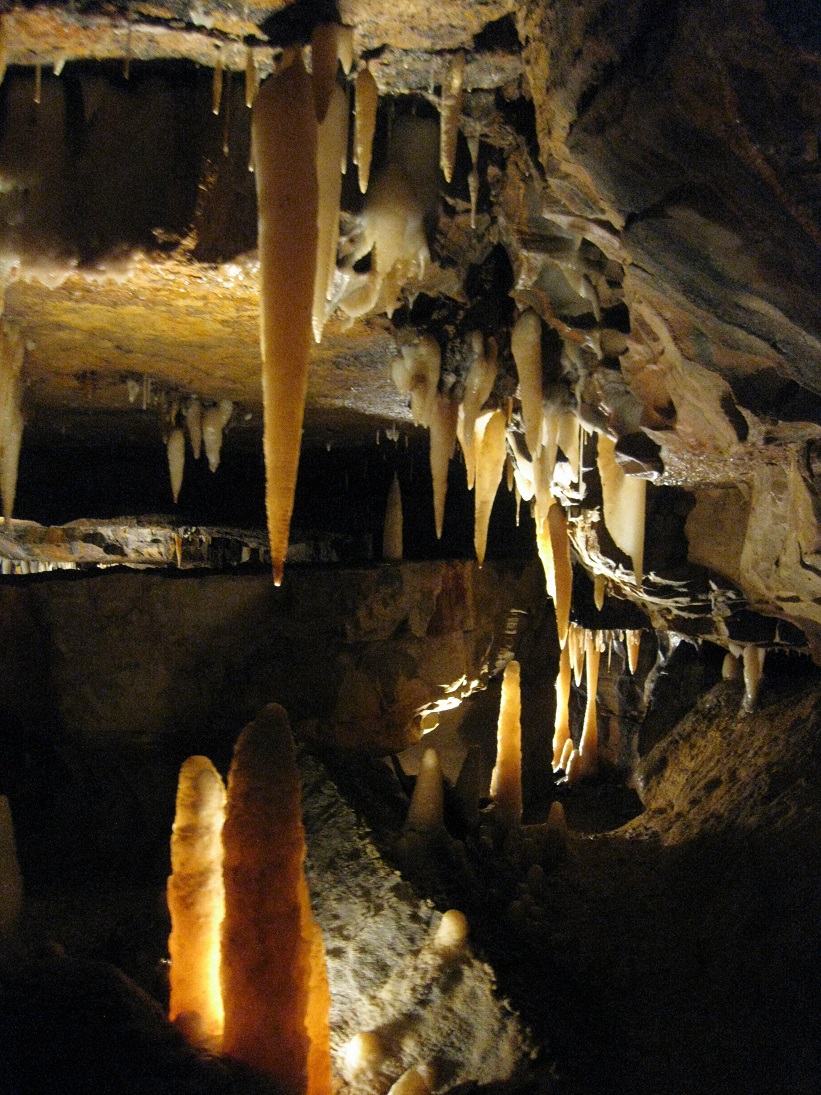
This particular cave system was formed by an underground river, carving a path through the limestone over thousands of years. The stalactites (“hanging tight to the ceiling”) and stalagmites (which “might someday reach the ceiling”) are simply the accumulated remains of water dripping in the same spot for millennia.

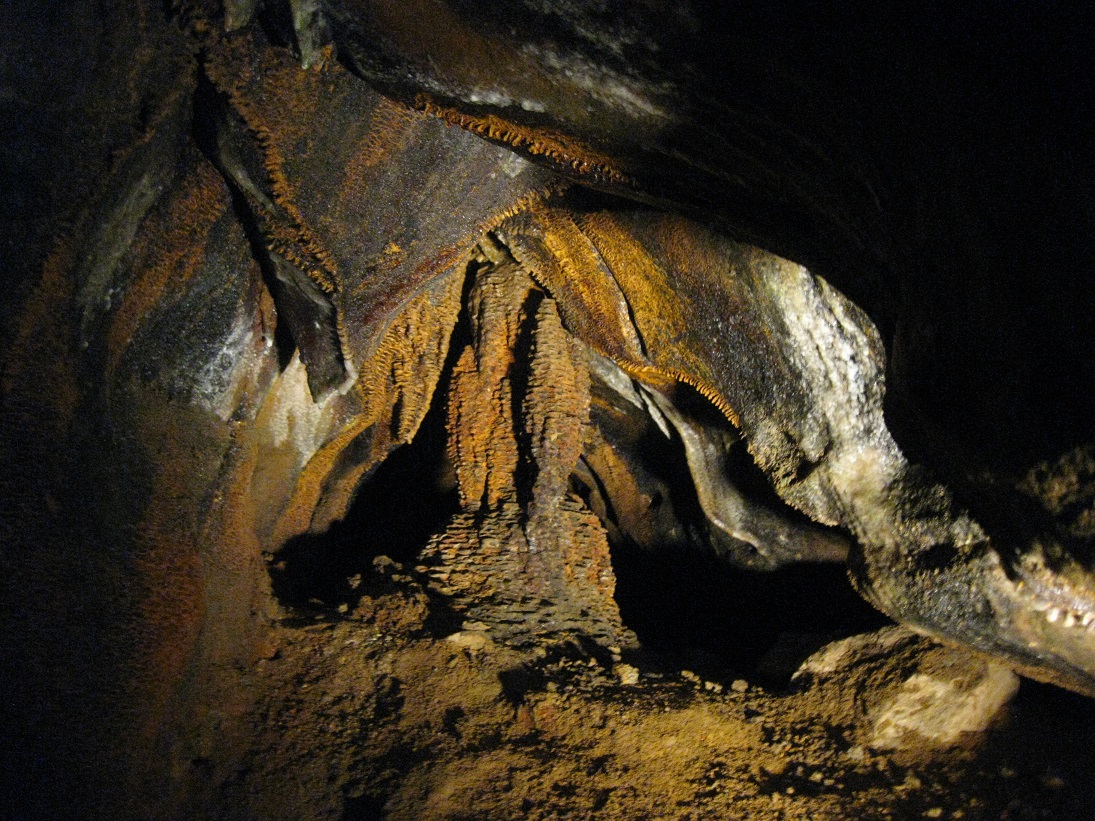
Rust (iron oxide) in its natural form.

Rust (iron oxide) in its natural form.

Apparently, the caverns were discovered in 1897 when a 17-year-old farm worker noticed that the water would pool up in a certain area of the land, then drain away. He wanted to find out where it went.

Now we know. The process of excavation took decades, but I’d say it was worth it.

What do we call it when a stalactite and stalagmite merge? We call 'em columns. Ha! Call 'em columns. omg do you get it

What do we call it when a stalactite and stalagmite merge? We call ’em columns. Ha! Call ’em columns. omg do you get it (Our tour guide actually made this joke. I liked it.)

It’s a strange feeling, walking on the raw rock under the surface of the earth. You find yourself in the presence of ancient, alien structures, the result of processes that operate on a truly geological time scale. They began thousands of generations before you were born, and absent some major calamity, they will continue for thousands of generations after you die.

It’s easy to forget, because of countless movies and photos like these, that there is no light underground. The Ohio Caverns are wired up with artificial lamps, of course, but when they flip them off – as they did for a minute during our tour – you find out what absolute darkness looks like. Supposedly, enough time in the dark will atrophy your eye muscles, leaving you blind.

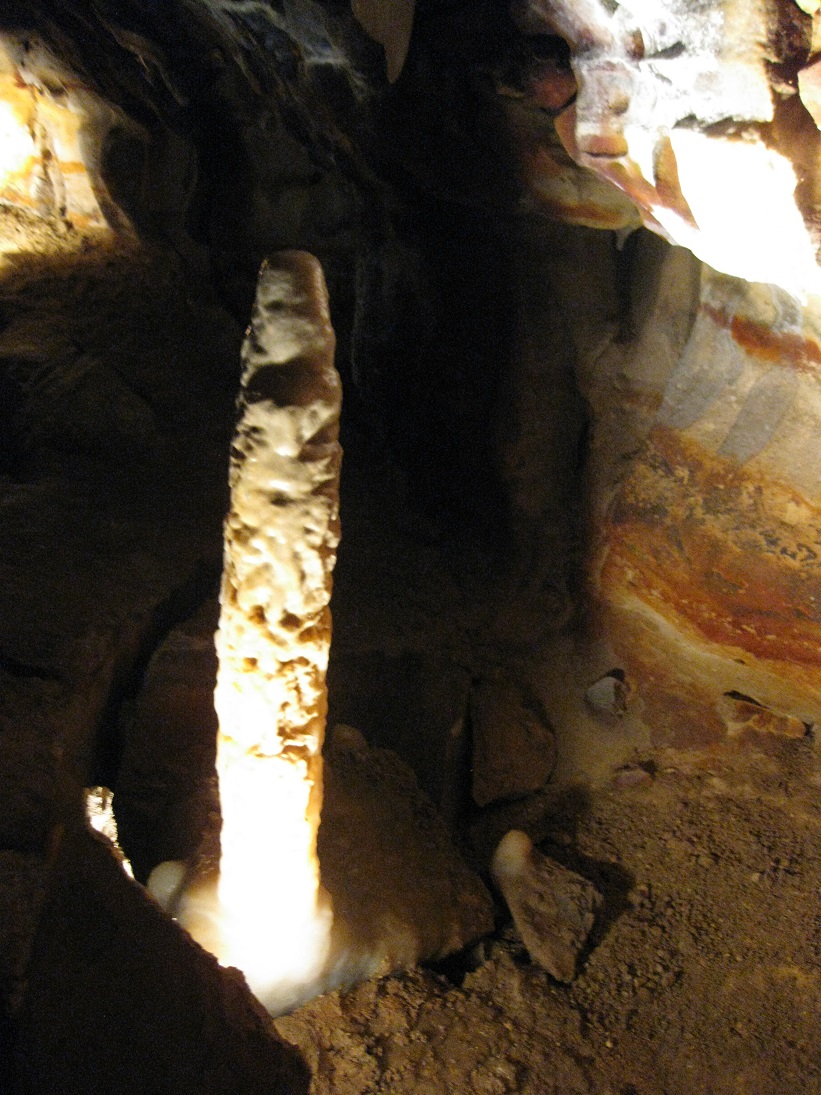
Back in 1925, they actually encouraged visitors to touch this stalagmite for good luck. That advice lasted only a year. It's still filthy from the skin oils today.

Back in 1925, they actually encouraged visitors to touch this stalagmite for good luck. That advice lasted only a year. It’s still filthy from the skin oils today.

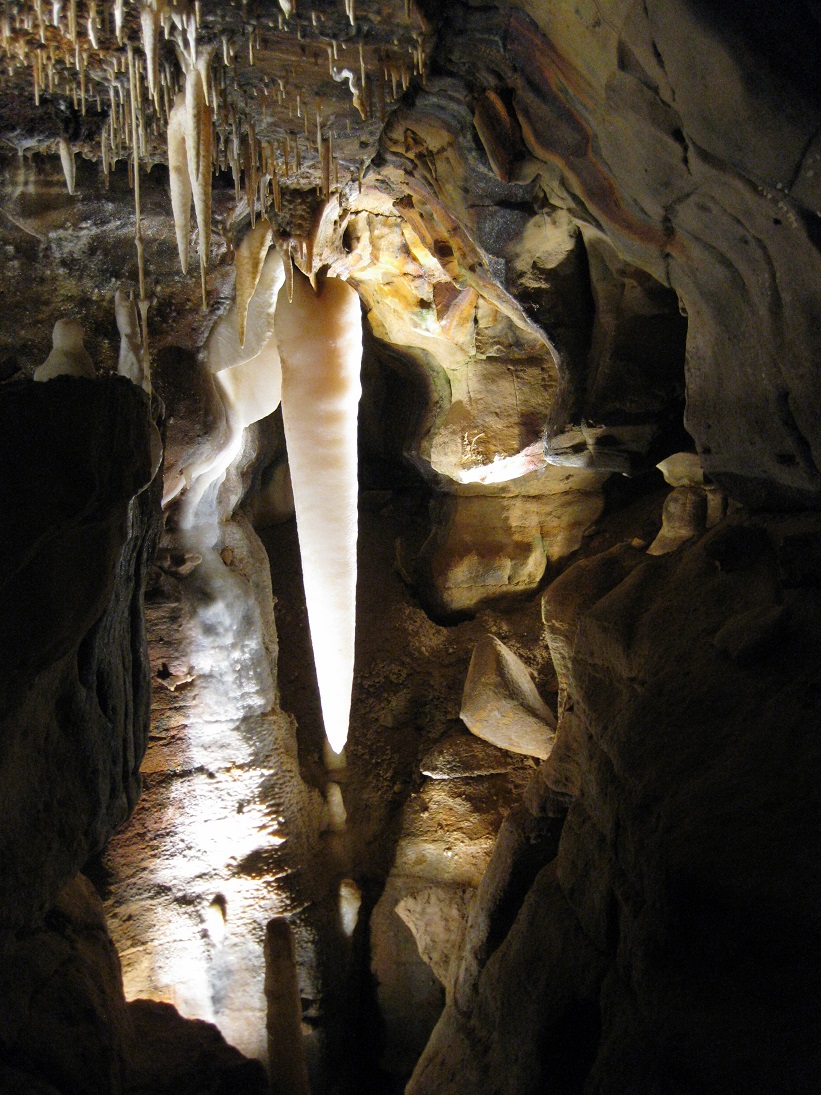
Even with the artificial light, photos are tricky. Your flash goes off by default, but it washes out the picture and makes it ugly. So you have to disable the flash and hope for the best. These photos are the ones that turned out okay, culled from a herd of blurry rejects.

The Crystal King, the largest stalactite in the caverns.

The Crystal King, the largest (and therefore, presumably, the oldest) stalactite in the caverns.

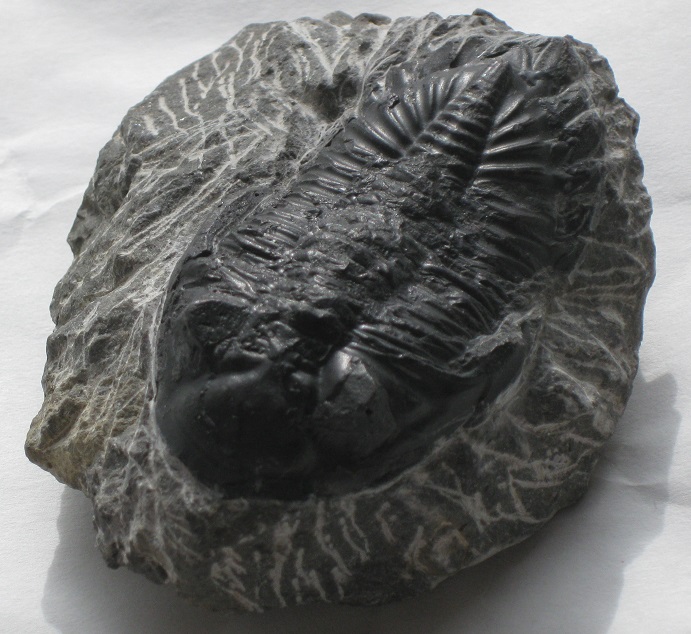
Of course, no tour is complete without a trip to the gift shop. This shop had a lot of stuff that wasn’t necessarily from the caverns themselves, but was still sort of cave-y or geological. For just $20, I snagged a trilobite:

The state fossil of Ohio, narrowly beating out such competition as "Can we even think of any other fossils?" and "Nobody cares."

The state fossil of Ohio, narrowly beating out write-in candidates “Can we even think of any other fossils?” and “Yo momma.”

Have you ever been in a cave?

New Theme

When Dave updated his blog’s header, it reminded me I’m long overdue for a site makeover myself. So I cracked open the Appearance menu, fired up Paint.NET, and got to work.

Let me know what you think. I updated the “Best of Buckley” links too.