Monthly Archives: June 2013

Friday Link: Mr. Sulu and the NSA

Takei

George Takei, the actor who played Mr. Sulu on Star Trek, has an important perspective on the NSA’s domestic spying program. As a child, he was one of over 100,000 Americans to be “relocated” to an internment camp, due to fears that anyone with Japanese heritage might turn on the U.S. So he understands better than most why civil liberties are important.

“We know where this can go,” he said recently. “We have to be ever vigilant against overstepping of the fundamental ideals of our democracy.”

Article here.

9 Ways to Spread Happiness

1. If you notice someone’s gotten a haircut, tell them “Happy haircut!” Like “Happy birthday,” as if it’s a holiday or something. (My stepdad always does this, and now it’s stuck in my brain.) I am a strange person and this is a strange thing to do, and you will get some funny looks. But it’s all good.

2. When people ask how you are, don’t just refute a negative. “I’m not bad” and “I’m good” may mean similar things rationally, but there’s a subtle psychological difference. One is passively okay, while the other is actively positive. (Of course, this only applies if you actually are good. No need to lie!)

3. Jokingly pretend to be excited about things you hate. I don’t mean hide your misery behind a mask. I mean let it out through an excitement that’s so obviously fake that you can just have a good time with it. “Aw yeah, effin’ status reports! Gets me up in the morning!” But don’t just be bitterly sarcastic. Try to really act excited.

4. If you’re feeling down, comfort someone else. This is easier said than done. But often, the best way to get out of your own pit is to imagine what others are feeling. I’ve found that, when I can manage it, my empathy is far more interesting than my self-pity.

5. Exercise, if you can. The brain is an organ. Everything psychological is physical too. Even a little exercise can help. And if you’re feeling better, you can spread that feeling-better to others.

6. Sleep, if you can. You might be surprised just how much of a negative mood comes from pervasive tiredness.

7. Watch Louis C.K.’s standup comedy. Extremely offensive and definitely not for kids, Louis C.K. is nevertheless one of the funniest comedians I’ve ever seen. This video – the whole thing, but especially the part starting at minute 7 – made me laugh so hard I cried.

8. Play music. Everybody’s got a happy song. Personally, I’m partial to “Augie’s Great Municipal Band,” by John Williams. Whatever you like, bust that shiznit out.

9. Leave a note for someone you love. People don’t expect to get notes. As long as you don’t write “TAKE OUT THE GARBAGE,” you’re practically guaranteed a smile.

What ideas do you have?

Deep Mysteries of the Voynich Manuscript

Voynich

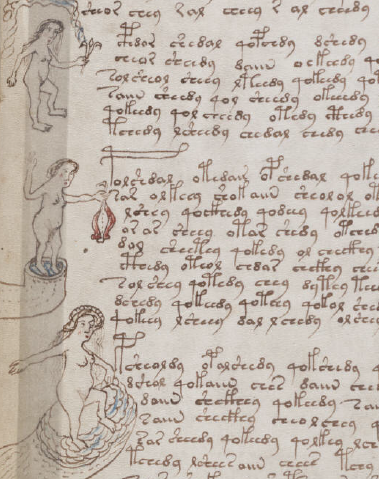
Can you read that text? I bet you can’t.

Don’t take it personally. Nobody can. The Voynich Manuscript is one of the world’s great unsolved mysteries.

Nobody knows who wrote it, or where. The date is estimated at early 15th century. The name “Voynich” comes from Wilfrid Voynich, a bookseller who bought it in 1912.

The manuscript is 240 pages of vellum, heavily illustrated with pictures of plants, astrological diagrams, and naked women. But the language, and even the script used to write it, are utterly unique. And a century of analysis has failed to extract any meaning from the text.

Voynich2

One obvious theory is that it has no meaning. It might simply be gibberish, a hoax of some kind, perhaps to be sold to some unsuspecting nobleman as a curiosity.

The problem with that theory is that the manuscript has a very complex structure, and exhibits subtle statistical properties that you wouldn’t expect to find in a book of nonsense. A recent scholarly analysis concludes, “…the accumulated evidence about organization at different levels, limits severely the scope of the hoax hypothesis and suggests the presence of a genuine linguistic structure.”

Voynich3

So who can unravel this puzzle?

As an AI developer and statistician-in-training, the Voynich Manuscript is immensely appealing to me. This is exactly the kind of thing someone should write a program to analyze.

Maybe I’ll give it a shot.

Or maybe you will. The full manuscript is right here, an enigma just waiting to be solved. Why not take a look?

Past Midnight

The clock on my computer screen reads 2:17 AM. I can’t sleep; I’m not even tired.

What should I write about? The usual topics fail me. My mind isn’t clear enough for a discourse on ethics or analysis of the latest news on Snowden. I suppose I could tell you about Ferdinand Cheval (1836-1924) and the fascinating palace he built by hand, but cool as that is, there isn’t much to say about it besides “Hey, look at this amazing palace he built by hand.”

I’ve been reading a lot lately. The Wonderful Wizard of Oz, by L. Frank Baum. The Bell Jar, Sylvia Plath. World War Z, Max Brooks. All very good, though it’s hard to imagine three more different books. Now I’m on a poetry kick.

Hence, viper thoughts, that coil around my mind,
Reality’s dark dream!

That’s Samuel Taylor Coleridge, the same man who wrote “Rime of the Ancient Mariner.”

I’m still on Duolingo, the language-learning website. Currently a Level 6 in Spanish, 82 experience points from Level 7. I love that I live in a world where you can get experience points for Spanish.

The air is nice and cool. We got our furnace and air conditioner replaced recently – glad that’s finally done. We also got a new tree planted in the back yard. The leaves are looking pretty dry so we’ve been watering it every day.

On the AI front, I’m still taking that statistics class on Udacity. About halfway done with it. The material started off unbearably easy, but it’s gotten quite challenging now. I’ve learned a lot. I think once I have a basic working knowledge of statistics, I’ll be in a much better position to continue with the AI.

Now I’m sitting here trying to think how to wrap up the post. What’s the proper denouement for a stream-of-consciousness ramble? Reply hazy, try again.

Well, it’s 2:48 AM now. Better get some sleep. Over and out.

Chomolungma

I was in Colorado this weekend for a friend’s wedding (which is why there was no post Friday). Now Ohio is very flat, so the sight of the Rockies got me thinking about mountains in general.

This poem was the result. “Chomolungma” is the Tibetan name for Mount Everest.

Chomolungma

If Everest dreams,
I hope it dreams slowly.
I hope its titanic visions
are the work of centuries,
its nightmares falling
like inverted cathedrals
through the rock,
wrapped in blackness
old as the sun.
I hope its deep wonders
writhe aeons at a time,
murmuring rumors yet
of their tectonic birth,
speaking long prophecies
in tongues of lightless fire.
If Everest dreams,
I hope it dreams
slowly.

I’d Like to Ride the Silver Wind

Yesterday I got a rare and exciting surprise – an e-mail from a reader!

She wanted to know if I had written this poem:

I’d like to ride the silver wind
And leave the planet in my wake
The heavens all around me bend
I’d like to ride the silver wind
By stellar pools that never end
Above the wide uncharted lake
I’d like to ride the silver wind
And leave the planet in my wake.

I didn’t recognize it at first, so I asked Google for help. Sure enough, I wrote it almost ten years ago, shortly after I graduated high school, as part of a guide to poetic forms on the art website Elfwood.

This particular form is called the triolet, which I had never heard of before I did my research, and promptly forgot all about afterward. Its distinguishing feature is a strict rhyme scheme of ABaAabAB, where the capital letters represent lines that repeat, and the lower case letters represent lines that rhyme. Wikipedia says they also tend to be in iambic tetrameter, which my example is.

Anyway, this woman wrote that my work “is one of the most beautiful poems I have ever read,” which put a smile on my face.

Last week was a bad week, but so far this week has been excellent.

What’s made you happy lately?

Postmortem: Moby-Dick

Mobimus-Dickimus

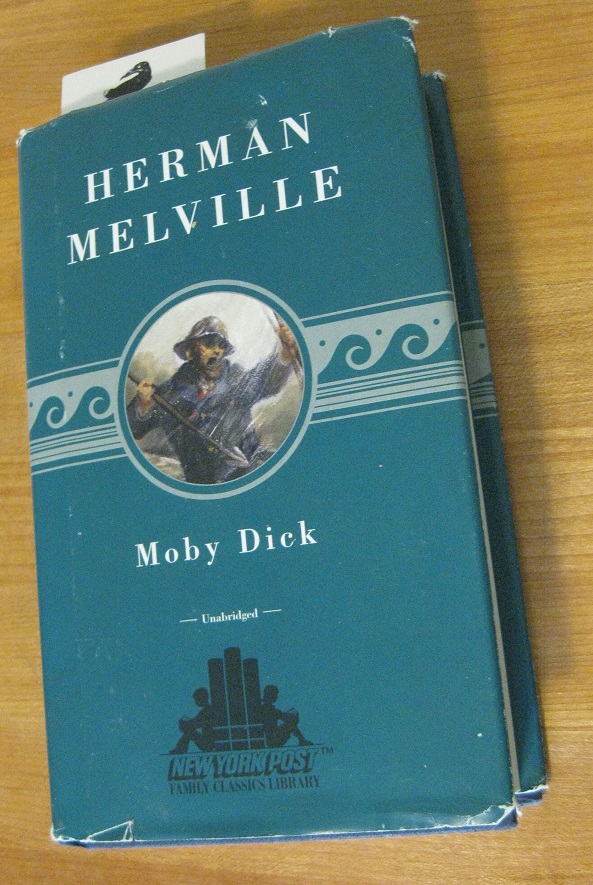
I wrote about Moby-Dick once before, when I was only one-quarter done. Well, I’ve finally finished.

What a strange, unusual book.

Really, it felt like two separate books that happened to be shoved between the same covers.

The first book is the story of the narrator Ishmael, the ship Pequod, her crew, her captain Ahab, and his infamous obsession with a certain seafaring mammal. The story begins with  Ishmael and his newfound best friend, the tattooed cannibal Queequeg. But once these two set foot on the ship (over a hundred pages in), Melville seems to forget all about them, and focus shifts completely to the rest of the crew and their quest. It’s an odd decision, given how much time’s been invested in the original pair, but the Pequod turns out to be an interesting place.

The crew is a wild assortment of characters, all unique and mostly compelling. The first mate, Starbuck, is a courageous and rational foil to the madness of Ahab. The second mate, Stubb, is a sort of Shakespearean jester, spouting nonsense that’s as real as anything else going on. Pip, a boy who is (rather unfairly) reviled for cowardice, develops a bond with Ahab late in the book which is unlike any other relationship I’ve ever read about.

And the style. The style is simply gorgeous, poetry rendered as prose: rich, like cheesecake, so it has to be savored slowly.

As they narrated to each other their unholy adventures, their tales of terror told in words of mirth; as their uncivilized laughter forked upwards out of them, like the flames from the furnace; as to and fro, in their front, the harpooneers wildly gesticulated with their huge pronged forks and dippers; as the wind howled on, and the sea leaped, and the ship groaned and dived, and yet steadfastly shot her red hell further and further into the blackness of the sea and the night, and scornfully champed the white bone in her mouth, and viciously spat round her on all sides; then the rushing Pequod, freighted with savages, and laden with fire, and burning a corpse, and plunging into that blackness of darkness, seemed the material counterpart of her monomaniac commander’s soul.

This book, the first book, I loved. This book is the one people quote, the one that calls generation after generation back to its song.

But as I said, there is a second book as well, its chapters all mixed and interleaved with the first. I will call this second book Herman Melville Wants to Tell You Some Things About Whales. Mostly nonfiction, mostly disconnected from the story, often strung together two or three in a row, these chapters read like boring essays by somebody obsessed with whaling. Their style is turgid and weak, the opinions they offer are not very convincing, and overall, you just wish he’d get on with it.

Here’s a sample:

In the first place, I wish to lay before you a particular, plain statement, touching the living bulk of this leviathan, whose skeleton we are briefly to exhibit. Such a statement may prove useful here.

According to a careful calculation I have made, and which I partly base upon Captain Scoresby’s estimate, of seventy tons for the largest sized Greenland whale of sixty feet in length; according to my careful calculation, I say, a Sperm Whale of the largest magnitude, between eighty-five and ninety feet in length, and something less than forty feet in its fullest circumference, such a whale will weigh at least ninety tons; so that, reckoning thirteen men to a ton, he would considerably outweigh the combined population of a whole village of one thousand one hundred inhabitants.

Think you not then that brains, like yoked cattle, should be put to this leviathan, to make him at all budge to any landsman’s imagination?

Having already in various ways put before you his skull, spout-hole, jaw, teeth, tail, forehead, fins, and divers other parts, I shall now simply point out what is most interesting in the general bulk of his unobstructed bones. But as the colossal skull embraces so very large a proportion of the entire extent of the skeleton; as it is by far the most complicated part; and as nothing is to be repeated concerning it in this chapter, you must not fail to carry it in your mind, or under your arm, as we proceed, otherwise you will not gain a complete notion of the general structure we are about to view.

Perhaps this brief sample doesn’t seem too bad. Maybe it even seems interesting. If so, trust me, the novelty wears off after a hundred pages.

I know that many critics defend this “second book,” saying it’s important to the structure of the novel, or that it enriches the story, or whatever else. But I have to believe that if Melville had published the “first book” alone, and somebody else years later had added the other stuff, nobody in their right mind would prefer the latter version.

Well, it is what it is. And as I said before, the highs redeem the lows. Poets and masochists must read Moby-Dick.


First Meeting of the Resistance

Yesterday evening we had our first meeting to discuss (nonviolent) resistance to the NSA’s domestic spying program.

We had six people at my house, plus three more over video chat. That was interesting. We used Google Hangouts on an iPad, which was propped up at one end of the table like a mini-monolith. It worked well, except for a few times we lost signal. They could hear & see us, we could hear & see them, and the app is smart enough to automatically switch the view to whoever’s talking.

The meeting lasted over an hour, and went surprisingly well. I say “surprisingly” because I’ve never organized anything like this before, I’m not really a political person, and I imagined a lot of ways it could go wrong. But we had an agenda, we followed it, we stayed on topic.

We started by going around the room, introducing ourselves and saying why we were against the spying program. For me, this was one of the more powerful moments of the evening. All different people: liberal, conservative, libertarian, independent; quiet and outspoken; men and women; those new to the cause, and those who have followed the NSA’s programs for years. But we had one thing in common. We had heard the news about the call database and PRISM, and we wanted to do something about it.

We talked about the stopwatching.us petition, which has over 200,000 signatures now (including Wil Wheaton and Cory Doctorow!) and still growing. We discussed the Restore the Fourth movement and the nationwide protests planned for July 4. We came up with a lot of ideas for action.

And we decided to stay organized. We’ll continue meeting monthly, and in between meetings, we’ll keep in touch with each other. We’ll share ideas and coordinate our efforts.

Because we’ve seen what our government is doing, and we’ve decided it needs to stop.

P.S. Protip for resistance cells: nonviolent rebellion is hungry work. Offer free pizza!

What Comes Next

Last week was a bad week.

For starters, there was the revelation that the NSA keeps a massive database of all our phone calls, which (in my view) shows a stunning disregard for our civil liberties.

Unrelated to that: my brain goes through cycles of clarity, and cycles of dark despair. Last week was sunless. I’m feeling better at the moment, which is why I’m able to write this post in the first place. Fingers crossed that it stays that way.

And I was out sick on Friday. So, there’s that.

I’m not trying to drown you in complaints. Just trying to get my head screwed on straight, and point this blog in the right direction.

In the wake of the NSA news, I wasn’t sure what to do with the blog. I generally avoid political stuff, and I generally don’t focus on any one topic for very long, for the sake of variety. I don’t want to alienate or bore you by droning on about civil liberties.

On the other hand, this blog is a reflection of what I’m thinking. And right now, it’s hard to think about much else. When you learn that your own government is using the Fourth Amendment as toilet paper, how can you just shrug your shoulders and move on?

Well, here’s what I’ve decided.

I’m not shrugging my shoulders. I’m going to do my best to organize (peaceful) resistance to the NSA’s domestic spying program. For starters, I’m going to publicly protest in Columbus on July 3. I’m organizing a local meeting of other people who feel the same way. I’ve signed the petition at stopwatching.us and I encourage you to do the same. And for those Redditors among you, check out reddit.com/r/restorethefourth for more information about the protest movement.

To be honest, I don’t know if it will make any difference. A lot of people (for reasons I fail to understand) honestly don’t mind that the government is doing this. And a lot more people don’t like it, but won’t do anything about it. I just don’t see enough public outcry at this point to be very hopeful.

But I have to try.

As for the blog, it will be what it will be. I’ll still talk about philosophy and AI and books and writing, and all those fun topics. But you’re also going to see a lot more about the NSA stuff, because this blog reflects my thoughts, and that’s front and center in my mind right now. If that’s a turnoff for you, I’m sorry, but it can’t be helped.

So. *deep breath* Onward.

Blog Returns Monday

I need a mental health break. And I need to think about some things.