Forty-Minute Story: Wordless

I descend the basement steps and cross the wide carpeted floor. On either side lie piles of CDs, power tools, old computer equipment, notebooks: orphans of the organized house above. Toward the far wall sits a pair of mismatched pillow cushions, one atop the other, each too thin to serve its purpose alone.

The cushions are a battleground.

I sit on them cross-legged as I do every day, taking in the wide white expanse of the basement wall, marred only by a few black smudges and the occasional outlet. I take out my cell phone, set an alarm for 15 minutes from now, and lay it on the carpet beside me. Then I take a moment to compose thoughts, to get in the proper frame of mind. Usually I talk to myself:

Although you’ve done this many times, you are not an expert. Zen mind is beginner’s mind. Don’t be proud. Be grateful for your life, for the chance to do this. Relax. This is not about you.

The last statement is a lie, but it’s also true. It’s a lie because Zen meditation is about transforming your mind, achieving enlightenment, releasing yourself from fear and uncertainty and suffering, and what could be more selfish than that? It’s also true, because enlightenment only comes by giving up the sense of self. More precisely, This is about you letting go of you. But precision isn’t useful right now.

I dwell on none of this. Rather I settle myself on the cushion, put one foot over the opposite thigh in a half-lotus position, straighten my back and shoulders, and place my hands together on my lap with thumbs pressed lightly together. The position is less important than the focus of getting and staying in position.

I take a deep breath, look straight forward at the wall, and begin.

The first few minutes are always rocky: fidgeting, scratching an itch, listening to the noise of the radon pump, mind bubbling with miscellany. The two enemies in the beginning are distraction and fatigue, and I know them well. But I must not let my lapses bother me, because that’s distraction, too. Instead I hold fast to my method: eyes open but unfocused, I breathe in, breathe out, shorter at first but longer as I continue.

With each breath I think of the word mu, which is my koan, my Zen riddle with no rational answer. What is mu? Hundreds of koans exist, some simple and relatable, others obscure and strange. Mu is the most common. They are all the same anyway. It is not enough to empty the mind of distraction, nor is it enough to repeat the word mu in your mind like a mantra. The mind must engage with the koan actively, looking into it, pulling it apart, relentlessly trying to understand that which cannot be understood.

The early moments pass, the small ripples of the mind fade, and I enter a place of stillness and silence. It is not perfect: small thoughts still flit across my consciousness here and there, the sound of the radon pump still occasionally intrudes. I am not yet skilled enough to transcend all this completely. But mostly I am in stillness and silence, gazing at but not really seeing a wide white wall, gripping mu as strongly as I can with my mind. Eventually I release even the word and focus only on the wordless, idea-less idea of mu itself. This last step is not sanctioned by the masters in the Zen books I’ve read, but I do it anyway. It feels right, and the scientist in me says I should experiment.

The stillness deepens, the wordless mu settles into all the places in the brain where thoughts raced constantly before. My head feels physically strange: sometimes light, sometimes twisting with other sensations I can’t explain. These feelings are signs that I’m making progress, but they are distractions, too. Focus.

Focus.

My phone buzzes. Another fifteen minutes have passed without revelation, without enlightenment. But I have traveled again to the place of deep silence, to the high stillness that remains when all else melts away.

Tomorrow I will try again.

There’s a Word for That!

One of my favorite things about the English language is how friggin’ huge it is. For a variety of reasons, English devours new words voraciously while holding on to old words forever. The result is a massive, freakish, glorious chimera that includes a word for just about anything you can imagine.

For instance…

You misheard the Jimi Hendrix line “‘Scuse me while I kiss the sky” as “‘Scuse me while I kiss this guy.” Hearing a phrase that was never spoken? There’s a word for that: mondegreen.

A guy on the street has three cups, puts a ball under one, and mixes them all up. He wants you to bet on which cup the ball’s under. The three-cup swindle? There’s a word for that: thimblerig.

Calling in sick when your only symptom is an aversion to work? There’s a word for that: malingering.

The symbol for division, this guy right here: ÷  Yeah, there’s a word for that: obelus.

The floppy hat Link wears in the Legend of Zelda games?

Like a boss.

No, Nintendo didn’t invent that. There’s a much older word for it: Phrygian cap.

And finally, something we’ve all encountered at one time or another: a dude (or lady!) who writes crappy poems. There’s a word for that, even if they probably don’t know it: poetaster.

Learned any cool words lately?

Contingencies

The black helicopters are coming. Yep, you're screwed.

The latest issue of TIME has an in-depth look at Operation Neptune Spear, the mission that successfully killed Osama bin Laden.

Tomorrow it will be exactly one year since a team of 24 Navy SEALs boarded Black Hawk helicopters in Jalalabad, Afghanistan, and made the dangerous hour-and-a-half flight to bin Laden’s secret compound in Abbottabad, Pakistan. They landed in the middle of the night.

But the first landing failed. Owing to a number of factors – including the extra weight of the stealth equipment onboard – the chopper crashed inside the walled-in yard of the compound, and only the maneuvers of the quick-thinking pilot saved everyone’s lives. Only the second chopper landed successfully.

I don’t know what was going through the minds of the SEALs right then, but it must have been difficult getting that kind of start to one of the most important missions of their lives. It must have been worrying to President Obama, to then-Director of the CIA Leon Panetta, and to Admiral William McRaven, who planned the mission.

But as McRaven watched the crash on a live video feed, this is what he said to Panetta, in a dead-calm voice:

“We will now be amending the mission. Director, as you can see, we have a helicopter down in the courtyard. My men are prepared for this contingency, and they will deal with it.”

One half of his entire strike force has just crashed in the middle of nowhere in Pakistan.

We will now be amending the mission.

My men are prepared for this contingency, and they will deal with it.

What presence of mind. What confidence in the skill and preparation of his team.

How many times have I been on some minor “mission” of my own, day-to-day things like giving a presentation, running a meeting, managing a project – and something went wrong? How many times have I panicked, or despaired, over circumstances far less dire than those in Abbottabad? Yet the mission can only succeed or fail, and as long as there’s still a chance of success, the mission continues. Maybe with different parameters than before, but it continues. Panic and despair are both worse than useless.

We will now be amending the mission.

I think I just found my new motto for the week.

Tell me – what are you most curious about regarding the bin Laden raid?

Friday Links

Fractal Week on the Buckley blog is over, but if you’re still in the mood for some sweet, sweet fractal action, then my good friend Ben Trube has the hookups. This week he rocked out with the Sierpinski Triangle, the Koch Snowflake, the Dragon Curve (my personal favorite), and the Labyrinth. Unlike the Mandelbrot Set, these are all fractals you can easily draw yourself! Go check ’em out.

So apparently there’s this Flash game called Super Mario Crossover, where you can play Super Mario Bros. as Samus, Link, Mega Man, and the dude from Contra. It’s free, nothing to download, just click and play. Epic. Even better, the game’s creator said in an interview that he’ll soon be adding Ryu, star of Ninja Gaiden, to the mix. You can watch the trailer right here.

Next up, a hilarious video of a guy reading a love poem. It starts a little slow, with a long explanation of how and why he wrote it, but you can skip straight to 1:55 for the beginning of the poem itself.

Speaking of hilarious videos: Liam Neeson vs. Patrick Stewart. What else can I say?

Now the webcomics:

Finally, it seems the xkcd cartoonist has been reading my blog! Okay, not really – but this comic fits perfectly with one of my posts from March, and this other comic about Skynet ties in nicely with an older post. Randall Munroe, I’m watching you!

That’s all for this week, peeps. See you on Monday. Have a funktastic weekend!

Breakfast…But at What Cost?

SO MUCH YOLK

WHAT THESE EYES HAVE SEEN THEY CANNOT UNSEE

The Fundamental Attribution Error

Remember that guy you passed in the hall last week? You said good morning to him, and he growled something unintelligible at you and rushed on. Man, that guy was a jerk, huh?

To be fair, you kind of snapped at that intern who walked in your office yesterday. Right? Okay, but that was different. You were up against a deadline and your car had just broken down. You had a right to be irritated. You’re not a jerk, you just had a bad day. Happens to everyone.

See what happened there?

We explain other people’s behavior, especially strangers, in terms of what kind of person they are. We explain our own behavior in terms of what our reasons are.

This bias is called the Fundamental Attribution Error, and it’s one of the biggest mental mistakes we make as humans. A good understanding of this error can change your entire outlook on humanity.

Because really, aren’t there always reasons for bad behavior – and aren’t those reasons usually hidden?

If a student fails to understand something, is it really just because she’s stupid? Maybe she’s distracted because her dog got sick yesterday, or because she’s running to a party right after class. Maybe  she’s just not trying because her parents say girls are bad at this subject. Maybe she can’t read, and has been hiding it for years – or she’s clinically depressed – or her brain is fried after a full day of classes – or, or, or…

Reasons are not excuses, of course. If someone’s a jerk to you (or worse), you shouldn’t roll over and take it just because they have a reason. But understanding those reasons, or even guessing at them, can take you a long way toward humanizing other people.

This kind of thinking can be transformative. Suddenly, the lady who cuts you off in the parking lot might just be late for her son’s doctor appointment. The boss who yells at you might be struggling to cope with tremendous pressure from upper management. The literary agent who rejects you might (and probably does) think you’d have a real shot if you worked harder.

Understanding that people are shaped by their circumstances is the foundation of empathy, of forgiveness. It means looking at anyone, absolutely anyone, and thinking there but for the grace of God go I.

Who knew that cognitive psychology could be so liberating?

Tell me, have you ever had an “a-ha!” moment, where you realized what made someone act a certain way? Did it change the way you thought about them afterward?

Decisions

Delenn: “She said you haven’t been sleeping, that you’ve barely been eating. She said that you have been, in her words, ‘carrying on cranky.’ I looked up the word cranky, it said ‘grouchy.’ I looked up grouchy, it said ‘crotchety.'” […]
Sheridan: (distracted) “Something here doesn’t make sense.”
Delenn: “That’s what I thought when I came across ‘crotchety.’ This cannot be a real word, I said.”
-Babylon 5

I woke up cranky this morning. Tired, not enough sleep, not excited about the day, afraid I didn’t have time to get everything done, bitter about life, the universe, and everything. Feeling sorry for myself. Determined to resent every minute of the morning.

It isn’t the first time I’ve done this. I’ve had practice.

But this morning was different. This morning I stopped, and I realized I was only making myself miserable. I was only setting myself up for failure, getting into a mood where any tiny setback (egad, this hotel didn’t pre-fill the iron with water!!) felt like a personal affront. I realized, in other words, that this wasn’t going to work.

So I changed. Just like that, I decided to be happy. And it worked.

It was easier than I thought.

Look, I hate to be that guy. That annoyingly cheerful, inspirational speaker dude who’s always smiling and saying things like, “Live your best life now!” And honestly, I’m not that guy. More often than I wish, I can be cranky; grouchy; crotchety.

Is it always as easy as just deciding to be happy? Maybe not. Okay, probably not. I know everyone’s life is different, people are going through all sorts of trials, and sometimes the energy or the mindset just isn’t there. I get that.

But this morning, for me, happiness was a decision. And if there’s even a chance it could be a decision for you too, I thought that was something worth sharing.

Dailies

When I was younger, I tended to work on projects in big bursts. I’d get excited about something new – writing a book, learning about dinosaurs, or even building a spaceship – and spend all my free time on it…for a week or two. Then I’d gradually get bored and move on to something else.

Now that I’m (a little) older, I still like the excitement of new projects, but I’ve realized that these big bonfires of enthusiasm go out too quickly to sustain any kind of major, long-term undertaking (like actually writing a book, or actually building a robot). Instead of bonfires, I need a slow burn.

I’ve learned that if I want to make real progress, I need to establish habits.

Here’s a list of my “dailies” – things I do (or try to do) every day:

  • Write this blog. ~40 minutes.
  • Exercise. 10 minutes. Not very long, but better than nothing – enough to keep me from going crazy. Usually this is karate practice in my living room, but sometimes it’s as easy as walking around the block with my wife.
  • Meditate. 15 minutes. This seems to help a little with focus and de-stressing, but that’s secondary. I’m chasing Zen enlightenment.
  • Work on artificial intelligence. 30 minutes. Good progress on this lately! I’ve built my project up from a mess of compile errors and segmentation faults into a program that actually runs, and does more or less what it’s supposed to do. No intelligence yet, but the framework for intelligence is there.
  • Listen to Writer’s Almanac. ~5 minutes. Teaches me about famous (and not-so-famous) writers, and lets me hear a new poem every day, all in Garrison Keillor’s soothing baritone.
  • Practice solving a Go problem. ~2 minutes. Gobase.org has a new problem every day. I rarely make time to play a full game of Go anymore, but I try to hang on to what limited Go abilities I have.
  • Work on needle desensitization. ~1 minute. I watch a YouTube video of someone donating blood, especially the part where the needle goes on. This is to overcome my needle phobia.
  • Practice with Anki. ~5 minutes. I’ve written about Anki before. It’s really cool, free software that shows you flashcards according to a special algorithm to help you retain the knowledge better. You can make the flaschards yourself, on any topic you want. I tend to focus on vocabulary, but lately I’ve added a General Knowledge section too.
  • Practice with the Unix command line. ~5 minutes. I don’t actually have Unix or Linux, but I downloaded Cygwin, which simulates a Unix command prompt on Windows. Haven’t found much practical use for it yet, but I figure if I’m going to make a career out of computers, I ought to get at least a little taste of the world outside Windows.
  • Read (or listen to) the news. ~5 minutes. Primarily MSNBC and Al Jazeera online, or NPR on the radio.
  • Write in my journal. ~5 minutes. Generally a quick, no-frills summary of what I did during the day, without taking a lot of time for thoughts or analysis.
  • Read webcomics. ~3 minutes. Not easy, but somebody has to do it!

That looks like a lot when you write it all out, but most of the items are only a few minutes. If you add it all up, it’s only a little over two hours – and remember, that two hours includes exercise, keeping up with this blog, and putting in real time toward a project I care about (the AI). Obviously I don’t always get around to everything every day, and items get added and removed from the list all the time. But it’s a start – it’s better than nothing.

What do you do every day?

Friday Links: Special Fractal Edition

First up, we have a variation on the Mandelbrot Set called the Buddhabrot, so named for its resemblance to the seated Buddha. They take the M-set, rotate it 90 degrees, and do some cool probabilistic effects to make it look ghostly. Here’s the result (click to enlarge):

im in ur fractalz, meditatin on ur equationz

We’ve also got an incredible 10-minute dive into the unfathomably microscopic reaches of the M-Set, right here:

And finally, reader Alex Caswell asked yesterday if I knew of any other sweet fractal patterns besides the M-Set. Absolutely! Here’s one called the Burning Ship Fractal:

Sir, we've got bad news. The complex plane is, uh, on fire.

Many more pictures of the Burning Ship, even cooler than the one above, are right here.

This concludes Fractal Week. It’s been fun! Have a great weekend. I’ll be back Monday with, I don’t know, something that isn’t about math!

Understanding Fractals, Part 4

Yesterday we put all that complex number knowledge to good use, and finally, actually constructed the Mandelbrot Set.

But so what? What’s so exciting about it? It’s just a couple weird-looking circles, right?

Well, turns out, it’s a lot more than that. Today we’ll transcend the equations and have a little fun…

Exploring the Mandelbrot Set

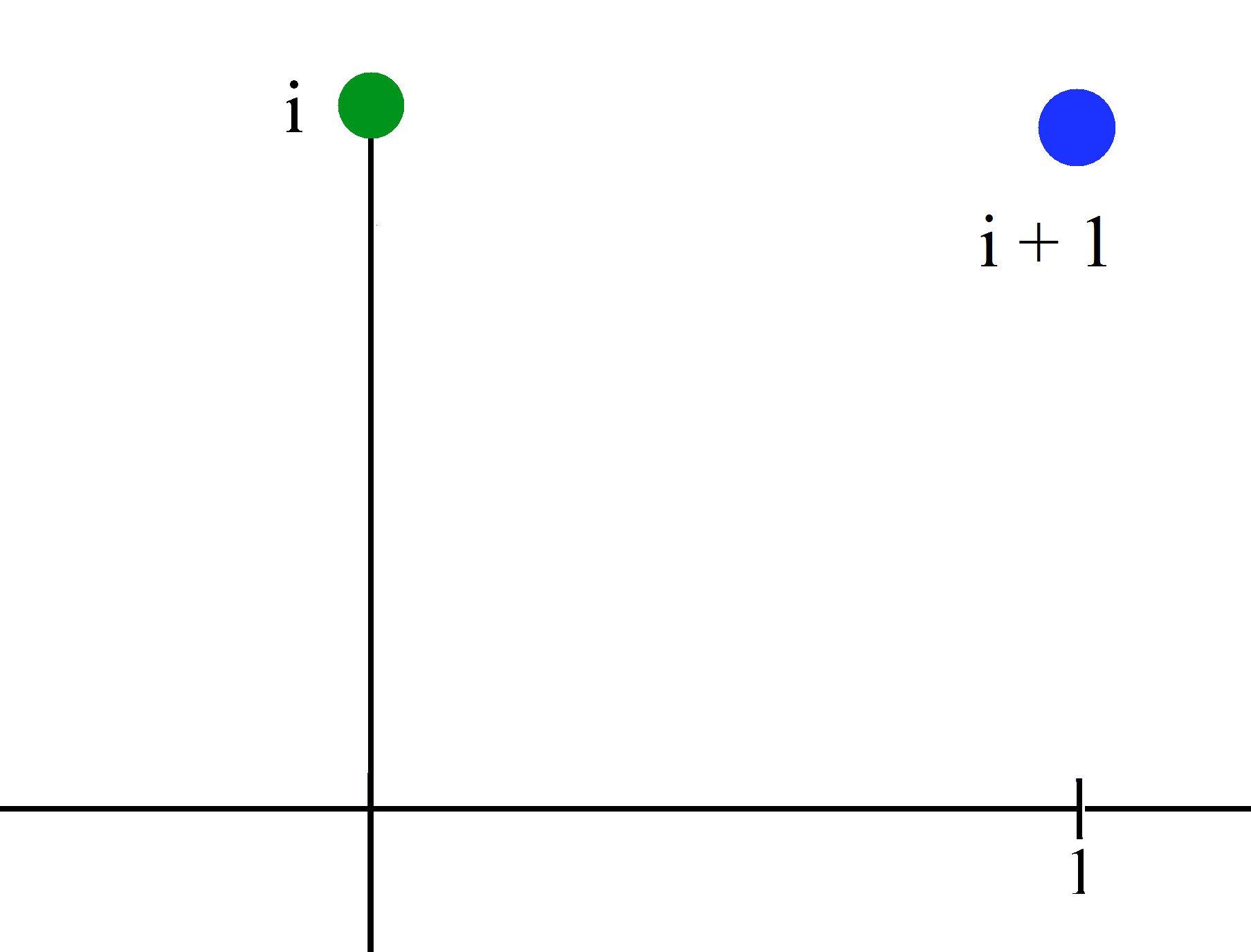
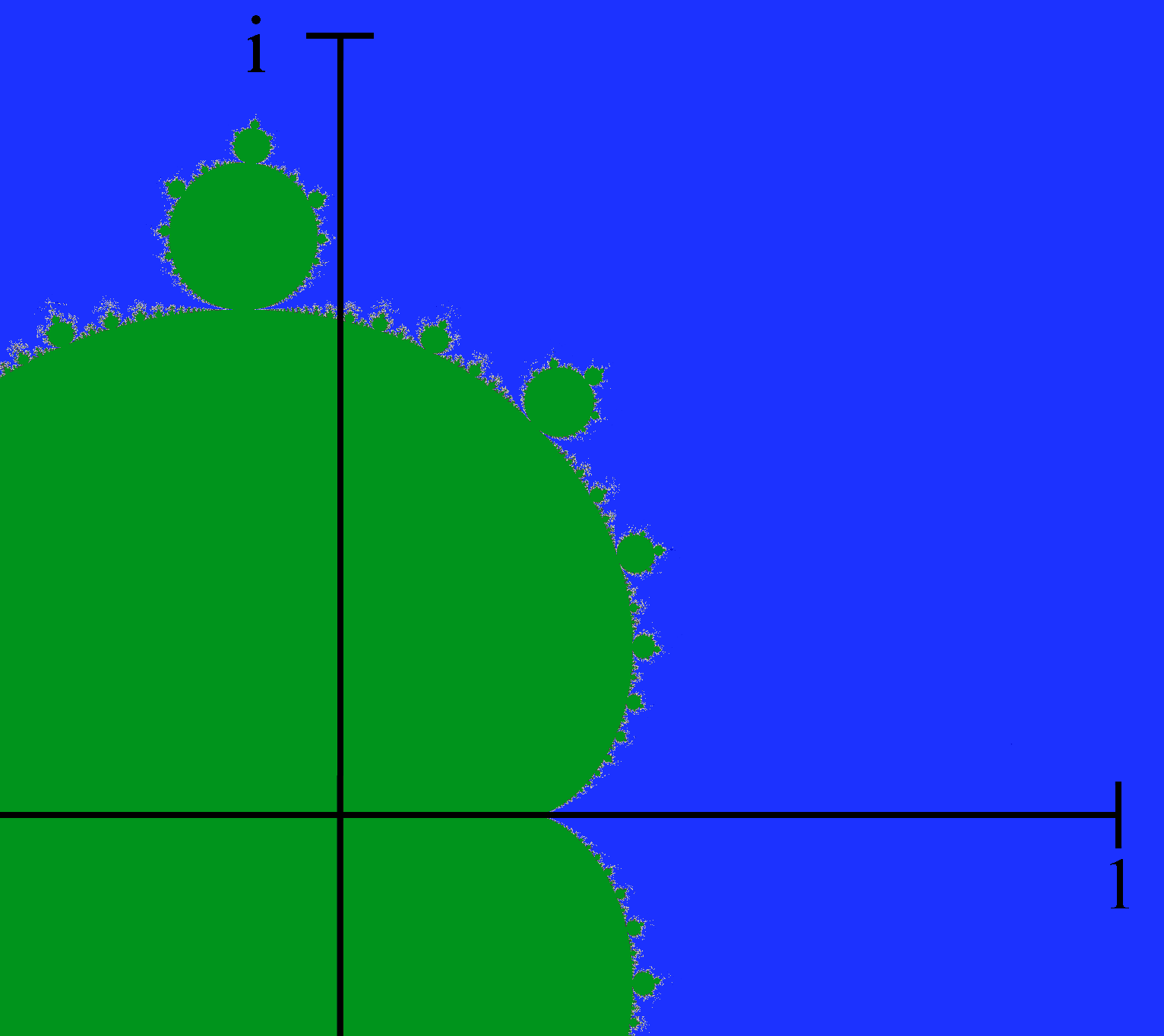
I’m surprised nobody yesterday asked this question: “How come we picked the number i as a ‘Tornado Number’ (i.e. inside the Mandelbrot Set) but the final graph showed it as being outside the set?”

In other words…

i plot

Mandel plot

How come the number i is green in the first picture, but blue in the second?

The answer is that i really is in the set – we were just too far away to see it. Let’s take a closer look – this time from a different rendering of the Mandelbrot. (This image and many of the following images come from right here.)

Tendril

At this higher resolution, we can see there’s actually a spidery tendril of Mandelbrottiness sneaking its way up and to the right, just barely managing to capture i in its clutches.

This tendril calls out the most fascinating feature of the Mandelbrot Set: its complexity. More precisely, its infinite complexity.

That’s right. No matter how far you zoom into the edges of this beast, you’ll always find more circles, more spirals, more microscopic worlds just as complicated as the whole big picture.

Let’s take a short journey of just eight steps. Each one merely zooms further into the one before:

zoom0

zoom1

zoom2

zoom3

zoom4

zoom5

zoom6

zoom7

There it is: buried deep, deep in the M-Set is another M-Set, almost (but not exactly) just like the big one. In fact, there are infinitely many of these little brothers, and if you were to zoom into this little one, you’d find even more along its boundaries, too.

But don’t take my word for it. Explore the M-Set for yourself.

This site is a very simple, stripped-down interface for zooming in and out wherever you want, using just the mouse wheel.

This site gives you more options. I recommend you try Manual (not Autopilot) and set the color map to Blues.

As you move in and out through the infinite complexity, try to remember that the whole thing exploded from a single, simple equation.

Well, that pretty much wraps up Fractal Week. Tell me, what did you think? Was this fun? Think you’d want to do another themed week in the future – probably on a non-math topic next time? Or just go back to random daily subjects? Let me know in the comments!