Haven’t had much blogging time lately because of a big new copyediting project — another MIT Press book, actually, which is exciting.
Anyway here’s Evan:


Haven’t had much blogging time lately because of a big new copyediting project — another MIT Press book, actually, which is exciting.
Anyway here’s Evan:
Posted in Uncategorized
Not far from where I live, there’s a store called Cigars N Stuff.
I love this name. It’s simultaneously so specific and so vague, so mundane and so ambitious. They’re saying that what might be in their store is the mathematical union of the sets {cigars} and {literally anything}. I can’t help being intrigued.
It’s like: “What’s in that store? Cigars and what else?”
“Not sure. Maybe Gouda cheese, or badminton rackets, or a lapis lazuli base-seven abacus. Possibly a Heisenberg compensator, or Season 3 of Avatar on Betamax, or a monopole, or Proxima Centauri, or the hedonic treadmill.”
“But definitely rolled-up tobacco?”
“Definitely that, yes.”
Posted in Uncategorized
I was recently asked what some of my favorite words are, and I gave a brief list that hit a few of the highlights. Ever since, more and more cool words are coming to me. So here’s an addendum with a bunch more favorites. (This, likewise, could easily be ten times as long, given more hours for contemplation.)
Originally I was planning to explain the meaning of every single one, and why I like it. But life is busy, so I’ll have to present the list unadorned, aside from a few links. Maybe I’ll circle back to some of these in the future.
Enjoy!
Posted in Uncategorized
Recently I distributed the complete first draft of Crane Girl to a select group of beta readers, which got me thinking …
Perhaps you know an author in real life.
My condolences.
Perhaps that author has chosen you as a beta reader.
You poor, poor soul.
In case you have to talk to this author of yours, here’s a handy translation guide to help you make sense of what they’re really saying.
Author says: Hi, how are you?
Author means: What did you think of my book?
Author says: How’s your job been going this week? How’s your cousin? Is she feeling better yet? Oh, good, I’m glad to hear that.
Author means: What did you think of my book?
Author says: So, did you happen to get a chance to look at the book at all?
Author means: I have thought about nothing else for the past ninety-six hours.
Author says: It’s fine if you didn’t read it yet.
Author means: “Fine” is the name of the pin I will stick in your voodoo doll.
Author says: Oh, you did read some of it? What did you think?
Author means: I will define my self-worth entirely based on what you say in the next sixty seconds.
Author says: I want your honest opinion.
Author means: I want your honest opinion to be “This is the most sublime piece of literary craftsmanship since the invention of cuneiform.”
Author says: What was your overall impression?
Author means: Negative impressions will be shattering, and positive impressions will not be believed. There is literally no good answer.
Author says: Thanks!
Author means: I am twitching on the floor.
Author says: All right, talk to you later.
Author means: You should probably find a saner friend.
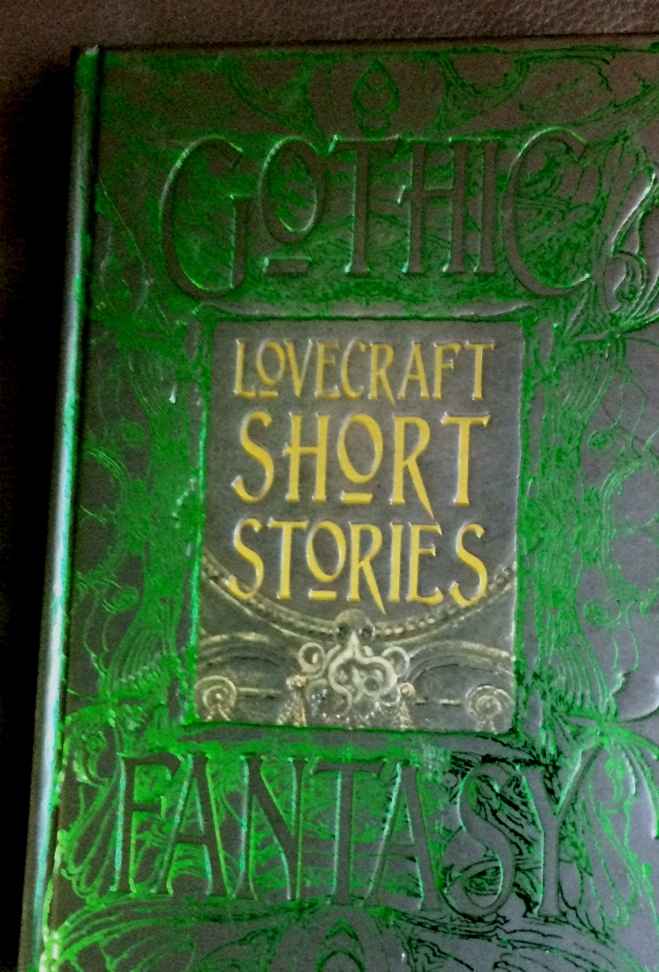
Bounce around the internet for a while and you’ll surely bounce into Cthulhu, that ubiquitous squid-headed eldritch abomination we’ve all grown to love so dearly. There are even Cthulhu plushies. (Aw …)
But despite all I’d seen and heard about this patriarch of horror, I had never actually sat down and read the original source text: “The Call of Cthulhu,” a story by H. P. Lovecraft, published in 1928. So when I stumbled across the volume above at a local Books-a-Million — overpriced, but bargain-discounted to a more palatable cost — I had to have it.
The story itself is remarkably short, for how influential it’s become — just twenty pages in my copy. The complete text is available here, if you like. There’s little plot to speak of. An eminently forgettable narrator does some digging into some old papers, talks to some people, etc., and learns about Cthulhu. What he finds is Truly Horrifying™. Cthulhu is a cosmic, horrific, ancient being that came to Earth long ago. He sleeps beneath the waves, but one day he will wake and bring madness to the whole world. Also, he has a cult. That’s basically it.
I’ve read a little other Lovecraft before: the novella At the Mountains of Madness, a long essay about horror writing, and some small story whose name I’ve forgotten. So, how does “The Call” compare?
Well, it’s the best of his fiction so far, and it’s sort of a fun little read. But it’s still Lovecraft, and his horror is all starting to run together for me, virtues and flaws alike.
Lovecraft’s main virtue is this singular vision he has, that the day-to-day world we know — comfortable, or at least familiar, with our human ambitions and worries and notions of good and evil — is just an infinitesimal speck in the belly of a universe dark and vast and ancient beyond imagination. That much, at least, is simple scientific fact, but Lovecraft gives the darkness force and personality in the form of the Great Old Ones — beings, like Cthulhu, that are so old and strong and strange that we literally cannot imagine their true nature. Even the names we use for them are just feeble human approximations. They are not so much evil, in the mustache-twirling sense, as simply other, utterly indifferent to our desires. Amoral, rather than immoral — and the former is far worse, at least for Lovecraft.
This is a compelling vision, not least because it feels powerfully real. We don’t actually believe in squid-headed mile-high monstrosities, but we do sense that the universe is far darker, deeper, and stranger than our human-centric views might suggest. It’s that particular brand of unfathomable weirdness that survives today as the core of his legacy, and that makes “The Call” enjoyable.
The problem, though, is that Lovecraft is a little too focused on his vision. He hammers it into you endlessly, with every paragraph, every sentence. He is forever insisting that his darkness is so dark, so ancient, so strange, so far beyond mortal comprehension, that you just want him to take a breath and maybe have a beer or something. Certain words pop up over and over: unhallowed, nameless, strange, aeons, Cyclopean (which means “enormous,” only bigger). So many people are driven mad that you start to wonder if they just need better psychiatrists.
Every writer hears the advice “show, don’t tell,” and Lovecraft desperately needs this remedy. You don’t convey horror by saying that something is horrible, or dark, or twisted. You’ve gotta give details, and let the reader’s brain supply the horror on its own. Lovecraft does give details, but he doesn’t let them stand on their own, and honestly the details he gives aren’t super horrifying, especially compared to the over-the-top reactions they induce in all his characters.
That’s another thing. Nobody in a Lovecraft story can hear or see anything remotely connected to the Great Old Ones and just blow it off. “Pfft, squid-head statue, whatever. Did you hear what Stacy said that Molly told Howard about Mike’s promotion?” It’s always shuddering, shivering, whispering. Everyone in this world is as impressed by the mythos as the author himself. And the experts (archaeologists, biologists, linguists) are always baffled by any Cthulhu-related artifacts they find. It’s like nothing they’ve ever seen. Really? You’re telling me a room full of scientists, all trying to impress each other, can’t come up with any connection, even superficially, to anything they know? Lovecraft is trying too hard.
He’s also pretty snooty. He says that only sensitive, receptive people get visions of Cthulhu — fair enough. But he then says that this is all artists and poets (and presumably writers of fiction), whom he calls “aesthetes.” Thoroughly excluded from this group are what he calls “average people in society and business,” who are clearly incapable of grasping the profundity of his darkness. I mean, I get that creative types might be more receptive, but really? That whole lump of “average” people is just right out? You’d almost think he was projecting a bit. (At another point, the narrator refers to a sailor rather condescendingly as an “unlettered seaman,” even though he is currently reading the man’s diary.)
Above all, Lovecraft’s fiction is rife with purple prose. In one passage, he says a statue of Cthulhu “squatted evilly,” which is fun to try and visualize. Elsewhere he speaks of “unhallowed blasphemies” (as opposed to the hallowed kind?) and describes something “visibly darkening the sun” (a contrast to all that invisible darkening you hear about).
Here’s a sentence that so perfectly capture’s Lovecraft’s style that I have to quote it in full. (The “It” below refers to Cthulhu.)
Everyone listened, and everyone was listening still when It lumbered slobberingly into sight and gropingly squeezed Its gelatinous green immensity through the black doorway into the tainted outside air of that poison city of madness.
Now you know why Hemingway was so sparing with adverbs — Lovecraft took them all.
(By the way, Lovecraft’s nonfiction is far better than his fiction, because he’s not trying so hard to impress you.)
One perk of this over-the-top writing, though, is that you get some really killer vocabulary. The three words below, all of which my web browser has underlined in red, are just a sample of the treasure trove this story comprises:
All criticism aside, though, Lovecraft’s dark-purple prose is fairly enjoyable in small doses — which is one reason that the twenty-page “Call of Cthulhu” is much better than the much longer At the Mountains of Madness. So if you’re curious about the origins of our tentacled, occasionally plush friend, this story is a fun way to spend an hour or two.
My friend Brianna writes:
In the ‘etymology’ category: what are your top 5 (or some generic enumerated list of your defined length) favorite words & why? There’s some cool etymology out there, and after taking Latin I realized why some weird words exist in English.
Also, what’s something that you enjoy talking about that people don’t ask you about enough? (Or, worded differently: a topic for which it’s hard to find a conversation partner?)
What do I think about this question?

Y’know — in a good way.
An etymology, for those who don’t know, is the origin of a word. For instance, coffee is from Italian caffe, from Turkish kahveh, from Arabic qahwah, according to the fabulous and endlessly fascinating Etymonline.com (which I used as a resource for much of this post). Most etymologies are like that — a gradual evolution from one language to the next, culminating in the English word we know today.
But some etymologies are different. For instance, the etymology for chortle is Lewis Carroll made it up in 1872 so now it’s a word, b****es. (I’m paraphrasing slightly.) But yeah, in Carroll’s novel Through the Looking-glass, the sequel to Alice’s Adventures in Wonderland, there’s a poem called Jabberwocky. It’s full of nonsense words like chortled, cleverly crafted so they sound like they mean something, but it’s hard to say exactly what. Most likely, chortle was formed by chuckle + snort.
By the way, if you’ve ever heard about someone galumphing along, that’s also from “Jabberwocky,” evidently gallop + triumph.
Think about that for a minute. One poem, 24 lines, at least two new words added to the dictionary. That’s an average of one new word every 12 lines. I mean, c’mon.
Okay. Enough about Carroll.
Another of my favorites is atonement. I read somewhere that it was formed by at + one + ment, as in, becoming at one with something or someone. I’m suspicious of such neat and convenient origins — false etymologies are a dime a baker’s dozen — but that one turns out to be true. Which is pretty cool, I say.
Some etymologies are fun just for the winding route they take. For instance, panties is a derivative of pants, which is a shortening of pantaloons, which comes from — and this is where it gets cool — Pantaloun, a silly old man character in 16th-century Italian comedy who wore tight trousers. He, in turn, derives ultimately from a person who may have actually existed, one Saint Pantaleon, whose name means all-compassionate.
That pan prefix, meaning all, pops up in lots of places. For example: Pangaea, a prehistoric supercontinent that combined all landmasses into one — hence pan (all) + gaia (earth). So Pangaea and panties use the same pan, albeit by an awfully circuitious route.
On a more serious note — one etymology I’ve never been able to get out of my head is the origin of excruciating. It has the same root as crucify — the Latin crux — and it suggests the pain of dying on a cross. Knowing that, I tend to use the word sparingly, as few pains are really awful enough to warrant that description.
What else? Well, al is Arabic for the, so a number of English words starting in al are ultimately from Arabic: algebra, algorithm, alchemy, alfalfa. If you’ve got one of those uncles (and everyone does) who don’t trust furrign-soundin’ names like Al Jazeera, remind him not to have any alcohol either. (You, on the other hand, should feel free to imbibe.)
Speaking of Arabic — it’s remarkable that so many Americans see Allah as a name completely different than God. Like, if you asked someone the name of the Jewish, Christian, and Islamic God respectively, the answers would be: God, God, Allah. Same, same, different. Right?
Well, it’s not wrong, but it’s awfully misleading. God in the Old Testament is (usually) a simple translation of the Hebrew Elohim. So a fair comparison between Judaism and Islam would be Elohim and Allah, or else God and God. And if you’re thinking that Elohim and Allah sound kinda similar, congrats — sure enough, the Arabic derives directly from the Hebrew. It’s the very same word.
(Brianna — if you have any cool etymologies to share, Latin or otherwise, feel free to leave ’em in the comments!)
Completely apart from etymology, there are some other words I enjoy just because:
The words listed above are odd or obscure. But I also like a lot of words that are reasonably common, because they’re strong, evocative, or beautiful. Words like:
As for your second question — What’s something that you enjoy talking about that people don’t ask you about enough? Man, that could be a whole blog post in itself. In no particular order:
As you’ve possibly guessed by now, I could keep on going till my keyboard breaks from attrition. I’ll stop there. But thanks for giving me the chance to ramble.
What about you, hypothetical reader? What’s something that you enjoy talking about that people don’t ask you about enough? Seems like a great question to open up the hidden corners of someone’s brain.
Anyway, that’s the end of the questions. Thanks, everyone, for another successful round of Ask Brian Anything. Have a weekend of Brobdingnagian proportions!
My friend Josh writes:
Could you compare and contrast your experience with writing code and writing literature? Personally, I think they share many things in common, such as rhythm and flow, common structures/patterns, and opinionated naming/spacing/etc. You did a blog a while back about simplifying language in sentences and that also reminded me a BUNCH of simplifying code.
This is an excellent question. Someone could write a whole book on this topic, and maybe someone already has. I’ll try to restrain myself.
As you mentioned, lots of parallels jump out immediately:
But there are huge differences too.
For instance:
It’s a lot harder to be a mediocre programmer than a mediocre writer.
And a lot more impressive, too.
Why? Because almost everyone can write English to some degree, so becoming a “writer” just means honing those commonplace skills by some ill-defined amount.
Programming, by contrast, requires a completely different kind of thinking — it’s a specialized skill that most people simply have never learned. (It’s getting more common, sure, but it’s still relatively unusual.) Programming means thinking logically and mathematically. If you can program reasonably well, that’s pretty cool, IMO. If you can write reasonably well, that’s nice too, but, y’know, get in line.
Also, programming has a higher bar to entry. Anyone with a pen and paper, or a text editor, can write a story. But to program, you first have to:
You can have syntax errors in English, too, and mediocre writers usually do. But nothing pops up and forces you to fix them.
On the other hand, becoming a master writer and becoming a master programmer are about equally difficult, I think. In either case, you’ve moved beyond just the basics of syntax, grammar, spelling, etc. You’re looking for clarity, purpose, elegance, and beauty, and I think that’s equally demanding in either medium.
A writer has one audience, but a programmer has three.
A writer writes, a reader reads. Fairly straightforward.
A programmer, though, has to keep three audiences in mind all the time:
The computer is the most immediate audience. The code has to run properly there, or the whole thing falls apart.
The next audience is the end user. Even if everything runs okay at a technical level, the program still has to work like the user wants.
Finally, the code itself has to be written in a way that’s clear and easy to follow so that other programmers can maintain it.
For writers of literature, the reader fills all three roles. The reader is the end user; the reader “executes the code” in their own brain; and the reader sees the source code. In my opinion, this makes things quite a bit simpler for English writers.
The world of programming changes very quickly.
In IT, new languages pop up constantly. New libraries pop up even faster. New standards, new design patterns, new IDEs, new hardware, you name it. Keeping up with the changes is a full-time job.
Yes, a lot of the fundamentals of programming apply just as much today as they did thirty years ago. But you still have to keep up. As the Red Queen says: “Here, you see, it takes all the running you can do, to keep in the same place.”
English changes too, but compared to programming, the pace is positively glacial. Pick up a 100-year-old novel and the style will only seem slightly antiquated. Pick up a 10-year-old program and the first thought will be, “How can we get this up-to-date?”
Standards for programming are far more rigorous and precise.
Almost anything you do as a programmer is governed by a standard. Python syntax is extremely well defined, and it is defined by a single specification. User interface design? There are standards for that. Software structure? Standards for that too. Not all of it is perfectly defined, to be sure, but there’s a remarkable degree of clarity about what you’re “supposed” to do.
English has standards as well, but they’re a lot fuzzier.
Even at the most basic level — spelling, grammar, punctuation — there is no single, precise standard. Dictionaries differ, and none is universally accepted as “the” dictionary. The same goes for style guides. And even if there were a gold standard, there would always be exceptions, because language is fluid and slips out of any mold.
At the higher levels — plot, character development, style — things get even fuzzier. Sure, there are recommendations and guidelines, but they’re often contradictory, and many of the best stories throw them out the window. The only real advice is “Figure out what works, and do that.”
This makes life harder for programmers — but easier too.
Harder, because there are a lot more hoops to jump through to get it right. But easier, because someone actually tells you what to do. I don’t want to minimize the independence and creativity that programming requires, of course. But as a writer, I can’t even imagine a document, or set of documents, that could outline English with anywhere near the precision of a programming language.
As I said, I could probably ramble on for years hours, but I’ll stop there.
Anyone who hasn’t asked a question yet, feel free!
The next two questions come from Dave, who is my dad, and thus part of the reason I’m so freakishly tall and bad at singing.
You being a writer and editor, and now a father, have you given any thought about writing a children’s book?
I haven’t, which is strange in retrospect, because it does seem like a good fit. I’m not great at drawing, but I bet I could whip up some cool illustrations in Paint.NET.
The ideas are coming to me already:
Seriously though, a kids’ book would be an intriguing challenge.
The hard part would be getting it published. From what I hear, the market for children’s books at the national level is extremely competitive. And that’s compared to the market for novels, which is already very difficult to break into. Most likely I’d have to find a small press, or self-publish, or make something just for Evan. And that’d be fun, too.
Second question:
Have there been occasions that have caused you to feel old yet?
Betsy and I often joke that we were born old, and we’re only half joking. We tend to stay home on weekends. We don’t like loud music. We don’t care about sports, or concerts, and we try to avoid parties. I only got a smartphone for the first time this month. I make noises when I sit down or stand up. I’ve always been forgetful about day-to-day stuff.
So at one level, I don’t feel too old, because I never did a lot of the things people associate with youth. (Wow, that came out more depressing than I intended.)
I guess it hits me most when I find out that stuff from my childhood happened a long time ago. Like — Star Trek: First Contact came out twenty years ago. How is that possible? It came out in the 90s! Yeah, it turns out the 90s were twenty years ago.
The actor currently playing Spider-Man was five years old when the first Spider-Man came out.
There are adults who aren’t old enough to remember 9/11.
Yeah. So, I try not to think too hard about stuff like that. 🙂 Everything changes.
Anyone who hasn’t asked a question yet, fire away!


 Brian D. Buckley