Friday Links

Voyager

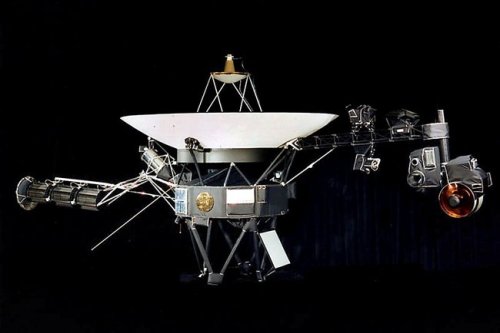
The Triumph of V’ger: NASA announced yesterday that Voyager 1, the little spacecraft that could, has officially become the first manmade object to exit the solar system. What’s more, it’s still working, still transmitting sensor data, still recording information on an 8-track tape. It’s now 11.7 billion miles from Earth, so distant that its messages take over 17 hours to reach home. But reach home they do, and we’re glad.

Wikiquote

Bored? Why not spend a fascinating hour (or three) browsing this Wikiquote page of people’s last words? A tantalizing example: Walt Disney’s last words were “Kurt Russell.” Nobody, not even Kurt, knows why.

2gag

Finally, Two Guys And Guy illustrates what happens when one of those cheesy pickup lines actually works.

One last reminder to Ask Me Anything by midnight tomorrow. Don’t be shy. Remember, every single question will be answered.

Have a great weekend!

I Love It When a Book Comes Together

With all respect, I am not a big fan of Neil Gaiman’s fiction. American Gods and The Graveyard Book both left me flat.

But I could listen to that man talk about writing all day.

Yesterday I stumbled into his Wikiquote page, and it was like coming home. Listen to this:

Everybody has a secret world inside of them. All of the people of the world, I mean everybody. No matter how dull and boring they are on the outside, inside them they’ve all got unimaginable, magnificent, wonderful, stupid, amazing worlds. Not just one world. Hundreds of them. Thousands maybe.

That’s what fiction writing is all about, isn’t it? Reaching inside yourself to show someone else your magnificent, wonderful, stupid, amazing world.

I spent an hour in a moon-eyed Gaiman-induced haze of writerly warm fuzzies, but I’ll spare you the rambling and cut to the quote that really got me:

The best thing about writing fiction is that moment where the story catches fire and comes to life on the page, and suddenly it all makes sense and you know what it’s about and why you’re doing it and what these people are saying and doing, and you get to feel like both the creator and the audience. Everything is suddenly both obvious and surprising (“but of course that’s why he was doing that, and that means that…”) and it’s magic and wonderful and strange.

This is eloquent and true any day of the week, but it really clobbered me yesterday, because I’d just had that very experience only an hour before.

“The story catches fire” is exactly the right way to say this. You have these characters, this plot, this world, and you’re excited and everything seems good and you don’t even know there’s anything missing. And then for no special reason you happen to say “Well I guess her struggle parallels this other conflict,” and suddenly that little sub-plot you were toying with becomes the story, becomes what the entire book is about, and maybe even what life is about and you get all giggly and useless to anybody else for upwards of ninety minutes.

It’s like turning the key in a Mustang, the difference between admiring its sleek lines in a parking lot and roaring down the freeway. And this is coming from a guy who drives a four-cylinder Honda Accord.

I guess what I’m trying to say is: I’m happy. And I hope you are too. And if you’re not, then dammit, I’m going to try my best to write a book that will take you there.

As for Neil Gaiman, I’m going to read his Sandman series. I may not have fallen in love with some of his other books, but damned if Sandman doesn’t look amazing. And every book is a fresh start – right?

Don’t forget to submit your question for Ask Brian Anything by the end of the week! The questions so far have been top-notch, grade-A material, on account of you guys rock. Keep ’em coming!

The Vorschkraag

The central character in The Crane Girl is called the Vorschkraag.

Note, I said the central character, not the main character. The main character, the hero, the reader surrogate, the Crane Girl herself, is a woman named Rana. But on the island where Rana lives, the Vorschkraag is the center of everything: geographically, politically, spiritually, even (gulp) ontologically.

The V won’t get much screen time. She’ll only appear in a couple chapters at the end of the book. But it’s her book.

I picture the V as a girl, about ten years old, although strictly speaking she’s genderless and immortal and definitely not human. She’s the quintessential demiurge, a spirit who creates for the sheer joy of creating, a lover of everything that’s alive and free. She’s an empress without laws, a sleeper whose dreams are the same as reality. If she’s a goddess, then she’s a goddess like no other: not a mother like Gaia, nor a wife like Hera, nor concerned with sexual chastity like Artemis; an accidental goddess, not interested in obedience or worship, only interested in making a world.

Her eyes are silver-in-silver and glow in the dark.

I keep searching for a picture that sums up the way I think about this character. I’m hunting Google Image Search and DeviantArt, cropping and altering and splicing images together, trying to figure her out. Sometimes she’s five years old and sometimes she’s thirty. Sometimes she’s a queen and sometimes she’s a little kid curled up in a ball. (I’d post the images, but most are copyrighted.)

I don’t know just who she is yet.

But I’m going to find out, and if you’re interested, you can too.

The Next Novel

I’ve started another novel.

I stopped working on the last one, The Counterfeit Emperor, nearly two years ago. That was a difficult decision, but I think it worked out. I spent some time  exploring AI, and recovering from novel-writing burnout.

Well, I’m recovered. Let’s rock and roll.

I’m not picking up Emperor again. First, because I still have a bad taste left over from before. And second, because I think the main character is fundamentally flawed. Going back would mean rewriting almost from scratch, so I might as well start something new – something I’m excited about.

The next novel is called The Crane Girl. Fantasy this time, rather than sci fi, although the lines get blurred in my stories anyway. I’m uber pumped for it, planning to do a lot of things differently.

For one, the hero is going to be strong, active, and (gasp) perhaps even likeable. I’m also doing a lot more research this time around. I’m taking my worldbuilding nice and slow, basing my nations on real historical empires (like the Byzantine Empire) rather than trying to imagine it all from scratch.

And I’m using images a lot more, searching online for photos and paintings that match the way I imagine my characters, locations, etc. This helps me get a good visual sense of what my story looks like. It’s a new technique for me, but I’m loving it. Everything feels so much more…alive.

More details to come. This is a writer’s blog, after all.

And don’t forget, you have till the end of the week to Ask Me Anything. I’ve gotten four great questions already. Keep ’em coming!

Ask Brian Anything!

It’s time for our third installment of Ask Brian Anything! Between now and the end of the week (midnight this Saturday, September 14), leave me a question in the comments. At the end of the week, I’ll round up all the questions, and once I’ve had a little time to ponder, I’ll post the answers.

No question is too personal, too bizarre, or too mundane. I will answer every single question I get. (Limit one per customer! But if you’ve asked a question in previous rounds, you’re welcome to ask again this round.)

You can browse previous questions and answers here. Previous questions have ranged from “Are we living in a computer simulation?” to “Where do you see the United States in twenty years?” to “How did you meet your wife?”

Ask away!

Friday Link

Clapper

The New York Times reported yesterday on new revelations about the NSA’s ability to break your privacy. Encryption, one of the most basic privacy protections on the Internet, has been mostly gutted by a top secret agency program called Bullrun “using supercomputers, technical trickery, court orders and behind-the-scenes persuasion.”

“The agency has circumvented or cracked much of the encryption…that guards global commerce and banking systems, protects sensitive data like trade secrets and medical records, and automatically secures the e-mails, Web searches, Internet chats and phone calls of Americans and others around the world.”
-New York Times

What’s more, the NSA isn’t just cracking our security, it’s deliberately building failure points into it so that we can be exploited. The NSA “used its influence as the world’s most experienced code maker to covertly introduce weaknesses into the encryption standards followed by hardware and software developers around the world.”

We’re getting continually, deliberately, and systematically fucked on an ongoing basis; we’re paying for the privilege of getting fucked, as well as research into new, more effective means of fuckery; and when we find out, they say they’re going to keep fucking us for our own protection.

Happy Friday, everybody.

What Doesn’t Kill You…

Homer Simpson: “But what doesn’t kill me makes me stronger, right?”
Doctor Hibbert: “Oh, on the contrary. The heart attack has left you weak as a kitten.”

There’s a lot of wisdom in The Simpsons.

The old saying, “What doesn’t kill you makes you stronger,” has stuck around for a reason. Suffering really can build us up.

The pain of exercise makes us healthier. The pain of losing a loved one can make us kinder to others, if we let it. Losing a game can motivate us to be better players in the long run.

But there are exceptions. A car accident might leave you too scared to drive again. Abuse can permanently damage someone, mentally or physically. What doesn’t kill you may simply make you weaker.

The key to getting stronger isn’t suffering. It’s recovery.

Suffering without recovery is simply damage. But suffering is also necessary, because we can’t experience recovery without it. A life of pleasure is a life of weakness.

It isn’t the workout that makes us tougher, it’s the healing of the muscles afterward. It isn’t the pain of loss that makes us wiser, it’s reflection on what the loss means. Christians don’t celebrate the Crucifixion, they celebrate the Resurrection.

This is obvious enough if you think about it, but I’m not sure I ever had.

It’s a useful concept for writers if they’re working on character development.

I daresay it’s also a useful concept for humans if they’re trying to be better humans.

P.S. The fact that “daresay” is a single word makes me want to get with the English language and have its babies.

Byzantrivia

da hag

Like most people, I come home after a long work day with just one thought in mind: researchin’ facts about the Byzantine Empire.

Here’s what’s up:

  • The Byzantine Empire was a large and powerful successor state to the Roman Empire, and its people considered themselves Romans. The term “Byzantine Empire” was a later term invented by historians.
  • The capital was Constantinople (a.k.a. Byzantium (a.k.a. Istanbul)), named after Emperor Constantine, who moved the capital there from Rome. Because when you’re the friggin’ Emperor, you can totally do that.
  • The Empire lasted a thousand years, from the fall of the Western Roman Empire in 476 AD to the fall of Constantinople in 1453.
  • Constantinople itself didn’t have much fresh water, so they had to build a ten-mile aqueduct to the nearest major source. This made them vulnerable to attack in spite of their giant city walls.
  • Surprise surprise, the Empire was a heavily patriarchal society. Infertility was considered shameful for women, and they wore amulets to protect themselves from the infertility demoness Gylou.
  • The Byzantine military used the mysterious substance known as Greek fire. They even made grenades by pouring the stuff into ceramic pots.
  • Eunuchs were a tricky subject. The Church condemned castration, but approved of the (supposed) result: a lack of sexual drive or personal ambition.
  • Only half of infants survived the first few years of life. Even among those who did, most adults didn’t make it past 35, with childbirth in particular taking a heavy toll. Consequently, marriages often came in the early teens.
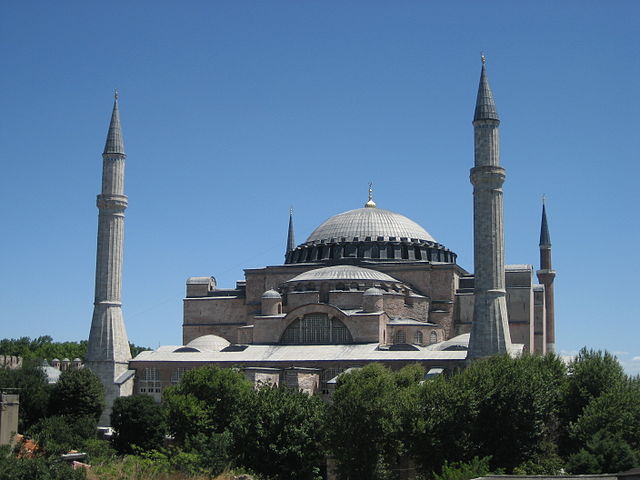
  • The photo above is the Empire’s main church, the Hagia Sophia (later converted into a mosque, and still standing today as a museum). If you don’t think that’s pretty much the sweetest thing ever, well, I don’t know what to tell you.
  • Half a million people lived in Constantinople at its peak, making it roughly the size of, uh, Albuquerque. What can I say, cities were smaller back then.
  • Byzantine doctors believed many female ailments were caused by the so-called “wandering womb”:

    In the middle of the flanks of women lies the womb…closely resembling an animal; for it is moved of itself hither and thither in the flanks…in a word, it is altogether erratic. It delights also in fragrant smells, and advances towards them; and it has an aversion to fetid smells, and flees from them; and, on the whole, the womb is like an animal within an animal.

    Oh yeah. That was a real thing in history.

  • The national symbol was a two-headed eagle. No word on the internal locomotion of female eagle organs.

That’s all for today. If you have any Byzantine Empire facts THEN LET’S SHARE THAT SWEET KNOWLEDGE BECAUSE LEARNING IS BETTER TOGETHER OKAY

Decisions

In last Thursday’s rather ominous post, I wrote that I’ve made two life changes to try and restore a bit of sanity.

First, I’ve resigned from the Read For Life Board of Directors. Read For Life is a local nonprofit that pairs tutors with adult learners to teach English and math skills. I’ve worked with them as a tutor for years now, and I’ve served on the Board for over a year. It’s a good group, but the truth is, I make a much better tutor than Board member.

I’ve also stepped down as organizer of the Cleveland chapter of Restore The Fourth. Similar situation: I believe in the group and what they’re doing, but organizer isn’t the correct job for me right now. Too many other stressors and issues to worry about. I’m working on finding a replacement.

Beyond these two changes, I’m also switching to a new medication, and shifting to some other forms of treatment. So, at the moment, I’m feeling pretty optimistic. To paraphrase Dory: just keep breathing, just keep breathing…

But if I’m phasing out those two jobs, what am I doing now?

For starters, I’d like to spend more time on writing again. Still making plans in this department. More to come later.

I also plan to make tomorrow’s post 90% less introspective. Rumors suggest there may exist a world outside myself, and just to spite the solipsists, I’m going to write about it.

What’s new with you?

Labor Day

See you tomorrow!