Ghoti

What is “ghoti?”

While you may not recognize the spelling, you’d know it if you heard it pronounced. So, how do you say this unusual word?

Let’s sound it out, using some common sense about English.

First, the “gh.” Well, “tough” is pronounced “tuff,” and “rough” is “ruff,” so clearly “gh”makes an F sound.

Next, the “o.” We know “women” is pronounced “WIHM-in,” so obviously this makes an IH (short i) sound.

Finally, the ending “ti.” This one’s easy. “Station” is “STAY-shun,” and “national” is “NASH-un-ul.” Without doubt, “ti” makes an SH sound.

Put it all together, and what do you get?

hola

Yep – “ghoti” is just an alternate spelling of “fish,” pronounced exactly the same way.

Okay, so this is fairly ridiculous, but the point is real. Someone in the 1800s – we don’t know exactly who – invented this word to make a point. We’re speaking a seriously messed-up language.

But oh, English. I can’t stay mad at you.

Reading With Betsy

LotR

The Atlantic Ocean is a little bit wet; the Himalayas are kind of high; I am sort of a geek.

The Lord of the Rings has been my favorite book for as long as I can remember. I’ve lost track of the number of times I’ve read it. I grew up on Tolkien, Asimov, Star Trek, and Carl Sagan.

For my wife, Betsy, it’s a bit different. From an early age, she was good at math. She liked working with computers. She was a geek – compared to her friends. But she had yet to venture into geekery’s deeper waters: the aforementioned Tolkien, Star Trek, etc.

So I’ve been turning her to the Dark Side, so to speak. Fortunately for me, she loves this stuff. She’s read (and enjoyed) Ender’s Game and Dune. We’re watching Star Trek: Deep Space Nine now.

We read The Hobbit together in college. And I do mean “together.” We sat on the couch and took turns reading the book aloud to each other, several pages at a time. We went through the whole book like that: speaking the words out loud.

Storytelling, literally.

And now, for the first time, she’s reading The Lord of the Rings. With me.

We love it. We’re both quiet people by nature, so we often find ourselves without much to say to each other. That isn’t a bad thing. But it’s nice to just sit and listen to the other person’s voice for long stretches at a time, holding them close, experiencing the story and the words in a new and intimate way.

Night after night, I get to hear my favorite book, read to me by my favorite person. And I get to return the favor.

Who in the world is luckier than me?

Artificial Intelligence and Nietzsche

Nietzsche

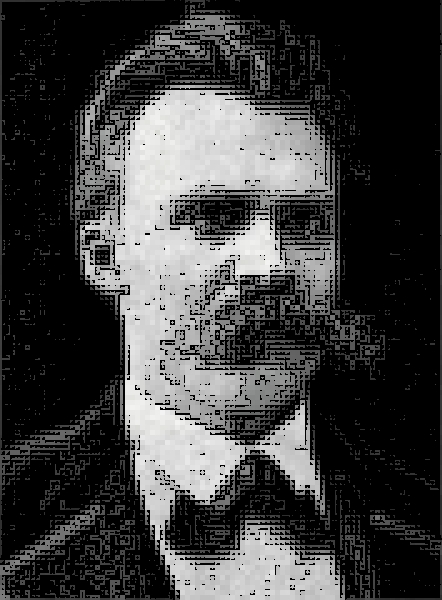
I’m working my way through Friedrich Nietzsche’s philosophical masterpiece, Thus Spoke Zarathustra. It’s easy to read, and more profound than I expected.

Take this quote:

The self says to the “I”: “Feel pain!” And at that it suffers, and thinks how it may put an end to it – and for that very purpose it is made to think.

The self says to the “I”: “Feel pleasure!” At that it is pleased, and thinks how it might often be pleased again – and for that very purpose it is made to think.

Nietzsche is saying that pain and pleasure aren’t just one small piece of consciousness. Rather, seeking pleasure and avoiding pain is the mind’s entire job, its sole function.

This defies tradition, and common sense too. We’re used to thinking of the mind as something noble and elevated, for which the body is merely a tool. Most people believe the mind can even exist apart from the body, as an immortal soul. Yet Nietzsche claims the mind is not a master but a slave, whose elaborate calculations serve only to avoid an ouch.

Here, you might say: “That sounds silly, but what’s the point of arguing about it? We’ll never know. We can’t test it one way or another, it makes no difference to anyone’s life, so this is all a bunch of hot air.”

I would’ve said that myself, not so long ago.

But one of the great beauties of artificial intelligence is that it’s a proving ground for philosophy, especially philosophy of the mind. (And after all, it’s all philosophy of the mind.)

Statements like “experience is the foundation of knowledge” seem airy and abstract. But to an AI engineer, it’s all very real. Every day, I write programming code that constructs the foundation of knowledge. When you’re building a mind, philosophical questions become practical.

And from what I’ve seen so far, I believe Nietzsche was exactly right. The mind is a noble, elegant, powerful thing, but at its roots, it has one main job: seek pleasure, avoid pain. Everything else is subordinate to that primary function.

You may argue that lots of people do things that could be considered pain-seeking: going to battle, even volunteering to be crucified. But I would say that these acts are driven by pursuit of a higher “pleasure” or a deeper “pain,” encoded in the conscience.

Well, you say, then isn’t my argument circular? Isn’t such a definition of pain and pleasure so broad as to be meaningless?

From a human, subjective viewpoint: perhaps. From the objective stance outside of the AI’s code: no, it’s not meaningless at all. Pleasure and pain are values that can be calculated and measured.

Of course, my AI design is not the only one possible. Even if my architecture works, it may be very different than how the human brain operates.

Maybe. But I don’t think so – not about this, anyway.

What’s on your mind this Monday morning?

Friday Links

nsi

Here’s North Sentinel Island: home to a tribe untouched by civilization. I don’t just mean they keep to their traditions. I mean, to this very day, they have virtually no contact with the outside world. They never leave, and they shoot visitors with arrows. No outsiders have explored the island, and because it’s covered in forest, nobody knows much about it. We think there are around 200 people there, but that’s just a guess. They have their own language, which nobody else knows. Even their political status is unclear: they’re kinda-sorta part of India, but there’s never been a treaty, so they’re in geopolitical limbo.

I suppose they don’t mind.

snow

Whenever there’s a blizzard, some poor reporter is always sent to the middle of it, trying to act like there’s anything to talk about besides look at all this snow. Finally, in this video clip, a reporter admits the truth. “I’ve run out of things to say. It is snowing and it sucks here. That’s pretty much it.” Amen.

onion

We all know those irritating people: the ones who are nice, successful, personally fulfilled, and have no real flaws. God, we hate them. Finally, The Onion calls them out on their shenanigans. Now, where did I put that cheeseburger?

This week is finito. Enjoy your weekend, and see you Monday!

Robo-Riddling

On Monday, I posed this riddle:

I thrive in gardens and in war.
I’m what drunk drivers oft ignore.
I am a thing no man can hear,
yet light a fire and I’ll appear.
When cherries rot, I also die.
I can’t be felt – but what am I?

Longtime blog reader momenteye asked an excellent question:

How would an AI approach solving this riddle?

Let’s talk about that!

Of course, I’m only going to tell you how my model of an AI would handle this. There are a million approaches to artificial intelligence, and I don’t claim to have the only right answer. The AI I’m building is named Procyon. What would Procyon do with this riddle?

We’ll start by asking: why is Procyon trying to solve this riddle in the first place?

At his most basic level, Procyon has two main impulses: seek pleasure and avoid pain. That may sound crude or hedonistic, but it’s only the foundation of the mind, not the mind itself. Humans are, I believe, built on the same foundation. Ideas as varied as pacifism, fascism, Zen, and even sadomasochism all derive, I think, from these two basic impulses.

(In a philosophy class, we might stumble now into a debate about the definition of “pleasure,” and whether the concept is really meaningful, etc. Fortunately, in an AI, it’s much simpler. “Pleasure” is what happens when this variable right here is set to True.)

The point is, Procyon isn’t working on the riddle because some high-level directive tells him that riddles are fun. He’s doing it because this kind of thing has brought him pleasure in the past. (And if it hadn’t, then he wouldn’t care about riddles.)

Similarly, his approach to figuring out the riddle doesn’t follow some crystal-clean logic that starts with a set of Riddle Axioms and derives an answer. Formal logic is good for a lot of things, but as a foundation for intelligence, it sucks.

Instead, Procyon compares his situation with similar scenes from his past. In effect, he’s asking, “When I’ve come across puzzling textual questions before, what did I do? Did I like the way that approach turned out? Then I’ll try to apply it here.” Though of course he may not explicitly think in those terms.

So how would Procyon solve it? The answer, like so much else, is simple but maybe unsatisfying: it depends. His approach will be based on whatever’s worked in the past, not on any pre-defined rules for Figuring Things Out. Kind of like how humans operate.

This strategy, which I’ve breezily summarized, turns out to be fiendishly complex in practice. When I talk about “similar scenes from his past,” for example, what do I mean by “similar?” How do I define a “scene?” What does this comparing his situation entail? And how does he “try to apply it here?”

As generations of AI researchers have learned the hard way, the devil is in the details. Just explaining my own approach to these questions would take a full-length book, and I’m still far from having all the answers. Likewise, Procyon in his current state is far from having any concept of what a question is, much less a riddle.

But he’s getting there, a day at a time. And so am I.

Image

Art Appreciation 101

artgirl

Frozen Ghost Town

Svalbard

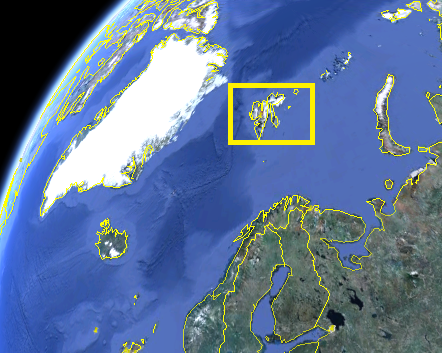
Deep in the Arctic, where the winters freeze flesh and the summers are ruled by the midnight sun, lies a rocky scrap of land called Svalbard.

In 1927, the Soviet Union set up a coal mining city there. It was home to over 1,000 Russians and lasted for seventy years. They called it Pyramiden, for the nearby pyramid-shaped mountain.

They built statues of Lenin. They imported a grand piano. Their “refrigerators” were just boxes sitting outside.

Then, on January 10, 1998, they abandoned Pyramiden, leaving behind what might be the coldest ghost town in the world.

I’ve written before about my fascination with remote places, and this spot hits all the right notes. Frigid mountains, remote island, brooding architecture. What I wouldn’t give to visit this place…

What’s that? I can?

Yes, in fact, the rest of the island is far from uninhabited. The largest city – Longyearbyen – has an airport, restaurants, and even tour guides. And as Pyramiden is only 50 kilometers away, it’s become an attraction itself. Visitors hoping to explore the lonely ruins are finding them ever less lonely. There are plans build a hotel. The Danish rock band Efterklang even recorded sound effects for their new album in Pyramiden. (Which, don’t get me wrong, is wicked cool.)

As a species, this is what we do: we explore, we domesticate, we make things safe and accessible and tidy. And sitting here in a warm thermostat-controlled house, sipping coffee, I hardly have room to complain. Still, there’s something sad about the taming of a ghost town.

We’ll just have to find someplace more remote to visit. I call dibs on Europa.

More pictures of Pyramiden here.

Riddle

I thrive in gardens and in war.
I’m what drunk drivers oft ignore.
I am a thing no man can hear,
yet light a fire and I’ll appear.
When cherries rot, I also die.
I can’t be felt – but what am I?

Friday Links

Peroxide

Did your parents ever put hydrogen peroxide on your cuts as a kid? Did it burn like a mofo? And did they happen to mention that hydrogen peroxide doesn’t actually disinfect cuts? Yeah, turns out, it’s good for killing bacteria on countertops, but not so much on skin. It can even inflame the wound, making it take longer to heal. H2O2 sucks, pass it on.

Tree

The next time someone insists that video games – or TV, or some musical genre – will unravel America’s moral fiber, just remember, people say that about every new thing. Everything? Everything. According to author Geoffrey Nunberg, paper mail in the 1850s “was alarming to moralists who complained that the postal system in general promoted promiscuity, illicit assignations, and the distribution of pornography.” Maybe the sky is not, in fact, falling?

Gosling

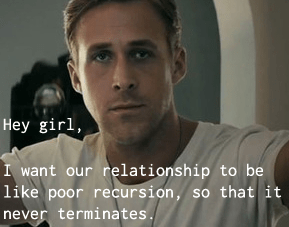
So, this exists: ProgrammerRyanGosling.tumblr.com. “Hey girl, did you lose a timestamp? Because I’m pretty sure it’s DateTime.Now()”

ManicPixie

Sinfest offers its take on the “Sensitive Dudebro Coming of Age Film.” It’s sad how many movies can be reduced to these four panels.

QC

Meanwhile, QC takes on weddings. This happens to me every. Single. Time.

Thanks for playing along, Hypothetical Reader! See you Monday, and have a weekend of mythological proportions.

Sick

No post today. 😛