My computer died this morning, so no Friday Links. It’s vacation time anyway.
Merry Christmas, Happy New Year, and I’ll see you in 2013!

My computer died this morning, so no Friday Links. It’s vacation time anyway.
Merry Christmas, Happy New Year, and I’ll see you in 2013!
Posted in Uncategorized
Yoda vs. Godzilla:
I see
rose-colored stars the size of basketballs,
violet rays spinning like dervishes,
cloudbursts ebbing to explode again
and then again, tracing swift nebulae
on all the parsec breadth of that
stern and sable canvas.
I see
sounds, the artful decibels twisting
to plunge across my retinas, painting
the rustle of furtive phantoms
who flee in serried bands
from the black, blind nightmare hunters
thundering like dark aurorae
through the aether.
They will ask
what it means, seeking idly for allegory,
pondering how to forge a syllogism
from axioms of spirit: but the sun
is not yet risen, and in the strange hour
when sleep yet lingers on the waking world,
we may sometimes forget to mean
and only see.
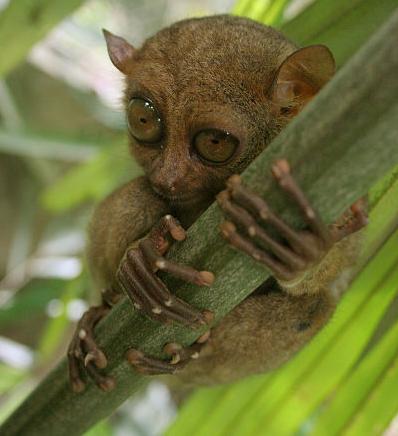
What is this guy? He’s a tarsier, one of the smallest primates on the planet. They live on the islands of southeast Asia: the Philippines, Borneo, Sumatra, and thereabouts.
If they look cute (and they do), consider that they are the only completely carnivorous primate in the world – although in their case, “carnivorous” mostly means they eat bugs. God bless Wikipedia, it says they catch insects, quote, “by jumping at them.” That sounds amazing.
The coolest thing about them by far, though, is those giant eyeballs. Supposedly each eyeball is the same size as its entire brain.
I like italics. Here, have another tarsier picture.
Despite what you’d think from the photos, they’re mostly nocturnal.
Why are they called “tarsiers,” you (probably aren’t) wondering? Great question! The name comes from the elongated tarsus bones in their feet.
Speaking of elongated, check out the tail on this little dude:
Wikipedia also claims, “Scientists are interested in these animals because of their unique taxonomic position in the order Primates.” Bollocks. Scientists are interested in them because they are adorable.
Some of you may have noticed by now that I have blatantly just copied a Wikipedia article and called it a blog post. I REGRET NOTHING TARSIERS ARE AMAZING here, watch a video of a tarsier eating a cricket. For science.
In conclusion: tarsiers.
Tell me, what cool animal do you think is underappreciated?
Posted in Uncategorized
This is what Christmas looks like at our house:
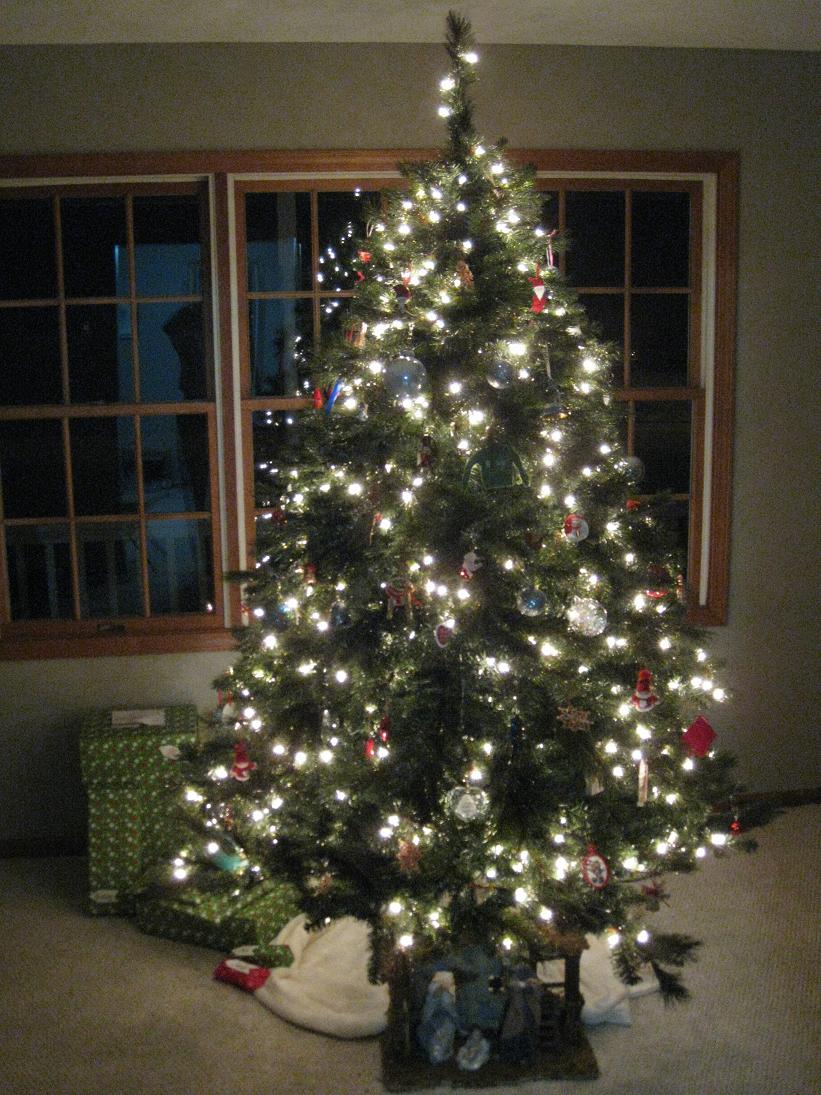
For those who celebrate Christmas: what are you giving this year?
For those who don’t: what’s the next holiday you’re looking forward to?
Posted in Uncategorized

If you like Star Trek and Monty Python, this mashup may be the funniest thing you see today. Everyone else: move along!

The ultimate First World Problem: we’re using so much data that we’re running out of words to describe it all.
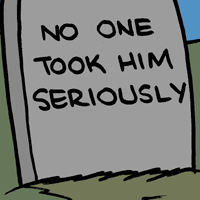
SMBC imparts life lessons in the traditional way: via tombstone.

And finally, Two Guys And Guy suggests an alternate way to do your Christmas shopping.
See you next week!
Yoda vs. a random ninja:
Yoda vs. James Bond:
I heard recently about an idea called “1,000 Gifts,” where you keep a sort of journal of all the little things you’re grateful for – the small gifts of life – until you reach a thousand. The idea is to cultivate a spirit of gratitude, of appreciation for the minute-by-minute miracles that happen around us, mostly unobserved.
(Apparently there’s a book. I haven’t read it, and I’m not much for the Christian Inspiration genre anyway, but I like the thought.)
I’m a long way from reaching 1,000 on my own little list. But today is 12/12/12: the last Gregorian trifecta for almost a century (until 1/1/2101). So I thought it was only appropriate to share 12 gifts, things that make me grateful:
1. The joy of writing computer code that does exactly what I want.
2. Small pains, like a pinched nerve or a strained wrist, that remind me I’m alive.
3. The constellations of light on my Christmas tree.
4. Reading a good book in the morning.
5. The soft, satisfying clack that computer keys make as I type.
6. The frigid December air.
7. Breathing.
8. The spiciness of hot chili for dinner.
9. The cold sharpness of Corona Light.
10. Webcomics.
11. The infinite beauty of fractals.
12. My wife, Betsy, who is the most wonderful person in my universe. She’s also the one who reminded me about the unusual date today.
What are you thankful for?
Posted in Uncategorized
A couple days ago, while reading Marco Polo’s account of his travels, I came across an interesting word: cachalot.
I had no idea what it meant, but Wikipedia – as always – held the answer. A cachalot is a sperm whale.
I love this word.
On the face of things, it’s completely useless. It’s so obscure that almost nobody will understand it, so obscure that Firefox insists even now that I’ve made a spelling error. It means exactly the same thing as “sperm whale,” so it’s completely redundant. This is exactly the kind of word that would be first on the chopping block in a newspeak regime.
But say it out loud – I mean actually try it. “KASH-uh-loh.” (It can also be KASH-uh-lot, but I think we can all agree that the long “o” and silent “t” make it sound 30% suaver and 45% more debonair.)
KASH-uh-loh. Cachalot.
It comes from French, of course, though its precise origins are hidden in the murky depths – much like the creatures themselves. One theory is that it’s based on an old French word for “tooth.” But my go-to source for etymology hasn’t even heard of it.
Some folks are so enamored with the name (and so dissatisfied with the current term) that they’ve launched a campaign to replace “sperm whale” entirely. Personally I think my time might be better spent on other causes, but there’s no denying the word has a poetic power.
And when I look at the animal itself…
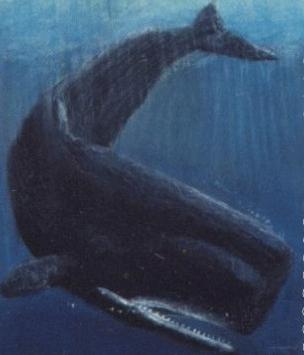
…I can certainly appreciate the majesty of a word like “cachalot.”
What useless word do you enjoy?
Posted in Uncategorized
I have often said that nothing brings me greater pleasure than watching the deductive powers of my friend Sherlock Holmes in action; but in all the years I have known this incredible gentleman, none of his cases ever caused me greater astonishment, or wonder at his intellectual capacity, than the one I am about to recount.
I recall the incident very well. It was a winter evening in 1889, and stirring in my soul I felt the curious mix of ennui and masochism which invariably leads me to seek out Holmes’s company. Mrs. Watson beseeched me not to go, employing various arguments and womanly enticements that I should stay, but my affections for her had always been minimal. Therefore while she was out one day shopping for herbs and remedies to make her face less hideously pale, I took up my coat and hat and went out to visit my companion.
I found him reclining in his favorite chair, examining some scrap of paper, and he looked up with a modicum of interest as I entered his flat. “Werstmann, dear fellow!”
“It’s ‘Watson.’”
“Whatever. I have been expecting your arrival. Do come in.”
“Expecting me? But how?”
“Simplicity itself. I deduced it, of course, by the sound of your footsteps as you approached.”
“But how could you know it was me?”
“By your smell,” said Holmes. “But never mind that, Watson. Your timing is convenient. I have major news to reveal, for which you will be the perfect audience.”
I could see at once that he was in one of his rare lucid moments that occasionally came between his month-long experiments with cocaine. I took a seat by my friend and endeavored to listen as best I could.
“Well, what is your news?” said I.
“My parents have been murdered,” said he.
“Murdered!” said I. “But how awful! You have my deepest sympathies, dear chap.”
“Nothing of the sort,” said Holmes. “You are being quite absurd, Watson, as usual. You know I am utterly without sympathy for any human being (excepting myself), and naturally I am glad of a chance to practice my detective skills. Hence I am elated at my mother and father’s demise.”
“Of course it seems obvious, when you explain it. But who can the murderer be?”
“Who, indeed?”
A long silence followed.
“I don’t know,” said I.
“Nor should you,” said he, “as I have not yet explained. But for once I will dispense with my habitual flourishes and reveal the criminal’s identity at the outset. The murderer is none other than you, my dear Watson.”
“What!” I cried, for on the face of things, I confess it seemed quite impossible. Such was my naïveté.
“Yes, indeed!” said Holmes, smiling in amusement at my obvious surprise. “Only two days ago I travelled to Southampton to pay them a visit, and discovered them hanging by the neck from a couple of nooses in the drawing-room. You, Watson, forced their heads through the nooses and left them to die. Rather more heartless than I have come to expect from you, I daresay.” His mirth getting the better of him, he chuckled briefly. Amusement was his second-favorite emotion, I recall, just after hubris, and just before annoyance.
“But how have you deduced that I am the culprit?”
He passed me the scrap of paper he had been examining. “Tell me what conclusions your limited faculties can draw from this evidence.”
I looked it over carefully. It was a single sheet of notebook paper. On it, in black ink, was written the following:
Sherlock,
We heard you were coming for another visit. We simply cannot abide you: your arrogance, your veiled insults, your non-veiled insults, your insufferable flatulence. As our decision to disown you and our endless entreaties to stop visiting have evidently made no impression on you, we are left with no other alternative than suicide. We can only hope that our deaths will serve as a warning to that impressionable young doctor whose name you can never remember, to cease his association with you forever.
Your former parents,
Ackerly and Elvina Holmes
“Suicide? But you said – “
“Watson,” said Holmes impatiently, “I already deduced that that side of the note is of no consequence. Can you not see I have crossed it out? Turn the paper over and look at the murderer’s note.”
I, Dr. John H. Watson, have killed the parents of Sherlock Holmes.
“But Holmes,” said I, “this is your own handwriting!”
“Not at all! Here, I will show you a sample of my own handwriting, and you shall see it looks nothing like this note.”
“But what do you mean? This is the London Times.”
“No, Watson, I have copied the London Times in my own handwriting to show you what it looks like. The fact that my handwriting looks exactly like the Times typography is only a testament to how amazing I am.”
“I see,” said I. “I must confess I never noticed it before, but your evidence admits of no other interpretation.”
“Quite,” said he. “And there is other evidence as well. There are calluses on your hands from handling the rope you used to make the nooses.”
“Actually, I have worked hard throughout my life, so it is not unnatural that I – “
“Watson,” Holmes interrupted, “when you have eliminated the impossible, whatever remains, however improbable, must be the solution.”
Holmes said this often, and it was as relevant then as ever.
“There is only one problem with all this,” said I. “I have an alibi, you see. I have been in London for the past week. Here, this is a picture of myself standing in front of Westminster Abbey, holding a newspaper that is clearly dated – “
Holmes seized the photograph and tossed it into the fire.
“What the devil did you do that for!”
“Do what?”
“Throw my picture in the fire!”
“Watson, I did nothing of the kind. But it should be no surprise that your memory is flawed, as you cannot remember murdering my parents either.”
“But I can still see it burning in the fire.”
Holmes seized a poker and stabbed at the photograph until it was quite indistinguishable from the rest of the ash. “And now?”
“I admit that I can no longer see the photograph, or provide any evidence that it existed.”
“Naturally,” said Holmes.
“Your argument is quite convincing. I would never have suspected myself of the murder, but then, I suppose that is what makes it such a perfect crime – a crime so perfect that only your exquisite mind could have yielded the solution! But tell me, what was my motivation?”
Holmes rolled his eyes. “Stupidity. Now, if you will excuse me, I must of course call the police to have you arrested. I hope you will not object, dear fellow?”
“Not at all,” said I. “Will you be posting bail for me?”
“No.”
“Quite all right. I shall give a full account of my wrongdoings. How very remarkable that you have uncovered it all! But tell me, Holmes, when they put me in prison, who shall remain to validate your impossibly inflated ego?”
“Nonsense,” said he, but I could tell I had upset him; and as the constables dragged me away, I almost fancied that I heard, coming from the direction of his door, the sound of inconsolable tears. And indeed, it was not long before he broke me out of prison and I was free once more, a testament to his abiding friendship.
[I wrote this three years ago for a friend, after I had finished reading a bunch of Sherlock Holmes stories.]




 Brian D. Buckley


