Friday Links & A Bit More Calligraphy

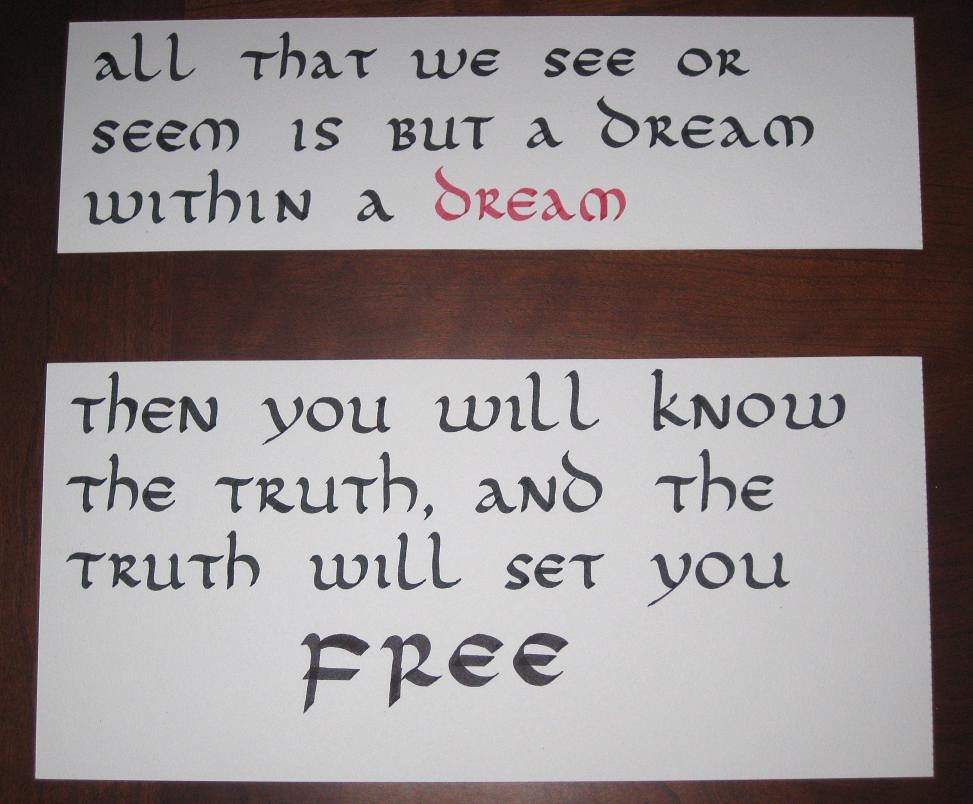
I’ve branched out into a new style of calligraphy, called uncial. It’s even older than blackletter, and was used in a lot of Irish writings, among other places. What do you think? (Click to enlarge.)

Uncial

On to the links…

Mars

So, that big NASA announcement? May not be so much “one for the history books” after all. The Curiosity rover found a few nonliving organic compounds…that may or may not be contamination from Earth. Keep watching, I suppose.

Unicorn

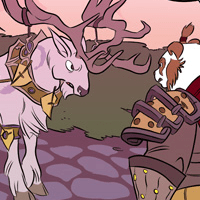
Meanwhile, the existence of unicorns has been proven…by, uh, the North Korean state media. Well, I’m convinced.

PA

Penny Arcade enlightens us on the true meaning of Christmas World of Warcraft.

PvP

PvP also has a WoW comic, but they – ahem – delve a little deeper.

That’s it for this week. See you Monday, and have a stellar weekend!

Brian Answers: Would You Live Forever?

Today, on our final Ask Brian Anything post, Shaila Mudambi wonders:

Do you want to be immortal and why?

If by “immortal” you mean that I would literally never die, ever, this would be pretty terrible. Fast forward a trillion trillion years: every other person or being everywhere is long dead, the stars have gone out, the universe is nothing but infinite frozen darkness – and there you still are, floating, powerless, alone, conscious for all of time. That kind of immortality is basically hell.

Generally, though, “immortal” means something a little more limited: you don’t die of old age or sickness, but you can be killed, by murder or suicide or just falling into a giant pit of molten sulfur. (Uh…for example.) This kind of immortality is much better, and if that’s what you mean, then my answer is an emphatic yes.

Imagine what you could do with a hundred thousand years!

You’d be master of anything you cared to study, just because you’d have so much time. A hundred years for calligraphy, a hundred years for computer programming, a hundred years to just read, and read. Think how much you could learn. Think how much money you’d have, with interest accumulating over the centuries.

Think how much good you could do in the world, with that much money and knowledge.

And think of getting to see what we mortals can only dream about: the future of the human race, the story unfolding as we write it. Will there really be a technological Singularity? Will we colonize other solar systems, and will we find life there? Will we ever have anything like world peace? In ten million years, what will we have evolved into? What is the ultimate potential of our species?

Yes, I would like to be immortal.

You hear a lot about the downsides of living forever – or at least, for millennia. Over and over and over, you watch your loved ones die. You get tired of life, weary of existing. You’ve seen too much. Et cetera.

On this, I call shenanigans.

Yes, those drawbacks exist, but I think the sheer potential of what you could learn and do and achieve vastly outweighs them all. What’s more, I think that the longer you live, the more strategies you could acquire for dealing with this accumulated sorrow, or existential weariness. You might, for instance, achieve Zen enlightenment, rendering the whole thing moot. The possibilities are so much vaster than our capacity to imagine them.

Now, through all of this, I’ve made the typical assumption that (semi) eternal life means (semi) eternal youth. But what if that wasn’t the case?

My good friend Adam asks:

Just to over simplify the situation a bit… assume for a second the singularity happens and you can become immortal… how will your answer to Shaila’s change if aging can not be reversed? Will you accept immortality at age 80 vs. 50?

Yes.

The fact is, I’m an old man already, in spirit if not in body. I’ve never been athletic. I go for walks, not runs. I sit at home reading and writing. I love to travel, but when I do, I mostly walk around looking at things and trying new foods. I could do all of that just as well at 80 (and I fully intend to). Centuries more of that would still be a priceless gift.

That’s assuming I’m a reasonably healthy 80. I’d still be okay with having a fair number of health problems, too – but at some point, if things are so bad that you’re doing more suffering than living, immortality really would just be a burden. So in that case I’d say no.

But it would have to be pretty bad. Because immortality sounds friggin’ amazing.

Well, that concludes Ask Brian Anything Week. Thanks to everyone for asking, and for reading! What did you think? Is this something I should do again in, say, six months or a year?

And would you want to be immortal?

Brian Answers: What Would You Lie About?

Today’s Ask Me Anything question arrives courtesy of longtime reader Jo Eberhardt:

What is the one question you wouldn’t answer honestly, no matter what?

This question is especially interesting to me, because as it happens, I’m a very honest person. Maybe it’s just my upbringing, but for whatever reason, I’ve been honest nearly to a fault ever since I was a little kid. This, in turn, has made me think a lot about the ethical foundations of honesty, and when lying really is acceptable.

I can think of two major reasons for telling the truth.

First, there’s trust: the more honest people are, the more they can trust each other. And trust has a wide array of benefits, from personal relationships (like marriage) all the way up to international diplomacy. Without trust, society falls apart.

My second reason is more nebulous, and would be harder to defend in a pinch, but here it is: I believe there is something inherently beautiful, or noble, about the truth. I feel that one of the great purposes in life is to understand the universe, and to that end, truth is a step forward and lies are a step backward.

With that in mind, I would say that lies are justified when the ethical good they can do (or the harm that the truth could cause) outweighs the benefits above. The classic example (at the risk of invoking Godwin’s Law) is if you’re hiding some innocent person in Nazi Germany, and the Nazis come banging on your door, asking if you’re hiding anyone. Of course you lie, because the need to save a human life is vastly more important than anything else in that situation.

That’s an extreme example, but it can act as a guide for thinking about ethics.

(To be clear, I’m not nearly as saintly as all this makes me sound. I certainly have lied for no other reason than to cover my own ass. Not too often, and I’m not necessarily proud of it, but it does happen.)

So. That was a long-winded philosophical monologue in reply to a simple question that I haven’t even answered yet: “What is the one question you wouldn’t answer honestly, no matter what?”

The short answer is that I can’t think of a single specific question I would never answer honestly. Rather, it’s a whole class of questions that I would lie about, according to the guidelines above. So much depends on context, and especially on who’s asking.There are very, very few things I would lie to my wife about; there are many more things I would lie to a stranger about, though still relatively few.

Not sure if that was a satisfying answer, but I’m afraid it’s the only one I have. Thanks for the question, Jo!

Tomorrow is the last “Brian Answers” post. I’ll respond to questions from Shaila and Adam about immortality (w00t!).


Brian Answers: Where Are We Headed?

The next Ask Me Anything question comes from Zeev:

Let’s give you an all encompassing question.

“Where do you see the United States in 20 years?”

Will it still be a world superpower? Or more like the British empire past its prime with waning power over the rest of the world?

Where do you see the US citizens? Happy? Prosperous? are we a Plutocracy? an Oligarchy? how’s the wage gap? how’s our civil rights record looking?

Feel free to include any an all ideas that you have on the future, the previous were just suggestions and not mandates.

The year is 2032, I’m forty-seven years old, Sony’s just released the Playstation 9, and we’ve discovered we’re all living in a computer simulation. What else is new? Of course, nobody knows, but these are my (somewhat) educated guesses.

On the world stage, I think we’ll continue to be a superpower. As I’ve mentioned before, the U.S. spends as much on its military as the next nineteen countries combined, and has more aircraft carriers than the rest of the planet put together. I don’t see that changing drastically anytime soon. The biggest danger I see militarily is that we’ll spread ourselves too thin. However, the quagmires of our involvement in Iraq and Afghanistan, and the far more successful and cheaper (in blood and money) action in Libya, have hopefully imprinted a distaste for entanglement on our collective psyche – at least for a while.

It does seem likely that our military dominance will become less overwhelming, due to the rise of countries like China, India, and Brazil. We worry a lot about China, and rightly so, but its leaders seem to crave stability more than anything. I don’t see them launching World War III, recent saber-rattling with Japan notwithstanding.

And there are other reasons for hope. In general, the world is slowly, slowly getting more democratic: witness the Arab Spring, the reforms in Burma, and last decade the revolutions in eastern Europe. Democracies tend not to fight each other, so this, too, is a sign of stability. Meanwhile al-Qaeda is weaker than ever – not that it was ever, statistically speaking, much of a threat. Americans on their home turf have always been more likely to be struck by lightning than killed in a terrorist attack.

Enough about geopolitics. What about at home?

For starters, the Republican Party is facing a pair of crises, and they know it. The first is a growing split between the moderates and the Tea Party; the second is demographics. Republicans are overwhelmingly losing the black and Latino vote, which is an ever-growing share of the electorate. I think they’ll find a way to adapt, but that will mean some significant changes to their platform over the next 20 years.

In terms of civil rights, marriage equality is perhaps the major battle of our time, and on that front, we’re making enormous progress. I’ve written about that recently, so I won’t belabor the point here. But I think same-sex marriage will be far less controversial twenty years from now, and thank goodness for that.

I’m painting a rosy picture so far, but of course we do face enormous challenges. Debt continues its long, slow spiral out of control, and despite all the talk recently about reining it in, I haven’t seen much hope that it’s going to happen. Our K-12 schools are failing even as our universities get more expensive. The threat of nuclear war, which has faded since the fall of the Soviet Union, never disappeared – and our drone strikes are winning us few friends in nuclear-armed Pakistan. (Although India is probably a more likely Pakistani target, if it comes to that.) And, of course, we’re still in the midst of a global economic crisis, and humanitarian crises in Syria and elsewhere.

Overall, though, I tend to be broadly optimistic. We’ve survived the Civil War, the Great Depression, two World Wars, and the Cold War. As problems emerge, we adapt. One way or another, we’ll figure it out. (See, I’m reciting platitudes – take that, dictatorships!)

I’ve written a lot, but of course I’ve necessarily left out a lot. I haven’t even mentioned privacy concerns or the exponential growth of technology. But my time and your attention are limited, so I’ll cut it short.

What do you think about the question or my answer? Leave me a comment!

Tomorrow I’ll answer Jo Eberhardt‘s question: “What is the one question you wouldn’t answer honestly, no matter what?”

Brian Answers: Is This the Real Life?

A little while ago, I put out the welcome mat to ask me anything and be guaranteed an answer. And you responded. What’s more, your questions were so intense, so thought-provoking, that I decided that cramming all the answers into one forty-minute post would be a crime (or at least a misdemeanor).

With questions this good, each one deserves its own post in answer. So all this week, I’ll be answering questions.

Here’s the first, from my good friend Ben Trube:

Okay Brian, I know you’re the right person to ask this question:

“Are we living in a computer simulation?”

Some potential source material and my inspiration for the question: NPR article

This is a great question, and as the article points out, people have been asking it long before The Matrix came out – indeed, long before computers were even invented. The puzzle of whether reality is “real” has kept philosophers busy for about as long philosophy has existed.

And the answer is simple: it’s utterly impossible to know. We can’t even speak meaningfully about how likely it is that we’re in a computer simulation.

Here’s why.

There are certain properties we would expect a computer simulation to have: finite computing resources, logic errors, and so on. Conceivably, you might design experiments that could test for these properties. So why do I say it’s impossible to know?

Simple. Because all of our ideas about how computers work are based on computers in this reality, which – if we’re a simulation – might be nothing like how computers operate in the “real” reality.

Our parent reality might have totally different laws of physics. It might even have different laws of logic. Two and two might not equal four. Since our entire lives have passed inside this reality, we have to concede that we have absolutely no basis for even speculating about any other reality.

So if our experiments didn’t find evidence of a computer simulation, that could just mean that we have no idea what “real” computers are like. Conversely, if we did find evidence, it could just mean that our reality happens to have properties of what we think of as a computer simulation; it says nothing about whether our reality matches the properties of a “real” computer simulation, which is unimaginable to us.

The NPR article you referenced quotes philosopher Nick Bostrom as saying that we’re “almost certainly” living in a computer simulation. But he makes the same logical error I just described: all his reasoning presupposes a “real” reality with the same properties as our own. There’s just no basis for such an assumption.

Okay, so we have no idea whether we’re made of baryons or bytes. A follow-up question might be: does it matter? Occam’s Razor says that if a hypothesis makes no observable predictions (that is, if “real” reality and simulated reality are subjectively identical) then it’s not worth worrying about.

But that’s a pretty big if. It could be, as in The Matrix, that waking up from the simulation has profound implications. It’s a question worth asking.

And a question that’s impossible to answer – just as Neo can never know that Zion is the real world, and not just another Matrix.

What do you think? Am I right, or did I miss something? Let me know in the comments!

Tomorrow, I’ll answer Zeev’s question: “Where do you see the United States in 20 years?”

Friday Links & Calligraphy!

Earlier this week I asked for calligraphy requests, and you responded. Anthony Lee Collins requested “The Dude abides,” a Big Lebowski quote, while my good friend Zeev went for Serenity quote “I am a leaf on the wind, watch how I soar.” Both excellent choices. Below are those two quotes, along with some others I’ve done in the past few days. Click to enlarge.

The most badass leaf-related quote of all time.

Also considered: Roflcopter

On to the links!

Try *this* on a Kindle.

The single coolest thing I’ve seen all week: a German dude created this gorgeous copy of Tolkien’s The Silmarillion, illuminated by hand medieval-style, over the span of a year. Can you imagine how much the highest-bidding Middle Earth fan would pay for this?

Yay for text

This is old news, but it was news to me. They’re actually, finally, no-joke making an Ender’s Game movie, to be released November 1, 2013, with Harrison Ford as Colonel Graff. W00t!

VELCOME TO MY BRIDGE

Cracked.com has a list of the 6 creepiest places on earth. How about a forest in Japan where people go to kill themselves? Or a bridge (pictured above) where dogs go to die? Yeesh.

You're on Candid Camera!

The Mars Rover has found something cool – “one for the history books,” according to NASA – but they won’t tell us what it is yet.

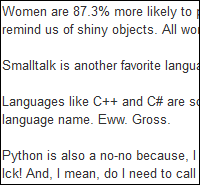
87.3% of statistics are made up on the spot.

The ridiculously sexist question “Which programming language is the most female friendly?” gets the ridiculous answer it deserves. Flawless victory.

I would play the *shit* out of this game

And finally, one more from Cracked.com, because I’m obsessed with them, apparently: a screenshot of Super Mario Bros. as played from Bowser’s point of view. Seriously: where can I buy this game?

See you next week!

Postmortem: Dracula

Get it? Dracula postmortem? Oh ho ho!

Ahem.

Bram Stoker’s Dracula is, of course, the quintessential vampire story, the grandaddy that spawned a genre still alive and kicking today. Stoker’s novel, published in 1897, didn’t invent the idea of the vampire – that was a much older myth – but it became the defining portrait of the creature for generations to come.

Reading it in 2012, therefore, is interesting for several reasons.

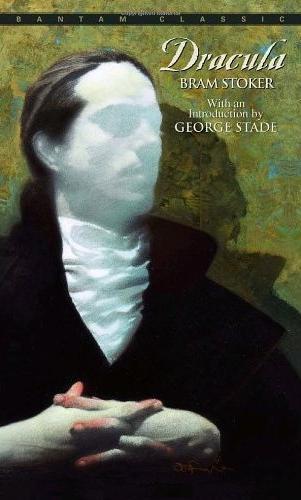
First, because it strips away a century of accumulated embellishment and returns you to the core tale. Most of the popular image of Dracula (tall, aristocratic, pale and creepy, East European accent) is accurate, but there are odd disparities. For instance: he has a mustache. This is so at odds with our modern perception that it isn’t even included on the cover, but it’s right there in the text. Dracula also has a host of supernatural abilities, including the ability to turn into a wolf or a large dog – which, today, would be more associated with werewolves, who are considered vampires’ enemies.

It’s interesting, too, because the novel presupposes a reader who no longer exists today: somebody who’s never heard of the Count. It’s hard to keep from laughing throughout the novel’s first fifty pages, as Jonathan Harker keeps thinking there’s something not quite right about this charming Count Dracula fellow. He lives alone in a castle, he only comes out at night, never eats, doesn’t have a reflection, is obsessed with blood…what could it be?

Putting aside the book’s status as a cultural icon, the novel itself holds up quite well even after a hundred years. It’s told in the form of diary entries, letters, telegrams, and newspaper clippings, which lends an air of verisimilitude to the work of fantasy. The first part – with Jonathan Harker traveling to Castle Dracula in Transylvania as the Count’s guest – is excellent, full of shadow and portent. Wolves – which the Count calls “the children of the night” – howl outside, and Harker becomes increasingly frantic as he realizes he’s trapped.

Dracula then travels to London, where the supply of blood is more plentiful. Here we acquire an ensemble cast of characters: Mina, Jonathan’s girlfriend; Lucy, Dracula’s first English victim; a handful of other, largely interchangeable, dudes who are all in love with Lucy; and of course, Professor Abraham Van Helsing, the only other character in the book that anyone remembers.

The London section of the book is also pretty good, with suspicions gradually increasing as nocturnal hijinx accumulate. Eventually, Van Helsing convinces everyone that Dracula’s gotta go, and the whole group works together to hunt him down. They eventually drive him back to Transylvania, where they finally (spoiler alert) kill him.

This final section of the book, which spans over a hundred pages, is also the weakest. The mystery is gone, replaced with the fairly complex mechanics of supernatural combat. Dracula himself spends most of his time not only offstage, but asleep in a box that other people are carting around for him. So, basically, they’re hunting a box. The climactic final scene? They open the box, find Dracula still comatose, and stab him. There’s a little more drama than that, but not much.

Still, a very solid read overall. For a book that’s over 400 pages, I tore through it pretty quick. Recommended to anyone who likes vampires or Victorian angst.

Or boxes.

Yoda vs. Everybody 17 & 18: Charlie Brown and Spock

Yoda vs. Charlie Brown:

Yoda vs. Spock:

How Old is “Old”?

There’s a line from the song Strawberry Wine that says: “I still remember when thirty was old.”

I’m twenty-seven now, but I don’t think I ever, even as a little kid, thought thirty was old. I’m not sure what I’d say, though, if I had to give a number. NPR did a story once where they said that as we age, we just move the “old” line back to whatever the next decade is, so that even eighty-year-olds think of ninety as the “real” old.

Which makes a kind of sense. Age is relative, after all. And we grow up thinking of “old” as something that happens to other people, so it’s strange to apply it to yourself when you’re still the same you inside.

Someday – hopefully – I will be eighty years old. It’s a strange thought. And yet, not so strange. Betsy and I both say that we’ve been old for years: we don’t like loud music or late parties, we tend to stay home, our joints hurt, and we listen to the Beatles. Hell, I’m reading Dracula right now, and that was published in 1897. Will it really be so different when my body catches up with my brain?

Another unusual wrinkle for me personally is that I think we are headed, sooner or later, for a Technological Singularity. I think that someday, technology will advance to the point that people live forever. And I think there is a small but very real chance that this will happen in my own lifetime, and that I personally could become immortal.

It’s certainly not something that I’m counting on or particularly expecting, and I realize it may sound bizarre. But when I think about getting old, that’s out there, too. Who knows?

Well, I’m rambling now. Just another sign that I need a cane and a rocking chair.

Remember, you still have till the end of the week to ask Brian anything!

Geek Calligraphy

Welcome back, hypothetical reader! Hope you had a wonderful Thanksgiving (for you Americans), and that everyone else had a superlative Thursday.

I went Black Friday shopping and bought…

dun dun dun

…a calligraphy pen. No particular reason. An impulse buy, really – just a simple felt-tipped deal, four dollars at Hobby Lobby.

I then learned how to write Blackletter (also known as “Gothic script” or, somewhat incorrectly, “Old English”) and spent hours practicing obsessively over the weekend. My pen ran out of ink, so I got five new ones (black, red, green, blue, brown) from Staples.

What happens when you teach calligraphy to a geek? You get, uh, geeky calligraphy.

Click images to enlarge.

Gothic Blackletter calligraphy: Live long and prosper.

Gothic Blackletter calligraphy: Honey Badger don't care.

Gothic Blackletter calligraphy: The Cake is a Lie

Gothic Blackletter calligraphy: Haters Gonna Hate

Gothic Blackletter calligraphy: May the Force be with you.

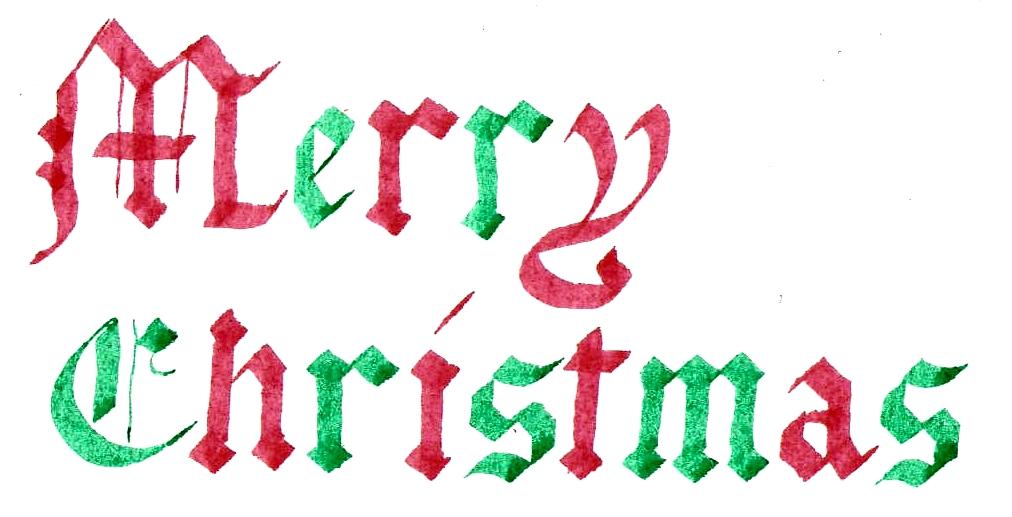
Gothic Blackletter calligraphy: Merry Christmas

Any suggestions for other phrases to try?

Don’t forget, Ask Brian Anything is open till the end of the day Friday. I’ve gotten three excellent questions already, so add yours to the list! I will answer every question I get.

See you tomorrow!