Tag Archives: Postmortem

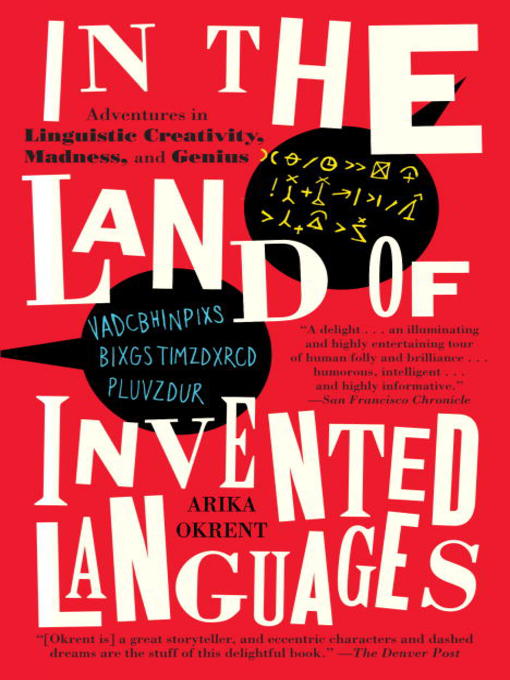
Postmortem: In the Land of Invented Languages

Languages

Ever heard of a language called Esperanto? Hundreds of thousands of people speak it worldwide, yet it’s not the official language of any country. That’s because it’s a constructed language, something invented by Ludwig Zamenhof in 1887. He wanted an international auxiliary language, easy to learn, belonging to everybody, owned by nobody, to promote world peace.

Or perhaps you know about Lojban, a more recent language created to be unambiguous and grammatically precise.

Arika Okrent’s In the Land of Invented Languages is a whirlwind tour of these and many others, from Hildegard of Bingen’s Lingua Ignota in the twelfth century, down to Star Trek‘s Klingon in the modern day.

And it’s utterly fascinating.

Part of it is the sheer variety of languages themselves, each trying to fill a different niche in the vast sphere of human activity – like John Wilkins’ philosophical language, where the structure of each word describes the meaning of the word itself.

Part of it is the personalities involved – like Charles Bliss, who was so controlling and erratic that he made it almost impossible for anyone to actually use his “Blissymbols.” He demanded (and received) $160,000 from a center for disabled children as part of a settlement involving his language.

And a big part of it is Okrent herself. Her style is light, quick, and full of vivid detail, which makes her a delight to read. Even better, she leaps into her research, going to Klingon-speaking conventions to see firsthand what it’s all about. You couldn’t ask for a better guide.

If you’ve ever wondered about made-up languages, this is the book for you.

Postmortem: The Myth of Sisyphus

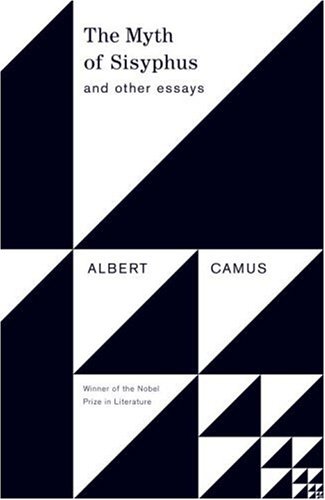
The Myth of Sisyphus

Sisyphus, for those who don’t remember, was the poor fellow in Greek mythology condemned to forever push a boulder up a mountain, only to have it roll back down to the bottom at the last moment.

Albert Camus’s 1942 work, The Myth of Sisyphus, is a long essay on philosophy. I read it this weekend. I can’t say I understood it all, but my personal summary matches pretty well with what I read on the Internet, so I suppose I got the gist.

The Myth of Sisyphus begins: “There is but one truly serious philosophical problem, and that is suicide.” The entire essay is, essentially, about whether or not it makes sense (from a philosophical standpoint) to go on living.

(Note for those concerned: I am not suicidal, I just like philosophy. No worries, mate.)

Camus says that the human condition consists of two elements. There is the human mind, which seeks meaning, order, and unity; and there is the universe, which (despite the heroic efforts of science) remains ultimately chaotic and meaningless. When these two meet, the mind recoils or revolts, giving rise to a condition he calls “the absurd.”

So far, I’m with him. I think this is basically how life is. Life isn’t necessarily horrible or evil, it’s just…there. And it doesn’t care what we think about it. Life is absolutely insane, if you ever stop to think about it. Camus is right on the money.

He then writes that the only solution to this absurdity is to embrace it. Not suicide, but constant revolt, is the answer. Living life on your own terms. Taking in the good, the bad, and the ridiculous all alike. Never giving up trying to understand, even though you never will. Hopelessness without despair.

Camus writes that we must imagine Sisyphus as happy, because he has embraced his own destiny, hopeless though it may be. He has his boulder and he knows his fate, and he gazes on it without flinching. This is the ideal, the so-called absurd hero (using the term “absurd” in a positive sense).

What do I think about all this?

As I said, there’s a lot that I don’t fully understand in this essay. I’ve presented it rather simply; however the text of his book is anything but, full of references to other philosophers and complex arguments.

If I understand correctly, though, the essence of the book is carpe diem, seize the day, which I’m fully on board with. I’m also on board with not suiciding. I’m less on board with a life sans hope, but I think I can see what he’s trying to say there too: it’s not about despair, it’s about grasping fully what is, rather than hoping for what is not. Another element of carpe diem.

Of course, Camus also assumes death is inevitable, while I haven’t yet ruled out the possibility of eternal life (without religion) in this world.

What do you think?

Postmortem: Stranger in a Strange Land

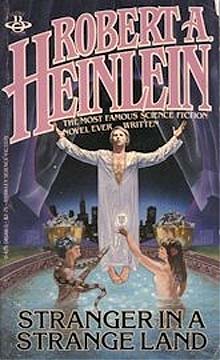
siasl

Robert Heinlein’s Stranger in a Strange Land sits high in the pantheon of sci fi, on the same shelf as Asimov’s Foundation, Clarke’s 2001: A Space Odyssey, and Herbert’s Dune. The cover of my copy claims it’s “The Most Famous Science Fiction Novel Ever Written,” and while that’s certainly not true now (if it ever was), it’s in the top tier. So I went into this with pretty high expectations.

I got about 80 pages in and stopped reading.

The premise is intriguing enough: a human, raised by Martians, comes to Earth for the first time. He doesn’t speak the language, he knows nothing about our culture, he’s trying to understand humanity from the middle of a media circus. Good stuff, right?

The problem is that our Martian friend – Valentine Michael Smith – is just about the only likeable character in the story.

Everyone else is astonishingly flat. The men are all fast-talking world-wise know-it-alls who never hesitate or take a breath. And the women – good lord, Heinlein’s women could not possibly be more cookie-cutter gender-stereotyped than they are. They’re forever bursting into tears, saying irrational things that need to be corrected, and generally just being “women” instead of people.

It’s a shame, because I get the sense that there really is a good story hiding under all the wreckage. I found myself curious about Smith, what his Martian culture was like, and where his interactions with humanity were headed. But the curiosity just wasn’t strong enough to overcome my intense hatred of the other characters – of what you might call the character of the entire book.

Maybe it’s just a personal thing. Anybody else read this novel? What did you think? Did you make it farther than I did?

Postmortem: Walden

walden

Around 1845, Henry David Thoreau went into the woods and built a small house for himself by Walden Pond (Concord, Massachusetts). He lived simply, frugally, and mostly alone, and then he wrote a book about it. His publisher having rejected Ramblings of a Bitter Man Beside a Pond, he settled on the title of Walden.

I’m very torn about this book.

It’s littered with many profound insights…scattered among long chapters of interminable boredom. It contains deep wisdom…if you can pick it out from the vast sea of his crotchety blathering. It seems to me that a misanthrope wrote a book about the essential goodness of humanity, and Walden is what we got.

The quotes I’ve scattered throughout this post were among my favorite parts of the book. They should give you a flavor of the good bits. I’ll spare you the longer, more soporific sections.

Why level downward to our dullest perception always, and praise that as common sense? The commonest sense is the sense of men asleep, which they express by snoring.

Let’s get to specifics.

First, I should be clear that Walden was and is an important book, the work of a gifted mind, the kind of book that rewards the reader for his time. I say this because I’m about to criticize it a lot, and I don’t want you to think that I don’t respect it. I do. It’s just that it also makes me very angry.

Many of the phenomena of Winter are suggestive of an inexpressible tenderness and fragile delicacy. We are accustomed to hear this king described as a rude and boisterous tyrant; but with the gentleness of a lover he adorns the tresses of Summer.

Walden is known for expressing a love of nature, of self-reliance, of economy, of the insight that can spring from silence and solitude. I’m 100% on board with all that, and it’s that sympathy with the core ideals which got me through the more difficult parts.

But Thoreau also (in my opinion) lets these ideas run away with him, which leads him to start spouting a lot of bullshit.

For instance, he says that he doesn’t read the newspaper, and he makes it clear that the trivial deeds of his fellow men are far less interesting than the comings and goings of the squirrels outside his house. Now, don’t get me wrong, I agree with this feeling, this idea that much of what we worry about is trivial, that nature is beautiful and too often unnoticed. But there’s also a great deal in the newspaper that does matter, because it can lead to joy or suffering for a lot of people. And if you stop caring about that, then in my opinion, you have left the path of real philosophy.

Yet some can be patriotic who have no self-respect, and sacrifice the greater to the less. They love the soil which makes their graves, but have no sympathy with the spirit which may still animate their clay.

Thoreau seems to give in to his romantic side too often. I don’t mean romantic love – I believe he got through the whole book without recognizing such a thing exists – but rather, he lets his feelings guide him too much. He romanticizes the idea of hunting animals, going on about the harmony of man with nature, the nobility of the circle of life. I hate stuff like this, because he says it having experienced only the good side of the aforementioned circle: hunting and eating animals. One wonders how much nobility he would find in being devoured by wolves himself, or in watching them eat his sister.

The light which puts out our eyes is darkness to us. Only that day dawns to which we are awake. There is more day to dawn. The sun is but a morning star.

It’s the same in his section about charity. He’s lukewarm on the idea of charity, preferring the ideal of self-reliance. Again, I’m all for self-reliance when it’s possible, but he seems to have no concept that sometimes, some people simply need help. So here we have a well-off white man in the era of slavery explaining that we shouldn’t trouble ourselves in the affairs of the world or try too hard to give to those in need. You’ll excuse me if I detect a whiff of hypocrisy there.

Standing on the snow-covered plain, as if in a pasture amid the hills, I cut my way first through a foot of snow, and then a foot of ice, and open a window under my feet, where kneeling to drink, I look down into the quiet parlor of the fishes, pervaded by a softened light as through a window of ground glass, with its bright sanded floor the same as in summer; there a perennial waveless serenity reigns as in the amber twilight sky, corresponding to the cool and even temperament of the inhabitants. Heaven is under our feet as well as over our heads.

I could go on, but I’ve rambled long enough already. In between the parts that put me to sleep and the parts that made me want to throw the book across the room, Walden was really quite beautiful – as the quotes indicate.

Read it if you can.

Postmortem: Avatar

In general, when someone describes a movie or show as “fun for the whole family,” they are lying. You’re lucky to get “fun for children and boring for adults.” If you’re unlucky, you get “fun for nobody.”

Rare exceptions do exist: movies like The Lion King or Beauty and the Beast or Toy Story. Kids’ stories where your appreciation only deepens as an adult.

On such story is the three-season cartoon Avatar: The Last Airbender, which I finished recently. (Note: do not confuse with James Cameron’s Avatar or M. Night Shyamalan’s horrific The Last Airbender. The former is unrelated, and we like to pretend the latter never happened.)

The world of Avatar: The Last Airbender features the four ancient elements: Earth, Air, Fire, and Water. (Evidently molybdenum hadn’t been discovered yet.) For each element, there are people who can “bend” it. Earthbenders can send rocks flying through the air, firebenders can breathe flame, and so on.

The Avatar, a child named Aang, is the only one who can bend all four elements. The story of A:tLA centers on Aang and his friends as they defend the world from a power-hungry Fire Nation bent on conquering everyone.

It’s a cool idea, but as any writer knows, the idea is the easy part. The challenge is in the execution. Fortunately, that’s just where Avatar shines.

Like Babylon 5, another of my favorite shows, Avatar was conceived with a fixed arc from the beginning. The writers had a story to tell, and it had a definite start, middle, and end. This shows in the tightness of the plot, which moves along briskly and brims with foreshadowing.

The world-building is no less impressive. Each of the four elemental nations is based on a real-world culture. The Water Tribe, for instance, is modeled on the Inuit of North America. The Airbenders are reminiscent of Tibetan monks. Much of the world is based on Eastern philosophy, fashion, or lifestyle in one way or another.

But the characters are the heart of the show. Aang himself is a bundle of paradoxes: a ten-thousand-year-old child, a humble demigod, fun-loving but occasionally grim as death, the most kick-ass pacifist you’ll ever meet. Meanwhile a Water Tribe boy named Sokka, a non-bender, offers comic relief that’s actually funny while still being a believable character. Prince Zuko of the Fire Nation is as brooding and whiny as Hamlet, while his tea-loving uncle Iroh is simply one of the best characters in any show, ever.

And then there’s Katara.

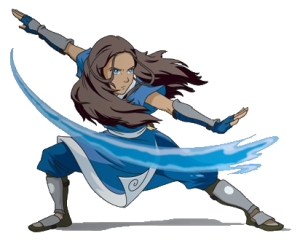
She’s the girl waterbending in the picture above. Katara is an excellent character – strong, compassionate, decisive, vulnerable, fascinating. She’s a rare example of a female character done right, and in a kids’ show, no less. Too often, women and girls in media fall into one of two categories: passive love interest for the hero (like Padme in Episode III) or sexy kickass uberhero (like Black Widow in Avengers). Katara, amazingly, is a woman who is also a genuine human being. She has friends, but a mind of her own; she’s in love, but that’s not her defining trait; she’s strong, but she’s weak sometimes too.

I’ve written before that Star Wars, although I love it, is sexist. Avatar: The Last Airbender is not sexist, and that’s remarkable in itself. It doesn’t (usually) beat you over the head with its feminism. It’s simply an excellent show that happens not to be gender-biased. It’s one of the best things I’ve ever seen on TV.

Don’t get me wrong, it’s still a kids’ show. It’s still goofy and colorful, so don’t go expecting Breaking Bad.

But when I have kids, I can’t wait to show them Avatar. And I can’t wait to sit down and watch it right beside them.

Postmortem: Moby-Dick

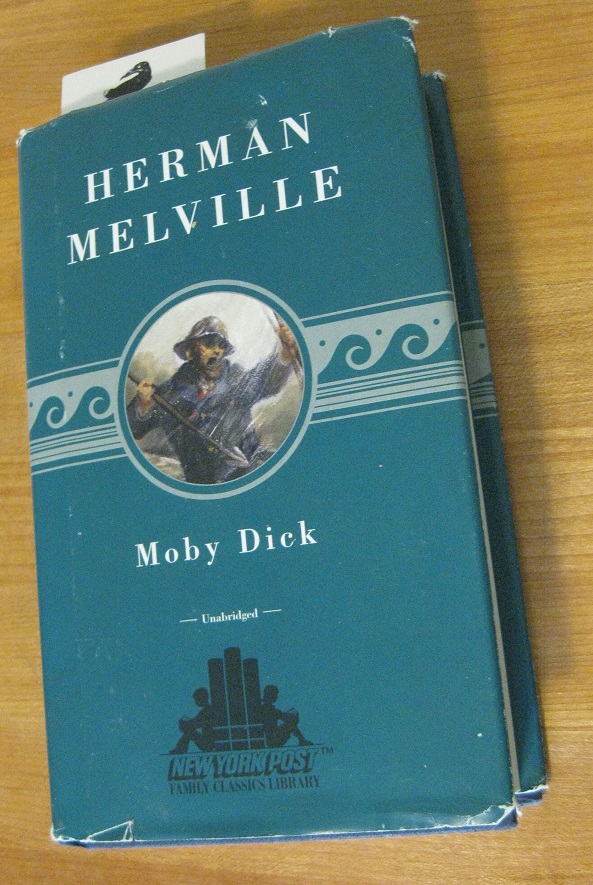
Mobimus-Dickimus

I wrote about Moby-Dick once before, when I was only one-quarter done. Well, I’ve finally finished.

What a strange, unusual book.

Really, it felt like two separate books that happened to be shoved between the same covers.

The first book is the story of the narrator Ishmael, the ship Pequod, her crew, her captain Ahab, and his infamous obsession with a certain seafaring mammal. The story begins with  Ishmael and his newfound best friend, the tattooed cannibal Queequeg. But once these two set foot on the ship (over a hundred pages in), Melville seems to forget all about them, and focus shifts completely to the rest of the crew and their quest. It’s an odd decision, given how much time’s been invested in the original pair, but the Pequod turns out to be an interesting place.

The crew is a wild assortment of characters, all unique and mostly compelling. The first mate, Starbuck, is a courageous and rational foil to the madness of Ahab. The second mate, Stubb, is a sort of Shakespearean jester, spouting nonsense that’s as real as anything else going on. Pip, a boy who is (rather unfairly) reviled for cowardice, develops a bond with Ahab late in the book which is unlike any other relationship I’ve ever read about.

And the style. The style is simply gorgeous, poetry rendered as prose: rich, like cheesecake, so it has to be savored slowly.

As they narrated to each other their unholy adventures, their tales of terror told in words of mirth; as their uncivilized laughter forked upwards out of them, like the flames from the furnace; as to and fro, in their front, the harpooneers wildly gesticulated with their huge pronged forks and dippers; as the wind howled on, and the sea leaped, and the ship groaned and dived, and yet steadfastly shot her red hell further and further into the blackness of the sea and the night, and scornfully champed the white bone in her mouth, and viciously spat round her on all sides; then the rushing Pequod, freighted with savages, and laden with fire, and burning a corpse, and plunging into that blackness of darkness, seemed the material counterpart of her monomaniac commander’s soul.

This book, the first book, I loved. This book is the one people quote, the one that calls generation after generation back to its song.

But as I said, there is a second book as well, its chapters all mixed and interleaved with the first. I will call this second book Herman Melville Wants to Tell You Some Things About Whales. Mostly nonfiction, mostly disconnected from the story, often strung together two or three in a row, these chapters read like boring essays by somebody obsessed with whaling. Their style is turgid and weak, the opinions they offer are not very convincing, and overall, you just wish he’d get on with it.

Here’s a sample:

In the first place, I wish to lay before you a particular, plain statement, touching the living bulk of this leviathan, whose skeleton we are briefly to exhibit. Such a statement may prove useful here.

According to a careful calculation I have made, and which I partly base upon Captain Scoresby’s estimate, of seventy tons for the largest sized Greenland whale of sixty feet in length; according to my careful calculation, I say, a Sperm Whale of the largest magnitude, between eighty-five and ninety feet in length, and something less than forty feet in its fullest circumference, such a whale will weigh at least ninety tons; so that, reckoning thirteen men to a ton, he would considerably outweigh the combined population of a whole village of one thousand one hundred inhabitants.

Think you not then that brains, like yoked cattle, should be put to this leviathan, to make him at all budge to any landsman’s imagination?

Having already in various ways put before you his skull, spout-hole, jaw, teeth, tail, forehead, fins, and divers other parts, I shall now simply point out what is most interesting in the general bulk of his unobstructed bones. But as the colossal skull embraces so very large a proportion of the entire extent of the skeleton; as it is by far the most complicated part; and as nothing is to be repeated concerning it in this chapter, you must not fail to carry it in your mind, or under your arm, as we proceed, otherwise you will not gain a complete notion of the general structure we are about to view.

Perhaps this brief sample doesn’t seem too bad. Maybe it even seems interesting. If so, trust me, the novelty wears off after a hundred pages.

I know that many critics defend this “second book,” saying it’s important to the structure of the novel, or that it enriches the story, or whatever else. But I have to believe that if Melville had published the “first book” alone, and somebody else years later had added the other stuff, nobody in their right mind would prefer the latter version.

Well, it is what it is. And as I said before, the highs redeem the lows. Poets and masochists must read Moby-Dick.

Postmortem: Star Trek Into Darkness (Spoiler-Free)

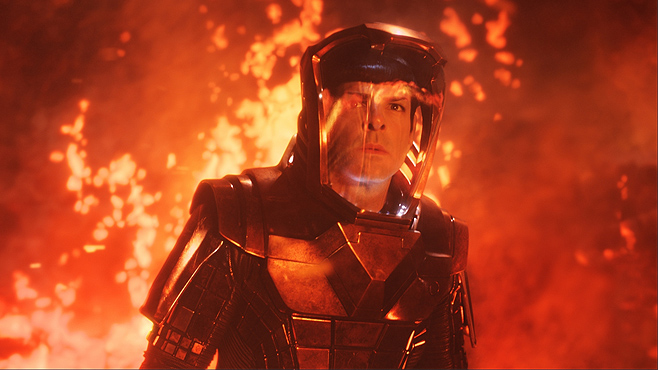
Rumor confirmed: Spock is hot.

I’m going to say a lot of good things about this movie, but let’s get one thing out of the way first. I don’t know who’s been picking titles for Star Trek movies lately, but they are bad at their job and they should feel sad.

The last one was just called Star Trek, but you can’t just call it Star Trek, because that’s already the name of the original show and the franchise. You can’t call it “the Star Trek movie,” because there are eleven other movies, one of which is Star Trek: The Motion Picture. You can’t call it Star Trek 11 because nobody knows what number it is, since none have been numbered since 6. And now you can’t even call it “the J.J. Abrams Star Trek movie” because there are two of them.

What the Star Trek Into Darkness title lacks in ambiguity, it makes up for in utter retardedness. Darkness might actually be the single most overused, clichéd metaphor of all time. The title suggests that our heroes are in for a supreme struggle, which might be more exciting if it weren’t already the plot of every single story since Gilgamesh.

Ahem. Okay, wow. I didn’t realize I had that much title anger. Breathe, Brian.

Mmm...still has that new-starship smell.

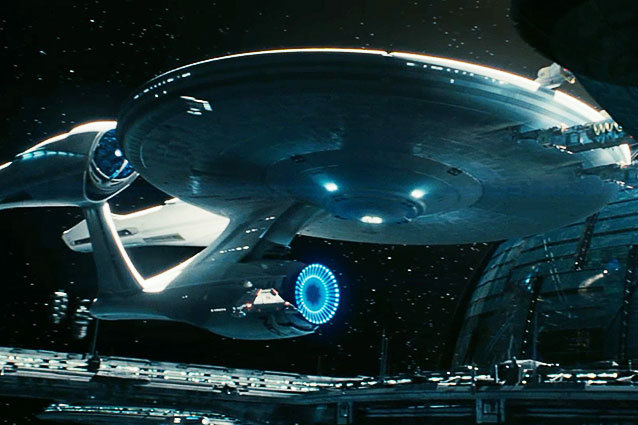
Mmm…still has that new-starship smell.

Anyway: nomenclature aside, the new Trek is excellent. Same director, actors, and style as Star Trek 11: The Search for a Subtitle, but a general step up in both storytelling and adrenaline. If you liked the last one, you’ll like this one too.

I’ll admit, the trailer had me worried. Exciting music aside, it looked like a mess of action and CG with no discernible storyline. I’m happy to report that there is indeed a plot, and even if it isn’t the greatest script in the franchise, it gets the job done.

Besides, Star Trek has never been about the plot. It’s about the characters, and the hard decisions they make. And fortunately, the characters in Darkness are excellent.

Kirk is bold, brash, decisive, almost (but never quite) to the point of absurdity. Spock outshines even the captain in the titular Darkness: his struggle between Vulcan control and human passion is intense and utterly believable. Scotty is funny without being a joke, and even Sulu gets in some good scenes. Only Bones seemed disappointing, though I can’t really say why. All the crew felt new and old at once, in the best possible way.

And then there’s this guy:

"Into Darkness" is also the title of my semi-autobiographical indie goth rock album.

“Into Darkness” is also the title of my semi-autobiographical indie goth rock album.

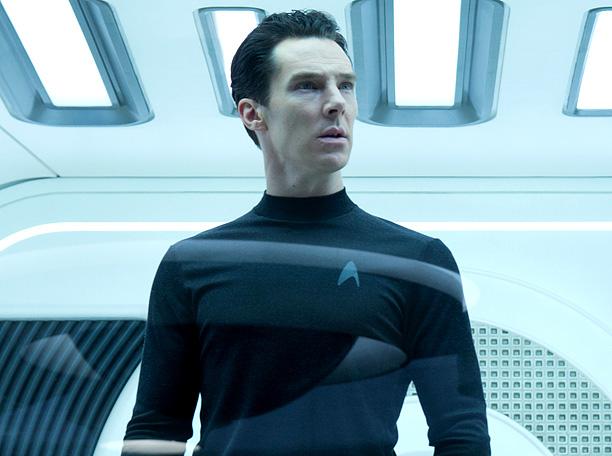
As I’m staying spoiler-free, I won’t tell you who he really is, but it’s a cool moment when you find out. Regardless, the pale dark dude is eminently menacing, with a sweet deep voice that Christian Bale’s Batman can only dream about. A starship duel has never felt more like a knife fight than with this guy at the helm.

The movie is awfully heavy on CG and action. Personally I would’ve toned it down a little. Not that it made for a bad movie, but it didn’t feel as much like a Star Trek movie. But that may be just the grumpy old man in me. J.J. Abrams, get off my lawn!

Besides, if you had any doubt this was a Star Trek movie, there’s a scene near the end that will erase your worries. For newbie fans, it’s merely an excellent scene. For veteran Trekkies, it borders on sublime.

I liked Into Darkness a lot, and if its Rotten Tomatoes score is any indication, I’m not alone.

If you’re on the fence about whether to watch this one, my advice is: boldly go.

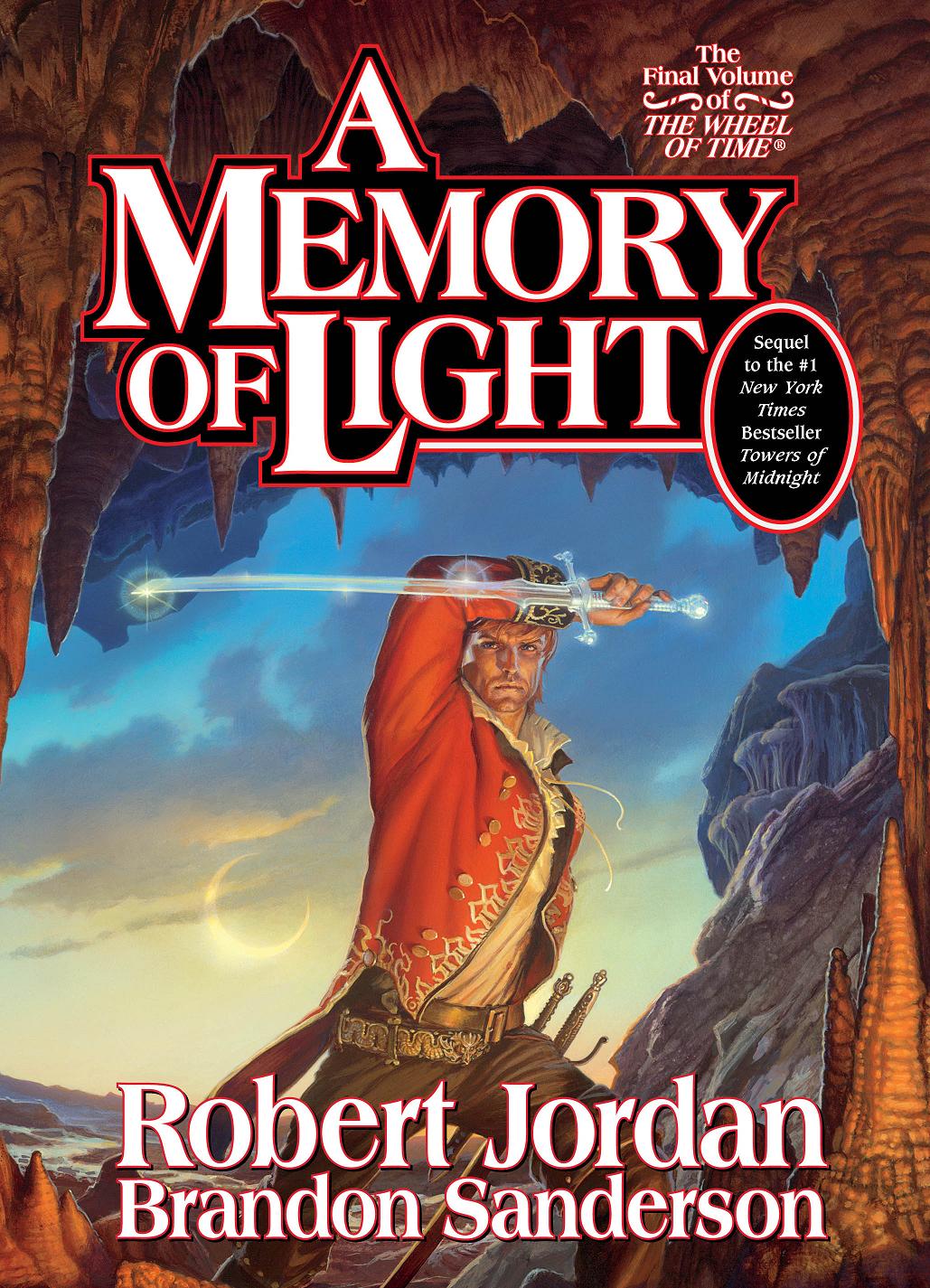
Postmortem: A Memory of Light (Spoilers!)

Callandor, bi0tch.

Yesterday, I waxed eloquent verbose on the Wheel of Time series as a whole. Today, I’ll dive into the final book in detail.

The short answer? It’s pretty damn good. Robert Jordan’s a genius, and Brandon Sanderson did a fine job building on his legacy. A Memory of Light was epic, unpredictable, and satisfying, and that’s exactly what it needed to be. Overall, no big complaints, job very well done.

Having said that, the book has some problems. That’s inevitable: expectations for the Last Battle were impossibly high after over a dozen volumes and twenty years of waiting. And of course, Sanderson was grappling with a monumental task under intense time pressure. The problems are understandable, and they’re not showstoppers. But they’re there.

I’ll get my biggest gripe out of the way first: Sanderson’s writing style. He’s good at plot, characters, and story arc, certainly much better than I am. But his sentence construction is awful. It grates on me so much that I stopped reading his Mistborn series after the first book, mainly because of that. Partly this bothers me because, as Ben points out, I am OCD about writing. But partly it’s just awkward style.

Here’s a sample:

Gaul felt a pressure from his friend. Like the pressure of the sun at noon after four days without having any water to drink.

This is a great image, but Sanderson buries it in an avalanche of extra words. Compare with: “Like the pressure of the noon sun after four days without water.” From seventeen words to twelve, and that’s just by applying some quick fixes, without trying to alter the meaning at all. Most writers (myself included) trip over these kinds of mistakes occasionally, but Sanderson does it practically on every page.

But enough about my OCD internal editor. What about the story? I’ll take it character by character, since Wheel of Time always been about the characters.

Lan – Amazing. Not that we’ve ever had a book where he wasn’t amazing, but here, in his battle with Demandred, he finally gets the moment of glory he’s long deserved. When he remained standing after taking a sword to the gut, I initially assumed it was because he’d become a Hero of the Horn.

Nynaeve – I hated Nynaeve in the first book (and the second, and third, and…) but she grew on me toward the end of the series. Her own moment of glory came nearer the start of AMoL, when Talmanes reaches the Amyrlin’s camp, near-dead from a Myrdraal wound. By this time, Talmanes has been passed from one healer to another, and nobody can help him, he’s so colossally messed up. And then he gets within thirty feet of Nynaeve and she’s like FOOM.

One of my favorite things about WoT in general is how characters can grow to seem almost ordinary in their everyday lives, and then suddenly they’re in their element again, and you remember just how effing incredible they actually are. Perfect example for Nynaeve. Her contribution in Shayol Ghul seemed almost like a letdown by comparison.

Mat – Amazing. Perhaps the best-written character in the book. The moment where I realized he was going to be supreme commander of the Last Battle…epic. His dynamic with Fortuona was great too. My only real complaint, which others have mentioned too, is that his final showdown with Mashadar seemed kind of desultory after how well-orchestrated the rest of the battle was. But at least they wrapped it up, and anything getting wrapped up – ever – is pure joy for a longtime WoT fan.

Perrin – Eh. Don’t get me wrong, he’s a great character, but his arc in this book seemed a little boring. Mostly because I’ve just never cared about Slayer, or the World of Dreams in general, so I spent most of that battle waiting for it to be over. I did like his interaction with Lanfear, though.

Min – A kickass character who doesn’t get nearly enough screen time, Min actually had – in my opinion – the best Moment of Awesome in the entire book. It came when Fortuona, Empress of the Seanchan, threatened to torture her if she wouldn’t reveal her visions. Min, looking her dead in the eye: “Try it.” Boom. Subtle, but boom. Grab a napkin, Empress, cuz you just got served.

Egwene – So a main character actually dies. I wondered if it would ever happen. I was never especially attached to Egwene, but the reverse balefire thing was sweet.

Moridin – Probably the most disappointing character of the whole book. He had such a deadly mystique throughout the series, but when it came down to brass tacks in Shayol Ghul, he just did a little swordfighting and got strung up like a puppet.

Rand – Ah yes, Rand. I loved Rand in this book. Admittedly, the long-awaited confrontation with the Dark One seemed a little weak to me – partly because it was too abstract, I think. It seemed like Shaidar Haran would have been a better form for the Dark One than the giant black blob, at least initially. Reading over and over about how the Dark One “attacked” Rand, without any concrete idea of what the attack looked or felt like, got a little old. I realize it’s supposed to be abstract, but nothing spices up metaphysics like a metaphor, and we could’ve used more of that here.

But none of that is Rand’s fault. He came, he saw, he kicked ass in style, which is all we ever really wanted from him. And the very last scene of the book, where he finally, finally gets relief from his burden and his pain, is beautiful. I even liked the pipe-lighting moment, inscrutable as it was. It felt right.

There’s so much more to say (Olver and the Horn! Compulsion on the Great Captains! etc.) but I’m already running late. I’ll wrap it up here.

If you’ve read the first thirteen books, you’re going to read this one too. And it will make you happy.

Postmortem: The Wheel of Time (Spoiler-Free)

WoT

It’s over. The Wheel of Time is actually over.

Robert Jordan’s magnum opus. Fifteen books, including the prequel New Spring. 684 chapters. Over 11,000 pages. Four million words. (That’s five King James Bibles put together.) Thousands – literally thousands – of named characters.

The first book, The Eye of the World, came out in 1990. The final one, A Memory of Light, was published January 8 of this year. Twenty-three years from start to finish.

The road hasn’t always been smooth. It’s no secret that the series lost steam around books 7-8. Book 9 was very slow. In book 10, the plot’s momentum practically stopped.

Admittedly, it’s hard to recommend a series with a 3,000-page slump in the middle. A lot of fans lost faith, and who could blame them?

But in book 11, Knife of Dreams, the old Jordan was back. The story got moving again. The end was in sight.

And then – on September 16, 2007 – Robert Jordan died.

He had written the ending already, and left extensive notes. The finale was there, waiting for someone to bring it home. His wife (and editor), Harriet, picked author Brandon Sanderson to finish the job.

It took him three more books, but he did it, and did it well. We didn’t get some half-finished outline or harebrained spinoff. We got the final books of The Wheel of Time.

And a week ago, I finished the last one.

I personally started reading the series around the time book 10 came out, so I’ve been following the story for about a decade. And that’s what it is, at its heart, in spite of its massive, almost overwhelming size: a story. Not some dry history of fictional events. Real characters you could – and did – really care about.

When the series began to drag, a lot of people said Jordan was just in it for the money, that he was cranking out filler for as long as he could. I never believed that. Traveling in the world he created, I could never believe that something so intricate, so beautiful, so painstakingly crafted over a quarter-century, was a work of anything other than love. And now that it’s over, I’m more convinced than ever that I was right.

The Wheel of Time wasn’t huge for the sake of being huge. It was huge because the story, the characters, the world, demanded no less. That was the size of his vision. And I’m lucky to have been a part of it.

Lan, Nynaeve, Elayne, Birgitte, Egwene, Aviendha, Min, Fortuona, Mat, Perrin, Rand: I’ll miss you all. Let the Dragon ride again on the winds of time.

Tomorrow I’ll post a detailed, spoiler-filled postmortem of the final book. Non-WoT fans, take a coffee break and come back Thursday. 🙂

Postmortem: Anna Karenina

ak

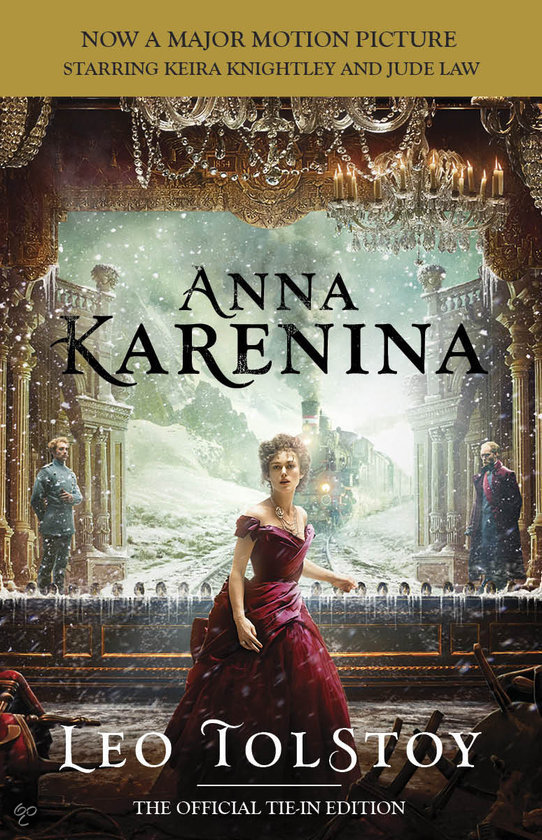
Anna Karenina stands beside War and Peace as one of Leo Tolstoy’s two great masterpieces. I’d been meaning to read it for a while, and I finally picked it up from an airport store a couple weeks ago to read over vacation. It wasn’t even a book store, just a newspaper-and-magazine place with a tiny book section, and they never would have had it except that the movie happened to be out. So I got the “official tie-in edition” – lucky me!

I was unprepared for how massive the book was, weighing in at just under a thousand pages. The story itself is likewise huge, spanning perhaps a dozen main characters and many more minor ones. I thought I’d have trouble keeping up with the names, but it turned out not to be too difficult. It helps to have a little knowledge of how Russian names work: characters are often referred to by their first and middle (patronymic) names together, omitting the last name, which is rarely done in English.

The novel takes place in 1870s Russia, mainly Moscow and St. Petersburg. There are three main threads to the story, corresponding to the three main couples:

  • Oblonsky and Dolly, who have a fairly happy marriage despite the husband being kind of a loser, having affairs and getting massively in debt. In spite of his immorality, Oblonsky is one of the most likeable characters, just because he’s friendly and cheerful and kind to everyone. As Tolstoy describes him in my favorite sentence of the book: “He was on familiar terms with everybody he drank champagne with, and he drank champagne with everybody.”
  • Anna and Vronsky, whose stormy passion is a stark contrast to the calm but tepid love of the Oblonskys. Anna herself transforms through the course of the story, from a tender and kindly young mother into something much darker. In the process, the gravitational pull of her personality attracts and alters everything around her.
  • Levin and Kitty, who find a kind of middle ground in their relationship, combining genuine love with the tolerance and patience necessary for a stable marriage.

One of the great joys of reading Tolstoy is how incredibly real the characters are. You never feel like the author is taking sides or preaching. You’re simply looking through a window at an incredibly detailed, shifting, multifaceted world. Characters frequently misunderstand each other’s motives, not just in big plot-altering ways, but in everyday conversation. The same person can be selfish, kind, caring, and cruel, sometimes all in the same moment.

Given the depth of the characterization, it was pretty cool to discover a character very much like me. I’m Levin. The love of reading, the obsession with abstract ideas and figuring out a system for life, the social awkwardness, the confusion about politics, the difficulty with practical matters, the intellectual pride, the reasons for agnosticism and the struggle with faith: it’s all there. Even his conversion to Christianity at the end, though unsatisfying to me philosophically, was still a lot more satisfying than many other reasons I’ve heard for believing in God (like the Ontological Argument).

I’m running out of time as always, so I’ll wrap it up. Anna Karenina is a good book and a great book, and if you ever want to get lost in a sprawling classic, you can’t go wrong with Tolstoy.