Crusading

The world is full of activists, people crusading for one cause or another: political, religious, corporate, technological, personal.

I’m a crusader now, fighting nonviolently for what I believe in. But it’s a strange thing, being a crusader: devoting your time to a cause, actively trying to change other people’s minds too.

I’ve been a crusader once before, several years ago, when I opposed one of the most corrupt, manipulative, and amoral groups on the planet: the so-called “Church” of Scientology. In many ways, that was good practice for what I’m doing now. I learned what it’s like to protest, how to do it effectively, how to operate in the dynamics of a resistance group.

In other ways, of course, my current crusade is different. Whereas Scientology is a small, malignant tumor that ruins a tiny subset of society, the NSA’s overreach has global implications and affects almost everyone alive today. If Snowden’s reports are correct, Britain’s GCHQ is even less scrupulous in its surveillance, and many other world governments – including Australia and Germany – are complicit as well.

In any case, being a crusader gives you a different perspective, pulls you a little outside of ordinary life. You want to grab every person you meet, shake them, scream: “How can you just walk around when THIS is going on?!”

But you don’t, of course.

For one thing, the world is full of crises. A hundred THISes are always going on. If every other crusader stopped me to yell about their own cause, I’d never make it to work in the morning. It would be hypocritical of me to pretend I’m the only one concerned about an important issue. I get that.

What’s more, I don’t want to be That Guy. You know: the friend who’s always bringing up his pet topic. The one that people start avoiding because they’re sick of hearing about it.

So I try to tone it  down.

And yet.

And yet, the NSA really is shredding the Bill of Rights. And yet, the world really is inching its way, slowly, slowly, toward 1984. And yet, we really do have to stop it.

So the crusade goes on. The double life goes on: polite smiles on the outside, fire on the inside, looking for a chance to spread.

Tell me: have you ever been a crusader?
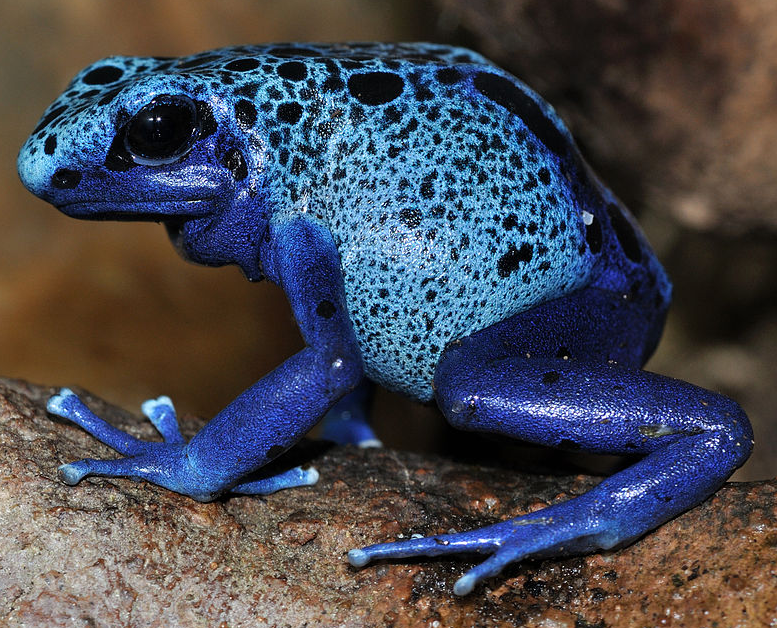
Dendrobates azureus

Try as I might, I can think of nothing interesting to say today.

Here, have a blue poison dart frog.

“Restore the Fourth” Rally in Cleveland!

2

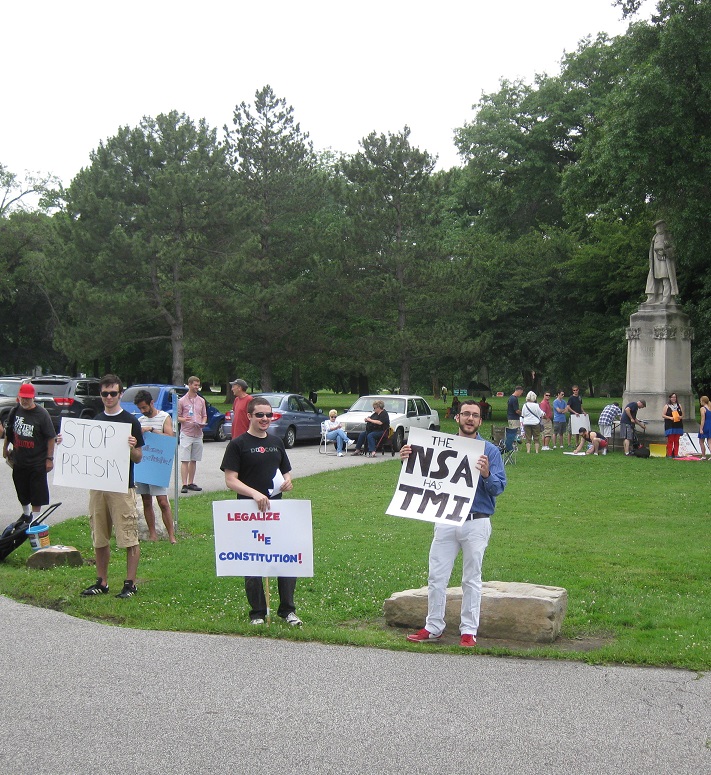
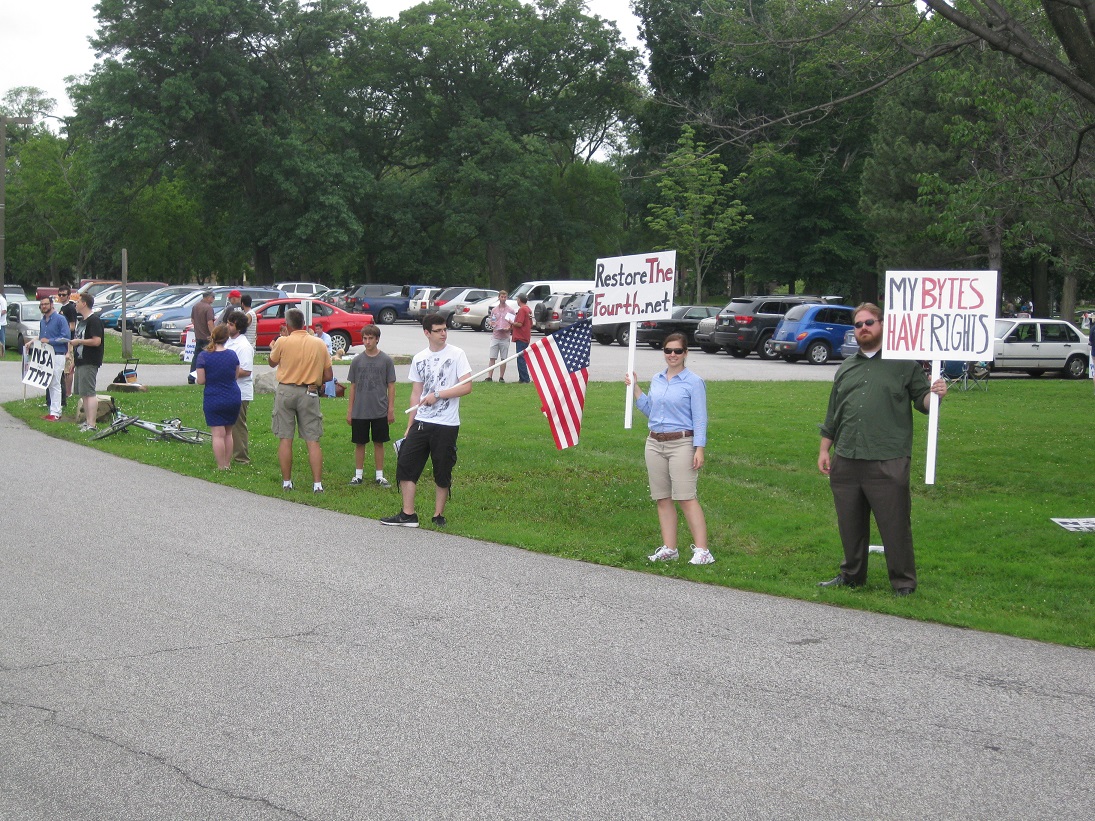
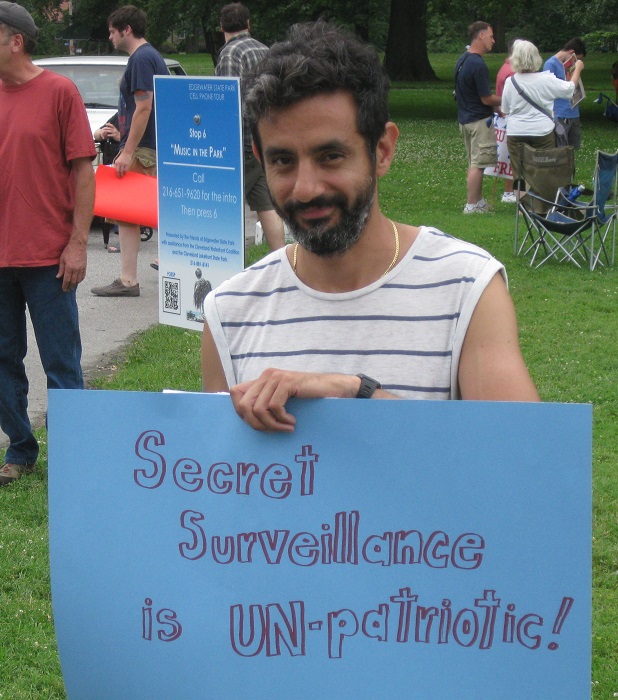
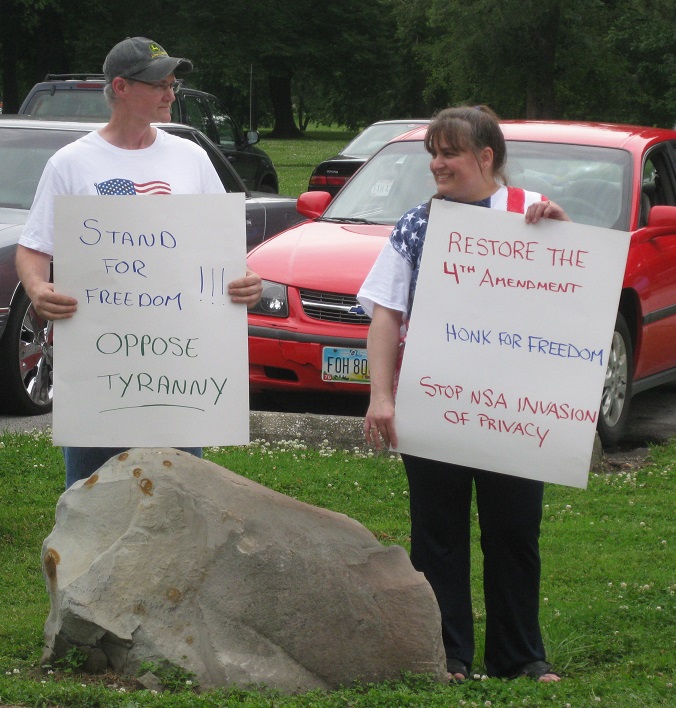
Yesterday I told you about the Restore the Fourth rally in Cleveland to protest the NSA’s massive and unconstitutional domestic spying program. It went forward as planned, and we had a successful event.

I’d estimate 40-50 people showed up, from Cleveland, Columbus, and all over Ohio. Young and old, men and women, conservative and liberal, we stood for the Fourth Amendment and our fundamental right to privacy.

1

(That’s my wife Betsy holding the RestoreTheFourth.net sign!)

We set up in Edgewater Park around 3:00. Cars driving by slowed down to read our signs, and I was gratified that so many honked in support. Curious people from around the park came over to talk about our message and get photos with us. The atmosphere was friendly, civil, and energetic.

7

Fortunately, the weather held out, and we only got a few drops of rain. Much cooler than it could’ve been for a July afternoon. The rally lasted about two and a half hours. Response from the public was almost universally positive.

6

That’s me on the left, and fellow blogger Ben Trube on the right, looking damn stylish in his Matrix shades.

4

3

8

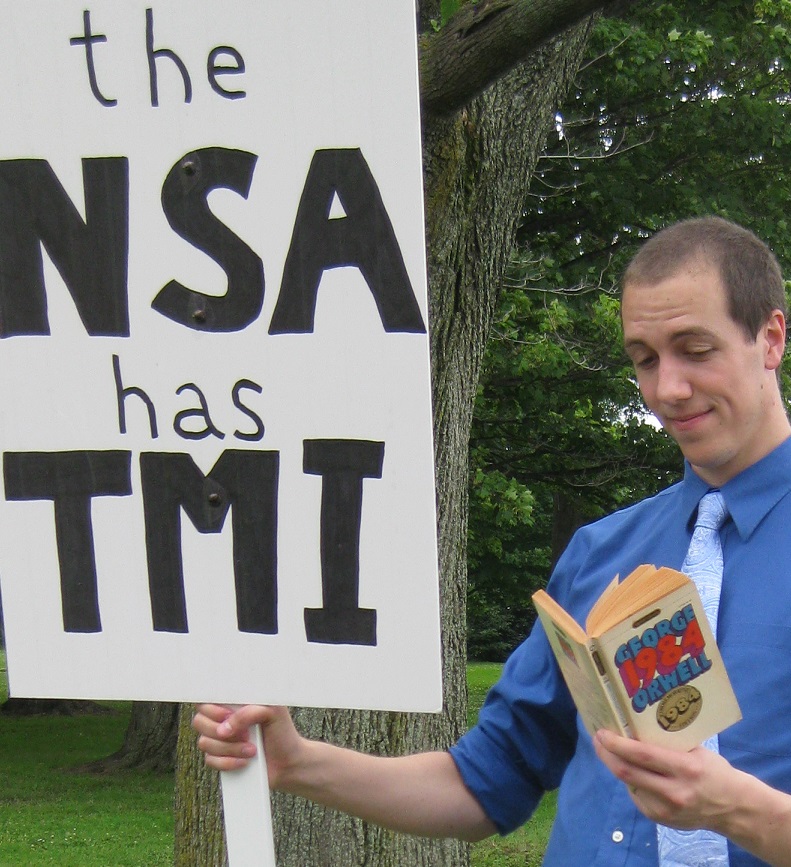
A little light reading on the job.

Of course, this wasn’t just about Cleveland. Similar protests were going on all over the country, with hundreds gathering in New York City, D.C., Boston, and San Francisco. We got coverage from NBC, CNN, Fox News, BBC, Reuters, the Guardian, and CNET. We even got official recognition from the NSA (thanks for spreading the word!)

All in all, a good first step. But only the first step. We need to spread the word about what the government is doing. We need to demand respect for the rule of law and the Fourth Amendment. Talk to your friends, write to your representatives, and go to RestoreTheFourth.net for more information.

Also, I added a permanent tab at the top called “NSA Domestic Surveillance.” It gives a simple, straightforward breakdown of what’s happening, why you should care, and how we can turn it around.

This country belongs to the people. Let’s keep it that way!

Restore The Fourth on July 4th

Restore The Fourth

Today, I’ll be protesting the NSA’s illegal and dangerous domestic spying program. I’ll be fighting to protect our Fourth Amendment right to privacy.

My wife Betsy, and my good friend Ben Trube, will be joining me at the rally in Cleveland. It’s a four-hour round trip, and we’ll probably be standing in the rain. Not necessarily your idea of a fun holiday. So why are we doing it?

We’re doing this to protect the future of all Americans. If you own a cell phone, the NSA is tracking your calls: who you call, and when, and where. That’s not paranoia, that’s a fact. They’ve admitted it publicly. And they don’t think you should be worried.

Well, I’m worried.

I don’t want to live in a country that treats the Fourth Amendment like toilet paper. I don’t want the government taking notes every time I call my mom.

The U.S. is not a dictatorship. But we’re building the foundation for one. And this Independence Day, I’m demanding that it stop.

Fortunately, I’m not alone. Restore The Fourth is a nationwide grassroots organization that’s gained enormous momentum in the past few weeks. They organized the Cleveland protest and other rallies across the country.

I stand with them proudly, because they stand for all of us.

I’ll post photos and a full write-up of the event tomorrow. Happy Fourth.

What Do You Want, I am Kind of Busy

kid

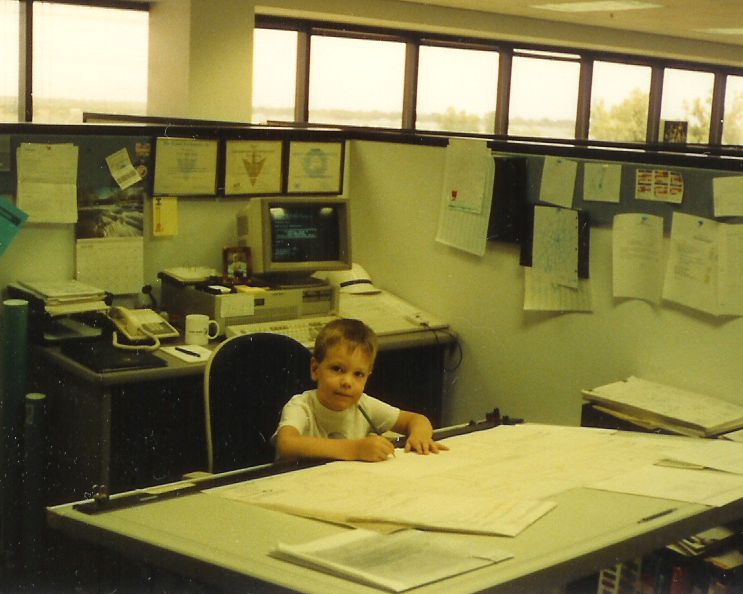
That’s me as a kid, sitting in my dad’s office.

Astounding, really, how little has changed.

Meet the Tardigrade

That’s a tardigrade. You’re looking at it from below, so you see its eight stubby legs, each with three claws. The head is at the top. Almost looks like some kind of freaky alien manatee.

Tardigrades, also known as water bears, are only a millimeter long, but they’re one of the toughest life forms on earth. According to the Wiki article:

…tardigrades can withstand temperatures from just above absolute zero to well above the boiling point of water, pressures about 6 times stronger than pressures found in the deepest ocean trenches, ionizing radiation at doses hundreds of times higher than would kill a person, and the vacuum of outer space. They can go without food or water for nearly 120 years, drying out to the point where they are 3% or less water, only to rehydrate, forage, and reproduce.

Plenty of microbes can survive under extreme conditions, but the tardigrade is unusual for an extremophile because it’s so big. A millimeter isn’t much to you or me, but it’s ginormous compared to a microbe.

(Really, spellcheck? You accept “ginormous” but not “extremophile”? Remind me to have a stern talk with your dictionary.)

I came across these hardy little creatures in a recent issue of National Geographic, which featured this gorgeous, full-color tardigrade photo. Just look at its face! I mean, I don’t even know if “face” is the right word for what’s going on there. It’s so…weird.

Perhaps even more remarkable, tardigrades were discovered way back in 1773, by the German scientist Johann Goeze. He was the one who first named them “water bears,” or, in his words, kleine Wasserbären.

More recently, according to this article, scientists “…exposed [them] to the open and harsh vacuum of space, with all its deadly radiation, on a spacecraft in low-Earth orbit. Many of them survived.” Just think about that for a second. They survived being in space.

I don’t know about you, but personally, I’d find a spacewalk sans protection to be…un-bearable? OH HO HO HO

I, uh. I’ll see myself out.

The Vice and Virtue of Laziness

I spend much of my time trying not to be lazy.

I’m writing this blog post when I could be asleep. I study statistics material for my A.I. even when I don’t feel like it. I go to work every day. None of this is anything special. We’re all familiar with this daily battle against laziness.

So we often see it as the enemy. It’s even listed as one of the Seven Deadly Sins: sloth.

But laziness can be a good thing, too. If necessity is the mother of invention, laziness is surely the father. How many machines have been created, how much software written, because somebody got tired of working and wanted an easier way?

The perfectly disciplined swordsman loses to the lazy warrior who invents a gun.

On a personal level, this means that self-discipline is…complicated. If I don’t feel like practicing Spanish on Duolingo, it generally means I should suck it up and do it anyway. But if I find myself getting lazy about Spanish practice all the time, perhaps that’s a signal I should be doing something else. After all, laziness evolved for a reason: to keep us from expending energy on tasks that don’t feel valuable.

(Not that I’m quitting Duolingo, by the way. It’s still fun. That was just a hypothetical.)

Laziness isn’t the only thing to manifest this vice/virtue duality. As I’ve said before, even vagueness can be a good thing.

The key, as in so many areas of life, is balance.

When you’re feeling lazy, how do you know whether to fight it or embrace it?

Friday Link: Mr. Sulu and the NSA

Takei

George Takei, the actor who played Mr. Sulu on Star Trek, has an important perspective on the NSA’s domestic spying program. As a child, he was one of over 100,000 Americans to be “relocated” to an internment camp, due to fears that anyone with Japanese heritage might turn on the U.S. So he understands better than most why civil liberties are important.

“We know where this can go,” he said recently. “We have to be ever vigilant against overstepping of the fundamental ideals of our democracy.”

Article here.

9 Ways to Spread Happiness

1. If you notice someone’s gotten a haircut, tell them “Happy haircut!” Like “Happy birthday,” as if it’s a holiday or something. (My stepdad always does this, and now it’s stuck in my brain.) I am a strange person and this is a strange thing to do, and you will get some funny looks. But it’s all good.

2. When people ask how you are, don’t just refute a negative. “I’m not bad” and “I’m good” may mean similar things rationally, but there’s a subtle psychological difference. One is passively okay, while the other is actively positive. (Of course, this only applies if you actually are good. No need to lie!)

3. Jokingly pretend to be excited about things you hate. I don’t mean hide your misery behind a mask. I mean let it out through an excitement that’s so obviously fake that you can just have a good time with it. “Aw yeah, effin’ status reports! Gets me up in the morning!” But don’t just be bitterly sarcastic. Try to really act excited.

4. If you’re feeling down, comfort someone else. This is easier said than done. But often, the best way to get out of your own pit is to imagine what others are feeling. I’ve found that, when I can manage it, my empathy is far more interesting than my self-pity.

5. Exercise, if you can. The brain is an organ. Everything psychological is physical too. Even a little exercise can help. And if you’re feeling better, you can spread that feeling-better to others.

6. Sleep, if you can. You might be surprised just how much of a negative mood comes from pervasive tiredness.

7. Watch Louis C.K.’s standup comedy. Extremely offensive and definitely not for kids, Louis C.K. is nevertheless one of the funniest comedians I’ve ever seen. This video – the whole thing, but especially the part starting at minute 7 – made me laugh so hard I cried.

8. Play music. Everybody’s got a happy song. Personally, I’m partial to “Augie’s Great Municipal Band,” by John Williams. Whatever you like, bust that shiznit out.

9. Leave a note for someone you love. People don’t expect to get notes. As long as you don’t write “TAKE OUT THE GARBAGE,” you’re practically guaranteed a smile.

What ideas do you have?

Deep Mysteries of the Voynich Manuscript

Voynich

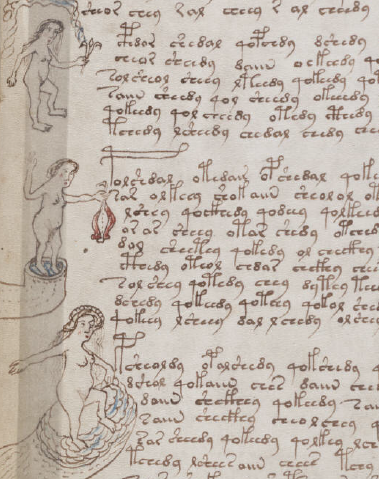
Can you read that text? I bet you can’t.

Don’t take it personally. Nobody can. The Voynich Manuscript is one of the world’s great unsolved mysteries.

Nobody knows who wrote it, or where. The date is estimated at early 15th century. The name “Voynich” comes from Wilfrid Voynich, a bookseller who bought it in 1912.

The manuscript is 240 pages of vellum, heavily illustrated with pictures of plants, astrological diagrams, and naked women. But the language, and even the script used to write it, are utterly unique. And a century of analysis has failed to extract any meaning from the text.

Voynich2

One obvious theory is that it has no meaning. It might simply be gibberish, a hoax of some kind, perhaps to be sold to some unsuspecting nobleman as a curiosity.

The problem with that theory is that the manuscript has a very complex structure, and exhibits subtle statistical properties that you wouldn’t expect to find in a book of nonsense. A recent scholarly analysis concludes, “…the accumulated evidence about organization at different levels, limits severely the scope of the hoax hypothesis and suggests the presence of a genuine linguistic structure.”

Voynich3

So who can unravel this puzzle?

As an AI developer and statistician-in-training, the Voynich Manuscript is immensely appealing to me. This is exactly the kind of thing someone should write a program to analyze.

Maybe I’ll give it a shot.

Or maybe you will. The full manuscript is right here, an enigma just waiting to be solved. Why not take a look?