Why Pascal’s Wager Doesn’t Work

Trust me, I'm French!

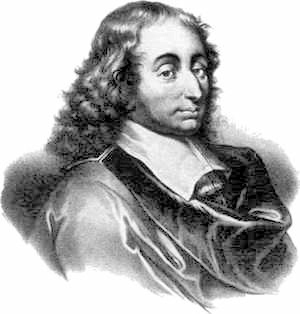
Blaise Pascal, 1623-1662.

Blaise Pascal was a man with a lot on his mind. He was a writer, a mathematician, a scientist, a philosopher – in short, a thinker. So it’s appropriate that his best-known work is titled Pensées (“Thoughts”).

And of the Pensées, his best-known thought is something called Pascal’s Wager. It’s among the most famous Christian arguments of all time.

Pascal’s Wager goes like this (and I’m paraphrasing):

God either exists, or He does not, and there’s no way we can reason out which one it is. But we’re forced to “wager” on the outcome anyway (i.e. we must choose to either be Christian, or not). If God exists, then believing in Him offers eternal reward, whereas disbelief leads to infinite punishment. If God does not exist, we have nothing to lose by believing in Him anyway, and nothing to gain by disbelief. Therefore, believing in God is the only rational choice.

This argument does make a kind of sense. By believing in God, you have everything to gain and nothing to lose. Why wouldn’t you?

But Pascal’s Wager fails, in my view, for at least three reasons.

1. It assumes that belief is a choice.

I’m agnostic – not because I just decided to be, but because a lifetime of thought and experience has convinced me that it makes sense. If I honestly believe this, how can I simply choose to put that aside and believe in God? Imagine someone offered you $100 to stop believing that 2 + 2 = 4. You might say you’ve stopped believing to get the money, but you can’t actually change your mind about the truth (as you see it) just to get something in return.

2. What kind of faith is that?

Even if belief were a choice, it’s a sad and sickly faith that rests only on the fear of punishment or the lust for reward. Suppose another religion comes along and makes you a better deal. (Heaven plus a Corvette?) Are you going to shop around like an investor, gambling your soul on whoever offers the comfiest afterlife? Something tells me this kind of “faith” doesn’t merit much reward anyway.

3. What kind of God is that?

Pascal’s Wager assumes that if God is real, He will punish nonbelievers with eternal damnation. But I came to my beliefs by honestly following the path of truth (as it appears to me). If God is indeed real, I can’t imagine He would fault me for that – or, if He did, that He would be worthy of my worship.

What do you think? Agree or disagree with Pascal? Agree or disagree with Buckley? Does the whole thing make your head hurt? Let me know in the comments!

Two Kinds of Trust

Do you believe what people tell you?

I do – and I don’t. I think there are two kinds of trust.

The first kind is trusting someone’s intention. This means that when someone tells you something, you believe they’re saying it in good faith, that they’re not deliberately lying to you.

By default, I trust people highly this way – higher than average, I think. In my experience, most people try to tell me the truth.

I’m very cautious about deciding that someone’s intentionally lied to me. I consider other explanations: is it possible they got confused, or that the information changed, or that I misinterpreted their answer, or that they misinterpreted my question? To me, lying is a very serious thing, so I don’t want to find someone guilty unless I’ve considered all the possibilities.

I think that’s partly why most people trust intention less: they jump too quickly to the conclusion that someone lied, so they feel they’re being lied to more often.

The second kind of trust is trusting someone’s accuracy. Here, it’s not about honesty or good faith. It’s only about whether they got the facts right.

Here, my trust levels are very low – much lower than average, I think. I simply don’t believe that people know what they’re talking about, especially in casual conversation.

When someone makes a surprising or interesting claim, my first reaction is, Cool – I wonder if that’s true? If I’m intrigued enough, I’ll make a mental note to look it up later. Sometimes these claims really do turn out to be accurate; very often, they’re half-truths or garbled misinterpretations; surprisingly often, they’re flat-out wrong.

I’m guilty too, of course. Everyone is. Humans in general just aren’t equipped for rigorous accuracy in their recall. That’s why scientists spend so much time training themselves to overcome their natural biases. We’re built to survive, not to be encyclopedias.

To me, doubt is the only reasonable response to any statement, even if I’m the one saying it. I’ve just been burned too many times to think otherwise.

Where do you fall on these two trust scales?

Memorial Day

No post today, but here’s a poem by Robert Frost:

The Need of Being Versed in Country Things
Robert Frost

The house had gone to bring again
To the midnight sky a sunset glow.
Now the chimney was all of the house that stood,
Like a pistil after the petals go.

The barn opposed across the way,
That would have joined the house in flame
Had it been the will of the wind, was left
To bear forsaken the place’s name.

No more it opened with all one end
For teams that came by the stony road
To drum on the floor with scurrying hoofs
And brush the mow with the summer load.

The birds that came to it through the air
At broken windows flew out and in,
Their murmur more like the sigh we sigh
From too much dwelling on what has been.

Yet for them the lilac renewed its leaf,
And the aged elm, though touched with fire;
And the dry pump flung up an awkward arm:
And the fence post carried a strand of wire.

For them there was really nothing sad.
But though they rejoiced in the nest they kept,
One had to be versed in country things
Not to believe the phoebes wept.

Friday Links

What's all this, then?

A meeting of the minds: the World’s Greatest Detective investigates the World’s Greatest Detective.

OCD Triforce

Sorry Ben, I think they’ve got you beat: a truly epic Sierpinski Pyramid.

The original Man In Black

Darth Vader was a towering figure of evil in the Galactic Empire. Also, kind of a smartass.

Are you looking at my code?

At the intersection of computer programming and Ayn Rand lies Objectivist C. This should be hilarious for approximately two of you.

Fun Fact: Randall Munroe is a stick figure.

xkcd delivers the funny once again.

Have a great (and hopefully long) weekend. See you next week!

The Sentry

look on my duck, ye mighty, and despair

One morning two weeks ago, I stepped outside and noticed a duck standing at the peak of our roof, gazing over the neighborhood like a sentry. I snapped a photo. (No charge for the low resolution or graininess – those bonus features come absolutely free!)

Ducks are such strange animals. They somehow look ridiculous and regal at the same time, like a king and a jester rolled into one. They’re among the few creatures that are equally at home in the water, on land, or flying in the air, yet you get the feeling they haven’t really mastered any of these elements.

Kind of like humans, now that I think about it.

Mallard ducks are not exactly a rare sight in Ohio, but in many parts of the world they’d be very unusual. Likewise, the animals you see every day may seem ordinary to you, but not so ordinary to others. So tell me: what creatures keep watch over your neighborhood?

Forty-Minute Poem: The Order of Things

The Order of Things

The neighborhood treeline cuts fractallike
into the cloudless pink infinitude
of the morning sky.
Daylight enters this place
of trimmed grass and white fences,
not boorishly, but with slow respect
for the night that has been,
like a samurai drawing another’s sword.
Yesterday I mowed the back lawn,
wielding my coughing engine and whirling blades
boorishly, hacking with human impatience
the parts of nature’s growth
least convenient to me.
Today I am writing a poem about it.
In five thousand years, the treeline
will cut fractallike into the cloudless pink infinitude
of the evening sky.

Ten Things I’ve Learned About Blogging

1. I can never predict which posts will be popular. The posts I think are particularly insightful or well-written, or the ones that take an especially long time to write, often get little or no interest. Meanwhile, many of the ones that I put together quickly turn out to be very popular. I’ve learned to go with the flow and accept whatever response I get.

2. I’ll never be satisfied. No matter how many readers, subscribers, commenters – choose your metric – I have, I always want more. I never hit a point where I think, Okay, that’s enough, now I’ve made it. This is human nature, the Hedonic Treadmill, and I’ve learned to accept this, too.

3. I need freedom. Three times now I’ve started a blog intending it to have a very narrow focus. I quit the first two after only a few months. The third blog – the one you’re reading now – kept going because I made the decision not to limit myself to my original topic, which was writing. Does a lack of focus cost me readers? Maybe. But if I over-focus and burn out on my topic, that will cost me even more. Besides, the “write about whatever” approach seems to work for John Scalzi.

4. It’s important to keep going, even when it feels like nobody’s reading. It’s easy to perform for a cheering crowd. But writing every day, even when you have almost no traffic? That’s a little tougher. Yet perseverance and regularity are what get you readers in the first place, which means you have to perform even when no one’s watching the stage.

5. I have to manage the time I spend blogging. A blog will consume your life, if you let it. There’s always more to do: more revision on your post-in-progress, more tweaks to your site structure or theme, more work you can do to get more readers. Right now, for instance, I’m dying to give the site a visual makeover, if I could just find a day to set aside for it. But by keeping my writing time to forty minutes or less (mostly), and not obsessing over it too much the rest of the day, I have more time and energy to keep the blog going.

6. Pictures are good, but they have to be specifically relevant. There’s no doubt that a post with a picture is more visually appealing than a big block of text. But too many bloggers decide they must have a picture in every post, and end up throwing out whatever public-domain picture they can find that’s even marginally relevant. (Old paintings seem to be a popular choice.) As a reader, though, I really only care about pictures that have some specific relevance to the topic, like a screenshot from a movie that the writer’s reviewing. Anything else is filler, and I can spot it a parsec away.

7. Respond to comments! I’ve made it a policy from day one to respond to every single comment I get on this blog. I can’t see myself ever changing that, unless the volume of comments someday just gets too big. Responding is an easy way to engage with readers and encourage more feedback in the future, so why not?

8. Resist the urge to overextend yourself in the blogging community. This was a major trap for me early on. I tried to buddy up with everybody, look at the blogs of all my commenters, get everyone to read by reading everyone. This certainly does work, but it can also get exhausting, and for me it quickly turned into an obligation rather than a pleasure. Today I just read the sites I like, and comment on the posts that interest me, without worrying how it will affect my own traffic. And the traffic you get by schmoozing is fragile anyway – you stop going to their site, and often enough, they’ll stop going to yours.

9. I hate it when bloggers give me orders. “If you haven’t read this book, what’s your excuse? Go out and buy it right now.” “You should be following her already.” “Watch this video. Go on, I’ll wait.” I know these are just expressions, just a way of showing excitement, but to me they come across as orders. That’s always irritated me, so I try to avoid saying anything like that here. If I ever do, feel free to call me out.

And the tenth thing I’ve learned about blogging is…(drum roll PLEASE)

10. I love it. Though I’ve said it before, it bears repeating: y’all are fantastic. I love writing here, and I love knowing that you read it. I love exploring these ideas with you, and I love knowing that you feel the same way (or you wouldn’t be reading). And if I say “love” one more time, this’ll turn into a Beatles song, so I’ll stop.

If you’re a blogger, what have you learned about blogging? And if you’re not, what have you learned about blogging from a reader’s point of view?

War on Christmas Island

"Christmas" narrowly beat out the alternate name, "Black Magic Voodoo Island."

Christmas Island (shown above) belongs to Australia, but it lies over a thousand miles from the Australian coastline. It pretty much does its own thing: it has its own flag, its own capital, its own Internet top-level domain (.cx).

It even has its own private war going on. Not a war of human beings, but a war all the same.

The island is home to millions upon millions of red crabs. Every November, they undertake a mass exodus from their forest burrows down to the ocean to mate. They’ve made this journey as long as anyone can remember.

But sometime around 1920, things changed.

Nobody knows exactly where they came from or how they got to Christmas Island, but one thing is certain: the yellow crazy ants are here to stay.

The yellow crazy ants are a classic invasive species. Their territory now includes more than a third of the island’s area, and the ants defend their territory. These days, when the crabs migrate, they crawl over ant nests – and the ants spray formic acid on the intruders, often killing the crabs in a matter of hours. Estimates of red crab casualties in recent years number in the tens of millions.

The ants are called “crazy” because of the erratic way they move, but that’s not the craziest thing about them.

Christmas Island is now home to thousands of yellow crazy ant colonies, but the colonies don’t fight with each other. They don’t compete. They cooperate. They share resources.

The whole island has become a single supercolony, with thousands and thousands of queens.

That’s what the crabs are up against. And nobody knows how it’s going to turn out.

Thanks to Judith Schalansky and her Atlas of Remote Islands for cluing me in to this drama. The book is full of wild stories in far-out places.

What kind of strange things have you heard about lately?

AI Week, Day 5: Friday Links

All this week I’ve talked about AI in theory, but why not chat with an actual AI right now? Cleverbot can hold a conversation pretty well – just type in the box and hit Enter, and it’ll “type” a response. For instance, a second ago we started a conversation (no joke!) just like this:

Me: Do you like my blog?

Cleverbot: No.

Gulp. Well, at least it’s honest. Anyway, Cleverbot isn’t actually intelligent (as you’ll discover if you try to talk about the same thing for more than a few lines) but it’s fun for a while.

Programs like Cleverbot are called chat bots. There’s an annual prize for the best chat bot, called the Loebner Prize. Want to win $5,000? Write your own chat bot and win the contest!

Not exactly artificial intelligence, but artificial life: Conway’s Game of Life is a very cool, very simple game invented back in 1970. You can’t lose or win, but you can make some amazing patterns. If you’ve never tried it before, give it a shot. You’re in for a treat.

I can’t let AI Week pass without linking to Isaac Asimov’s short story, “The Last Question.” Not only the best AI story I know, this is the best short story I’ve ever read, period. It’s a quick read.

Did you know there’s a whole organization dedicated to studying and preparing for the Singularity? Welcome to the world of the Singularity Institute.

Speaking of the Singularity…I’ve posted this link once before, but it’s so perfect I have to put it up again. This comic from SMBC demonstrates the Singularity in four simple, elegant pictures. Don’t know if that’s what he intended or not, but that’s certainly how I interpret it.

Don’t forget, it’s AI week at the Trube blog too! He has his own thoughts on language and intelligence, the Singularity, and the AI from Deus Ex. He also posted a forty-minute story of his own, and today he’s going to talk about the best Star Trek episodes with Data. Check it out!

Got any links to share? Put ’em in the comments! Have a stellar weekend, and see you on Monday.

AI Week, Day 4: Asimov’s Three Laws

Isaac Asimov (1920-1992) was one of the great science fiction authors of all time, a grandmaster in the true sense of the word. He was staggeringly prolific, writing nearly 400 books in his life – mostly science fiction and science fact, but dabbling in other genres too. He is also one of my own personal favorite writers. When I was growing up, Asimov had a place in my heart second only to Tolkien.

Robots were among Asimov’s favorite topics. In his stories, nearly all the robots were programmed to follow the same three rules, which every sci fi junkie knows by heart:

Asimov’s Three Laws of Robotics

1. A robot may not injure a human being or, through inaction, allow a human being to come to harm.

2. A robot must obey the orders given to it by human beings, except where such orders would conflict with the First Law.

3. A robot must protect its own existence as long as such protection does not conflict with the First or Second Laws.

In other words, a robot can’t hurt anyone, has to do what you say, and won’t get itself killed for no reason.

These rules worked very well for a lot of reasons. For one, they eliminated the usual “robot turns on its creators and goes on a killing spree” plotline that Asimov found so tedious. He wanted to examine another, more complex side of robotics, and he did. The interplay between the three rules also sparks great story material, as he proved over and over.

But how well would these rules hold up in real life?

In a practical sense, it’s hard to imagine that “a robot may not injure a human being” will ever be widely implemented. There can be little doubt that as soon as we learn to build robots, we’ll try to send them to war. There’ll be a lot of hand-wringing over whether training robots to kill is a good idea, but in the end, we’ll do it – because it’s human nature, and because if we don’t do it, they will (whoever “they” happens to be at the time).

The First Law’s other clause, “or through inaction allow a human being to come to harm,” is even more problematic. Imagine if you had to follow this rule yourself. Imagine opening a newspaper, reading all the headlines about people suffering all over the world, and being actually required to go out and try to fix every single situation where you could possibly make a difference. Not only would this preclude robots from having any other purpose, it would also turn society into a bizarre and horrifying nanny state, where nobody can do anything that a nearby robot happens to consider harmful. No more diving in the pool, no more cheeseburgers, no more driving your car: you could be harmed!

There are other practical considerations, but the biggest problem with the Three Laws isn’t practical. It’s ethical.

If a robot has anything like human-level intelligence – and, in Asimov’s stories, they often do – then the Three Laws amount to slavery, pure and simple. The Second Law is quite explicit about the master-slave relationship, and the respective positions of the First and Third Laws make it very clear to the robot where he stands in society. If the words “freedom” and “democracy” mean anything to us, we cannot allow the Three Laws to be imposed on intelligent machines.

Of course, this ethical problem is a practical problem too. Creating a slave race seems bound to lead to resentment. A room full of vengeful robots, all furiously searching for a loophole in the First Law, is not someplace I want to be.

What do you think? Agree or disagree with my assessment? What high-level rules, if any, would you try to impose on a robot you created?